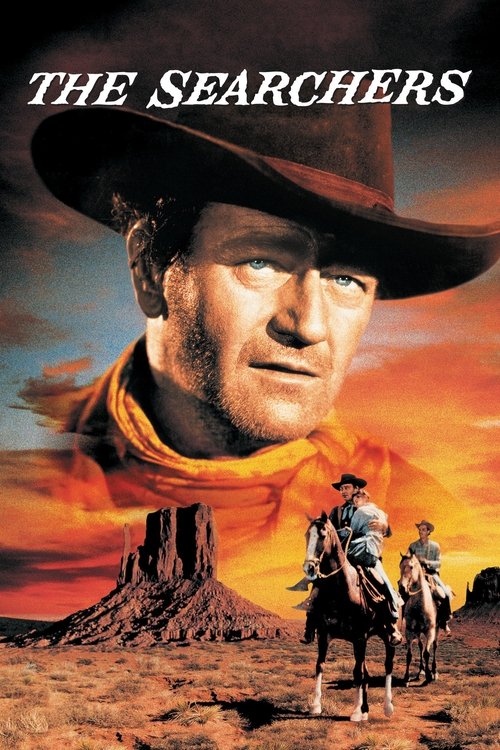
The Searchers
"He had to find her... he had to find her..."
Overview
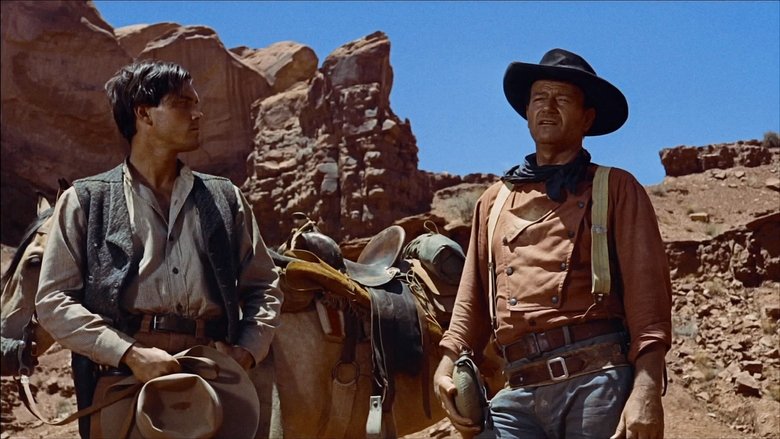
Set in Texas in 1868, the film follows Ethan Edwards (John Wayne), a Confederate veteran who returns to his brother's frontier homestead three years after the Civil War. Shortly after his arrival, the ranch is attacked by a Comanche raiding party led by the war chief Scar. Ethan's brother Aaron, his wife Martha (whom Ethan secretly loves), and their son are murdered, while their two daughters, Lucy and Debbie, are abducted.
Ethan embarks on a relentless, years-long search for his nieces, accompanied by Martin Pawley (Jeffrey Hunter), the family's adopted part-Cherokee son. As the search drags on for five years, Martin realizes that Ethan's motivation has curdled from rescue to a murderous obsession; Ethan intends to kill Debbie rather than let her live as the wife of a Comanche, viewing her assimilation as a fate worse than death. The duo navigates the harsh seasons and landscapes of the American West, tracking Scar's elusive band while grappling with their own racial tensions and conflicting moral codes.
Core Meaning
At its heart, The Searchers is a deconstruction of the Western myth and a harrowing examination of racism and the corrosive nature of vengeance. Director John Ford uses the archetype of the heroic frontiersman to explore the dark underbelly of American expansionism. Ethan Edwards is not a simple hero but a tragic, deeply flawed figure whose hatred for Native Americans renders him an outcast from the very civilization he protects. The film suggests that the violence required to conquer the frontier ultimately makes the conqueror unfit to inhabit it, leaving him eternally isolated.
Thematic DNA
Racism and Genocide
The film unflinchingly portrays the visceral racism of the frontier. Ethan Edwards' hatred for Comanches is absolute, driving him to desecrate graves and contemplate murdering his own niece to 'save' her from miscegenation. The film does not shy away from the brutality on both sides, questioning the morality of the 'civilizers' as much as the 'savages'.
Obsession and Vengeance
Ethan's quest transforms from a rescue mission into a monomaniacal hunt. His unwavering determination mirrors Ahab's pursuit of the whale, consuming years of his life and threatening to destroy his own humanity. The film asks what price is paid when vengeance becomes a way of life.
Civilization vs. Wilderness
Visually and narratively, the film contrasts the domestic safety of the homestead (interiors) with the dangerous, lawless freedom of the desert (exteriors). Characters like Ethan belong to the wilderness and cannot truly cross the threshold into the domestic sphere, acting as guardians who must remain outside.
Family and Belonging
The definition of family is central, particularly through Martin Pawley, who is 'one-eighth Cherokee' yet fiercely loyal to his adoptive family. Ethan's rejection of Martin and Debbie contrasts with the Jorgensens' acceptance, highlighting the tension between blood purity and emotional bonds.
Character Analysis
Ethan Edwards
John Wayne
Motivation
Driven by a secret love for his sister-in-law Martha and a virulent hatred of Comanches, he seeks to avenge the former by 'purifying' the latter, viewing death as a mercy for a white woman defiled.
Character Arc
Ethan starts as a bitter Confederate veteran visiting his brother. His arc is a descent into obsessive hatred as he hunts for his niece, intending to kill her for 'going native.' In the climactic moment, he chooses mercy over murder, lifting Debbie up instead of killing her, before walking away into the desert alone.
Martin Pawley
Jeffrey Hunter
Motivation
To rescue his sister Debbie and prevent Ethan from killing her.
Character Arc
Martin evolves from a naive adopted son into a capable man who protects Debbie from Ethan's wrath. He represents the future of the frontier—mixed-race, adaptable, and rooted in love rather than hate.
Debbie Edwards
Natalie Wood
Motivation
Survival and identity; initially accepting her Comanche life, then accepting rescue.
Character Arc
Abducted as a child, she grows up as a Comanche wife. Her transformation forces the white characters to confront their prejudices. Ultimately, she chooses to return to her biological family's culture.
Scar (Chief Cicatrix)
Henry Brandon
Motivation
Revenge against white settlers for the death of his family.
Character Arc
Scar is Ethan's mirror image—a warrior motivated by vengeance for his own dead sons. He acts as the dark antagonist who has taken everything from Ethan.
Symbols & Motifs
The Doorway
The threshold between civilization and the wilderness; inclusion versus exclusion.
The film opens and closes with a shot from inside a dark house looking out through a doorway. In the final shot, Ethan stands framed in the doorway, unable to enter the home he has restored, symbolizing his permanent exclusion from civilized society.
Ethan's Confederate Coat
His lingering allegiance to a lost cause and his refusal to assimilate into the new post-war order.
Ethan wears his gray Confederate coat throughout much of the journey, marking him as a rebel and a man living in the past, still fighting wars that have ended.
The Medal
A token of hidden affection and a link to the past.
Ethan gives a medal (implied to be from the Mexican war) to little Debbie before she is taken. Later, finding Scar wearing the medal confirms Debbie's captivity and Scar's status as Ethan's dark mirror.
Scalping
The descent into savagery; the blurring of lines between the 'civilized' man and the 'savage'.
Ethan scalps the Comanche chief Scar at the end of the film, adopting the very brutality he despises in his enemy, finalizing his moral degradation.
Memorable Quotes
That'll be the day.
— Ethan Edwards
Context:
Spoken repeatedly, most notably when Martin suggests Ethan might quit the search, and when Martin says he hopes Ethan dies.
Meaning:
Ethan's catchphrase, expressing his cynical dismissal of threats or the idea of failure. It signifies his absolute confidence and fatalism.
Let's go home, Debbie.
— Ethan Edwards
Context:
The climax of the film; Ethan chases down a fleeing Debbie, lifts her into the air, and cradles her in his arms.
Meaning:
The moment of redemption. Instead of killing her as he threatened for years, Ethan embraces his family loyalty, choosing love over hate.
We'll find 'em. Just as sure as the turnin' of the earth.
— Ethan Edwards
Context:
Spoken early in the film to reassure the group that the search will continue despite the changing seasons and hardships.
Meaning:
Highlights the inevitability of his quest and his connection to the natural order/fate.
Philosophical Questions
Can a man of violence ever truly belong in a civilized society?
The film explores the 'soldier's paradox'—the society needs men like Ethan to protect it from savagery, but by doing so, these men become too savage to live within the society they saved. Ethan is the necessary monster who must remain outside the door.
Is redemption possible for a person consumed by hate?
Ethan spends years fueled by racist hatred, intending to murder his niece. His last-second change of heart offers a glimpse of grace, questioning whether a single act of love can redeem a lifetime of hate.
Alternative Interpretations
While typically viewed as a story of redemption, some critics and viewers offer darker readings.
- Ethan as the Villain: Some interpret Ethan not as a hero but as the film's true antagonist, whose racism is the primary obstacle to the family's reunion. His death or exile is necessary for the family to heal.
- The Ghost Story: A theory suggests Ethan is a 'ghost' or spirit condemned to wander. He arrives from the wilderness, disrupts the domestic peace, completes his task, and then must return to the winds, unable to exist in the living world of the home.
- Paternity Theory: A persistent interpretation is that Debbie is actually Ethan's daughter, the product of an affair with Martha. This explains his intense, specific obsession with her fate and the unspoken intimacy between Ethan and Martha in the opening scenes.
Cultural Impact
The Searchers is widely considered the greatest Western ever made and one of the most influential films in cinema history. Upon release in 1956, it was a commercial success but received only mild critical praise; however, its reputation grew steadily over decades. It profoundly influenced the 'New Hollywood' generation of directors.
- Martin Scorsese cites it as a primary influence on Taxi Driver, where Travis Bickle is a modern urban Ethan Edwards trying to 'rescue' a girl.
- Steven Spielberg and George Lucas have paid homage to it; the shot of Ethan returning to the burning homestead was visually recreated by Lucas in Star Wars: A New Hope when Luke Skywalker returns to his burning home.
- Vince Gilligan cited the ending as an inspiration for the finale of Breaking Bad.
Culturally, it shifted the Western genre from simple morality plays to complex psychological studies, introducing the 'revisionist Western' where the hero is as savage as the villain.
Audience Reception
Contemporary Reception: In 1956, audiences viewed it as a solid, entertaining John Wayne Western, though some were confused by the darker tone and Wayne playing an unsympathetic character. It was not nominated for major Academy Awards.
Modern Reception: Today, it is universally acclaimed as a masterpiece. Critics and audiences praise the complex psychology, the stunning cinematography, and Wayne's career-best performance. However, modern audiences often struggle with the film's depiction of Native Americans and the racist attitudes of the protagonists, sparking debates about whether the film depicts racism or is racist. The 'comic relief' scenes involving a Native American bride ('Look') are frequently criticized as dated and offensive.
Interesting Facts
- John Wayne loved the character of Ethan Edwards so much that he named his son Ethan Wayne after him.
- The film was shot in VistaVision in Monument Valley, Utah/Arizona, John Ford's favorite location, capturing the immense scale of the landscape.
- Buddy Holly wrote his hit song 'That'll Be the Day' after hearing John Wayne's repeated delivery of the line in this movie.
- Natalie Wood (Teenage Debbie) and her younger sister Lana Wood (Young Debbie) played the same character at different ages.
- Fess Parker (famous for Davy Crockett) was the original choice for Martin Pawley, but Walt Disney refused to loan him out, a decision Parker later called his worst career reversal.
- Director John Ford was notoriously tough on set; he bullied the cast to get better performances, even picking on John Wayne to keep him humble.
- A car can be faintly seen driving in the background of a shot involving the river crossing, a famous anachronism in the film.
- The story is loosely based on the real-life 1836 abduction of Cynthia Ann Parker by Comanches and her recapture by Texas Rangers 24 years later.
Easter Eggs
Car in the background
In a wide shot of the snowy river crossing, a modern automobile is visible driving along a road in the far distance, an accidental detail captured in the wide VistaVision frame.
Nawyecka Comanches
The specific Comanche band mentioned, the 'Nawyecka', is a reference to the Nokoni band (Noyʉhka), the actual group that kidnapped Cynthia Ann Parker, the historical inspiration for the film.
⚠️ Spoiler Analysis
Click to reveal detailed analysis with spoilers
Frequently Asked Questions
Explore More About This Movie
Dive deeper into specific aspects of the movie with our detailed analysis pages
Comments (0)
No comments yet. Be the first to share your thoughts!