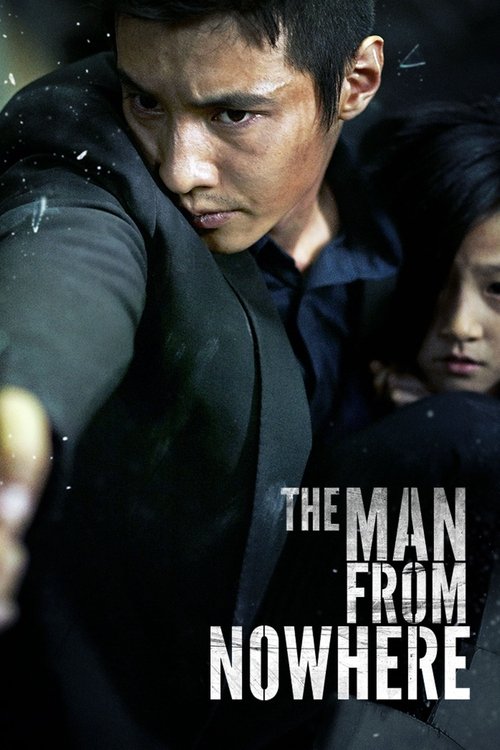
The Man from Nowhere
아저씨
"Nothing to lose, nothing to compromise."
Overview
The Man from Nowhere (Korean: Ajeossi) follows Cha Tae-sik, a quiet and mysterious pawnshop keeper with a tragic past. His only connection to the world is So-mi, the young daughter of his drug-addicted neighbor. When So-mi's mother steals heroin from a powerful organized crime syndicate, the gang kidnaps both mother and daughter, dragging Tae-sik into a violent underworld to retrieve them.
As Tae-sik pursues the kidnappers, his background as a lethal special forces operative is revealed. He tears through the criminal organization, facing child traffickers and organ harvesters. The film culminates in a brutal quest for vengeance and rescue, challenging Tae-sik to retain his humanity while wading through a sea of blood to save the one person who calls him 'Mister'.
Core Meaning
At its heart, the film explores the saving power of human connection. It posits that even a man who has 'locked himself away' from the world (a 'man from nowhere') can find a reason to live through the innocent trust of a child. The director, Lee Jeong-beom, contrasts the utter commodification of human life (organ trafficking, child labor) with the sacrificial love Tae-sik holds for So-mi, suggesting that protecting one life can redeem a soul lost to violence.
Thematic DNA
Redemption through Violence
Tae-sik uses his capacity for extreme violence—the very thing that likely traumatized him in the past—as a tool for redemption. The film asks if a 'beast' can be a savior, channeling destructive skills for a righteous cause.
The Commodification of Life
The villains represent the ultimate evil: reducing humans to parts (eyes, organs) and labor (drug manufacturing). The film critiques modern apathy and greed, showing a society where the vulnerable are literally harvested for profit.
Paternity and Protection
Although not her biological father, Tae-sik assumes a paternal role. The film deconstructs the traditional family unit, showing that the bond of shared pain and care is stronger than blood ties, especially given So-mi's biological mother's negligence.
Isolation vs. Connection
Both protagonists are outcasts—So-mi for her poverty and mother's reputation, Tae-sik for his past. Their connection bridges their isolation, proving that no one is truly 'from nowhere' if they are tethered to another person.
Character Analysis
Cha Tae-sik
Won Bin
Motivation
To save the only person who treated him as a human being and not a monster or a stranger.
Character Arc
Starts as a 'ghost'—a man waiting to die, haunting his own life. Through the crisis, he reawakens his dormant skills and emotions, transforming from a passive observer into an active avenger, finally accepting his grief and ability to love again.
So-mi
Kim Sae-ron
Motivation
To find connection and acceptance; she refuses to hate Tae-sik because it would leave her with no one.
Character Arc
She begins as a victim of neglect seeking validation. Despite the horror she endures, she retains her humanity and trust, ultimately being the one to pull Tae-sik back from the brink of suicide.
Ramrowan
Thanayong Wongtrakul
Motivation
Professional duty and the desire for a worthy duel.
Character Arc
A professional killer who recognizes Tae-sik's skill. Unlike his greedy employers, he follows a warrior's code. He evolves from a mindless henchman to someone who shows a flicker of mercy, sparing So-mi because of her kindness.
Symbols & Motifs
Nail Art
Represents innocent affection and the human mark left on Tae-sik. It symbolizes how So-mi has 'colored' his drab, dark world with brightness and care.
So-mi paints Tae-sik's fingernails with colorful designs. Even as he prepares for war, he looks at these nails, reminding him of his purpose.
The Eyes
Symbolize the 'window to the soul' versus a commodity to be sold. The villains harvest eyes, representing their dehumanization, while Tae-sik is driven by the fear of So-mi losing hers.
The villain Man-seok taunts Tae-sik with a jar of eyes, claiming they are So-mi's. This triggers Tae-sik's final, explosive rage.
The Pawnshop
A purgatory for lost things and lost people. It represents Tae-sik's self-imposed prison where he waits for a future that never comes—until So-mi forces him out.
The film begins in this cage-like environment, emphasizing Tae-sik's separation from society before he breaks the bars (literally and metaphorically) to leave.
The MP3 Player
So-mi's isolation and her desire to block out the harsh world. It becomes a token of her existence that Tae-sik carries.
So-mi often listens to music to escape her mother's neglect. Tae-sik finds it and it becomes a link to her when she is taken.
Memorable Quotes
Those who live for tomorrow get fucked by those who live for today. I only live for today. I'll show you just how fucked up that can be.
— Cha Tae-sik
Context:
Delivered to the brothers (Man-seok and Jong-seok) over the phone/intercom when they threaten him with future retribution.
Meaning:
Defines Tae-sik's nihilistic determination. He has no fear of consequences or the future, making him infinitely more dangerous than criminals who have plans and greed.
Even though that pig called me a bum... you're meaner. But I don't hate you. Because if I do, I won't have anyone I like.
— So-mi
Context:
So-mi says this to Tae-sik after he initially ignores her in front of the police to avoid trouble.
Meaning:
Reveals the depth of So-mi's loneliness and her unconditional attachment to Tae-sik. It is the emotional anchor that guilt-trips Tae-sik into action.
I'll accept your gold tooth. But the gold tooth is all I'll take. I'll chew up everything else.
— Cha Tae-sik
Context:
Said during the final confrontation when the villain offers money/gold to spare his life.
Meaning:
A terrifying promise of total annihilation. It signifies that he isn't there to negotiate or steal, but to destroy.
Philosophical Questions
Can violence be an act of love?
The film explores the paradox where the ultimate expression of care requires the ultimate inhumanity (slaughtering dozens). It questions if purity (So-mi) can only be preserved by impurity (Tae-sik's bloodshed).
Does one good deed wash away a lifetime of sins?
Tae-sik's past is soaked in blood, yet saving So-mi is presented as total absolution. The film asks the audience to forgive a mass murderer because of his motivation, challenging conventional morality.
Alternative Interpretations
While the ending is generally accepted as a happy reunion, some critics argue the 'Dream Logic' interpretation: that Tae-sik actually died during the final suicide attempt or the massive shootout, and the reunion with So-mi is a dying hallucination. However, the majority view and canonical events support their survival. Another interpretation focuses on Ramrowan's role: he acts as a 'dark mirror' to Tae-sik—a professional who lost his humanity completely until So-mi's brief kindness sparked a final act of redemption (sparing her), paralleling Tae-sik's own journey.
Cultural Impact
The Man from Nowhere is a landmark in South Korean action cinema. It moved the genre away from stylized, wire-fu action toward grounded, brutal realism (specifically knife combat). Its influence is often compared to John Wick in the West, establishing the 'retired killer' trope as a staple of modern action. The film cemented Won Bin's status as a top-tier actor despite his hiatus. Culturally, it redefined the word Ajusshi from a generic term for older men into a symbol of masculine protectiveness and coolness. The 'haircut scene' became an iconic visual meme in Korean media.
Audience Reception
The film received near-universal acclaim from audiences, holding high ratings on portals like Naver, IMDb, and Rotten Tomatoes. Praised for: The intense, realistic knife fight choreography (especially the final duel), Won Bin's emotional yet stoic performance, and the tear-jerking relationship between the leads. Criticized for: Some Western critics noted the plot's similarity to Taken and Man on Fire, calling it formulaic. A few viewers found the violence against children and the organ harvesting themes overly disturbing and dark.
Interesting Facts
- This film remains Won Bin's last acting role to date (as of 2025), making his performance legendary in South Korea.
- The martial arts style featured prominently in the film is a mix of Filipino Martial Arts (Kali/Arnis) and Silat, which was relatively new to Korean cinema at the time.
- The film was the highest-grossing movie in South Korea in 2010, surpassing Hollywood blockbusters like 'Inception' and 'Iron Man 2'.
- Kim Sae-ron was only 10 years old during filming and was not allowed to watch the movie in theaters due to its 19+ rating.
- Won Bin performed the famous window-jump stunt himself, with a cameraman following him on a wire.
- The original title 'Ajusshi' literally translates to 'Mister' or 'Uncle', a common term for a middle-aged man, but the film redefined the term to imply a 'lethal protector' in pop culture.
Easter Eggs
Ramrowan's Band-Aid
Earlier in the film, So-mi puts a band-aid on Ramrowan's wound. This small act of kindness is why he eventually spares her life and shoots the jar of eyes to mislead Tae-sik, adding depth to his villainous archetype.
Homage to 'Léon: The Professional'
The setup of a solitary hitman/agent protecting a neglected young girl from corrupt drug dealers is a direct thematic nod to Luc Besson's 1994 film, though the tone here is far darker and more visceral.
⚠️ Spoiler Analysis
Click to reveal detailed analysis with spoilers
Frequently Asked Questions
Explore More About This Movie
Dive deeper into specific aspects of the movie with our detailed analysis pages
Comments (0)
No comments yet. Be the first to share your thoughts!