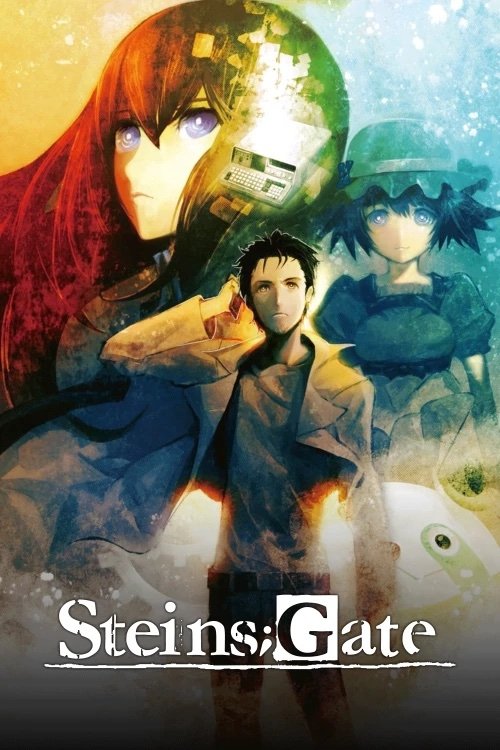
Steins;Gate
"Changing the past only makes the future worse."
Overview
Steins;Gate is a seminal science fiction thriller set in the otaku heartland of Akihabara, Tokyo. The story follows Okabe Rintarou, an eccentric college student who spends his days in a makeshift lab with his friends, inventing "Future Gadgets" that usually have little practical use. Their lives take a harrowing turn when they accidentally discover that their modified microwave can send text messages into the past, effectively altering history. What begins as a series of playful experiments with "D-mails" quickly escalates into a high-stakes conspiracy involving a shadowy global organization and the terrifying realization that every change to the timeline comes with an agonizing price.
The series is masterfully structured in two distinct halves: a lighthearted, character-driven slow burn that establishes deep emotional bonds, followed by a relentless, psychological descent into tragedy. As Okabe realizes the gravity of his actions, he is forced to navigate complex theoretical concepts like Attractor Fields and world-line divergence. The narrative evolves from a quirky slice-of-life comedy into a profound meditation on causality, as Okabe desperately attempts to navigate a labyrinth of timelines to find the one singular path—the Steins Gate—where those he loves can survive.
Core Meaning
At its heart, Steins;Gate is an exploration of the human weight of causality and the ethical responsibility that comes with the power to change the world. It suggests that while the universe may seem deterministic and bound by fate, the human spirit's capacity for sacrifice and persistence is the only force capable of "deceiving the world" to forge a new path. The series argues that our identity is defined by our memories and the connections we share, and that escaping suffering by erasing the past is often an impossible and hollow pursuit.
Thematic DNA
Determinism and Fatalism
The series explores the concept of Attractor Fields, where certain events are "convergent points" that must happen regardless of small changes in the past. Throughout the show, Okabe battles the terrifying realization that the universe itself seems to conspire to ensure certain tragedies occur, challenging the notion of free will against a seemingly fixed destiny.
Identity and Memory
Through the Reading Steiner ability, the show examines how identity is tied to memory. Okabe is the only one who remembers previous world lines, making him a solitary witness to lives that no longer exist. The series asks whether a person is still the same if their memories are erased or rewritten by a shift in time.
The Burden of Choice and Sacrifice
The narrative is a brutal exercise in the trolley problem. To save one person, Okabe must often undo changes that brought happiness to others, or even sacrifice another loved one. It highlights the psychological toll of playing God and the impossibility of a "perfect" choice without loss.
The Ethics of Science
Starting with playful "Future Gadgets," the show eventually depicts the horrific consequences of unchecked scientific ambition. It contrasts the innocent curiosity of the lab members with the cold, calculated dystopia sought by organizations like SERN.
Character Analysis
Okabe Rintarou
Mamoru Miyano
Motivation
Initially motivated by a desire for excitement and scientific discovery, his goal shifts entirely to the desperate, singular focus of saving his childhood friend Mayuri and the woman he loves, Kurisu.
Character Arc
Okabe begins as a delusional "Chuunibyou" who adopts the persona of the mad scientist Hououin Kyouma to mask his insecurities and keep his friends close. His arc is one of brutal maturation; he is forced to shed his facade to face the harrowing reality of time travel, eventually becoming a weary, traumatized man who must rediscover his "madness" as a weapon to save the future.
Kurisu Makise
Asami Imai
Motivation
She seeks to reconcile with her estranged father and validate her scientific theories, though her motivation eventually shifts to supporting Okabe's mental health and survival.
Character Arc
A brilliant neuroscience researcher who is initially a staunch skeptic of time travel. Her arc involves breaking down her professional walls and "tsundere" exterior to reveal a deeply compassionate woman willing to sacrifice her own existence for the sake of others. She becomes Okabe's intellectual equal and his greatest emotional support.
Mayuri Shiina
Kana Hanazawa
Motivation
Her primary motivation is the happiness of the lab members and maintaining the "Future Gadget Lab" as a peaceful sanctuary.
Character Arc
While she appears as the simple-minded "hostage" of the lab, she is the emotional core that prevents Okabe from losing his humanity. Her character development is subtle, revealing a profound emotional intelligence and an awareness of Okabe's pain that he tries to hide. She is the "North Star" that guides him back from the brink of madness.
Amane Suzuha
Yukari Tamura
Motivation
To prevent the rise of a global dictatorship by finding an IBN 5100 and stopping the research that leads to SERN's time machine.
Character Arc
Introduced as a quirky part-time worker, she is revealed to be a resistance fighter from a dystopian 2036. Her arc highlights the tragic weight of her mission; she carries the hopes of a destroyed world on her shoulders, leading to one of the series' most heartbreaking moments when her mission initially fails.
Symbols & Motifs
The Divergence Meter
A visual representation of Okabe's isolation and the objective state of reality. It measures the percentage difference from the original world line.
Created by a future version of Okabe, it appears frequently as a reminder of how far he has strayed from his goal and the thin margin between success and failure.
Nixie Tubes
Symbolizes nostalgia and the fragility of time. Their warm, flickering orange glow represents the analog nature of human memory in a digital world.
Used in the Divergence Meter, these tubes provide the series with its iconic aesthetic, grounding the high-concept sci-fi in a retro, mechanical feeling.
Cogs and Gears
Represent the inevitable machinery of causality and the "clockwork" nature of the universe's Attractor Fields.
Frequently seen in the opening credits and transitions, emphasizing that time is a rigid system that Okabe is desperately trying to break.
Metal Upa
A symbol of chaotic insignificance—a tiny object that inadvertently determines the fate of the entire world.
The rare toy obtained in the first episode becomes the catalyst for the entire series' climax, illustrating the Butterfly Effect.
Memorable Quotes
El Psy Kongroo
— Okabe Rintarou
Context:
Used throughout the series as a catchphrase, but takes on a deeper, more poignant meaning in the finale as a symbol of the lab's shared history.
Meaning:
A nonsensical phrase Okabe uses to end his "secret" phone calls. It symbolizes his delusional mad scientist persona.
I am mad scientist! It's so cool! Sonuvabitch.
— Okabe Rintarou
Context:
Episode 15, when Okabe tries to impress a group of foreigners. It highlights the lighter side of his character before the plot gets darker.
Meaning:
A comedic use of broken English that underscores Okabe's eccentric personality.
No one knows what the future holds. That's why its potential is infinite.
— Okabe Rintarou
Context:
Spoken in the final episode, marking Okabe's acceptance of a world line where the future is no longer determined by predestination.
Meaning:
The core philosophy of the series: that the lack of knowledge about the future is what makes life meaningful and free.
Time is passing so fast. I want to tell you so many things.
— Kurisu Makise
Context:
Episode 22, during their final moments before Okabe must switch world lines, effectively erasing her from his current reality.
Meaning:
A tragic acknowledgement of the brevity of their time together and the depth of her unspoken feelings.
Episode Highlights
Prologue to the Beginning and the End
The series opens with Okabe discovering Kurisu's body, sending a text, and suddenly finding himself in a world where she is alive and a satellite has crashed into the building.
Sets up the entire mystery and establishes the rules of world-line divergence that only become clear in the finale.
Dogma in Ergosphere
After a celebratory pizza party, the lab is raided by Rounders, and Mayuri is shot and killed by Moeka.
The definitive turning point where the series shifts from sci-fi comedy to a dark, psychological thriller.
Physically Necrosis
Okabe attempts to save Mayuri dozens of times, only to watch her die in different ways every time, leading to his mental breakdown.
Explores the horror of determinism and Okabe's realization that he is trapped in an Attractor Field.
Being Meltdown
Okabe realizes that to save Mayuri, he must return to the Beta world line where Kurisu dies.
The emotional climax of the series, featuring a heartbreaking confession of love and the ultimate sacrifice.
Open the Steins Gate
Okabe receives a video message from his future self explaining how to "deceive the world" to save Kurisu without creating a paradox.
The ultimate payoff that connects the first episode to the end, revealing the path to the true Steins Gate world line.
Philosophical Questions
Is it ethical to rewrite someone's life without their consent?
The series explores this through the D-mails sent for other characters (Faris, Ruka, Moeka). Even when the changes make them 'happier,' Okabe must eventually decide that their original suffering is more 'real' and necessary for the timeline.
Does free will exist if the universe has convergence points?
Okabe's struggle represents the battle between human agency and cosmic determinism. The ending suggests that free will exists only when we find the 'blind spot' in fate.
Alternative Interpretations
One common interpretation is that the entire series is a meta-commentary on the player's experience in a visual novel, where Okabe's 'Reading Steiner' represents the player remembering previous 'save states' or failed routes. Another darker reading suggests that Okabe's mental state may be more fractured than it appears, and that his 'mad scientist' persona is a defense mechanism against the absolute solitude of being the only person who truly knows the history of the world. Some fans also interpret the 'Steins Gate' world line not as a perfect happy ending, but as a fragile truce with a universe that could still converge into tragedy at any moment.
Cultural Impact
Steins;Gate is widely regarded as one of the greatest time-travel stories in any medium. It played a significant role in popularizing the 'visual novel adaptation' trend, setting a high bar for narrative cohesion and character development. Its influence can be seen in how it handles the 'butterfly effect' and its blend of hard science fiction with deeply personal drama. In Japan, it cemented Akihabara's status as a 'holy site' for fans, while globally, it is frequently cited as a 'gateway' anime for those who prefer complex, mature storytelling over typical shonen tropes. Its legacy includes a successful sequel (Steins;Gate 0) and a lasting impact on how time travel is depicted as a source of psychological trauma rather than just a plot device.
Audience Reception
Steins;Gate received near-universal acclaim, consistently ranking in the top 5 anime of all time on major platforms like MyAnimeList. Critics praised its intricate plotting and the chemistry between Okabe and Kurisu. While some viewers initially found the first half's slow pace and Okabe's eccentric personality off-putting, the dramatic shift in episode 12 is often cited as the moment that 'hooks' the audience for life. The emotional payoff of the finale is frequently listed as one of the most satisfying endings in television history.
Interesting Facts
- The character John Titor is based on a real-life internet personality from 2000-2001 who claimed to be a time traveler.
- SERN is a direct parody of CERN, the European Organization for Nuclear Research, including their use of the Large Hadron Collider.
- The IBN 5100 is a parody of the IBM 5100, which in real life had a secret function to emulate older mainframe code, just as in the show.
- The desaturated color palette of the anime was an intentional choice by studio White Fox to emphasize the oppressive heat of summer and the 'washed-out' feeling of Akihabara.
- The series takes place in 2010, which was the 'near future' during the development of the original visual novel in 2009.
- Many of the 'Future Gadgets' are parodies of items from other famous anime, such as Doraemon and Gundam.
Easter Eggs
References to 2channel (known as @channel in the show)
The series uses real Japanese internet slang and culture from the 2000s, grounding the sci-fi in a very specific time and place.
Cameos of other Science Adventure series characters
Mentions of characters or companies from Chaos;Head and Robotics;Notes connect the series to its shared universe.
The 'D-Mail' acronym
Initially stands for 'DeLorean Mail,' a direct reference to Back to the Future, before being shortened.
⚠️ Spoiler Analysis
Click to reveal detailed analysis with spoilers
Frequently Asked Questions
Explore More About This Movie
Dive deeper into specific aspects of the movie with our detailed analysis pages
Comments (0)
No comments yet. Be the first to share your thoughts!