Smiling Friends
A kaleidoscope of grotesque whimsy where surreal multimedia hallucinations meet mundane office banter. Optimistic pink and cynical yellow navigators attempt to mend broken spirits within a chaotic, neon-lit landscape of hard-won smiles.
Smiling Friends

Smiling Friends

01 April 2020 — 30 November 2025 United States of America 3 season 25 episode Returning Series ⭐ 8.5 (328)
Cast: Michael Cusack, Zach Hadel, Marc Moceri, Joshua Tomar, Erica Lindbeck
Animation Sci-Fi & Fantasy Comedy
Optimism vs. Nihilism Modern Media Satire The Beauty of the Grotesque The Subjectivity of Joy

Overview

Smiling Friends is an adult animated series following the employees of a small Pennsylvania-based company dedicated to spreading happiness. The show centers on the duo of Pim Pimling, a relentless optimist, and Charlie Dompler, a pragmatic straight man, as they tackle increasingly bizarre and often dangerous requests from a colorful cast of eccentric clients. Supported by their colleagues Allan and Glep, and led by the volatile but affectionate Mr. Boss, the team navigates a world where the boundary between the mundane and the supernatural is non-existent.

Across three seasons, the series evolves from a workplace comedy into an experimental odyssey. While Season 1 establishes the show's signature "uncomfortable realism," Season 2 and Season 3 push the boundaries of visual media, incorporating 3D animation, stop-motion, and live-action. The overarching narrative explores the growth of the team as they survive political assassinations, hellish dimensions, and forgotten video game mascots, eventually revealing deeper lore about the company's origins and Glep's ancient history. The show maintains a unique tone of optimistic nihilism, finding genuine heart in a grotesque, indifferent universe.
Core Meaning

The core message of Smiling Friends is that while the world is inherently chaotic, grotesque, and often unfair, the act of attempting to help others—however messy the process—is a noble and necessary pursuit. It serves as a critique of performative positivity, suggesting instead that genuine connection and subjective happiness are the only effective defenses against a nihilistic reality. Through its surreal lens, the series argues that even in a universe that seems designed to make you fail, finding meaning in friendship and humor is what makes life worth living.

Thematic DNA

Optimism vs. Nihilism 30%
Modern Media Satire 25%
The Beauty of the Grotesque 25%
The Subjectivity of Joy 20%

Optimism vs. Nihilism

This is the central philosophical tension of the series, personified by the relationship between Pim and Charlie. Throughout the show, Pim's unwavering belief in the goodness of humanity is constantly tested by horrific realities, while Charlie's low expectations are occasionally shattered by moments of wonder or genuine terror, leading to a middle-ground of absurdist resilience.

Modern Media Satire

The series frequently lampoons internet culture, celebrity worship, and the fickle nature of the entertainment industry. Characters like Mr. Frog and Gwimbly represent the decay of corporate mascots and the predatory nature of modern media, reflecting the creators' roots in independent internet animation.

The Beauty of the Grotesque

Visually and narratively, the show celebrates the "ugly" and the "weird." By finding humanity in hyper-detailed, wrinkled, and distorted character designs, the show promotes a radical acceptance of the physical and psychological imperfections that define the human (and critter) condition.

The Subjectivity of Joy

The missions often reveal that what makes one person smile—such as exterminating bliblies or seeing a 1,000-year war end—might be horrifying to others. The show posits that happiness cannot be commodified or standardized; it is a personal, erratic, and deeply weird state of being.

Character Analysis

Pim Pimling

Michael Cusack

Archetype: The Idealist
Key Trait: Boundless Empathy

Motivation

Driven by an innate, almost pathological need to validate his own happiness by making others smile, often at the expense of his own safety.

Character Arc

Pim begins as a purely manic source of positivity. Over three seasons, he undergoes a sobering transformation as his idealism is repeatedly crushed by the world's cruelty. By the end of Season 3, he remains optimistic but gains a more grounded, weary understanding of his mission's difficulty.

Charlie Dompler

Zach Hadel

Archetype: The Pragmatist
Key Trait: Cynical Loyalty

Motivation

Initially motivated by personal comfort and avoiding conflict, his drive evolves into a genuine, if begrudging, commitment to the well-being of his colleagues.

Character Arc

Charlie's development is defined by his literal brush with death and subsequent trip to Hell in Season 1. This experience gradually moves him from a position of lazy apathy to a more active, protective role within the company, eventually seeing him face existential dread in Season 3 with a newfound sense of loyalty to his friends.

Mr. Boss

Marc Moceri

Archetype: The Chaotic Mentor
Key Trait: Erratic Paternalism

Motivation

Maintaining his empire of smiles through whatever surreal or unethical means necessary, fueled by a warped sense of love and control.

Character Arc

Moving from a background figure to a central catalyst for chaos, Mr. Boss is revealed to be far more than a simple businessman. His arc reveals a history of demonic marriages and secret society involvements, ultimately showing him as a dangerously insane but oddly paternal figure to the team.

Allan Park

Michael Cusack

Archetype: The Bureaucrat
Key Trait: Deadpan Competence

Motivation

The pursuit of order and personal satisfaction, often finding himself forced into heroic roles despite his desire for a simple, quiet life.

Character Arc

Allan evolves from an office manager obsessed with cheese and paperclips into a highly capable action hero. His solo adventures in Season 2 and Season 3 showcase his hidden competence, proving he is the structural glue that keeps the company from falling into total madness.

Glep

Zach Hadel

Archetype: The Wildcard
Key Trait: Mysterious Immortality

Motivation

Contentment with small pleasures (iPad games, snacks) while secretly carrying the weight of centuries of experience and history.

Character Arc

Long viewed as a background joke, Glep's arc culminates in the Season 3 finale, "The Glep Ep." It is revealed that Glep is an immortal being nearly 1,700 years old who influenced world history and co-founded the Smiling Friends after saving Mr. Boss's life in the 1990s.

Symbols & Motifs

The Smiling Friends Logo Colors

Meaning:

Represents the core ensemble and the mystery of the company's past.

Context:

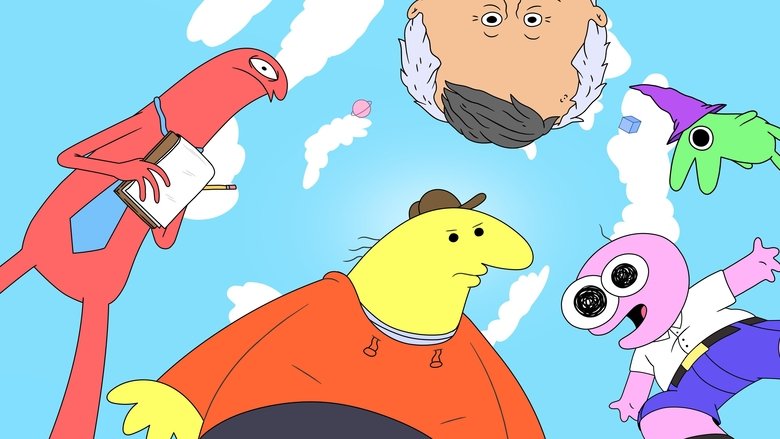
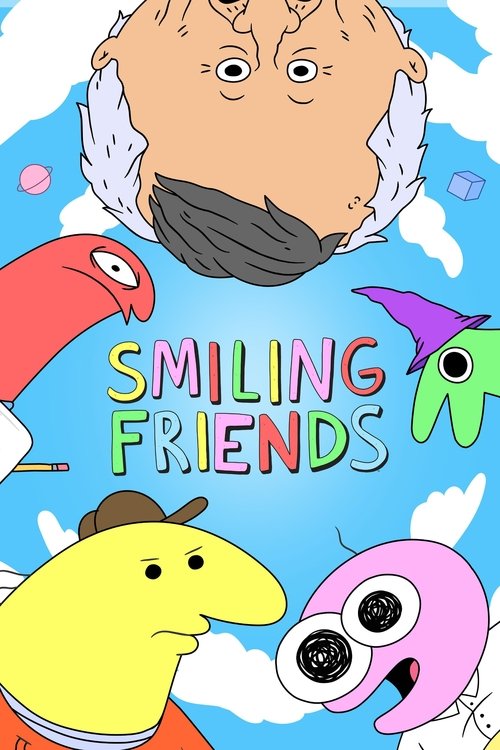
Yellow (Charlie), Pink (Pim), Red (Allan), and Green (Glep). The inclusion of blue in the logo refers to a scrapped "fifth friend" (the Blue Janitor) whose absence haunts the company's lore and appears as a recurring background easter egg.

Mr. Frog

Meaning:

Symbolizes the unhinged and violent nature of celebrity culture.

Context:

Appearing across multiple seasons, first as a fallen star and later as President, Mr. Frog represents a force of nature that cannot be tamed by PR, serving as a warning against the monsters created by media obsession.

The Man in the Walls

Meaning:

Symbolizes the hidden, unsettling layer of reality that exists just out of sight.

Context:

A realistic human figure seen in the background of various episodes (most notably in the pilot and Season 2). He represents the persistent, unacknowledged paranoia inherent in the show's world.

Memorable Quotes

I love kids, Pim! I love kids!

— Pim Pimling

Context:

Season 1, Episode 1: Pim shouts this in a public setting to express general love for humanity, immediately attracting negative attention.

Meaning:

A line that perfectly captures the show's talent for creating immense discomfort through socially oblivious dialogue.

Hello, thank you for watching. Hello, but I'm not sorry.

— Mr. Frog

Context:

Season 1, Episode 2: Mr. Frog's televised "apology" for eating a reporter, which only further highlights his psychopathy.

Meaning:

A satire of the non-apology culture prevalent in modern media and influencer circles.

You look like you're about to tell your friend not to come to school tomorrow, man.

— Charlie Dompler

Context:

Season 1, Episode 3: Charlie describing Shrimp's new, dark look after his breakup.

Meaning:

An example of the show's use of edgy, internet-inflected humor to describe a character's aesthetic.

Episode Highlights

Desmond's Big Day Out

S1E1

The series opener features a suicidal man holding a gun to his head while Pim and Charlie try to show him the joy of life. The resolution—finding purpose in killing bliblies—sets the tone for the entire series.

Significance:

Established the core philosophy that happiness is personal and often originates from dark or absurd sources.

Charlie Dies and Doesn't Come Back

S1E8

Charlie is killed by a falling tree and experiences a low-resolution CGI Hell, meeting a vaping Satan and a casual God. It is a visual and narrative pivot that introduced supernatural stakes to the show.

Significance:

Confirmed the existence of an afterlife in the series lore and deepened Charlie's character development.

Gwimbly: Definitive Remastered...

S2E1

Focuses on a washed-up PS1 mascot. The episode utilized high-quality retro CGI and addressed themes of corporate greed and fan nostalgia.

Significance:

Became a viral hit, cementing the show's status as a premier satirist of gaming and internet culture.

The Glep Ep

S3E8

The Season 3 finale focuses entirely on Glep after he is fired. It reveals his 1,600-year history, his role in the fall of the Roman Empire, and how he founded the company with Mr. Boss.

Significance:

Reshaped the audience's understanding of Glep and the origin of the Smiling Friends company itself.

Philosophical Questions

Is happiness a choice or a chemical accident?

The series explores this through characters who find joy in the most illogical or violent things, questioning whether the Smiling Friends are truly helping or simply facilitating delusions.

Can optimism survive in a truly nihilistic universe?

Through Pim's repeated failures and trauma, the show asks if his hope is a sign of strength or a form of madness that allows him to ignore reality.

Alternative Interpretations

Some critics interpret the series as a meta-history of animation, where each character's visual medium (2D, 3D, clay) reflects a different stage of digital evolution, and their struggle to co-exist represents the difficulty of maintaining artistic integrity in a changing industry. Another popular theory suggests the world is a shared purgatory, where characters are perpetually forced to 'make each other smile' to avoid existential collapse. The Season 3 finale's revelation about Glep's immortality has led some to view the entire series as a grand divine comedy where the Smiling Friends are unwitting angels or spirits facilitating a balance between hope and despair.

Cultural Impact

Smiling Friends has redefined modern adult animation by proving that the chaotic, multimedia-rich humor of the internet (specifically the Newgrounds and YouTube eras) can successfully translate to a mainstream television format. It is celebrated for its awkward realism, where characters speak with the pauses, stutters, and tangents of real people, contrasting sharply with its surreal visuals. The show has generated a massive cult following, with characters like Mr. Frog and Gwimbly becoming internet icons. By moving away from the 'mean-spirited' cynicism common in shows like Rick and Morty or Family Guy, it has introduced a new genre of empathetic surrealism that resonates deeply with Gen Z and Millennial audiences.

Audience Reception

The series has been met with universal acclaim, specifically praised for its visual diversity and the naturalistic chemistry between the lead voice actors. Fans have lauded the show for its ability to balance intense, sometimes disturbing imagery with genuine heart. Season 2's focus on broader satire and Season 3's deep-dive into the supporting cast's lore were particularly well-received, solidifying the show's longevity. While some criticized the initial 'shock humor' elements, the general consensus is that Smiling Friends is one of the most innovative and 'honest' comedies on television.

Interesting Facts

  • The character of God in Season 1 was voiced by the late Gilbert Gottfried in one of his final performances.
  • The series was created by Newgrounds veterans Zach Hadel (psychicpebbles) and Michael Cusack, bringing an 'internet-first' sensibility to Adult Swim.
  • The 'Man in the Walls' is a recurring background gag where a realistic human figure can be seen lurking in various scenes, never mentioned by the characters.
  • Finn Wolfhard and his brother Nick Wolfhard have both made multiple guest appearances as various voices.
  • The show's high frame rate (24fps) for its 2D characters creates a fluid, unsettlingly realistic motion compared to standard TV animation.

Easter Eggs

Marge Simpson Cameo

Glep's wife, seen in several holiday episodes, is canonically Marge Simpson. The creators confirmed this as a meta-joke about the nature of character crossovers and copyright in the critter world.

The OneyPlays 'Egg' Lore

The episode 'Brother's Egg' is filled with references to a recurring 'hypothetical egg' joke from co-creator Zach Hadel's gaming channel, OneyPlays.

Nostalgia Critic Cameo

Doug Walker (The Nostalgia Critic) appears in live-action as a 'Demon Slayer' in Season 1, a nod to the creators' history within the early 2010s YouTube review community.

⚠️ Spoiler Analysis

Click to reveal detailed analysis with spoilers

Frequently Asked Questions

Explore More About This Movie

Dive deeper into specific aspects of the movie with our detailed analysis pages

Comments (0)

Leave a comment

No comments yet. Be the first to share your thoughts!