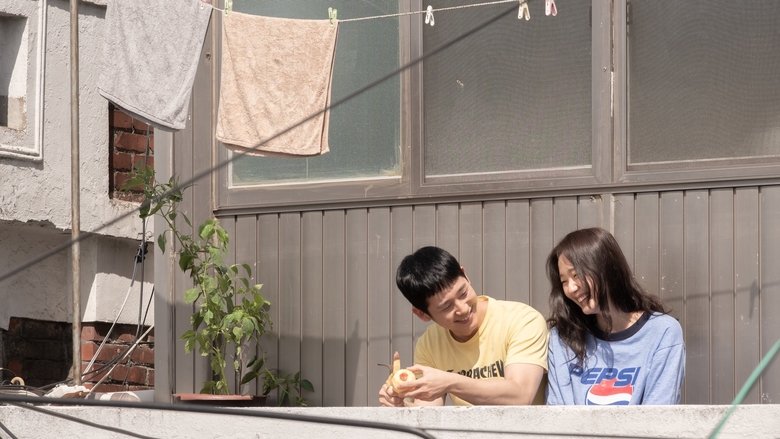

Tune in for Love
A nostalgic romantic drama tracing a decade of missed connections and fragile hopes, where the static of a radio frequency mirrors the flickering warmth of two souls searching for the right frequency to love.
Tune in for Love

Tune in for Love

유열의 음악앨범

"Let me get what I want."

28 August 2019 South Korea 122 min ⭐ 7.8 (308)
Director: Jung Ji-woo
Cast: Kim Go-eun, Jung Hae-in, Park Hae-joon, Kim Guk-hee, Jung Yoo-jin
Drama Romance
Timing and Fate Trauma and Redemption Communication and Technology Nostalgia and Resilience
Box Office: $8,631,781

Overview

Set against the backdrop of a changing South Korea from the mid-1990s to the early 2000s, Tune in for Love follows the intermittent romance between Mi-soo and Hyun-woo. Their story begins in 1994, on the day singer Yoo Yeol takes over as the DJ of a popular radio show. Hyun-woo, a young man recently released from a juvenile detention center, wanders into the small bakery where Mi-soo works. Despite an awkward start, a gentle bond forms between them, only to be abruptly severed by a sudden incident involving Hyun-woo's past.

The narrative unfolds through several time jumps—1997, 2000, and 2005—as the characters navigate the 1997 Asian financial crisis, military service, and the dawn of the digital age. Each time they manage to reconnect, external circumstances or internal insecurities pull them apart. The film focuses less on dramatic twists and more on the quiet, realistic struggles of two people trying to align their lives while carrying the weight of their own histories and the passage of time.


Core Meaning

The core of Tune in for Love lies in the concept of "frequency"—the idea that love is not just about finding the right person, but about finding the right time when both individuals are tuned into the same emotional wavelength. Director Jung Ji-woo explores the resilience of the human spirit and the way first love matures through hardship. It suggests that while the past can be a heavy anchor, the act of persistently reaching out to someone else is what eventually allows a person to forgive themselves and move forward.

Thematic DNA

Timing and Fate 35%
Trauma and Redemption 25%
Communication and Technology 20%
Nostalgia and Resilience 20%

Timing and Fate

The film emphasizes that love is often a victim of bad timing. The characters repeatedly miss each other by mere days or through simple technological mishaps, like a forgotten email password, illustrating how fragile human connections can be in a world transitioning from analogue to digital.

Trauma and Redemption

Hyun-woo's character is defined by the guilt of a childhood accident. The film examines how a criminal record and social stigma prevent him from feeling worthy of Mi-soo's love, framing his journey as a struggle to escape the ghosts of his past.

Communication and Technology

The evolution of communication tools—from radio and handwritten notes to early email and the first cell phones—serves as a metaphor for the characters' internal distance. Technology is both the bridge that connects them and the barrier that fails them.

Nostalgia and Resilience

The film captures the collective memory of 1990s Korea, including the IMF crisis. It portrays the resilience required to survive economic hardship and personal loss, showing that love is often sustained by the hope of returning to a simpler, shared past.

Character Analysis

Kim Mi-soo

Kim Go-eun

Archetype: The Persevering Lover
Key Trait: Steadfastness

Motivation

To find stability in a changing economy while holding onto the one person who makes her feel truly seen.

Character Arc

Mi-soo grows from a shy girl working in her family's bakery to a successful but lonely editor. Her journey is one of emotional maturation—learning to trust her feelings despite the repeated disappearances of the man she loves.

Cha Hyun-woo

Jung Hae-in

Archetype: The Tragic Hero
Key Trait: Vulnerability

Motivation

To prove he is a "decent person" and to escape the toxic influence of the friends who remind him of his worst mistake.

Character Arc

Hyun-woo moves from a troubled youth burdened by guilt to a man who eventually finds the courage to stop running from his past and face his feelings for Mi-soo openly.

Eun-ja

Kim Guk-hee

Archetype: The Mentor / Earth Mother
Key Trait: Warmth

Motivation

To protect and nurture Mi-soo and Hyun-woo like family, providing them with a moral compass.

Character Arc

She remains a constant supportive figure for both Mi-soo and Hyun-woo, even as her own life changes. She represents the unconditional kindness that allows Hyun-woo to believe in redemption.

Symbols & Motifs

Yoo Yeol's Music Album (Radio Show)

Meaning:

It symbolizes a constant thread of continuity in a rapidly changing world. It is the "frequency" that links the characters' souls even when they are physically apart.

Context:

The show plays in the background of every pivotal meeting and separation, eventually providing the medium for the final reconciliation.

Tofu

Meaning:

A traditional Korean symbol for a clean slate and the desire to live a "white" (sinless) life after being released from prison.

Context:

Hyun-woo enters the bakery asking for soy products immediately after his release, signaling his desperate wish to start over.

The Email Password

Meaning:

Represents the small, human errors that can alter the course of a lifetime. It is a symbol of the "missed connection" that defines their early relationship.

Context:

Mi-soo creates an account for Hyun-woo but forgets to give him the password, leading to years of one-sided communication as she sends emails he cannot read until much later.

The Bakery

Meaning:

Symbolizes warmth, family, and the lost innocence of their youth.

Context:

It is the place where they first meet and the place they both return to in their minds when life becomes difficult.

Memorable Quotes

Let's meet again when something good happens.

— Hyun-woo

Context:

Said before Hyun-woo leaves for his mandatory military service, setting the stage for their next long separation.

Meaning:

This quote captures the tragedy of their relationship; the belief that they can only be together when they are successful or "okay," rather than supporting each other through the bad times.

I prayed that you would never find out.

— Hyun-woo

Context:

Said when he realizes Mi-soo has learned the truth about the accident that sent him to juvenile prison.

Meaning:

Highlights his deep-seated shame and the fear that his past will inevitably destroy any happiness he finds with Mi-soo.

Don't run anymore. You'll hurt yourself.

— Mi-soo

Context:

A climactic moment where she confronts him after he chases her vehicle on foot.

Meaning:

A double-meaning line; she is literally telling him to stop chasing her car, but figuratively telling him to stop running away from his life and his guilt.

Philosophical Questions

Is love a matter of character or a matter of timing?

The film suggests that even two people with perfect chemistry cannot succeed if the world around them is in chaos or if they are not at peace with themselves. It posits that 'destiny' is simply the alignment of timing and personal readiness.

Does the past define our right to be happy?

Through Hyun-woo's struggle, the film asks if a single mistake should haunt a person forever. It explores the idea that self-forgiveness is a prerequisite for allowing someone else to love you.

Alternative Interpretations

While many viewers see the film as a straightforward happy ending, some critics interpret the final scene as more ambiguous. The 'Visual Radio' setting at the end suggests that while they have found their 'frequency' for now, their relationship is fundamentally tied to a nostalgic medium that is itself fading away. Another interpretation suggests that the film is not about love at all, but about the impossibility of ever truly escaping one's social class and past in Korea; despite their love, the characters spend more time apart than together, suggesting that their 'timing' is permanently fractured by the social forces surrounding them.

Cultural Impact

Tune in for Love tapped into a powerful wave of 'Newtro' (New Retro) nostalgia in South Korea. It was praised for its authentic recreation of the 1990s, from the fashion to the specific software (Windows 95) and the rise of PC Bangs. The film also addressed the trauma of the 1997 IMF crisis, which remains a defining historical scar for the generation depicted. Critically, it was hailed for its 'analogue' sensibility—focusing on slow-burn emotions and physical presence in an era dominated by fast-paced digital content. It reinforced Jung Hae-in's status as a top romantic lead and showcased Kim Go-eun's range in more grounded, realistic roles.

Audience Reception

The film received generally positive reviews, particularly for the chemistry between Kim Go-eun and Jung Hae-in, which many described as 'electric' and 'natural.' Audiences in their 30s and 40s praised the nostalgic elements and the realistic depiction of the late 90s. However, some critics and younger viewers found the pacing too slow and the 'bad timing' plot devices to be repetitive or frustrating. The ending was a point of contention—some found it deeply moving and earned, while others felt it was too abrupt given the long years of separation.

Interesting Facts

  • This film marks the second collaboration between Kim Go-eun and director Jung Ji-woo, who discovered her for her debut role in 'A Muse' (2012).
  • Jung Hae-in and Kim Go-eun previously worked together in the hit drama 'Goblin' (2016), where he played her character's first love, making this film a 'spiritual sequel' to their brief on-screen romance.
  • The film set a box office record for a romance film on its opening day in South Korea, with over 173,000 admissions.
  • Real-life radio host and singer Yoo Yeol actually appears in the film, providing his voice and a cameo role.
  • The soundtrack features iconic Korean hits from the 90s, including songs by Yoo Yeol, Shin Seung-hun, and the song 'Fix You' by Coldplay, which underscore the film's emotional beats.
  • The filming process lasted approximately three months, from September to December 2018.

Easter Eggs

The 'Goblin' Reunion

In the drama Guardian: The Lonely and Great God, Jung Hae-in played 'Tae-hee Oppa,' the first love that made the titular Goblin jealous. Tune in for Love serves as an Easter egg for fans, finally giving that 'first love' pairing a full-length feature story.

Lucid Fall's 'The Night My Heart Set Sail'

The use of specific indie songs from the early 2000s acts as a cultural time capsule for Korean viewers, referencing the shift in the music scene from mainstream pop to more introspective acoustic sounds.

⚠️ Spoiler Analysis

Click to reveal detailed analysis with spoilers

Frequently Asked Questions

Explore More About This Movie

Dive deeper into specific aspects of the movie with our detailed analysis pages

Comments (0)

Leave a comment

No comments yet. Be the first to share your thoughts!