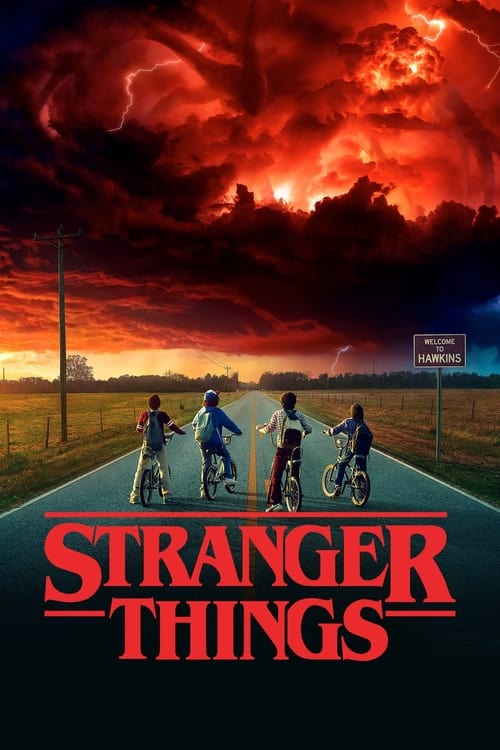
Stranger Things
"One last adventure."
Overview
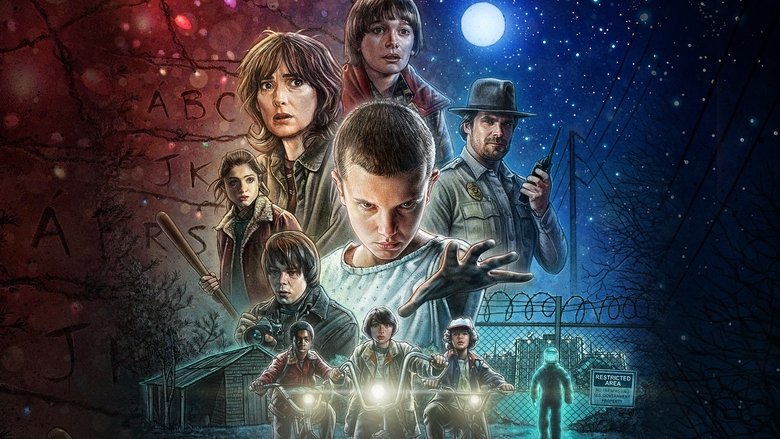
Set in the 1980s in the fictional town of Hawkins, Indiana, "Stranger Things" begins with the mysterious disappearance of a young boy, Will Byers. His mother, the local police chief, and his three best friends—Mike, Dustin, and Lucas—launch desperate searches for him. Their investigation leads them to a shocking government conspiracy, a terrifying alternate dimension known as the Upside Down, and a mysterious young girl with psychokinetic powers named Eleven, who has escaped from a sinister laboratory.
Across its seasons, the series expands its scope, chronicling the group's recurring battles against monstrous entities from the Upside Down, including the Demogorgon and the powerful Mind Flayer. As the children navigate the complexities of adolescence, their friendships are tested, new alliances are forged, and the adults are drawn deeper into the town's dark secrets. The narrative weaves together personal drama, coming-of-age comedy, and large-scale supernatural horror, as the heroes of Hawkins repeatedly fight to save their town and the world from the encroaching horrors of the Upside Down, culminating in a confrontation with its ultimate ruler, Vecna.
Core Meaning
The core meaning of "Stranger Things" lies in the transformative power of friendship, empathy, and collective action against encroaching darkness. Created by the Duffer Brothers, the series posits that the bonds of found family and platonic love are the most potent weapons against both supernatural monsters and human evils like government overreach and social ostracization. It's a celebration of outcasts and the idea that courage isn't the absence of fear, but facing that fear together. The show argues against existentialism, suggesting that identity and actions are largely a product of our social environment and obligations to others. Ultimately, it conveys a message of hope, asserting that even in the face of overwhelming terror and trauma, the light of human connection and loyalty can prevail.
Thematic DNA
Friendship and Loyalty
This is the central theme of the entire series. The unwavering loyalty between Mike, Dustin, Lucas, and Will is the catalyst for the initial search for Will and the foundation of their strength. The introduction of Eleven tests and ultimately strengthens these bonds. The motto "Friends don't lie" becomes a moral compass for the group. This theme evolves to include older characters, like the unlikely but powerful friendship between Steve Harrington and Dustin, and the alliance between Joyce, Hopper, and Murray. The series consistently demonstrates that the characters are strongest when they unite and trust one another.
Coming of Age and Loss of Innocence
The characters are forced to confront adult fears and life-or-death situations at a young age, accelerating their transition from childhood to adolescence. They grapple with first loves, heartbreak, and identity while simultaneously battling monsters. Season by season, their innocence is stripped away as they witness death, government corruption, and horrific violence. The Upside Down can be seen as a metaphor for the anxieties and terrors of adolescence itself, a dark mirror to their changing world.
The Mundane vs. The Supernatural
"Stranger Things" excels at grounding its extraordinary events in a familiar, mundane setting. The quiet, suburban life of Hawkins—with its bike rides, arcades, and school dances—is violently interrupted by the supernatural horror of the Upside Down. This contrast is a key source of the show's tension and appeal. Joyce's use of Christmas lights to communicate with her son in another dimension is a perfect example of this theme, blending a humble, everyday object with otherworldly terror. The series explores how ordinary people react when confronted with the impossible, and how they use ordinary means to fight extraordinary threats.
Good vs. Evil
The series presents a clear, though not always simple, conflict between good and evil. The 'good' is represented by the empathy, love, and self-sacrifice of the main characters. The 'evil' is multifaceted: the predatory, hive-mind monsters of the Upside Down like the Mind Flayer and Vecna, who seek to consume and control; and the cold, utilitarian cruelty of human antagonists like Dr. Brenner, who exploit children for power. The show explores how these forces corrupt and test individuals, but ultimately champions the idea that inherent goodness and the choice to fight for others can triumph over malevolence.
Character Analysis
Eleven (Jane Hopper)
Millie Bobby Brown
Motivation
Initially, her motivation is simple survival and escape from the 'bad men'. This quickly evolves into a fierce desire to protect her new friends, who are the first people to show her kindness and treat her like a person rather than an experiment. As the series progresses, her motivation becomes about protecting her found family (especially Mike and Hopper) and saving her home, Hawkins, from the forces she inadvertently unleashed. She is driven by love and a deep-seated sense of responsibility.
Character Arc
Eleven's arc is a profound journey from a traumatized, nameless test subject to a powerful hero and a young woman building her own identity. In Season 1, she is a feral, near-mute child defined by her powers and the abuse she suffered under Dr. Brenner. Through her friendship with Mike and the boys, she learns about trust, friendship, and self-sacrifice. In Season 2, she struggles with isolation under Hopper's protection and explores her past, briefly joining a group of outcasts before realizing her true home is with her friends in Hawkins. She embraces her identity as 'Jane'. Season 3 sees her experience a normal teenage life, exploring romance with Mike and friendship with Max, asserting her independence and sense of self. By Season 4, having lost her powers and moved to California, she is bullied and powerless, forced to confront her past and the true origins of Vecna to regain her abilities, emerging stronger and more in control of her trauma and identity than ever before.
Jim Hopper
David Harbour
Motivation
Hopper's primary motivation is to atone for his past failures, specifically his inability to save his daughter. Protecting the children of Hawkins, and especially Eleven, becomes his way of finding redemption. He is driven by a deep, often buried, sense of justice and a powerful paternal instinct. Later, his motivation also includes building a future with Joyce and creating a real family.
Character Arc
Hopper begins Season 1 as a cynical, alcoholic, and detached police chief, haunted by the death of his young daughter, Sara. The investigation into Will Byers' disappearance forces him out of his stupor, reigniting his detective instincts and sense of purpose. His arc is one of redemption and learning to be a father again. In Season 2, he adopts Eleven, and their relationship is loving but fraught with conflict as he struggles with being an overprotective and often angry parent. Season 3 sees him trying to navigate Eleven's teenage romance with Mike, which brings out his insecurities, though he seemingly sacrifices himself in the finale to save everyone. In Season 4, after surviving and being imprisoned in a Russian gulag, he is broken down physically and mentally. He confronts his past trauma and self-destructive tendencies, emerging more vulnerable but also more heroic, finally ready to accept love from Joyce and fully embrace his role as a protector.
Mike Wheeler
Finn Wolfhard
Motivation
Mike is motivated by an intense loyalty to his friends and a strong moral compass. His initial quest is to find his best friend, Will. This quickly expands to protecting Eleven, whom he falls in love with. He is the planner and strategist, driven by a need to keep his 'party' together and safe, both from supernatural threats and the mundane challenges of growing up.
Character Arc
In Season 1, Mike is the optimistic and compassionate leader of his friend group. His unwavering belief in and empathy for Eleven makes him the group's 'heart' and is crucial to her integration and decision to help. He is the first to offer her shelter and friendship, forming an immediate, powerful bond. In Season 2, he is sullen and heartbroken over Eleven's disappearance but remains the strategic leader when the threat of the Mind Flayer emerges. Season 3 challenges his leadership as the group fractures due to romantic relationships; his arc centers on learning to navigate his relationship with Eleven and reconnecting with his friends. By Season 4, he feels like he's losing his place in the group and struggles to articulate his feelings for Eleven, fearing he is not needed anymore. His journey culminates in him finally confessing his unconditional love for her, providing the emotional strength she needs to defeat Vecna and reaffirming his role as her emotional anchor.
Symbols & Motifs
The Upside Down
The Upside Down is a powerful, multifaceted symbol. It represents the hidden fears, trauma, and corruption that lie beneath the surface of a seemingly perfect suburban town. It's a dark mirror of our world, symbolizing internal struggles, anxiety, and the menacing aspects of adolescence. It also embodies the consequences of unchecked scientific ambition and the Cold War paranoia that fueled the secret experiments which opened the gate in the first place.
The Upside Down is the primary antagonist setting throughout the series. It is a cold, dark, and decaying alternate dimension that mirrors Hawkins. Characters are frequently pulled into it or must venture there to rescue others and fight its monstrous inhabitants. Its presence is often signaled by flickering lights and a dark, spore-filled atmosphere. In Season 4, it's revealed to be frozen on the date Will Byers disappeared in 1983.
Christmas Lights
The Christmas lights symbolize hope, the resilience of maternal love, and a bridge between two worlds. They represent Joyce Byers' unwavering faith that her son is alive and her desperate attempt to communicate with him. The lights transform a mundane holiday decoration into a tool of supernatural connection, perfectly encapsulating the show's blend of the ordinary and the extraordinary. The flickering lights more broadly symbolize the thinning veil between dimensions and the presence of danger.
In Season 1, Joyce strings Christmas lights all over her house. Will, trapped in the Upside Down, is able to manipulate them to communicate with her, spelling out messages and answering her questions. This becomes a pivotal method of investigation and a powerful visual motif for the season. Flickering lights continue to be a recurring signal of a monster's proximity in subsequent seasons.
Dungeons & Dragons
The game of Dungeons & Dragons (D&D) symbolizes friendship, imagination, and the framework through which the children understand the incomprehensible supernatural events. It provides them with a language and a set of roles to process the real-life monsters they face, naming them the Demogorgon, the Mind Flayer, and Vecna after D&D villains. The game represents their "nerdy" outsider status but also becomes the source of their strategic strength and collaborative spirit.
The series opens with the boys playing D&D in Mike's basement, a scene that establishes their characters and friendship. The disappearance of Will Byers occurs immediately after this game. Throughout the series, they use D&D analogies to strategize against the creatures from the Upside Down. In Season 4, the game becomes a source of social panic, linking it to Satanism, which reflects a real-world moral panic of the 1980s.
Memorable Quotes
Friends don't lie.
— Eleven
Context:
First said in Season 1, Episode 5 ("The Flea and the Acrobat"), Mike explains the concept of friendship to Eleven. She later repeats it back to him and others throughout the series, often when holding them accountable or expressing the depth of her loyalty.
Meaning:
This is arguably the most iconic quote of the series and serves as the core principle of the main friend group. Taught to Eleven by Mike, it becomes her foundational understanding of trust and relationships after a lifetime of deception and abuse. It's a simple yet powerful moral code that guides the characters' actions and decisions.
Mornings are for coffee and contemplation.
— Jim Hopper
Context:
Said in Season 1, Episode 1 ("The Vanishing of Will Byers"), Hopper says this to his secretary, Flo, as he tries to ease into his workday before the chaos of Will's disappearance upends his life.
Meaning:
This quote perfectly encapsulates Hopper's character in the first season: a world-weary, slightly grumpy police chief who prefers a quiet, routine life. It has become a fan-favorite line for its deadpan delivery and relatable sentiment, representing the 'calm before the storm' of the series' supernatural events.
I dump your ass.
— Eleven
Context:
This happens in Season 3, Episode 2 ("Chapter Two: The Mall Rats"). After getting advice from Max about boys, Eleven confidently confronts Mike at the Starcourt Mall and breaks up with him.
Meaning:
A pivotal and humorous moment of empowerment for Eleven. Coached by her new best friend Max, Eleven stands up to Mike, who has been lying to her. It marks a significant step in her finding her own voice and identity outside of her relationships with Mike and Hopper, showcasing her growing independence and confidence.
Make mistakes, learn from them, and when life hurts you, because it will, remember the hurt. The hurt is good. It means you're out of that cave.
— Jim Hopper
Context:
Read by Eleven in a voiceover at the end of the Season 3 finale ("The Battle of Starcourt"), after Hopper is presumed dead. The 'cave' is a reference to a story he told her, symbolizing his own emotional isolation after his daughter's death.
Meaning:
This is part of a heartfelt letter Hopper wrote to Eleven, intended to be read during a conversation about her and Mike. It's a poignant piece of fatherly advice, reflecting his own painful journey of growth. It speaks to the show's theme of finding strength through adversity and embracing the painful process of growing up.
Episode Highlights
Chapter One: The Vanishing of Will Byers
The pilot episode masterfully establishes the series' tone, characters, and central mystery. It introduces the endearing friendship of the four boys through a game of Dungeons & Dragons, the eerie setting of Hawkins, and the inciting incident of Will Byers' disappearance. It also introduces the mysterious and powerful Eleven.
This episode sets the entire series in motion. It lays the groundwork for every major plotline: the search for Will, the discovery of the Upside Down, the sinister experiments at Hawkins Lab, and the arrival of Eleven. It perfectly captures the 80s aesthetic and Spielbergian tone that would become the show's hallmark.
Chapter Eight: The Upside Down
In the tense Season 1 finale, Joyce and Hopper venture into the toxic Upside Down to rescue Will. Meanwhile, the boys and Eleven make a final stand against the Demogorgon at the middle school. The episode culminates in Eleven's heroic self-sacrifice, where she destroys the monster and vanishes.
This episode provides a thrilling and emotional climax to the first season's arc. It solidifies the bonds between the characters and establishes Eleven as a true hero. Will's rescue and subsequent coughing up of a slug-like creature teases the lingering connection to the Upside Down, setting up future seasons.
Chapter Nine: The Gate
The Season 2 finale sees the characters converge to fight the Mind Flayer on multiple fronts. Joyce, Jonathan, and Nancy exorcise the entity from Will using heat, while Steve becomes a protector for the younger kids. The emotional centerpiece is Eleven's dramatic return to close the gate to the Upside Down beneath Hawkins Lab.
This episode showcases the group working as a cohesive, expanded team. Eleven's closing of the gate is a triumphant display of her power and growth. The epilogue at the Snow Ball dance provides a rare, heartwarming moment of normalcy for the kids, while the final shot of the Mind Flayer looming over the Upside Down's version of the school warns that the threat is not over.
Chapter Four: Dear Billy
Widely considered one of the series' best episodes, "Dear Billy" focuses on Max as she becomes the next target of Vecna. While writing goodbye letters to her friends, she is pulled into Vecna's mind lair. The episode climaxes with a breathtaking sequence where her friends use her favorite song, Kate Bush's "Running Up That Hill," to pull her back to reality.
This episode was a cultural touchstone, causing a massive resurgence in popularity for Kate Bush's song. It powerfully visualizes the theme of friendship and personal connection as a literal lifeline against depression and trauma (symbolized by Vecna). It establishes the rules for fighting Vecna and elevates Max to a central character for the season.
Chapter Seven: The Massacre at Hawkins Lab
This episode contains one of the series' biggest plot twists. Through Eleven's restored memories, it is revealed that the friendly orderly at Hawkins Lab was actually Henry Creel, Dr. Brenner's first test subject, Number One. The episode details how he massacred the other children and how a young Eleven, in self-defense, banished him to the Upside Down, where he became Vecna.
This episode reframes the entire mythology of the series. It establishes Vecna as the ultimate antagonist, connecting the events of all four seasons. It reveals that Eleven did not open the first gate out of simple curiosity, but as an act of defeating the original evil of Hawkins Lab, tying her origin story directly to the creation of the show's main villain.
Chapter Nine: The Piggyback
The feature-length Season 4 finale sees the separated groups enact a multi-pronged plan to kill Vecna. Eleven enters Max's mind to fight Vecna psychically, while Steve, Nancy, and Robin attack his physical body in the Upside Down. The plan has devastating consequences: Max is clinically killed before being revived by Eleven, Eddie Munson sacrifices himself in a heroic guitar-shredding diversion, and despite their efforts, Vecna succeeds in opening four gates, causing the Upside Down to begin bleeding into Hawkins.
This episode marks a major turning point, ending on a somber and ominous note unlike previous seasons. The heroes suffer significant losses and, for the first time, fail to completely stop the villain's plan. It sets up an apocalyptic scenario for the final season, with the barrier between dimensions shattered and Hawkins facing its greatest threat.
Philosophical Questions
Are we defined more by our individual nature or by our connections to others?
The series strongly advocates for a collectivist worldview. The monsters of the Upside Down, particularly the Mind Flayer, operate as a hive mind, a purely collectivist entity devoid of individuality. However, this is portrayed as a malevolent force bent on consumption. In contrast, the heroes demonstrate that strength comes from freely chosen bonds of friendship and family. They act as a collective, sharing knowledge and protecting one another, but retain their individuality. The show seems to ask whether true strength lies in surrendering the self to a group (like the Flayed) or in using one's individual talents to support a community founded on love and trust.
What is the true nature of a 'monster'?
"Stranger Things" explores this question from multiple angles. Initially, the 'monster' is the non-human Demogorgon. However, the series quickly reveals the human monstrosity of Dr. Brenner and the government agents who abuse and dehumanize a child. Eleven herself fears she is a monster due to her destructive powers. The Season 4 introduction of Vecna complicates this further, as he was once a human child, Henry Creel, whose nihilistic worldview and trauma twisted him into a literal monster. The show forces the audience to consider whether monstrosity is an inherent quality or something created through abuse, ideology, and a lack of empathy.
Alternative Interpretations
While "Stranger Things" presents a fairly direct narrative of good versus evil, several alternative interpretations have been discussed by critics and fans.
One common reading is that the Upside Down is a metaphor for trauma and mental illness. It is a dark, toxic reflection of the real world that characters are pulled into against their will. Vecna, in particular, explicitly preys on characters' past trauma and guilt, reinforcing this interpretation. Eleven's journey can be seen as a struggle to confront and control the trauma of her upbringing, using it as a source of strength rather than letting it consume her.
Another interpretation views the series through a political lens, seeing the Upside Down as a symbolic byproduct of the Cold War. The gate is opened by a secret government agency obsessed with defeating the Soviet Union, suggesting the monsters are an allegorical consequence of unethical government experimentation and the dangerous secrets kept from the public during that era of paranoia.
Some fan theories also explore character relationships in-depth, such as the widely discussed theory that Will Byers' connection to the Upside Down and his emotional arc are tied to his struggles with his sexuality and identity in a less-accepting time.
Cultural Impact
"Stranger Things" debuted on Netflix in 2016 and quickly became a global cultural phenomenon and a flagship series for the streaming service, attracting record viewership with each new season. Its most significant impact was popularizing 1980s nostalgia as a dominant aesthetic in mainstream entertainment. The series is a meticulously crafted love letter to the era's pop culture, referencing the works of Steven Spielberg, Stephen King, and John Carpenter, which resonated with both audiences who grew up in the 80s and younger viewers. This success fueled a wider trend of 80s-inspired films, music, and fashion in the late 2010s and early 2020s.
The show launched its young cast, particularly Millie Bobby Brown, into global stardom. It also had a notable impact on the music industry; the prominent use of Kate Bush's 1985 song "Running Up That Hill (A Deal with God)" in Season 4 propelled the track to the top of charts worldwide, 37 years after its initial release. Similarly, Metallica's "Master of Puppets" saw a massive surge in popularity after being featured in the season finale. The series has spawned a larger franchise, including a Broadway prequel play and an upcoming animated spin-off, cementing its legacy as one of the most influential and successful television shows of the streaming era.
Audience Reception
"Stranger Things" has been met with widespread critical acclaim and massive audience enthusiasm since its debut, though reception has varied slightly across seasons. Season 1 was a surprise hit, lauded for its casting, characterization, pacing, and loving homage to 1980s cinema. It was seen as a fresh and compelling new property. Season 2 was also well-received, though some critics and viewers found it to be a slightly less focused retread of the first season. The standalone episode "The Lost Sister," which followed Eleven's journey to Chicago, was particularly polarizing. Season 3 received more mixed, though still generally positive, reviews. Critics praised its vibrant, summer blockbuster feel, humor, and character dynamics, but some audience members felt the tone was occasionally too light and the plot involving the secret Russian base was overly silly. Season 4 was hailed as a return to form and the show's most ambitious season yet. Audiences and critics praised its darker, more horror-centric tone, the introduction of the compelling villain Vecna, its emotional depth, and its epic scale. Across all seasons, the show has consistently broken viewership records for Netflix, cementing its status as a global phenomenon.
Interesting Facts
- The series was created by twin brothers Matt and Ross Duffer, known professionally as The Duffer Brothers.
- The show was initially pitched under the title "Montauk," and was set in Montauk, Long Island, inspired by the real-life conspiracy theories of the Montauk Project.
- The creators auditioned 906 boys and 307 girls for the main children's roles.
- Gaten Matarazzo (Dustin) has cleidocranial dysplasia, a real condition that affects bone and teeth development. The writers incorporated this into his character.
- To achieve Eleven's floating effect in the sensory deprivation pool in Season 1, over 1,200 pounds of Epsom salt were dissolved in the water.
- The monster's effects in Season 1 were largely practical. A man in a suit, Mark Steger, played the Demogorgon.
- Winona Ryder was convinced to take the role of Joyce Byers during a four-and-a-half-hour meeting with the Duffer Brothers.
- The iconic opening title sequence was inspired by the work of Richard Greenberg, who designed titles for 80s films like 'Alien' and 'The Goonies'.
- Noah Schnapp's (Will Byers) realistic corpse prop from Season 1 was used by the crew to prank his mother.
Easter Eggs
Numerous direct homages to Steven Spielberg's 'E.T. the Extra-Terrestrial' (1982) are present, especially in Season 1.
Eleven's character arc mirrors E.T.'s: a powerful, non-human entity hidden by a group of suburban kids. Scenes of Eleven using her powers, the kids hiding her in the house, and the gang escaping on bicycles are direct visual and thematic references to the classic film. Eleven's love for Eggo waffles is also a nod to E.T.'s fascination with Reese's Pieces.
The works of Stephen King are a major source of inspiration for the series.
The show's logo font is reminiscent of the font used on many of King's 1980s book covers. The plot element of a group of kids banding together to fight a supernatural evil is a direct homage to King's novel 'It'. The kids walking along the railroad tracks is a visual reference to 'Stand by Me' (based on King's novella 'The Body').
The character of Nancy Wheeler and certain horror elements are references to 'A Nightmare on Elm Street' (1984).
Nancy's name is a nod to the film's protagonist, Nancy Thompson. The scene in Season 1 where the Demogorgon pushes through Joyce's wall is a visual echo of Freddy Krueger pushing through Nancy's wall. Season 4's villain, Vecna, who attacks teenagers in their minds through their trauma, is heavily inspired by Freddy Krueger. The season even features a cameo from Robert Englund, the original actor for Freddy.
The character of Jim Hopper shares many traits with Chief Brody from 'Jaws' (1975).
Both are police chiefs in small towns dealing with a new, unprecedented threat that the authorities want to cover up. Hopper's uniform and vehicle in the first season are also very similar to Chief Brody's, paying homage to another Spielberg classic that heavily influenced the Duffer Brothers.
⚠️ Spoiler Analysis
Click to reveal detailed analysis with spoilers
Frequently Asked Questions
Explore More About This Movie
Dive deeper into specific aspects of the movie with our detailed analysis pages
Comments (0)
No comments yet. Be the first to share your thoughts!