Skip to content
Strangers from Hell
A suffocating descent into psychological madness, dripping with claustrophobic dread and bilious rot, where a cramped hallway transforms into a living meat grinder that consumes the human soul.
Strangers from Hell

Strangers from Hell

타인은 지옥이다

"Humans are the most fearful beings."

31 August 2019 — 06 October 2019 South Korea 1 season 10 episode Ended 8.0 (149)

Cast: Yim Si-wan, Lee Dong-wook, Lee Hyun-wook, Park Jong-hwan, Ro Jong-hyun

Drama Crime Mystery Urban Alienation & Socioeconomic Claustrophobia The Contagion of Violence & Latent Monstrosity Psychological Gaslighting & Erosion of Reality Toxic Social Conformity & Repression

Overview

Strangers from Hell (also known as Hell Is Other People) is a 10-episode psychological horror-thriller drama based on the acclaimed Naver webtoon by Kim Yong-ki. The story follows Yoon Jong-woo, an aspiring crime-fiction writer in his late twenties who moves from the countryside to Seoul after securing an unpaid internship at a senior college friend’s PR agency. Chronically strapped for cash, Jong-woo is forced to take up residence at Eden Gosiwon—an exceptionally cheap, decrepit, and suffocating micro-dormitory sharing communal kitchens and bathrooms.

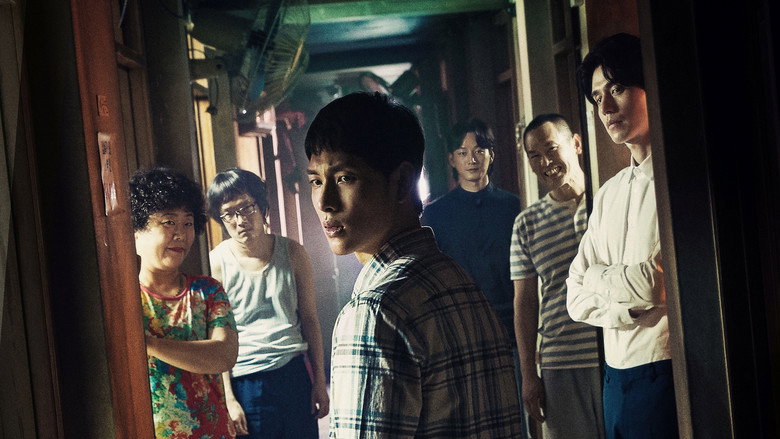
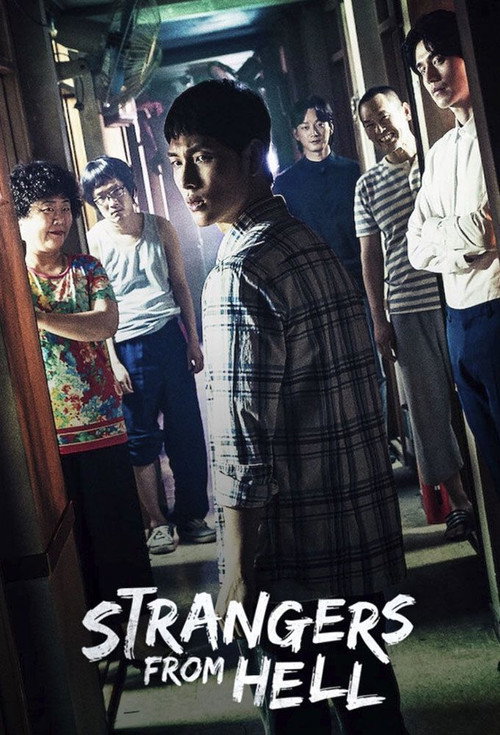
Soon after settling into Room 303, Jong-woo realizes that the gosiwon is inhabited by deeply unsettling neighbors: a creepy, giggling twin; a suspicious pervert; a suspiciously hospitable landlady; and a charming, sophisticated dentist residing next door. As bizarre incidents, disappearances, and ambient hostilities pile up inside the dormitory and at his toxic workplace, Jong-woo's paranoia escalates rapidly. The series charts his harrowing psychological deterioration as the oppressive social environment and predatory strangers systematically strip away his sanity, pushing him toward the threshold of irreversible darkness.

Core Meaning

Drawing its title and philosophical foundation from Jean-Paul Sartre’s play No Exit ("L'enfer, c'est les autres"), the creators of Strangers from Hell critique modern urban alienation, socioeconomic inequality, and the dehumanizing pressures of modern societal hierarchies. Rather than portraying evil as an external, demonic force, the drama posits that society itself—indifferent peers, exploitative bosses, suffocating economic precarity, and malicious voyeurs—serves as the catalyst that nurtures and unleashes latent human monstrosity. Through Jong-woo's unraveling, the series demonstrates how systemic emotional neglect and gaslighting can transform a vulnerable, ordinary individual into the very nightmare they feared.

Thematic DNA

Urban Alienation & Socioeconomic Claustrophobia 30%
The Contagion of Violence & Latent Monstrosity 25%
Psychological Gaslighting & Erosion of Reality 25%
Toxic Social Conformity & Repression 20%

Urban Alienation & Socioeconomic Claustrophobia

Eden Gosiwon serves as an architectural manifestation of economic destitution. The series examines the vulnerability of young workers who move to metropolitan Seoul without financial safety nets, demonstrating how poverty physically confines individuals to squalor and strips them of dignity and personal boundaries.

The Contagion of Violence & Latent Monstrosity

Evil in the series is an infectious, transmissible pathology. The story tracks the gradual awakening of Jong-woo's repressed violent urges under the deliberate mentorship and provocation of Seo Moon-jo, questioning whether monsters are born or cultivated.

Psychological Gaslighting & Erosion of Reality

The narrative continuously challenges Jong-woo’s subjective perception. Surrounded by killers who feign normalcy and outsiders who dismiss his concerns as overreactions, Jong-woo suffers acute cognitive dissonance and loses his grasp on sanity.

Toxic Social Conformity & Repression

The workplace subplot mirrors the horrors of the dormitory. Jong-woo is repeatedly forced to swallow insults, appease condescending superiors, and suppress anger to maintain social harmony, proving that civilized society extracts the same soul-destroying toll as a den of killers.

Character Analysis

Yoon Jong-woo

Yim Si-wan

Archetype: Tragic Protagonist / Corrupted Antihero Key Trait: Repressed rage and volatile hypersensitivity

Motivation

To survive, make money, protect his relationship, and finish his novel—which eventually devolves into primal survival and sadistic vengeance.

Character Arc

Begins as an introverted, financially struggling aspiring writer attempting to endure harsh urban realities; under incessant external pressure and psychological torment, his internal defenses collapse, culminating in a descent into violent madness.

Seo Moon-jo

Lee Dong-wook

Archetype: The Dark Mentor / Machiavellian Predator Key Trait: Chillingly composed sadism disguised by an immaculate smile

Motivation

To deconstruct human psyche, foster true predatory nature, and achieve symbiotic union with a kindred soul.

Character Arc

A charismatic, fastidious dentist who leads a double life as the mastermind serial killer of Eden Gosiwon; rather than merely slaughtering Jong-woo, he treats him as a psychological sculpture, dismantling his moral inhibitions to craft his "masterpiece".

All 4 characters and cast

Symbols & Motifs

The Gosiwon / Eden Studio

Meaning:

Irony incarnate; named "Eden", it represents a decaying, hellish labyrinth that symbolizes the inescapable entrapment of poverty and mental degradation.

Context:

Used as the primary setting of the series, featuring paper-thin walls and dark corridors where Jong-woo is physically and mentally trapped.

Extracted Human Teeth & The Bracelet

Meaning:

Represents the commodification, total subjugation, and artistic fetishization of human prey.

Context:

Crafted into jewelry by Seo Moon-jo from the molars of his victims and worn as a grotesque trophy.

Raw Mysterious Meat / The Dish

Meaning:

Symbolizes cannibalistic consumption, moral transgression, and complicity in gosiwon society.

Context:

Shared repeatedly in the communal kitchen by Ms. Eom and Moon-jo with Jong-woo.

The Eye / Peeping Holes & Keyholes

Meaning:

Motifs of voyeurism, panoptic surveillance, and psychological invasion, stripping individuals of privacy and agency.

Context:

The gosiwon residents constantly observe Jong-woo through holes in the walls and keyholes.

The Broken Laptop and Typewriter

Meaning:

Reflects Jong-woo’s fractured creative mind, shattered aspirations, and the violent narrative mechanically scripted into his psyche.

Context:

Appears throughout Jong-woo's writing attempts and in the climactic hospital sequence where he compulsively types.

Memorable Quotes

타인은 지옥이다.
— Yoon Jong-woo

Context

Delivered via voiceover in Episode 1 during his arrival and initial monologue.

Meaning

Encapsulates the thematic premise of the series, drawing directly from Sartre to establish how society and strangers create torment.

자기는 내 최고의 작품이에요.
— Seo Moon-jo

Context

Spoken in Episode 10 during their climactic final confrontation.

Meaning

Confirms Moon-jo's true motive—not simply to kill Jong-woo, but to reshape his mind into a mirror image of himself.

All 4 quotes

Episode Highlights

Hell Is Other People (타인은 지옥이다)

S1E1

Introduces the claustrophobic world of Eden Gosiwon and establishes the pervasive tension between economic desperation and atmospheric horror.

Significance:

Sets up Jong-woo's financial precarity and first encounters with the unsettling tenants.

Human Nature (인간 본능)

S1E2

Features the murder of Yoo Ki-hyuk (Room 302) and unveils Seo Moon-jo as the true alpha predator of the residence.

Significance:

Subverts audience expectations who believed Room 302 was the main webtoon villain, elevating Moon-jo as the central mastermind.

Malte's Notebook (말테의 수기)

S1E5

References Rainer Maria Rilke's existential book, highlighting Jong-woo's rapid psychological deterioration, sleep deprivation, and burgeoning hallucinations.

Significance:

Serves as the mid-season pivot point where Jong-woo begins losing control of his temper at work and at home.

Cognitive Dissonance (인지 부조화)

S1E9

Captures Jong-woo's complete breakdown as the gosiwon predators lure his girlfriend Ji-eun into their trap.

Significance:

Strips away the remaining barriers between Jong-woo and Eden Studio, leading directly into the deadly finale.

Gaslighting (가스라이팅)

S1E10

The blood-soaked finale where the residents fight to the death and Jong-woo unleashes absolute savagery.

Significance:

Delivers the narrative twist showing that Jong-woo himself executed the gruesome purge, completing Moon-jo's psychological transmission.

Philosophical Questions

Are human beings inherently civilized, or is morality merely a fragile veneer maintained by external social surveillance?

Explored through Jong-woo's rapid regression once stripped of polite societal checks, showing how primal violence surfaces when social safety nets and dignity disappear.

Is true "hell" created by the presence and judgment of other people, or does it originate from one's inability to reconcile internal desires with societal demands?

Explored via the Sartrean premise, contrasting the overt malice of the gosiwon tenants against the subtle, crushing cruelty and demands of Jong-woo's workplace colleagues.

Can an individual subjected to constant gaslighting, hostility, and isolation retain their moral integrity, or is corruption inevitable?

Examined through the deliberate psychological dismantling of Jong-woo by Moon-jo, questioning whether moral corruption is an infectious transmission under extreme duress.

Who bears greater moral culpability: the overt predator who acts openly outside societal rules, or the polite society whose passive cruelty drives people to ruin?

Investigated by juxtaposing the brutal murders inside Eden Gosiwon with the systemic exploitation, condescension, and indifference of the corporate and urban hierarchy.

Alternative Interpretations

The narrative and ambiguous conclusion offer several interpretive layers:

  • Literal Psychological Assimilation: Jong-woo was fundamentally broken and brainwashed; in a state of dissociative psychosis, he carried out the murders under the hallucinated identity and spirit of Seo Moon-jo.
  • The Latent Awakening (He Was Always a Monster): Eden Gosiwon did not create Jong-woo’s darkness; it merely provided the permissive environment and catalyst for his repressed violent tendencies (manifested earlier during his military service) to erupt.
  • Hallucination vs. Reality of Moon-jo’s Death: While Officer Soh Jung-hwa confirms Moon-jo's body was found deceased, the closing shot of Moon-jo staring back from Jong-woo's face represents how Moon-jo now lives on as an inescapable internal voice and psychic parasite.

Full ending explanation

Cultural Impact

The series made a distinct impact across multiple cultural and cinematic dimensions:

  • Sartrean Existential Foundation: The series directly explores Jean-Paul Sartre’s existentialist philosophy from No Exit, examining the agony of living under the unyielding gaze and judgment of others.
  • Socioeconomic Commentary on "Gosiwon" Living: In South Korea, gosiwon housing originally emerged for students preparing for state exams but evolved into substandard micro-housing for impoverished youth and marginalized laborers. The drama turned this social reality into a horror landscape.
  • Redefining Korean Thrillers: The series set a standard for webtoon adaptations in South Korea by introducing significant script modifications (e.g., creating Seo Moon-jo to replace/expand the webtoon's Room 302 character) that surprised even source readers while preserving thematic fidelity.

Audience Reception

Strangers from Hell received strong critical acclaim for Lee Chang-hee’s cinematic direction, suffocating atmospheric tension, and award-worthy performances—particularly Yim Si-wan’s descent into madness and Lee Dong-wook’s career-defining villainous turn.

However, the series proved polarizing for some viewers and critics who found the relentless psychological brutality, gore, and cannibalism motifs difficult to stomach, resulting in modest domestic broadcast ratings despite immense buzz, streaming acclaim, and a devoted cult following. Overall, it is regarded as one of the darkest, most masterfully executed psychological horror K-Dramas ever produced.

Interesting Facts

  • Strangers from Hell was the second installment of OCN’s "Dramatic Cinema" project (following Trap), designed to bridge the format of high-production film directing with multi-episode serialized television.
  • Director Lee Chang-hee, known for his psychological mystery film The Vanished (2018), made his television directing debut with this project, filming it with the mindset of producing ten 1-hour feature films.
  • This drama was Yim Si-wan’s first acting role immediately following his mandatory military discharge in March 2019.
  • Prior to this drama, Lee Dong-wook was widely recognized for romantic and fantasy roles (Goblin, Touch Your Heart); he lost weight and underwent rigorous character study to deliver his first major villainous psychopath role.
  • The entire Eden Gosiwon interior was constructed on an enclosed soundstage with intentionally compressed, narrow hallway dimensions to foster genuine feelings of claustrophobia in both actors and viewers.
  • The finale was granted a 19+ age rating in South Korea due to intense psychological violence, gore, and graphic slasher sequences.

Easter Eggs

Acrostic Episode Title Hidden Message

Taking the first Korean syllable of each of the 10 episode titles (, , , , , , , , , ) spells out the phrase "타인은 정말로 지옥인가?" which translates to "Are other people really hell?".

Literary References

Episode 5 references The Notebooks of Malte Laurids Brigge by Rainer Maria Rilke, an existential novel chronicling a young writer's descent into urban alienation and psychological fragmentation in Paris, mirroring Jong-woo’s experience in Seoul.

The Hannibal Parallel

The dynamic between Seo Moon-jo and Yoon Jong-woo strongly mirrors the relationship between Hannibal Lecter and Will Graham in Thomas Harris' works and the TV adaptation Hannibal, emphasizing artistic grooming and cannibalistic double entendres.

Frequently Asked Questions

Explore More About This Movie

Dive deeper into specific aspects of the movie with our detailed analysis pages

Comments (0)

Leave a comment

No comments yet. Be the first to share your thoughts!

Similar Movies