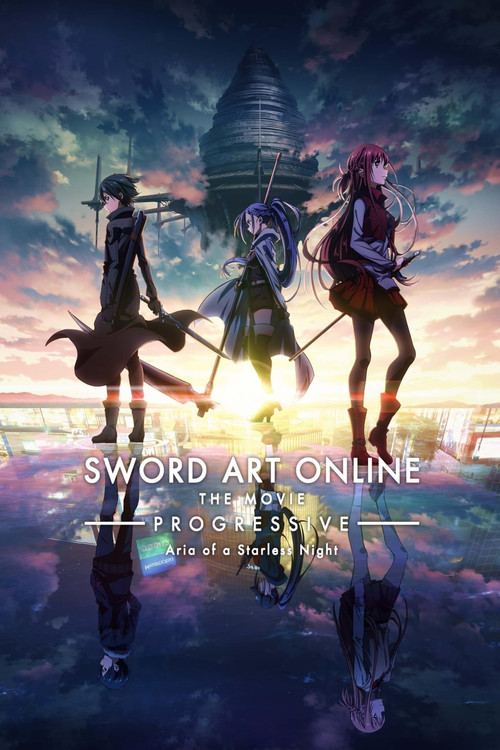
Sword Art Online the Movie – Progressive – Aria of a Starless Night
劇場版 ソードアート・オンライン-プログレッシブ- 星なき夜のアリア
Overview
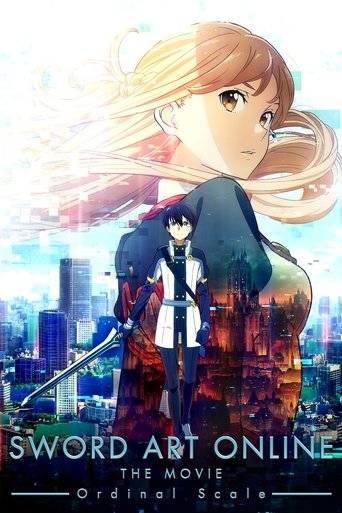
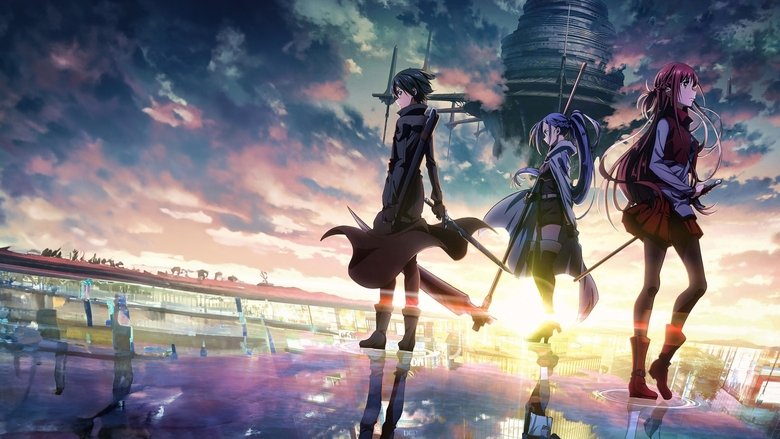
Sword Art Online the Movie – Progressive – Aria of a Starless Night revisits the beginning of the deadly Aincrad arc from the popular series, but retells it from the perspective of Asuna Yuuki. Asuna, a top student with little interest in video games, is convinced by her classmate and secret friend, the avid gamer Misumi "Mito" Tozawa, to try the world's first full-dive VRMMORPG, Sword Art Online.
When the game's creator, Akihiko Kayaba, traps 10,000 players inside—announcing that death in the game means death in real life—panic ensues. Relying on her beta-tester knowledge, Mito protects and trains Asuna. However, the immense pressure and a terrifying encounter cause a rift between them, leaving Asuna isolated and despairing. It is during this low point that she encounters a solo swordsman named Kirito, a meeting that sets her on a new path to fight for her survival and find her own strength within the floating castle of Aincrad.
Core Meaning
The core message of Aria of a Starless Night is a profound exploration of fear, resilience, and the birth of a hero. By shifting the narrative focus to Asuna, the film delves into the psychological horror of being a novice trapped in a death game. Director Ayako Kono's intent was to showcase the initial despair and vulnerability that was largely skipped over in the original series, grounding the epic fantasy in a more personal and relatable struggle. The film posits that strength isn't an innate quality but something forged through confronting one's deepest fears, enduring loss, and finding the will to stand up, even when completely alone. It highlights that even in a virtual world, the connections we make and the resolve we discover are what truly define our reality and our ability to survive.
Thematic DNA
Fear and Survival in a High-Stakes World
The film immerses the audience in the visceral terror of the death game's premise. From Asuna's initial shock and panic to her period of hopeless despair, the narrative emphasizes the psychological toll of knowing that a single mistake means permanent death. The theme is revealed through her struggles as a non-gamer, her desperate attempts to level up, and the constant, oppressive atmosphere of Aincrad's first floor, where 2,000 players die in the first month alone.
The Weight of Friendship and Betrayal
A central pillar of the film is the relationship between Asuna and the anime-original character, Mito. Mito acts as Asuna's mentor and protector, but her fear for her own life ultimately leads her to abandon Asuna in a moment of crisis. This act of perceived betrayal is a defining moment for Asuna, forcing her into isolation and shaping her initial cynical worldview within the game. The film explores how friendship can be both a source of immense strength and a catalyst for profound pain.
Finding Identity and Inner Strength
Stripped of her real-world identity as a perfect student, Asuna is forced to discover who she truly is when faced with mortality. Her journey is one of transformation from a terrified novice into a determined fighter. Initially dependent on Mito, she later learns from Kirito and ultimately finds her own resolve to fight on the front lines. The film shows her progression from a hooded, isolated player to the formidable warrior she is known to become.
Social Dynamics and Ostracism
The film touches upon the societal pressures that form within the game. This is most evident in the climax, where beta testers are blamed for the deaths and chaos. Kirito's decision to embrace the derogatory label of "beater" (a portmanteau of "beta tester" and "cheater") is a pivotal moment. He intentionally draws all the hatred and fear onto himself to protect other beta testers, like Mito, from becoming targets of a player-led witch hunt, demonstrating the formation of social outcasts and scapegoats even in a virtual world.
Character Analysis
Asuna Yuuki
Haruka Tomatsu
Motivation
Initially, her motivation is simple survival, driven by fear. After meeting Kirito and finding a new sense of purpose, her motivation shifts to actively fighting to clear the game and reclaim her life, refusing to die in a world she didn't choose.
Character Arc
Asuna begins as a top-tier student with no gaming experience, entering SAO on a whim. Trapped in the game, she is initially terrified and completely dependent on her friend Mito. After being abandoned, she falls into despair before a chance encounter with Kirito sparks her will to survive. She transitions from a passive victim to an active fighter, learning to wield a rapier and contributing to the front lines, beginning her transformation into the strong leader seen in the main series.
Kirito (Kazuto Kirigaya)
Yoshitsugu Matsuoka
Motivation
Kirito is motivated by a deep-seated need to survive and a heavy sense of responsibility. He aims to use his knowledge to get stronger and clear the game, while also trying to atone for what he perceives as past failures and protect others in his own detached way.
Character Arc
Already a skilled and knowledgeable beta tester, Kirito starts the game determined to be a solo player, partly due to guilt from past experiences. The film portrays him as more socially awkward and less of an unflappable hero than the original anime. His arc in the film involves reluctantly intervening to help others, specifically Asuna. He mentors her and ultimately makes a major sacrifice by taking on the 'beater' label to protect the community from tearing itself apart, solidifying his path as a solo player who nonetheless protects others from the shadows.
Mito (Misumi Tozawa)
Inori Minase
Motivation
Mito's primary motivation is to protect Asuna at all costs. This singular focus, however, is corrupted by her own fear of loss and death, leading to a moment of weakness that she spends the rest of the film trying to overcome and atone for.
Character Arc
An anime-original character, Mito is Asuna's real-world friend and an expert gamer who was a top beta tester. She initially acts as Asuna's guardian, confidently guiding her. However, her greatest fear is seeing her friend die, which causes her to panic and abandon Asuna during a dangerous monster attack. Overcome with guilt, she distances herself until the climactic boss battle, where she returns to save Asuna, seeking redemption for her failure and mending their broken friendship.
Symbols & Motifs
The NerveGear
The NerveGear headset symbolizes both technological marvel and inescapable prison. It is the key to the immersive world of Sword Art Online but also the instrument of the players' entrapment and potential death. It represents the dark side of technological advancement, where the lines between virtual entertainment and mortal reality are terrifyingly erased by its creator.
The device is shown at the beginning of the film as Asuna borrows her brother's to log in. Later, Akihiko Kayaba explains that any attempt to forcibly remove the NerveGear from the outside will trigger a microwave transmitter that will destroy the player's brain, cementing its role as the ultimate symbol of their captivity.
Aincrad's First Floor
The first floor of the floating castle, Aincrad, symbolizes the initial, overwhelming stage of a seemingly impossible challenge. It is a world of both wondrous beauty and lethal danger. For the trapped players, it represents a brutal learning curve where the rules of their new reality are written in blood. Conquering it is the first tangible proof that escape, however distant, might be possible.
The entirety of the film takes place on the first floor. It is here that Asuna learns to fight, experiences betrayal, meets Kirito, and participates in the first major Raid Battle against the boss, Illfang the Kobold Lord. Clearing this floor is the film's climactic goal.
The 'Beater' Title
The term 'beater' is a symbol of social ostracism and sacrifice. It is a label created out of fear and resentment, aimed at players with prior knowledge from the beta test. By willingly accepting this title, Kirito transforms it into a shield. He becomes a scapegoat, absorbing the community's anger to protect others and shoulder a burden he feels he partly deserves.
After the first floor boss is defeated, players accuse Kirito of withholding information and letting their leader, Diabel, die. To quell the rising tension and protect other beta testers in the crowd, Kirito embraces the 'beater' moniker, painting himself as an arrogant cheater who is different from the other, 'innocent' beta testers.
Memorable Quotes
This may be a game, but it is not something that you play.
— Akihiko Kayaba
Context:
This line is delivered by Akihiko Kayaba's avatar to all 10,000 players who have logged in for the first time. After revealing that the logout button has been removed, he explains the deadly rules of his new world, beginning the death game.
Meaning:
This is the chilling declaration that establishes the central conflict of the entire series. It instantly transforms the fantasy game into a horrifying reality, setting the stakes as life and death and erasing the boundary between the virtual and the real.
I'll never let you die.
— Mito
Context:
Mito says this to a terrified Asuna shortly after the death game is announced. She takes on the responsibility of keeping her non-gamer friend alive, using her beta tester knowledge to guide and shield her.
Meaning:
This quote establishes Mito's core motivation and her promise to Asuna. It is a vow of protection that becomes tragically ironic when her own fear causes her to break it, forming the central emotional conflict between the two friends.
I'd rather trust and regret, than doubt and regret.
— Kirito
Context:
This sentiment is expressed during Kirito's interactions with Asuna after he finds her on the verge of giving up. He gives her advice, shares his resources, and encourages her to join the boss raid meeting, choosing to place his faith in a fellow player rather than leave her to die alone.
Meaning:
This line, representative of Kirito's underlying philosophy, is crucial to his dynamic with Asuna. Despite his preference for playing solo, he chooses to trust Asuna and help her, a decision that lays the foundation for their legendary partnership. It speaks to choosing hope and connection over cynicism, even in a world designed to foster distrust.
Philosophical Questions
How does extreme pressure reveal a person's true character?
The film places its characters in the ultimate high-pressure cooker: a game where death is real. It explores this question through the contrasting actions of Mito and Kirito. Mito, who is confident and strong, breaks under the fear of losing her friend and chooses self-preservation. Conversely, Kirito, who is emotionally withdrawn and burdened by guilt, consistently chooses to help others at great personal risk, culminating in his self-sacrifice by taking on the 'beater' label. The film suggests that true character isn't about skill or confidence, but about the choices made when facing one's deepest fears.
What defines 'reality' when consciousness is fully immersed in a virtual world?
From the moment Kayaba declares the game is their new reality, the film blurs the lines between the two. Asuna initially struggles to cope with this, but eventually learns that the pain, fear, friendships, and will to live are just as real in Aincrad as they were in the outside world. The film explores the idea that 'reality' is defined by the experiences and emotions that shape us, regardless of the environment's physical or digital nature. The threat of real death forces every player to treat the virtual world with the gravity of the real one.
Alternative Interpretations
The most significant point of alternative interpretation revolves around the film's canonicity. Because it introduces a major new character, Mito, who was not in the original Progressive light novels, the movie creates a distinct timeline. One interpretation is that the film series is a 'what-if' scenario or a separate continuity from the novels, designed specifically for a cinematic experience. This allows for more narrative freedom without contradicting the source material directly.
Another interpretation suggests this is a 'soft retcon,' where Mito's existence can be slotted into the background of the main story, even if she isn't mentioned. Her influence is seen as primarily shaping Asuna's early days, but not fundamentally altering the key plot points that follow with Kirito. Fans debate whether the movie timeline should be considered the definitive anime version of events, replacing the original Episode 2, or if it's simply an alternate retelling that coexists with the light novel and original anime versions.
Cultural Impact
Sword Art Online Progressive: Aria of a Starless Night represents a significant moment for the massive SAO franchise. Created nearly a decade after the original anime's debut, the film serves as both a nostalgic return and a modern re-entry point. By rebooting the Aincrad arc from Asuna's perspective, it addresses a common critique of the original series—the glossing over of the early stages of the game and Asuna's initial character development. The introduction of the anime-original character Mito generated considerable discussion among fans, demonstrating the franchise's willingness to add new elements to established canon, creating a parallel narrative to the light novels.
Critically, the film was largely praised for its stunning visuals by A-1 Pictures, its focus on Asuna's emotional journey, and for providing a more grounded, terrifying perspective of the death game. It allowed the franchise to re-examine its foundational premise with more mature storytelling and deeper character psychology. For audiences, it offered a chance to experience the beginning of the beloved story with fresh eyes, making it accessible to newcomers while providing rich new content for veteran fans. Its success led directly to a sequel film, Scherzo of Deep Night, cementing the Progressive movie series as a vital and ongoing part of the Sword Art Online cultural legacy.
Audience Reception
Audience reception for Aria of a Starless Night was generally positive, particularly among existing fans of the franchise. A major point of praise was the shift in perspective to Asuna, which audiences felt provided a much-needed depth to her character that was absent in the original anime's early episodes. The high-quality animation from A-1 Pictures and the powerful musical score by Yuki Kajiura were also frequently highlighted as standout elements that enhanced the cinematic experience. Many viewers also appreciated the more nuanced and socially awkward portrayal of Kirito, finding it more faithful to his light novel counterpart.
Points of criticism were often directed at the film's pacing, which some felt was uneven, particularly concerning the conflict between Asuna and Mito. The inclusion of the anime-original character Mito was a divisive topic; while many found her to be a compelling and meaningful addition to Asuna's story, some purists of the light novels were critical of the deviation from the source material. Minor critiques also mentioned the continued use of some fan-service tropes, such as a clichéd bath scene.
Interesting Facts
- The character Mito (Misumi Tozawa) is an anime-original creation specifically for the 'Progressive' film series and does not appear in the original light novels written by Reki Kawahara.
- This film serves as a retelling and effective replacement for Episode 2 of the original 2012 'Sword Art Online' anime, providing a much more detailed account of the first month in Aincrad and the first floor boss battle.
- The movie is the feature directorial debut of Ayako Kono, who had previously worked as an assistant director and episode director on other notable anime series.
- The film's story is based on the first volume of the 'Sword Art Online: Progressive' light novel series, which is itself an expanded, floor-by-floor reboot of the original Aincrad arc.
- Yuki Kajiura, the celebrated composer for the original 'Sword Art Online' TV series, returned to compose the score for the film, remixing some classic tracks and creating new ones.
Easter Eggs
During large crowd scenes, especially the one where Akihiko Kayaba announces the death game, several key characters from later in the SAO series make brief, non-speaking cameo appearances.
Eagle-eyed fans can spot future allies and antagonists in the crowd. These include Lisbeth, Silica, Agil, Rosalia, Kuradeel, and even Sachi from the Moonlit Black Cats guild. These cameos serve as fun nods for long-time fans, showing that all these characters were present from the very beginning, even before they formally met Kirito and Asuna.
Argo the Rat, a key information broker in the light novels, makes a brief appearance.
Although she has a larger role in the 'Progressive' novels, her inclusion in the movie is a significant easter egg for novel readers. She appears at the end of the film, hinting at her future involvement in Kirito and Asuna's journey through the lower floors of Aincrad.
⚠️ Spoiler Analysis
Click to reveal detailed analysis with spoilers
Frequently Asked Questions
Explore More About This Movie
Dive deeper into specific aspects of the movie with our detailed analysis pages
Comments (0)
No comments yet. Be the first to share your thoughts!