
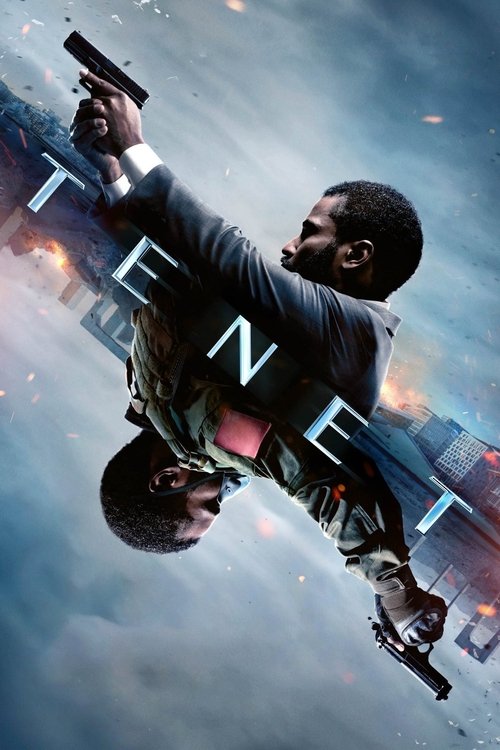
Full spoilers follow.
The mechanics. Inversion is not time travel. A person or object passed through a turnstile has its relationship to entropy reversed, and must then physically live back through the intervening days to reach an earlier point. The rules are strictly enforced: inverted people cannot breathe ordinary air (hence the masks), cannot feel wind in its true direction, and experience reversed heat transfer — an inverted body exposed to fire freezes. Nothing is edited out of history; anything a character does while inverted was always part of the past.
The plot's true object. The Algorithm is a device that would invert the entropy of the entire world, annihilating the present from the perspective of everyone in it. It was built by a scientist in the future who, appalled at what she had made, broke it into nine pieces and hid each in the most secure places available — nuclear facilities in the past — before killing herself. Sator, recruited as a young man in a poisoned Soviet closed city, is the future's chosen agent in the present, paid to collect the nine fragments and bury them somewhere they can be recovered.
Sator's endgame. He is dying of inoperable cancer, and has rigged a dead man's switch to his own vital signs: when his heart stops, the assembled Algorithm activates. His plan is to die at the moment of his greatest happiness, on the yacht in Vietnam, with Kat watching — annihilation as the ultimate act of possession. This is why Kat's role is decisive: her hatred, not the professionals' strategy, is the variable that breaks the plan.
The temporal pincer at Stalsk-12. The climax is a coordinated assault in which one team moves forward through a ten-minute window and another moves backward through the same ten minutes, each feeding intelligence to the other. This is the palindrome made literal — and it is happening at exactly the same moment as the opera-house siege that opened the film, which is why the film's shape reads identically in both directions.
The two great reveals. First: the Protagonist is the founder of Tenet. The organisation recruiting him, briefing him and withholding information from him is his own future self's creation; Priya has been taking orders, from further up the line, that originate with him. He is not the pawn of the plan, he is its author, and the entire film is the loop by which he becomes the man who wrote it. Second: Neil has known all along. The corpse in the underground tunnel with the red string on its backpack is Neil, who goes back through the turnstile knowing he will die unlocking the gate that saves the Protagonist's life. Their friendship, from Neil's side, is a long relationship approaching its beginning; from the Protagonist's side, it is a beginning that has just been revealed as an ending.
What snaps into place on rewatch. The masked inverted figure who saves the Protagonist at the opera is himself. The freeport fight is a single fight seen from both directions, with the Protagonist confronting his inverted self. The clues about who Neil is — his knowledge of the Protagonist's drink order, the red string, his unexplained expertise — are seeded from his first scene. The paradox of the loop is the film's philosophical payload: the Protagonist can only found Tenet because Tenet recruited him, which means the mission has no origin outside itself, and its success depends entirely on people choosing to complete a circle they did not draw. Priya's final elimination confirms the cost: the organisation the Protagonist built is ruthless, and he now has to run it.