Skip to content
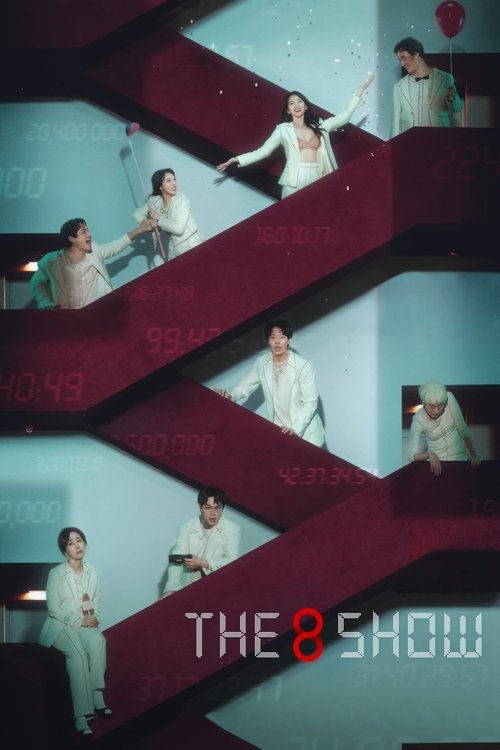
The 8 Show
A claustrophobic descent into pastel-draped depravity, where human dignity is systematically auctioned by the minute under the merciless glare of a theatrical pantomime.
The 8 Show

The 8 Show

"Irresistible but brutal."

17 May 2024 — 17 May 2024 South Korea 1 season 8 episode Ended 7.3 (340)

Cast: Ryu Jun-yeol, Chun Woo-hee, Park Jeong-min, Lee Yul-eum, Park Hae-joon

Drama Comedy Mystery Social Stratification and Class Warfare The Commodification of Pain and Media Voyeurism The Illusion of Meritocracy and Social Mobility Moral Decay and Complicity of the "Neutral" Middle

Overview

The 8 Show (2024), adapted by writer-director Han Jae-rim from Bae Jin-soo’s hit Naver webtoons Money Game and Pie Game, gathers eight desperate individuals on the brink of suicide due to insurmountable financial debts. Lured into an isolated, eight-story concrete theater facility, they are invited to play an alluring game: every minute spent inside the complex increases their accumulated cash prize. They are housed on separate numbered floors (from 1 to 8) and allowed to gather in a shared theatrical courtyard during daytime hours, with all basic provisions costing one thousand times their outside market rate.

The initial camaraderie fractures as the hidden mechanics of the venue reveal structural inequity: higher floors earn exponentially more money per minute, occupy lavish penthouses, and control the flow of shared food and water, while lower floors languish in tiny rooms with meager pay. Furthermore, the contestants realize that the countdown clock extending their stay only adds time when they entertain their unseen voyeuristic audience. As light entertainment quickly loses its novelty, the participants turn toward humiliating games, coercive hierarchies, and violent subjugation to keep the cameras fed and the cash flow uninterrupted.

The complete eight-episode arc documents a psychological and sociological spiral. The lower and upper floors engage in cycles of revolt, torture, mutiny, and desperation. What begins as an innocent attempt to earn enough to pay off debts becomes an existential struggle between preserving one's humanity and feeding an insatiable consumer entertainment machine.

Core Meaning

The overarching thesis of The 8 Show is a scathing critique of modern capitalism, class stratification, and media voyeurism. Director Han Jae-rim illustrates how arbitrary initial advantages (deciding one’s floor simply by picking a number at random) become rigid social classes that breed tyranny and oppression. Unlike typical survival death-matches where eliminating rivals is the objective, The 8 Show forbids death—if any participant dies, the game instantly terminates and all accumulated fortunes are forfeited. This rule mirrors real-world labor exploitation: the ruling class does not desire the death of the working class, but rather their continued, manageable suffering to generate surplus value and amusement. The series posits that society commodifies human misery into consumable spectacles, implicating not only the show's mysterious organizers, but the viewer watching from home.

Thematic DNA

Social Stratification and Class Warfare 35%
The Commodification of Pain and Media Voyeurism 25%
The Illusion of Meritocracy and Social Mobility 20%
Moral Decay and Complicity of the "Neutral" Middle 20%

Social Stratification and Class Warfare

The literal vertical architecture of the building reflects a socioeconomic hierarchy. Floor 8 enjoys luxury, vast space, and endless resources, while Floor 1 occupies a closet-sized cubicle and handles group waste disposal. The series details how privilege blinds the upper tiers to the structural torment of those below, leading the higher floors to ally with brute force to enforce systemic dominance.

The Commodification of Pain and Media Voyeurism

Time, money, and entertainment are directly linked. The clock adds hours only when the contestants deliver heightened drama, absurd antics, physical injury, and psychological torment. Han Jae-rim uses this mechanic to indict the contemporary creator economy and audience appetites for sensationalized trauma.

The Illusion of Meritocracy and Social Mobility

The players entered the game through arbitrary choice, not merit. When the lower floors attempt to play by the rules and buy their way into upper-floor status, they find that systemic rules are manipulated against them. Upward mobility is revealed to be a cruel mirage designed to extract every last bit of labor and hope from the underprivileged.

Moral Decay and Complicity of the "Neutral" Middle

The moral tragedy of the series is driven as much by the passivity of middle floors (like Floor 3 and Floor 5) as by the overt villainy of the top. By prioritizing comfort and self-preservation over collective resistance, the middle tiers enable authoritarian cruelty until the system inevitably consumes them as well.

Character Analysis

3rd Floor / Bae Jin-su

Ryu Jun-yeol

Archetype: The Everyman / Flawed Narrator Key Trait: Passive decency, conflict-averse

Motivation

Initially seeks 900 million won to clear his debt; evolves into an urge to stop the escalating horror and honor fallen humanity.

Character Arc

Begins as a timid, debt-laden man contemplating suicide. Throughout the game, he tries to stay neutral and avoid confrontation, but his cowardice often enables atrocity. In the climax, he breaks out of his passivity, choosing moral rebellion over monetary gain by destroying the surveillance cameras and ending the game to save what remains of his soul.

8th Floor / Song Se-ra

Chun Woo-hee

Archetype: The Hedonistic Tyrant Key Trait: Unapologetic sociopathy

Motivation

Escaping boredom and pursuing artistic/sensory ecstasy at any human cost.

Character Arc

An eccentric performance artist who views life as an art experiment. Occupying the penthouse, she embraces her structural advantage immediately, treating other human beings as live puppets. She never experiences moral reform, deriving pure thrill from violent spectacle until she is forcefully dethroned.

All 5 characters and cast

Symbols & Motifs

The Vertical Chute (Food & Trash Elevator)

Meaning:

A physical metaphor for trickle-down economics. Rations descend from Floor 8 down to Floor 1, leaving the lower tiers to subsist on scraps and manage the collective waste sent back down.

Context:

Used as the primary conduit for resources and waste between floors throughout the eight-story complex.

The Giant LED Countdown Clock

Meaning:

Represents the commodification of human lifespan. Time is converted directly into currency, making human beings consume their own vitality and sanity to generate abstract capital.

Context:

Displayed prominently in the shared courtyard, dictating the duration of the contestants' confinement and earnings.

The Surveillance Cameras

Meaning:

The omnipresent lens representing invisible elites and streaming consumers. When characters perform toward the camera, the fourth wall is blurred, exposing the audience’s complicity in consuming suffering for entertainment.

Context:

Positioned throughout the facility, monitoring every action and determining if entertainment value warrants added time.

The Fake Courtyard Set & Swimming Pool

Meaning:

Represents the consumer facade of luxury and leisure, masking the brutal concrete trap underneath.

Context:

Constructed with artificial turf and plastic backdrops in the central gathering arena where the contestants interact during the day.

Bobby Vinton’s "Mr. Lonely"

Meaning:

Encapsulates the alienation and isolation of each contestant despite being trapped together, juxtaposing cheerful pop orchestration with profound despair.

Context:

Serves as the haunting opening theme song of the series.

The Loose Canine Tooth / Pliers

Meaning:

Represents the escalating physical cost of compliance and punishment, culminating in gruesome bodily mutilation as the currency of survival.

Context:

Featured during scenes of authoritarian control, coercion, and torture among the participants.

Memorable Quotes

재미있나 봐.
— 7th Floor (Yoo Phillip)

Context

Spoken in Episode 4 as Phillip realizes why the timer mysteriously jumps up when violence and misery occur, staring directly at the surveillance cameras.

Meaning

Marks the series’ meta-break and confirms the sadistic logic of the venue, highlighting that time is awarded strictly for human suffering and spectacle.

여기는 사람이 죽으면 게임이 끝납니다.
— Jin-su (3rd Floor narrator)

Context

Narrated in Episode 1 while detailing the foundational mechanics and rules of the facility.

Meaning

Establishes the foundational rule differentiating the premise from standard battle royales: survival is mandated not out of benevolence, but to preserve the source of labor and entertainment.

All 4 quotes

Episode Highlights

The Curtain Rises

S1E1

Jin-su enters the facility after receiving a mysterious text message on the brink of suicide. The introductory rules, card selection, and the staggering reality of room disparity establish the core economic system.

Significance:

Lays the groundwork for the economic hierarchy and the initial social dynamics of the eight floors.

The Escalation

S1E3

The bathroom crisis forces the group to confront waste logistics, resulting in a democratic vote that burdens the lowest floor.

Significance:

Shatters the illusion of egalitarian collective living, initiating the exploitation of the lowest floor.

The Talent Show

S1E4

Contestants stage bizarre, humiliating talent shows to add time. When innocent performances fail, physical slapstick and violent brawls reveal what the audience truly values.

Significance:

Forces the participants to recognize that their unseen audience rewards physical harm and humiliation over benign entertainment.

The Hierarchy of Pain

S1E6

The upper floors, backed by the physical intimidation of 6th Floor, establish an authoritarian regime. Sleep deprivation and torture (the sleep-deprivation apparatus) turn the courtyard into a nightmare.

Significance:

Marks the descent into systemic oppression, bodily torment, and absolute class dominance.

The Mutiny

S1E7

Lower floors mount a counter-rebellion, overthrowing 8th Floor and 6th Floor. However, internal guilt, psychological collapse, and shifting alliances unleash chaos.

Significance:

Depicts the collapse of the authoritarian regime and explores the moral complexities of retribution and power transfer.

The Final Act

S1E8

1st Floor’s tragic high-wire routine results in devastating consequences. Jin-su takes a stand to stop the clock by destroying surveillance cameras, leading to the survivors' bittersweet return to society and an eerie meta epilogue.

Significance:

Concludes the game through moral rebellion, ending the exploitation and delivering the ultimate critique of commercialized trauma.

Philosophical Questions

Is morality an inherent human virtue or a luxury afforded only by wealth?

The series shows how moral behavior erodes under artificial scarcity, testing whether ethical principles can survive existential deprivation.

Why does human society instinctively accept arbitrary hierarchies?

The contestants accept their unequal floor numbers simply because they drew cards at random, illustrating how easily populations legitimize unearned privilege.

What is the ethical responsibility of the spectator?

By continuing to watch the characters suffer for entertainment, the viewer is confronted with their own role in incentivizing sensationalized media cruelty.

Alternative Interpretations

Various critical and audience interpretations of the series include:

Full ending explanation

Cultural Impact

Emerging in the slipstream of global Korean survival thrillers like Squid Game, The 8 Show distinguished itself by avoiding standard elimination tournaments. Upon its May 17, 2024 global premiere on Netflix, it reached the Global Non-English Top 10 chart and peaked at #2 worldwide, performing strongly across Asia, Latin America, and Europe.

Critics praised its biting social satire, stage-like visual aesthetics, and standout performances by Chun Woo-hee and Park Jeong-min. However, the intense turn toward physical and psychological torture in episodes 6 and 7 provoked debate, with some reviewers finding the tonal shift from dark comedy to grueling violence jarring.

Audience Reception

Early episodes (1–4) were celebrated for their dark humor, puzzle-like tension, and clever deconstruction of social contracts. The visual design was acclaimed for its theatrical, surreal pastel aesthetics, and performances—especially Chun Woo-hee's—were universally lauded.

The later episodes (5–7) generated polarized reactions due to graphic brutality (teeth pulling, sleep deprivation, physical torture), which some viewers found excessively grim compared to the playful opening tone. Nevertheless, the concluding episode successfully tied the narrative threads together, leaving viewers with an unsettling, resonant reflection on contemporary media culture.

Interesting Facts

  • The series merges two of webtoon creator Bae Jin-soo’s interconnected works—Money Game (which provided the basic economic rules and supply mechanics) and Pie Game (which provided the multi-floor vertical power structure).
  • Renowned as a blockbuster filmmaker (The Face Reader, Emergency Declaration, The King), The 8 Show marked Han Jae-rim's first foray into directing an episodic streaming series.
  • The role of 8th Floor was originally cast with singer-actress IU (Lee Ji-eun); due to schedule conflicts, Chun Woo-hee stepped in and won wide acclaim for her chaotic, high-pitched comedic portrayal.
  • The entire eight-story building atrium and courtyard were built as a practical set inside a giant studio soundstage to emphasize theatrical claustrophobia and genuine verticality.
  • The series was produced with an estimated budget of approximately ₩24 billion KRW (~$18–20 million USD) by Studio N and Magnum Nine.

Easter Eggs

Stanley Kubrick’s A Clockwork Orange Homage

In Episode 6 and 7, the eye-clamp sleep deprivation torture device used by the contestants directly references the iconic Ludovico technique scene in Stanley Kubrick’s 1971 classic.

Nasubi / Susunu! Denpa Shōnen Inspiration

The premise of surviving in confinement under public surveillance for cash references Japan’s infamous 1998 reality show involving comedian Nasubi.

Theatrical Proscenium Framing

The series frequently frames the courtyard actions with traditional theater proscenium arches, red velvet curtains, and spot lighting, reinforcing that the characters are unwilling stage performers.

Meta Webtoon and Streaming Satire

The epilogue featuring 7th Floor pitching a script titled The 8 Show to entertainment producers serves as self-referential commentary on how real studio executives commodify tragedy for global subscriber bases.

Frequently Asked Questions

Explore More About This Movie

Dive deeper into specific aspects of the movie with our detailed analysis pages

Comments (0)

Leave a comment

No comments yet. Be the first to share your thoughts!

Similar Movies