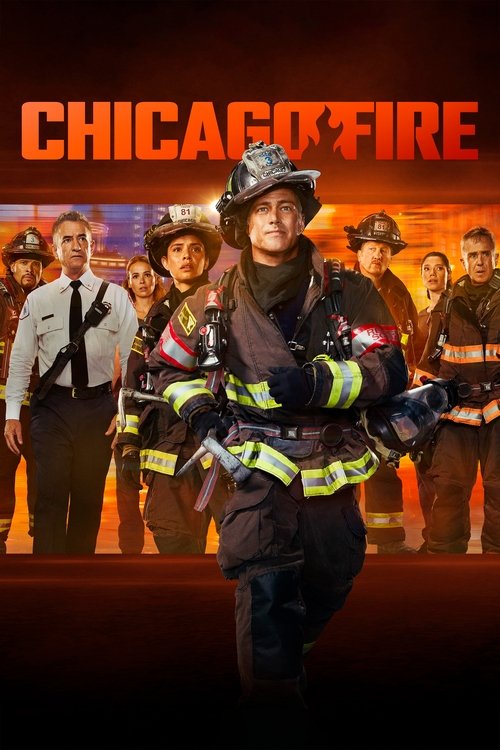
Chicago Fire
"Welcome home."
Overview
Chicago Fire follows the lives of the courageous firefighters, rescue squad members, and paramedics of Chicago Firehouse 51. The series explores the high-stakes professional world of first responders alongside the complex personal lives of its ensemble cast. At its heart, the show focuses on the leadership and rivalry between Lieutenant Matthew Casey and Lieutenant Kelly Severide, who must navigate the grief of losing their own while protecting a city that never sleeps.
Spanning over a decade of storytelling, the series evolves from a gritty procedural into a sprawling saga of a "found family." While the faces within the firehouse change over the seasons due to tragic deaths, promotions, and departures, the spirit of Firehouse 51 remains constant. The narrative arc emphasizes the heavy psychological toll of the job, the intricate politics of the Chicago Fire Department (CFD), and the enduring bonds forged in the face of life-threatening infernos and urban disasters.
Core Meaning
The core meaning of Chicago Fire lies in the concept of sacrificial service and the indestructibility of the human bond. The creators use the volatile nature of fire as a metaphor for the unpredictable trials of life, suggesting that while trauma is inevitable, it can be survived through collective resilience. The series posits that true heroism isn't just found in the act of saving a life, but in the willingness to show up for one's "brothers and sisters" every day, regardless of personal cost. It serves as a tribute to the silent nobility of civil service and the idea that a firehouse is not just a workplace, but a sanctuary of shared morality.
Thematic DNA
Found Family and Brotherhood
Throughout the series, Firehouse 51 is depicted as a cohesive unit that transcends biological family. This theme is reinforced during moments of grief, such as the deaths of Shay or Otis, where the firehouse members provide the only emotional support network capable of understanding the trauma of their profession.
The Burden of Heroism
The show consistently examines the psychological weight carried by first responders. Characters like Severide and Casey often struggle with the "hero" label, facing survivor's guilt and the crushing expectation to be infallible in life-or-death situations.
Legacy and Tradition
The tension between old-school firefighting traditions (represented by Boden and Herrmann) and modern departmental politics is a recurring conflict. It highlights how the values of the past are passed down to the next generation of "candidates."
Resilience in the Face of Loss
Loss is a constant in the series. The show develops this theme by showing how the characters rebuild themselves after every tragedy, emphasizing that while fire destroys, the community that remains is forged stronger by the heat.
Character Analysis
Kelly Severide
Taylor Kinney
Motivation
Driven by a need to prove himself outside of his father's influence and a deep-seated instinct to protect those who cannot protect themselves.
Character Arc
Initially a reckless "ladies' man" dealing with a career-threatening injury and the shadow of his father's legacy, Severide evolves into a dedicated husband and a mentor who prioritizes the safety of his squad above his own adrenaline-seeking impulses.
Christopher Herrmann
David Eigenberg
Motivation
To provide for his large family and ensure the next generation of firefighters understands the honor of the badge.
Character Arc
Moving from a hot-headed firefighter constantly chasing failed business schemes to a wise Lieutenant and father figure, Herrmann becomes the soul of the firehouse, guarding its traditions and values.
Joe Cruz
Joe Miñoso
Motivation
To redeem himself for past mistakes and honor the memory of his best friend, Otis.
Character Arc
Starting with a dark past involving his brother's gang affiliation, Cruz works his way into the elite Rescue Squad 3, eventually becoming a devoted father and a pillar of stability for the firehouse.
Randall 'Mouch' McHolland
Christian Stolte
Motivation
Protecting the rights and benefits of his fellow firefighters while maintaining his own place in the 51 family.
Character Arc
Often the source of comic relief, Mouch's journey includes multiple brushes with death and retirement, leading him to realize that his true purpose is serving as the firehouse's legal and emotional anchor.
Harold Capp
Randy Flagler
Motivation
To be the dependable wingman for Severide and maintain the camaraderie of the Squad.
Character Arc
As a mainstay of Squad 3, Capp represents the unsung stability of the firehouse, providing consistent support and levity through over a decade of service without losing his sense of humor.
Symbols & Motifs
Molly's Bar
Symbolizes the sacred secular space where the characters shed their professional armor and find community.
Owned by Herrmann, Otis, and Dawson (and later others), it serves as the primary setting for off-duty interactions and significant life milestones across all seasons.
The Firehouse Kitchen Table
Represents the heart of the home and equality among the ranks.
Nearly every episode features a scene at this table, where hierarchy is briefly set aside for shared meals, banter, and heavy emotional confessions.
The 51 Patch
A symbol of identity and belonging to a specific elite legacy within the CFD.
Characters often touch or look at the patch when their loyalty is questioned or when they are facing a difficult career transition.
The GOAT (Truck 81 Logo)
Symbolizes unyielding grit and a fighting spirit.
The "Fighting Goat" of Truck 81 is frequently contrasted with the Cerberus of Squad 3, highlighting the friendly but fierce rivalry between the two companies.
Memorable Quotes
It's my job as an old firefighter to teach the young firefighters how to become old ones.
— Christopher Herrmann
Context:
Spoken in multiple variations, notably when Herrmann is mentoring a new candidate.
Meaning:
Encapsulates the series' focus on mentorship and the continuity of the profession.
There is no greater love than to lay down one's life for another.
— Matthew Casey
Context:
Season 2, Episode 6; Casey explains the sacrifice of a fallen firefighter to his son.
Meaning:
The definitive credo of the show, emphasizing the selfless nature of the job.
Brat, ya vsegda budu s toboy. (Brother, I will be with you always.)
— Brian 'Otis' Zvonecek
Context:
Season 8, Episode 1; Otis's final words to Cruz as he dies in the hospital.
Meaning:
A heart-wrenching final testament to the bond between Cruz and Otis.
Family isn't just who you're born to—it's the folks who run beside you when the flames get high.
— Gabriela Dawson
Context:
Season 2, reflecting on the unity of the firehouse.
Meaning:
Summarizes the theme of found family that underpins the entire series.
Episode Highlights
Pilot
The episode introduces the central conflict: the death of Andy Darden and the resulting blame game between Casey and Severide.
Sets the emotional foundation for the entire series and establishes the high-stakes reality of Firehouse 51.
Always
The aftermath of a massive explosion reveals that Leslie Shay has died, leaving the house in total shock.
The first major death of a series regular, changing the show's tone to one where no character is truly safe.
Deathtrap
A massive warehouse party fire leads to dozens of casualties, including the daughter of a Chicago P.D. detective.
One of the most intense crossover events, highlighting the interconnectedness of the One Chicago universe.
Sacred Ground
Following a mattress factory fire, Otis succumbs to his injuries, leading to the installation of a memorial at the firehouse.
Marks the end of an era and provides one of the most emotional character exits in television history.
Two Hundred
Matthew Casey makes the difficult decision to leave Chicago for Oregon to care for the sons of his late friend, Andy Darden.
The departure of the show's primary lead, forcing a massive shift in the firehouse hierarchy and Severide's role.
Port in the Storm
Casey and Sylvie Brett finally marry and leave for their new life together.
A long-awaited resolution to the central romance, providing a rare happy ending for two core characters.
Philosophical Questions
What is the true cost of a life saved?
The series repeatedly asks if the physical and mental destruction of the rescuer is a fair trade for the survival of the victim.
Can duty and personal happiness coexist?
Through the failed marriages and personal sacrifices of Casey, Severide, and Boden, the show explores the idea that absolute devotion to service often precludes a normal domestic life.
Alternative Interpretations
Critics have often interpreted Firehouse 51 as a modern-day Round Table, where Chief Boden acts as King Arthur, guiding a band of flawed but noble knights. Another perspective views the show as a study of cyclical trauma; the firehouse itself is a stationary protagonist that stays the same while the humans within it are burned, broken, and eventually replaced in an endless cycle of urban sacrifice. Some thematic analyses suggest the fire represents divine intervention or chaos that forces the characters to reveal their true, unvarnished selves.
Cultural Impact
Chicago Fire revitalized the first-responder drama genre by blending procedural action with soap-opera emotional depth. Its success birthed the 'One Chicago' franchise, including Chicago P.D. and Chicago Med, creating a shared television universe that dominates Wednesday night ratings. Beyond entertainment, the show has had a tangible impact on the city of Chicago, boosting tourism to 'Firehouse 51' and Lottie's Pub (the real-life Molly's Bar). It has been praised for its realistic depiction of the firefighting community, often serving as a recruiting tool and a source of pride for real-life first responders.
Audience Reception
Audience reception has remained remarkably high over 14 seasons, with fans praising the chemistry of the ensemble cast and the high production value of the rescue sequences. While critics occasionally poke fun at the 'melodramatic' romantic subplots, the show's ability to handle major character deaths (like Shay and Otis) with genuine emotional weight has maintained a loyal fanbase. Controversies usually arise regarding character departures (such as Monica Raymund's exit), but the show's resilience in introducing new, likable characters has allowed it to outlive many of its contemporaries.
Interesting Facts
- The series is filmed on location in Chicago, primarily using the real-life Engine 18 firehouse.
- Many of the background actors are actual off-duty Chicago firefighters.
- Jesse Spencer (Casey) is Australian and Eamonn Walker (Boden) is British; both use vocal coaches to maintain their American accents.
- A scene involving a plane crash was so realistic that a local news station briefly reported it as a real tragedy.
- Taylor Kinney (Severide) was once engaged to pop star Lady Gaga, who was a frequent visitor to the set in the early seasons.
- The character 'Tony' is played by Tony Ferraris, who is a real-life Chicago firefighter.
Easter Eggs
Derrick Gibson's Name
The Season 12 character Derrick Gibson was named as a tribute to series co-creator Derek Haas.
The Shining Reference
In a Halloween episode, a box of brownies is delivered in a tin with the pattern of the carpet from the hotel in The Shining, from a shop named 'Halloran's'.
Badge Number 1068
Severide's badge number changed from 1751 to 1068 early in the series, a subtle detail fans debate as either a production error or a hidden symbolic promotion.
⚠️ Spoiler Analysis
Click to reveal detailed analysis with spoilers
Frequently Asked Questions
Explore More About This Movie
Dive deeper into specific aspects of the movie with our detailed analysis pages
Comments (0)
No comments yet. Be the first to share your thoughts!