Assassination Classroom
暗殺教室
Overview
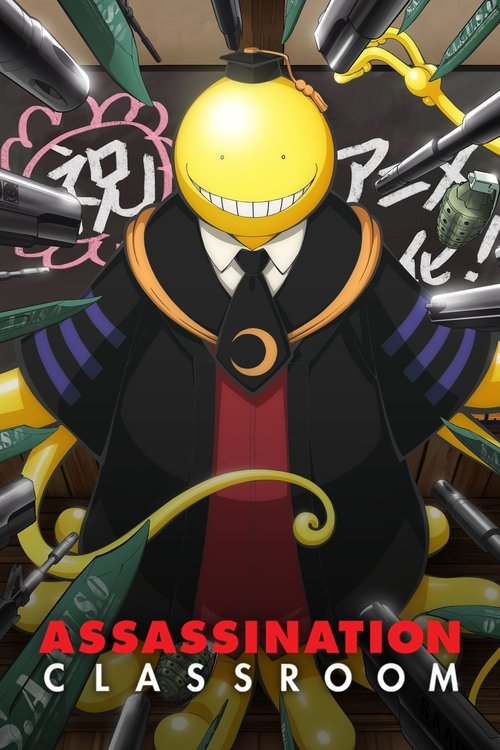
Assassination Classroom follows the students of Class 3-E at Kunugigaoka Junior High School, a group of academic underachievers relegated to a dilapidated campus on a remote mountain. Their lives take a surreal turn when the Japanese government introduces them to their new homeroom teacher: a powerful, tentacled creature capable of moving at Mach 20, who has already destroyed 70% of the moon and threatens to do the same to Earth within a year. The students are tasked with an impossible mission: assassinate their teacher before graduation to save the world and earn a massive bounty.
As the series progresses over two seasons, the narrative transforms from a quirky, episodic comedy into a profound exploration of personal development. The creature, named "Koro-sensei" by the students, proves to be the most effective and compassionate mentor they have ever encountered. While teaching them lethal techniques, he also nurtures their individual talents and builds their self-confidence. The plot expertly balances the comedic attempts on Koro-sensei's life with the darker mysteries of his origin and the systemic corruption within the elite school's administration.

Core Meaning
The series centers on the idea that true mentorship sees value where society sees failure. It argues that no individual is beyond redemption or growth if given the right guidance and support. The "assassination" serves as a metaphor for the students' struggle to "kill" their own insecurities and the dependency they have on their mentor, ultimately preparing them to face the challenges of adulthood with resilience and empathy.
Thematic DNA
The Flaws of Meritocracy
The series critiques a rigid educational system that classifies children as 'elites' or 'trash' based on grades. Class 3-E represents the marginalized who, through Koro-sensei's unconventional methods, prove that talent is diverse and that a supportive environment is more effective than competitive pressure.
The Responsibility of Power
Koro-sensei's overwhelming physical power is contrasted with his restraint and dedication to service. This theme explores how those with influence should use their capabilities to uplift others rather than dominate them.
Identity and Self-Actualization
Many characters, particularly Nagisa and Karma, struggle with who they are meant to be versus who others expect them to be. The show follows their journey of discovering their 'inner bloodlust'—their unique drive and talent—and channeling it toward constructive goals.
Mortality and Legacy
The series is a countdown to Koro-sensei's death. It teaches that the impact one leaves on others is more significant than the length of their life, emphasizing the bond between teacher and student as a form of immortality.
Growth through Failure
Through constant failed assassination attempts, students learn that failure is not a permanent state but a necessary step toward mastery. Koro-sensei encourages them to learn from every missed shot.
Character Analysis
Koro-sensei
Jun Fukuyama
Motivation
To fulfill a promise to Aguri Yukimura and to ensure his students are strong enough to carry on after he is gone.
Character Arc
He begins as a mysterious monster threatening the world and ends as a beloved father figure. His arc reveals his tragic past as the original 'God of Death' and his journey toward redemption by honoring a promise to a woman he loved to guide the students she cherished.
Nagisa Shiota
Mai Fuchigami
Motivation
Finding his own purpose and breaking free from his mother's overbearing expectations.
Character Arc
Nagisa evolves from a timid student with low self-worth into a calm, professional assassin, and finally, into a dedicated teacher. He learns to use his natural observational skills and stealth—traits others viewed as weaknesses—as his greatest strengths.
Karma Akabane
Nobuhiko Okamoto
Motivation
To find a challenge that truly tests him and to protect the place where he finally feels accepted.
Character Arc
Initially a brilliant but violent delinquent who distrusts all adults, Karma learns humility and the value of hard work through Koro-sensei's guidance. He transitions from a lone wolf to a reliable leader who respects others' efforts.
Symbols & Motifs
The Crescent Moon
A symbol of permanent change and the countdown to a global catastrophe.
The moon, visible throughout the series with a massive bite taken out of it, serves as a constant visual reminder of the stakes and the mystery surrounding Koro-sensei's power.
Koro-sensei's Tie
A symbol of past love, a promise kept, and his remaining connection to humanity.
The tie was a gift from Aguri Yukimura. The crescent moon pattern and the small hole represent the tragedy of his past and the reason he became a teacher.
The Second Blade
The necessity of having diverse skills and a backup plan in life.
Koro-sensei frequently uses this metaphor to explain why students need to study academic subjects while also training as assassins; they need a 'second blade' to survive if their primary plan fails.
Memorable Quotes
The difference between the novice and the master is that the master has failed more times than the novice has tried.
— Koro-sensei
Context:
Said during a pivotal training moment to encourage students who were discouraged by their lack of progress.
Meaning:
This quote encapsulates the series' philosophy on perseverance and the importance of learning from mistakes.
Whether a fish lives in a clear stream or a ditch, so long as it continues swimming forward, it will grow up beautifully.
— Koro-sensei
Context:
Addressing Class 3-E's status as the 'End Class' in the very first episode.
Meaning:
It emphasizes that one's environment does not dictate their potential for growth.
Episode Highlights
Karma Time
Introduces Karma Akabane and his high-stakes attempt to kill Koro-sensei via a suicide jump.
It establishes that Koro-sensei prioritizes his students' safety over his own and shows the first crack in Karma's cynical worldview.
Nagisa Time
Nagisa faces the sadistic Takaoka in a duel, using a technical 'assassination' move to win.
The moment Nagisa's true potential is recognized by everyone, shifting the power dynamic of the class.
Secret Identity Time
Kayano reveals her hidden identity and the painful tentacles she has been hiding to avenge her sister.
The major turning point that leads to the revelation of Koro-sensei's origins and the final arc of the series.
Final Period
The emotional climax where the students must perform their final task: the assassination of their teacher.
One of the most emotional finales in anime, serving as the ultimate 'graduation' for Class 3-E.
Philosophical Questions
Is it possible to be a 'killer' and a 'savior' at the same time?
The show explores this through Koro-sensei's history as an assassin and his transition into a life-saving educator, and through the students who learn to 'kill' in order to save themselves and the world.
Alternative Interpretations
Some viewers interpret the series as a political allegory for government overreach and the weaponization of children. Another perspective views the entire assassination mission as a psychotherapy session, where Koro-sensei is the therapist helping the students eliminate the toxic parts of their personalities to integrate into society.
Cultural Impact
Assassination Classroom is considered a landmark series in the 'school-life' genre for its sharp critique of the Japanese education system. It has inspired a massive following due to its blend of high-concept sci-fi and relatable coming-of-age drama. The character of Koro-sensei has become an icon of the 'ideal teacher' in pop culture, symbolizing patience and the belief in student potential. The series' bittersweet ending is often cited as one of the most effective and satisfying conclusions in modern anime.
Audience Reception
The series was widely praised for its ability to balance absurd comedy with deep emotional resonance. While some critics initially found the premise strange, the development of the large cast and the eventual payoff of the plot won over audiences. The second season, in particular, is highly rated for its narrative consistency and powerful finale.
Interesting Facts
- The names of the students in Class 3-E are based on the historical 47 Ronin of Japanese legend.
- Koro-sensei's name is a portmanteau of 'Korosenai' (unkillable) and 'Sensei' (teacher).
- The series was produced by Studio Lerche and became a massive hit in Japan, leading to a live-action film adaptation.
- The creator, Yusei Matsui, also wrote Neuro: Supernatural Detective.
- The anime finale aired concurrently with the manga's conclusion, which is rare for ongoing series.
Easter Eggs
Koro-sensei's disguises
Koro-sensei often disguises himself as famous characters from other Shonen Jump series, such as Naruto or Goku, reflecting the show's publication history.
⚠️ Spoiler Analysis
Click to reveal detailed analysis with spoilers
Frequently Asked Questions
Explore More About This Movie
Dive deeper into specific aspects of the movie with our detailed analysis pages
Comments (0)
No comments yet. Be the first to share your thoughts!