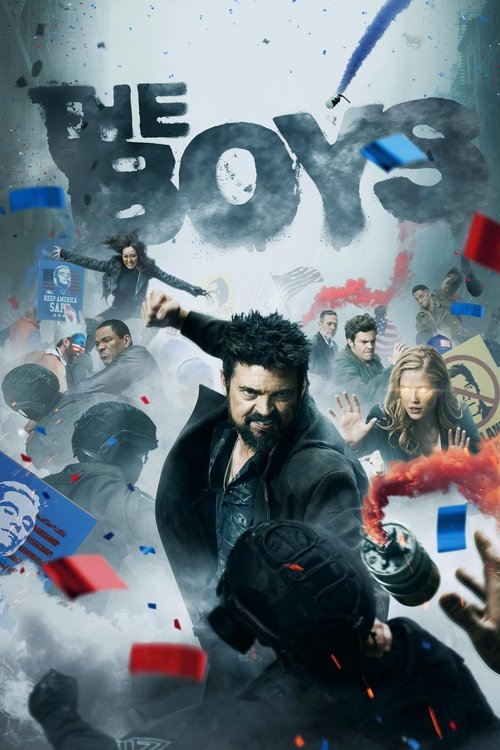
The Boys
"Never meet your heroes."
Overview
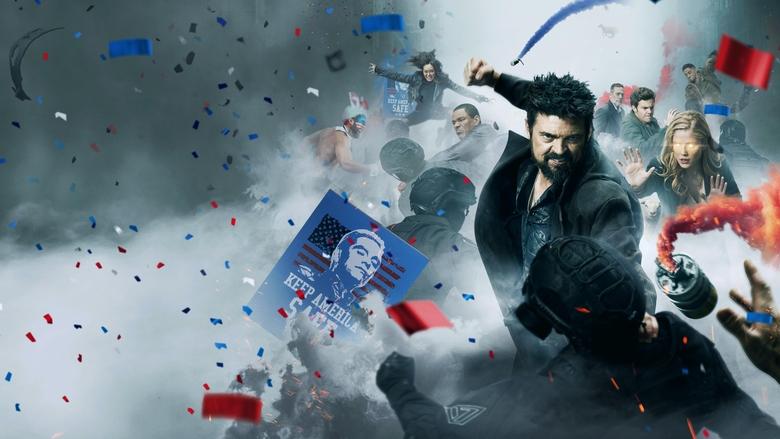
Set in a world where super-powered individuals, known as 'Supes,' are revered as heroes and managed by the powerful corporation Vought International, "The Boys" reveals the dark and corrupt reality behind their public personas. Most Supes are arrogant, reckless, and dangerous, their heroic deeds carefully orchestrated for maximum profit and public adoration. The series follows two main groups: The Boys, a band of vigilantes led by the supe-hating Billy Butcher, who seek to expose Vought's crimes and control the out-of-control heroes; and The Seven, Vought's premier and exceedingly dysfunctional superhero team, led by the narcissistic and terrifyingly unstable Homelander.
The story ignites when Hugh 'Hughie' Campbell's girlfriend is killed by the careless actions of a Supe, leading him to join Butcher's crusade. Simultaneously, the idealistic Annie January, also known as Starlight, joins The Seven, only to have her dreams shattered by the moral decay she discovers among her idols. Across its seasons, the series escalates the conflict between The Boys and Vought, exploring themes of unchecked power, corporate malfeasance, celebrity culture, and political radicalization, all while the characters navigate personal vendettas, shifting alliances, and the devastating consequences of their brutal war.
Core Meaning
"The Boys" is a deconstruction of the superhero myth, using it as a lens to critique contemporary society. The core message is a cautionary tale about the inherent danger of absolute power, not just in individuals but in corporate and political systems. The show argues that when power is concentrated and commercialized, it inevitably leads to corruption, exploitation, and fascism. It explores how celebrity worship, corporate media, and political polarization can be manipulated to control the public and obscure horrific truths. Ultimately, the series suggests that true heroism lies not in superpowers, but in the willingness of ordinary, flawed people to fight against systemic injustice, even when the odds are insurmountably stacked against them.
Thematic DNA
The Corruption of Absolute Power
This is the central theme of the series. The Supes, particularly Homelander, embody Lord Acton's maxim: "Power tends to corrupt, and absolute power corrupts absolutely." Their abilities place them above the law and morality, leading to depravity, violence, and a god complex. The corporation Vought International mirrors this on a systemic level; its power allows it to cover up crimes, manipulate governments, and create the very 'heroes' it profits from, showing that institutional power is just as dangerous as individual power.
Critique of Celebrity Culture and Corporate Media
"The Boys" satirizes how modern society manufactures and worships celebrities. The Seven are products, meticulously marketed by Vought with movies, merchandise, and curated public appearances. Their public image is a complete fabrication designed to generate profit and influence, hiding their monstrous actions. The series relentlessly critiques how corporate-controlled media shapes public opinion, spreads disinformation, and creates divisive social movements to maintain power and profit.
Humanity vs. Power (The Powerless vs. The Powerful)
The series pits ordinary, powerless humans—The Boys—against god-like beings and a mega-corporation. It explores the idea that morality and strength are not linked to physical power. Hughie, Butcher, and MM are often outmatched, but their humanity, resilience, and determination are their greatest weapons. The show questions what it means to be human in a world of gods, suggesting that flaws, vulnerability, and the capacity for empathy are what truly define heroism, a concept often lost on the Supes themselves.
Political Radicalization and Fascism
As the series progresses, it increasingly mirrors real-world political polarization. Through characters like Stormfront and Homelander, the show directly examines how fear, nationalism, and populist rhetoric can be used to cultivate a fascist movement. It depicts the rise of alt-right ideologies and conspiracy theories, showing how a charismatic leader can exploit public anxieties to seize power, turning a segment of the population into a radicalized, violent base of support.
Character Analysis
Billy Butcher
Karl Urban
Motivation
Initially, his motivation is simple revenge for his wife, Becca. This evolves into a broader, almost fanatical mission to destroy Vought and every Supe. A key part of his motivation is also a twisted sense of protection over Hughie and his team, acting as a reluctant, toxic father figure. Ultimately, his prime motivation is his internal war with his own capacity for violence and hatred, inherited from his abusive father.
Character Arc
Butcher begins as a man singularly driven by revenge against Homelander for the supposed death of his wife, Becca. His crusade is fueled by an all-consuming, black-and-white hatred for all Supes. Across the seasons, his arc is a descent into becoming the very thing he despises. He compromises his morals, manipulates his friends, and eventually takes Temp V, gaining temporary powers. His journey is a tragic exploration of how hate can corrupt, forcing him to confront that his obsessive quest for vengeance is destroying himself and everyone he cares about, especially Becca's son, Ryan.
Homelander
Antony Starr
Motivation
Homelander's core motivation is a desperate, childlike need for love, approval, and a family. This manifests as a hunger for public adoration and a series of twisted relationships (Madelyn, Stormfront, Ryan). When he doesn't receive the unconditional love he craves, his motivation shifts to control and domination, demanding worship through fear. He wants to be loved, but will settle for being feared above all else.
Character Arc
Homelander's arc is one of devolution. He starts as a secretly unstable but publicly beloved hero, craving adoration to fill the void of a loveless upbringing in a lab. As the series progresses, the mask slips entirely. He becomes increasingly unhinged, realizing his power means he doesn't need anyone's approval. His arc is about shedding the last vestiges of his humanity and embracing his god complex, moving from a corporate puppet to a fascist leader who discovers that fear and worship are interchangeable, culminating in him realizing he can do whatever he wants without consequence.
Annie January / Starlight
Erin Moriarty
Motivation
Her initial motivation is to genuinely save people and make a difference, a pure desire that is almost immediately corrupted by the system. Her motivation evolves into a quest for justice and truth. She is driven to expose Vought's crimes and protect the innocent from the collateral damage of the Supes. Her relationship with Hughie and her commitment to doing the right thing, even at great personal cost, become her guiding principles.
Character Arc
Annie begins as a naive, hopeful, and genuinely good-hearted hero from the Midwest, thrilled to join The Seven. Her arc is a painful disillusionment with her dream. She is immediately confronted by the corrupt and cynical reality of Vought and the heroes she idolized. Her journey is about finding her own form of heroism outside the corporate system. She transforms from a victim into a rebel, learning to fight back, expose the truth, and use her public platform against Vought. She becomes the moral compass of the show, proving that true power lies in integrity, not superpowers.
Hugh 'Hughie' Campbell
Jack Quaid
Motivation
Initially motivated by revenge for his girlfriend's death, Hughie's purpose shifts to a broader desire to hold Supes accountable and prevent others from suffering his fate. He is the moral counterpoint to Butcher's cynicism, often motivated by a need to save everyone and find a less violent solution. His love for Annie becomes a central driving force, pushing him to fight for a world where they can be safe and happy.
Character Arc
Hughie starts as a regular guy whose life is shattered when A-Train kills his girlfriend. He is defined by anxiety, inaction, and moral paralysis. His arc is about finding his courage and agency. Recruited by Butcher, he is dragged into a world of violence and conspiracy that constantly tests his moral boundaries. He struggles with the bloody work but grows from a passive victim into a capable, strategic member of The Boys. His journey is about learning that he doesn't need superpowers to be strong, though he briefly succumbs to the temptation of Temp V, ultimately realizing his true strength is his intellect and moral fortitude.
Symbols & Motifs
Compound V
Compound V is the literal source of superpowers, but it symbolizes corruption, corporate sin, and the myth of being "chosen." It represents the lie at the heart of the superhero world—that powers are God-given or natural, when in reality they are a manufactured product of a corporation playing God. It is the original sin of Vought that taints everyone it touches.
Initially presented as the substance that creates Supes, its origin is a central mystery. It's revealed that Vought has been secretly injecting babies with it for decades, creating a fraudulent narrative of superhuman evolution. The Boys constantly hunt for it, use it, and are endangered by it, making it the central MacGuffin and thematic core of the entire series.
Milk
Milk, particularly breast milk, symbolizes Homelander's stunted emotional development, his deep-seated mommy issues, and his desperate need for unconditional love and control. It represents a twisted form of nourishment and comfort that he, a being with ultimate power, craves but can never truly receive in a healthy way. It's a visual metaphor for his infantile psychology trapped in a god's body.
This motif is most prominent in Homelander's disturbing relationship with Madelyn Stillwell in Season 1, where he drinks her breast milk. The theme reappears throughout the series, notably in Season 4 with Firecracker lactating for him, highlighting his perpetual psychological neediness and perversion.
Supe Costumes & Branding
The costumes and corporate branding of the Supes symbolize the superficiality and commercialization of heroism. They are not uniforms for battle but carefully designed corporate assets. The American flag motif on Homelander and Soldier Boy represents the perversion of patriotism, twisting national identity into a tool for fascism and corporate control.
Every Supe has a brand identity managed by Vought. Starlight's costume is sexualized against her will upon joining The Seven, symbolizing her loss of innocence and autonomy. Homelander's pristine, eagle-adorned costume is a constant visual irony, contrasting his all-American image with his monstrous nature.
Memorable Quotes
With great power comes the absolute certainty that you'll turn into a right c*nt.
— Billy Butcher
Context:
Butcher says this in Season 1, Episode 5, during a conversation that lays bare his worldview. It's a foundational line that establishes the show's deconstruction of the superhero genre.
Meaning:
This quote is a cynical subversion of Spider-Man's famous mantra ("With great power comes great responsibility"). It perfectly encapsulates the core philosophy of both Butcher and the show itself: that power inevitably corrupts and that superheroes, by their very nature, are dangerous and morally compromised.
You are not a god. You are simply bad product.
— Stan Edgar
Context:
Spoken during a tense confrontation in Season 3, Episode 4, after Homelander tries to intimidate Stan Edgar, the CEO of Vought. Edgar effortlessly cuts Homelander down to size, asserting his own superior form of power.
Meaning:
Delivered with chilling calm, this line strips away Homelander's entire self-perception. It reframes the most powerful being on Earth not as a deity, but as a flawed asset of a corporation. It's a powerful statement on corporate power dwarfing even superhuman might, reminding Homelander that he is a creation, not a creator.
Since when did 'hopeful' and 'naïve' become the same thing?
— Annie January / Starlight
Context:
This line is from a conversation in Season 2, as Annie grapples with the moral compromises she is forced to make as a member of The Seven and a reluctant operative for The Boys.
Meaning:
This quote captures the essence of Starlight's character and her struggle to maintain her idealism in a deeply cynical world. She questions the prevailing notion that having hope is a sign of weakness or ignorance. It is her declaration that she will not let the corruption around her extinguish her belief in doing good.
I'm Homelander. And I can do whatever the f*ck I want.
— Homelander
Context:
This iconic line is famously delivered at the end of the Season 2 finale, after he has been thwarted but faces no real consequences. He repeats this sentiment throughout the series, but this moment crystallizes his terrifying freedom.
Meaning:
This is the ultimate expression of Homelander's god complex and the terrifying culmination of his character arc. It signifies his final break from any pretense of heroism or accountability. It's a declaration of pure, unchecked ego and power, marking his full transformation into the monster he was always meant to be.
Episode Highlights
The Name of the Game
The pilot episode masterfully sets the tone for the entire series. It begins with the horrific, sudden death of Hughie's girlfriend, Robin, at the hands of A-Train, immediately establishing the show's brutal and unforgiving world. It introduces the central characters, the corrupt nature of The Seven through Starlight's traumatic initiation, and the vengeful mission of Billy Butcher.
This episode is the perfect thesis statement for the show, defining its blend of dark humor, graphic violence, and sharp critique of the superhero genre. It establishes the core conflict and the emotional stakes for Hughie, providing the catalyst for the entire series' narrative.
The Female of the Species
This episode is pivotal for introducing Kimiko (The Female), a vital member of The Boys. More importantly, it features one of the series' most defining and haunting moments: Homelander and Maeve's failed rescue of a hijacked airplane. Homelander's cold, pragmatic decision to abandon the passengers to their deaths to protect Vought's image reveals the true depths of his monstrosity.
The plane crash sequence is a point of no return for understanding Homelander. It irrevocably shatters the superhero illusion for the audience and for Queen Maeve, planting the seeds of her eventual rebellion. It demonstrates that the greatest threat is not a villain, but a 'hero' who is utterly devoid of empathy.
You Found Me
The Season 1 finale is packed with shocking revelations. Homelander murders Madelyn Stillwell after discovering her lies about his son. Butcher's plan for revenge culminates in a tense standoff, which Homelander interrupts. The episode ends on a massive cliffhanger: Butcher wakes up to find not only is his wife Becca alive, but she has been raising Homelander's super-powered son, Ryan.
This episode completely upends the central premise of Butcher's motivation, transforming his quest for vengeance into something far more complicated. The reveal of a living Becca and a super-powered child of Homelander sets the primary character and plot conflicts for the next two seasons.
What I Know
The finale of Season 2 features the explosive confrontation with Stormfront. In a cathartic moment, Starlight, Kimiko, and Queen Maeve team up to beat her down. The climax is tragic, as Ryan, trying to protect his mother from Stormfront, accidentally mortally wounds Becca with his heat vision. The season concludes with Butcher entrusting Ryan to the CIA and The Boys being officially cleared, but also reveals that Congresswoman Victoria Neuman is the secret head-exploding Supe.
Becca's death is a devastating turning point, profoundly impacting both Butcher and Ryan and setting up their complex relationship. The Neuman reveal is a brilliant twist, establishing a new, insidious threat for Season 3 that is embedded within the political system The Boys thought they could trust.
Herogasm
Adapting one of the comic's most infamous storylines, this episode features the annual superhero orgy. However, the party is merely the backdrop for the series' most anticipated confrontation: Butcher (on Temp V), a newly returned Soldier Boy, and Hughie (also on Temp V) fight Homelander. For the first time, Homelander is physically challenged and even appears vulnerable.
"Herogasm" is a watershed moment for the series' action and power dynamics. It fulfills the promise of a genuine battle against Homelander and pays off the entire season's build-up around Soldier Boy and Temp V. The fight fundamentally changes the characters' understanding of what it will take to kill Homelander and fractures their fragile alliances.
Philosophical Questions
Does absolute power inevitably corrupt absolutely?
The series is a brutal case study for this question. Homelander, a being with no physical equal, devolves from a troubled man-child into a sociopathic monster precisely because there are no consequences for his actions. The show explores this through other Supes as well, who abuse their powers for fame, pleasure, or cruelty. It also applies the question to institutions; Vought International, with its immense corporate and political power, operates with near-total impunity, committing horrific acts for profit. The series consistently argues that without checks, balances, and accountability, power is a corrupting agent for both individuals and systems.
What is the nature of true heroism?
"The Boys" deconstructs the traditional image of a hero. The Supes, who look the part, are rarely heroic. True heroism in the show is messy, costly, and often performed by deeply flawed individuals. Starlight tries to be a traditional hero but finds she can only make a difference by rebelling and breaking the rules. The Boys themselves are violent and morally grey, yet they fight to protect the powerless. The show suggests heroism isn't about having powers or a perfect moral compass, but about the choice to fight injustice, especially when one is powerless and has everything to lose.
Can one fight monsters without becoming a monster?
This question is embodied by Billy Butcher. His entire life is dedicated to destroying Homelander and Vought, but in his pursuit, he adopts methods that are just as brutal and manipulative as his enemies'. He lies to his team, endangers civilians, and takes Temp V to gain powers, blurring the line between him and the Supes he hates. His character arc serves as a constant warning that a righteous cause can be poisoned by hateful methods, forcing the audience to question if the ends can ever truly justify such monstrous means.
Alternative Interpretations
While the primary interpretation of "The Boys" is a critique of right-wing populism and corporate power, some alternative readings and fan theories exist. One perspective views the series not just as a political allegory but as a more fundamental exploration of human nature, suggesting that the capacity for corruption is universal and not confined to a single ideology. In this view, Butcher's journey is as much a cautionary tale as Homelander's; his extremism, driven by personal trauma, mirrors the fanaticism he fights, suggesting that anyone, when pushed, can become a monster.
Another interpretation focuses on the series as a commentary on toxic masculinity. Nearly every major male character struggles with a twisted version of fatherhood or manhood. Homelander's need for a father figure, Butcher's abusive relationship with his own father which he replicates in his violent methods, and Soldier Boy's hyper-masculine, emotionally stunted persona all serve as critiques of traditional, toxic male archetypes. Hughie's arc, in this context, can be seen as a search for a healthier, less destructive form of masculinity.
Some fan theories also posit that Vought, despite its evil, is not the ultimate antagonist, suggesting a larger, perhaps governmental or even international, power structure is pulling the strings. The character of Stan Edgar, with his calm demeanor and immense influence, has led some to speculate that Vought's obsession with Supe-weaponry is part of a much larger, unseen geopolitical game.
Cultural Impact
"The Boys" premiered in 2019 and immediately distinguished itself as a potent and timely satire, arriving when the superhero genre dominated pop culture. Developed by Eric Kripke, the series modernized the source comics' critique of power, aiming its sights squarely at 21st-century issues. Its influence on television is marked by its successful deconstruction of superhero tropes, proving there was a massive audience for cynical, R-rated, and politically charged genre content. It paved the way for other adult-oriented superhero shows like "Invincible" and "Peacemaker."
The series is renowned for its sharp and often blunt social commentary, which became more pointed with each season. It directly parodies corporate culture, celebrity worship, the military-industrial complex, and the hypocrisy of "rainbow capitalism." More significantly, starting with Season 2's Stormfront storyline, the show began explicitly tackling the rise of the alt-right, online radicalization, and populist fascism, using Homelander as a clear analogue for authoritarian political figures. This has made the show a cultural touchstone in political discourse, celebrated by some for its relevance and criticized by others for its perceived "woke" agenda.
Critics have consistently praised the show for its writing, performances (especially Antony Starr's Homelander), and willingness to take risks. However, audience reception has become more polarized over time. While early seasons enjoyed broad acclaim, later seasons have seen a growing divide, with some viewers engaging in "review bombing" due to the increasingly overt political commentary. Despite this, "The Boys" remains one of Amazon Prime Video's flagship series, expanding into a successful franchise with spin-offs like "Gen V" and "Diabolical." Its legacy is that of a show that successfully used the superhero genre as a Trojan horse to deliver one of the most savage and relevant critiques of contemporary American culture on television.
Audience Reception
The audience reception for "The Boys" has been strong overall, but has become increasingly polarized as the series has progressed. Season 1 was widely praised by audiences, earning a 90% score on Rotten Tomatoes, for its fresh, subversive take on the superhero genre. Viewers lauded its dark humor, shocking violence, and compelling characters.
Seasons 2 and 3 saw audience scores dip slightly to 83% and 75% respectively, even as critic scores soared to near-perfection. While the majority of viewers remained engaged, a growing minority began to criticize the show's increasingly overt political commentary, particularly its satirical depiction of right-wing politics and media ecosystems. These criticisms intensified dramatically with Season 4, which received a record-low 49% audience score on Rotten Tomatoes, making it the first installment in the franchise to be rated "Rotten" by viewers. Many negative reviews accused the show of being "woke" and preachy, with some viewers admitting to "review bombing" the season in response to the showrunner's public statements about the show's political stance.
Despite the score drop, the show maintains a passionate fanbase that praises its audacity, complex characters, and sharp social satire. The main points of praise consistently revolve around Antony Starr's terrifying performance as Homelander, Karl Urban's portrayal of Butcher, and the show's unflinching willingness to tackle controversial themes. Points of criticism, beyond politics, sometimes include the slow pace of certain subplots and a feeling that the central conflict is being stretched out. Overall, the audience's opinion has evolved from near-universal acclaim to a more divided reception, reflecting the show's increasingly pointed and controversial social commentary.
Interesting Facts
- In the original comics by Garth Ennis, the character of Hughie was drawn to look exactly like British actor Simon Pegg. In a perfect meta-casting choice, Simon Pegg plays Hughie's father in the TV series.
- The character Translucent, the invisible member of the Seven in Season 1, was created specifically for the television show. He replaced a comic book character named Jack from Jupiter, an alien, whom the creators felt was too fantastical for the more grounded world of the series.
- The massive, decomposing whale that The Boys drive a boat through in Season 2 was a practical effect. The crew built a huge, detailed whale carcass made of silicone and styrofoam, which took five months to create.
- The final shot of Season 2, where Homelander pleasures himself atop the Chrysler Building screaming "I can do whatever the f*ck I want!", was originally filmed for the end of Season 1 but was cut by executives for being "too much." Showrunner Eric Kripke saved it and used it for Season 2, where its context gave it a different meaning of impotent rage rather than celebration.
- Actor Nathan Mitchell, who plays the silent Black Noir, has a severe tree nut allergy in real life. This was incorporated into the show when Queen Maeve incapacitates Black Noir by shoving an Almond Joy into his mouth.
- While the show is set primarily in New York City, it is almost entirely filmed in Toronto, Canada.
- Showrunner Eric Kripke is also the creator of the long-running series "Supernatural." He brought in several "Supernatural" actors for key roles, most notably Jensen Ackles as Soldier Boy and Jeffrey Dean Morgan as Joe Kessler.
Easter Eggs
In the background of many scenes, there are references to a superhero movie within the show's universe called "Dawn of the Seven."
This is a direct parody of Zack Snyder's DC Extended Universe films, particularly "Batman v Superman: Dawn of Justice" and "Justice League." There are even jokes about a "Bourke Cut" of the film, referencing the fan campaign for the "Snyder Cut" of Justice League.
The character of Senator Robert Singer is played by actor Jim Beaver.
This is an Easter egg for fans of "Supernatural." Showrunner Eric Kripke also created "Supernatural," where Jim Beaver played a beloved character named Bobby Singer. The character name in both shows is a nod to "Supernatural" executive producer Robert Singer.
Throughout the series, Hughie is often seen wearing t-shirts of real-world classic rock and punk bands like Billy Joel, James Taylor, and The Damned.
This detail grounds Hughie's character as an "everyman" with a distinct personality and interests outside the world of Supes. It reflects his more sensitive, classic, and slightly nerdy nature, contrasting him with the hyper-modern, corporate world of Vought and the brutal cynicism of Butcher.
A poster for a movie starring the Supe "Soldier Boy" can be seen, showing his classic comic book costume.
In Season 4, when Butcher and Neuman meet in an abandoned Vought video store, a poster for a Soldier Boy movie is visible. This poster shows his original, campier costume from the comics, a fun nod for comic readers before his grittier, modern version was introduced in Season 3.
The van The Boys use in Season 4 belongs to "Mr. Marathon Catering."
Mister Marathon was the original speedster in The Seven in the comic books, preceding A-Train. While he has been mentioned in the show, this is a direct visual reference to the character who was killed during the 9/11-parody storyline in the comics.
⚠️ Spoiler Analysis
Click to reveal detailed analysis with spoilers
Frequently Asked Questions
Explore More About This Movie
Dive deeper into specific aspects of the movie with our detailed analysis pages
Comments (0)
No comments yet. Be the first to share your thoughts!