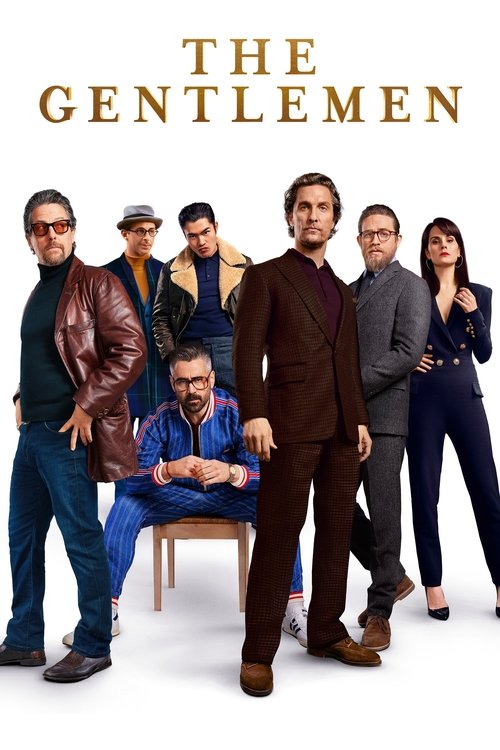
The Gentlemen
"Criminal. Class."
Overview
The Gentlemen introduces Mickey Pearson, a brilliant American expatriate who has built a highly lucrative marijuana empire in London. When word gets out that he is looking to cash out and retire to a life of peace with his aristocratic wife, Rosalind, it triggers a chaotic frenzy among the city's criminal underworld. Various eccentric rivals, including an ambitious Chinese gangster and a ruthless billionaire, begin scheming to steal his domain.
The narrative unfolds through the highly unreliable lens of Fletcher, a sleazy private investigator who attempts to blackmail Mickey's right-hand man, Raymond. Fletcher frames the story as a cinematic movie script, dramatically recounting the plots, betrayals, and street-level brawls that ensue. His storytelling introduces a colorful cast of characters, including a fiercely protective boxing coach and a gang of rapping martial artists known as the Toddlers.
Blending Guy Ritchie's signature kinetic pacing, rapid-fire dialogue, and non-linear storytelling, the film weaves a tangled web of double-crosses and aristocratic exploitation. It asks a primal question: can a refined "lion" of the jungle maintain his throne when the younger, hungrier animals come out to play, or will he be forced to bare his fangs once again?
Core Meaning
At its heart, The Gentlemen is a reflection on the laws of the jungle and the evolution of power. Director Guy Ritchie explores the tension between old-school, refined criminal elegance and the chaotic, ambitious ruthlessness of a new generation.
The film posits that true power is not just about acting like a king, but fundamentally being one. It serves as a commentary on the gentrification of crime and class mobility in modern Britain, suggesting that behind the polished veneer of high society and aristocratic manors lies an inherently savage, predatory world where only the sharpest and most ruthless survive.
Thematic DNA
The Law of the Jungle
The film frequently invokes animalistic metaphors—lions, dragons, and silverbacks—to establish a clear criminal hierarchy. Mickey views himself as the reigning lion whose territory is challenged by younger, ambitious predators. The narrative reinforces that maintaining power requires absolute ruthlessness, embodying the primal rule that the strong survive while the weak are consumed.
Class, Aristocracy, and Gentrification
Ritchie brilliantly juxtaposes the grimy underworld with British high society. Mickey builds his empire on the sprawling estates of cash-strapped aristocrats, illustrating a symbiotic relationship between impoverished nobility and lucrative crime. The film highlights how the upper classes are the "original gangsters" who stole their wealth, while exploring how criminals themselves seek gentrification.
Storytelling and Unreliable Narration
Through Fletcher's meta-narrative pitch of his script, the film explores the subjective nature of truth and the power of storytelling. Fletcher embellishes, edits, and dramatically frames events, blurring the line between reality and cinematic fiction. This reflexively comments on the filmmaking process itself.
Loyalty vs. Betrayal
In a world fueled by greed, true loyalty is the rarest commodity. The unwavering devotion between Mickey and his wife Rosalind, as well as the steadfast reliability of his right-hand man Raymond, stands in stark contrast to the backstabbing nature of characters like Berger and Dry Eye. Loyalty is portrayed as the ultimate shield.
Character Analysis
Michael "Mickey" Pearson
Matthew McConaughey
Motivation
To successfully cash out his billion-dollar marijuana business and retire in peace with his beloved wife, Rosalind, without appearing weak to his rivals.
Character Arc
Mickey begins the film desiring a peaceful exit from his criminal empire to enjoy middle age. However, when his transition is violently threatened, he must shed his gentrified exterior and re-embrace his primal, ruthless nature to secure his throne.
Raymond Smith
Charlie Hunnam
Motivation
To protect Mickey's interests, maintain order within the organization, and efficiently neutralize Fletcher's elaborate blackmail attempt.
Character Arc
Ray serves as the steadfast anchor amidst the chaos. While he tries to maintain a civilized approach to problem-solving, the escalating threats force him to employ increasingly brutal methods to protect the empire.
Fletcher
Hugh Grant
Motivation
To extort 20 million pounds from Mickey's organization for his gathered intelligence, or alternatively sell the story to a movie studio for a massive profit.
Character Arc
Operating from a place of sleazy opportunism, Fletcher believes he holds all the cards. His arc is one of hubris; his grand cinematic blackmail scheme ultimately unravels as he vastly underestimates the men he is trying to extort.
Rosalind Pearson
Michelle Dockery
Motivation
To manage her legitimate auto business, support Mickey's retirement plan, and maintain their shared dominance over their domain.
Character Arc
As the matriarch of the empire, Rosalind acts as Mickey's equal and sounding board. She remains fiercely composed under pressure, proving her own lethality when directly attacked by Dry Eye.
Coach
Colin Farrell
Motivation
To protect "his boys" from the lethal consequences of their misguided heist and to repay his debt of honor to Mickey's organization.
Character Arc
A principled boxing instructor who accidentally gets entangled in the underworld when his students rob Mickey's farm. He steps up to make amends, becoming a surprisingly effective and honorable asset to Ray.
Symbols & Motifs
The Lion and the Dragon
These animals symbolize the generational and racial power struggle within the criminal hierarchy. The lion represents established, unquestioned dominance, while the dragon represents arrogant, untested ambition.
Mickey tells a fable about a foolish dragon asking a wise lion for his territory, ending with the lion shooting the dragon. It serves as a dire warning to his young rival, Dry Eye.
The Paperweight Gun
It symbolizes hidden danger, underestimation, and the Chekhov's Gun principle. It represents how lethal power can be disguised as a harmless, decorative object in a "civilized" setting.
Gifted to Mickey by Berger and passed to Rosalind, who later uses its two bullets to lethally defend herself against Dry Eye's henchmen when her office is invaded.
Tailored Suits and Tweed
Clothing represents the "gentrification" of the criminal class, serving as armor that projects power, civility, and upward mobility. It masks the savage, primal nature of the characters.
Mickey wears classic British tweed, signaling his integration into the aristocracy, while Raymond's immaculate tailoring shows his methodical nature. Even the street-level Toddlers wear coordinated tracksuits.
Memorable Quotes
If you wish to be the king of the jungle, it's not enough to act like a king. You must be the king. And there can be no doubt. Because doubt causes chaos and one's own demise.
— Mickey Pearson
Context:
Mickey says this in a voiceover at the very beginning of the film, establishing the thematic foundation of his character and the criminal underworld he dominates.
Meaning:
The thesis statement of the film. It highlights the absolute certainty and ruthlessness required to maintain power in a predatory, unforgiving environment.
There once was a young and foolish dragon who came to ask a wise and cunning lion about acquiring his territory. Now the lion, he wasn't interested, so he told the little dragon to fuck off.
— Mickey Pearson
Context:
Mickey delivers this fable directly to Dry Eye when the younger gangster rudely attempts to buy Mickey's empire out from under him.
Meaning:
A thinly veiled threat illustrating the strict hierarchy of power and the foolishness of upstarts challenging established rulers.
Every movie needs a bit of action, doesn't it? And it's not like Michael doesn't have a reputation.
— Fletcher
Context:
Fletcher says this to Ray while narrating the story in Ray's living room, justifying his exaggerated retelling of the violence.
Meaning:
Reflects the meta-narrative structure of the film, blurring the lines between the actual events occurring and Fletcher's dramatized, heavily embellished script.
I'm flattered to hear that from you, Matthew. I imagine that big brain of yours is sweating a stream of tears just trying to figure it out.
— Mickey Pearson
Context:
Mickey replies to Matthew Berger after the billionaire marvels at how Mickey manages to hide fifty tons of marijuana production across the country.
Meaning:
Showcases Mickey's intellectual dominance and refusal to reveal his trade secrets, mocking his rival's desperation to understand his operation.
Philosophical Questions
What defines true nobility and class?
The film aggressively juxtaposes impoverished British aristocrats with wealthy, self-made criminals. By revealing that the aristocracy originally built their wealth through theft and land-grabbing ("the original gangsters"), the narrative questions the inherent moral superiority of the upper class, suggesting that "class" is merely a matter of time and successful gentrification.
Can a predator ever truly change its nature?
Mickey attempts to evolve from a ruthless jungle king into a peaceful, refined gentleman. However, when threatened, he is forced to revert to his violent instincts. The film explores whether civilization is just a veneer and if one's primal, violent nature is inescapable once cultivated in the underworld.
Alternative Interpretations
A prominent alternative interpretation of The Gentlemen revolves around the reliability of the narrative itself. Because the majority of the film is framed through Fletcher's recounting of his screenplay "Bush," some viewers and critics argue that the events we see are heavily embellished or entirely fabricated. In this reading, the hyper-stylized violence and perfectly tailored outcomes are merely a reflection of Fletcher's cinematic imagination and desire for a dramatic climax, rather than objective reality.
Another interpretation focuses on the film's ending. While the literal reading suggests Mickey has successfully defeated his rivals and retained his empire, a deeper thematic reading implies that the closing door in the final scene symbolizes Mickey finally shutting out the criminal underworld for good. Despite forcing Berger to pay, Mickey's ultimate goal was retirement, and the final moments can be seen as his true ascension from the chaotic "jungle" into a life of untouchable, peaceful gentrification.
Cultural Impact
The Gentlemen marked a triumphant return to form for director Guy Ritchie, bringing him back to the kinetic, fast-talking British gangster roots that made him famous with Lock, Stock and Two Smoking Barrels and Snatch. Released in early 2020, the film resonated as a highly stylized time capsule of modern Britain, exploring themes of globalization, class mobility, and the gentrification of crime.
Critically, the film received mixed-to-positive reviews; while many praised the sharp dialogue, star-studded ensemble, and energetic pacing, some critics pushed back against its politically incorrect humor, casual slurs, and borderline offensive racial tropes. However, audiences largely embraced the film's unapologetic bravado and entertaining swagger, leading to strong box office returns. The film's distinct aesthetic and popularity even spawned a successful spin-off television series on Netflix in 2024, proving the enduring cultural appeal of Ritchie's hyper-masculine, impeccably tailored criminal underworld.
Audience Reception
Audiences enthusiastically welcomed The Gentlemen as a glorious return to Guy Ritchie's roots. Viewers highly praised the film's razor-sharp, endlessly quotable dialogue, the non-linear storytelling, and the impeccable costume design that elevated the gangster aesthetic. The standout performances of Hugh Grant, playing delightfully against type as a sleazy investigator, and Colin Farrell as the principled, track-suited Coach, were frequently highlighted as the film's brightest spots.
However, the film was not without its controversies. Some viewers and critics took issue with the film's use of politically incorrect humor, racial slurs, and stereotypical depictions of Asian and Jewish characters, finding it dated or unnecessarily offensive. Additionally, a subplot involving an attempted sexual assault on Rosalind was criticized by some as a tonal misstep. Despite these criticisms, the overall verdict from the general audience was highly positive, viewing it as a slick, wildly entertaining, and stylish caper.
Interesting Facts
- During the pitch scene at Miramax, a poster for 'The Man from U.N.C.L.E.' can be seen in the background. Guy Ritchie directed that film, which also starred Hugh Grant.
- The film's working titles during production were 'Toff Guys' and 'Bush' before officially becoming 'The Gentlemen'.
- Matthew McConaughey's character orders a pint of 'Gritchie' pale ale at the pub, which is a real-life beer brewed by director Guy Ritchie's own brewing company.
- Hugh Grant's character, Fletcher, was heavily inspired by the sleazy tabloid journalists and private investigators of the British press.
- The film uses a meta-narrative structure where the script Fletcher writes is visually shown on screen, acting as the exact screenplay of the movie the audience is watching.
Easter Eggs
The 'Gritchie' beer tap in the opening pub scene.
A direct, cheeky reference to director Guy Ritchie's real-world brewery, Gritchie Brewing Company, subtly inserting his personal brand into the fabric of the film's universe.
The Miramax studio pitch featuring a poster of 'The Man from U.N.C.L.E.'
Miramax is the real-life distributor of The Gentlemen. The poster is a nod to Ritchie's 2015 spy film, creating a self-referential cinematic moment and highlighting Ritchie's own filmography.
Fletcher's script titled 'Bush'.
Fletcher's screenplay is named "Bush," which was the actual working title for The Gentlemen during its early development, serving as a clever meta-joke for industry insiders.
⚠️ Spoiler Analysis
Click to reveal detailed analysis with spoilers
Frequently Asked Questions
Explore More About This Movie
Dive deeper into specific aspects of the movie with our detailed analysis pages
Comments (0)
No comments yet. Be the first to share your thoughts!