
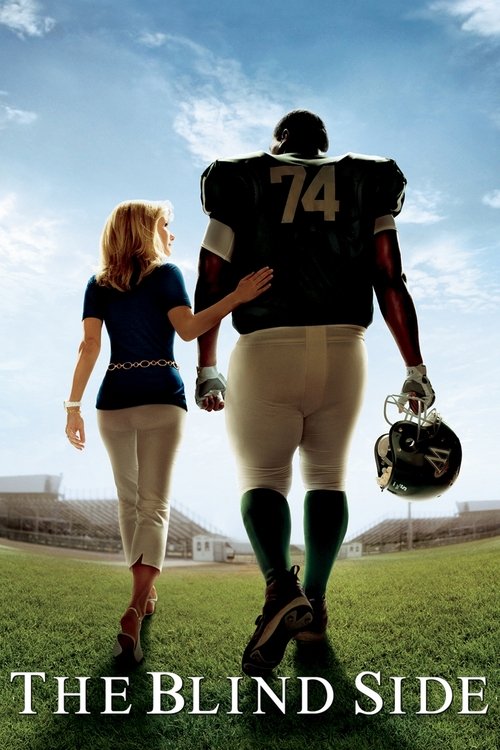
The Blind Side
"Based on the extraordinary true story"
Overview
Based on a true story, The Blind Side follows the extraordinary journey of Michael Oher, a traumatized, impoverished African-American teenager living on the streets of Memphis. Despite his massive physical stature, Michael is remarkably quiet and gentle, drifting through life unnoticed and struggling severely with his academics after being admitted to a prestigious Christian school primarily for his athletic potential.
His life changes forever when Leigh Anne Tuohy, a fiery and strong-willed wealthy interior designer, spots him walking alone in the freezing rain. Acting on a profound instinct of compassion, she invites him into her home for the night. What begins as a temporary act of charity rapidly evolves into a permanent arrangement, as Michael becomes an integral part of the Tuohy family, deeply bonding with Leigh Anne's husband, Sean, and their two children, Collins and S.J..
With the steadfast emotional and academic support of his new family, Michael begins to unlock his true potential. Discovering that his highest psychological trait is his protective instinct, Leigh Anne helps translate this drive onto the football field. Michael blossoms into a formidable left tackle, securing a bright future and a path to the NFL, while simultaneously teaching the Tuohys profound lessons about love, privilege, and the true meaning of family.

Core Meaning
The core message of The Blind Side revolves around the transformative power of compassion, the necessity of looking beyond societal prejudices, and the reciprocal nature of salvation. The director aims to illustrate that while immense talent and potential exist in forgotten corners of society, it often requires someone willing to cross racial and socio-economic boundaries to nurture it. Furthermore, the film emphasizes that true charity is not a one-way street; in protecting Michael's vulnerabilities (his "blind side"), the Tuohys find their own lives enriched, their perspectives widened, and their family strengthened.
Thematic DNA
CompassionandGenerosity
Thefilmchampionsunconditionalgenerosity.TheTuohysopentheirhometoacompletestrangerwithoutexpectinganyreward, highlightinghowasingleactofradicalkindnesscanpermanentlyalterthetrajectoryofaperson'slife[1.7].
Race, Privilege, and Inequality
By juxtaposing the extreme poverty of Hurt Village with the opulent lifestyle of the Tuohys, the film explores systemic inequality. It forces characters to confront their own biases and demonstrates how utilizing privilege to provide access and opportunity can break down social barriers.
Family and Belonging
The narrative redefines the concept of family, suggesting that true belonging is not strictly determined by bloodlines, but by the people who choose to love, accept, and protect you unconditionally.
Protective Instincts
Protection serves as both a literal and emotional theme. Michael's innate desire to protect those he loves is channeled into his role as a left tackle, while Leigh Anne fiercely protects Michael from the judgments of her peers and the dangers of his past.
Character Analysis
LeighAnneTuohy
SandraBullock
Motivation
Driven by an uncompromising moral compass and a deep-seated maternal instinct to nurture, protect, and advocate for someone the rest of the world has discarded.
Character Arc
LeighAnneevolvesfromacomfortable, wealthysocialitetoafierce, empatheticmotherfigure.Shelearnstolookbeyondtherigidboundariesofheraffluent, conservativebubble, ultimatelyrealizingthatMichaelhaschangedherlifejustasmuchasshehaschangedhis[1.5].
Michael Oher
Quinton Aaron
Motivation
To find a safe, permanent home and to fiercely protect the people who have shown him genuine love and acceptance.
Character Arc
Michael transitions from a silent, traumatized, and deeply guarded outcast into a confident, communicative family member and an aggressive, highly skilled athlete who understands his own worth.
Sean Tuohy
Tim McGraw
Motivation
To support his wife's bold decisions and maintain harmony and love within his household.
Character Arc
Sean remains relatively steady throughout the film, serving as a reliable pillar of support. He seamlessly embraces Michael and quietly provides the emotional and financial resources necessary to facilitate Michael's integration into the family.
S.J. Tuohy
Jae Head
Motivation
To bond with his new older brother and eagerly partake in the excitement of the college football recruiting process.
Character Arc
S.J. immediately accepts Michael without any racial or societal prejudice. He takes it upon himself to act as Michael's unofficial coach, confidant, and college negotiator, cementing a true brotherhood.
Symbols & Motifs
TheLeftTackle/TheBlindSide
Thepositionofthelefttackle—whosejobistoprotectthequarterback'sunseen"blindside"—symbolizesthenecessityofguardingthevulnerabilitiesofothers[1.5]. It represents the protective emotional shield that the Tuohys provide for Michael, and the physical protection he offers them in return.
This is explicitly explained in Leigh Anne's opening monologue regarding the evolution of the game, and later applied to Michael when she tells him to view his teammates as his family members who need his protection on the field.
Hurt Village
Michael's old neighborhood symbolizes urban decay, cyclical poverty, and the systemic neglect that traps countless talented individuals without ever giving them a chance to flourish.
It is depicted in stark contrast to the Tuohys' wealthy neighborhood, and serves as a literal and emotional anchor that Michael must safely navigate and eventually transcend.
The New Bed and Clothing
A sense of dignity, identity, and stable comfort. They represent Michael's transition from a transient, forgotten outsider to a recognized, permanent member of a household.
When Leigh Anne gives Michael his own room, he remarks that he has never had a bed before. Later, Leigh Anne buys him brightly colored clothes (like his orange and blue rugby shirt), visually signaling his shift out of the shadows.
Memorable Quotes
Ifyoudietryingforsomethingimportant, thenyouhavebothhonorandcourage, andthat'sprettygood.
— MichaelOher
Context:
Michael writes this profound insight in an essay regarding "The Charge of the Light Brigade," proving to his teachers that he is highly capable of complex thought.
Meaning:
ThisquotereflectsMichael'sdeepinternalphilosophyandintelligence.Ithighlightshisunderstandingofsacrifice, integrity, anddoingwhatisrightregardlessofthesystemicrulesimposedbyauthorityfigures[1.1].
You're changing that boy's life. / No. He's changing mine.
— Leigh Anne Tuohy (and Beth)
Context:
Leigh Anne says this to her affluent friends at a restaurant after they make condescending remarks about her taking in a Black teenager.
Meaning:
This encapsulates the reciprocal nature of charity. While society views Leigh Anne as the sole benefactor, she acknowledges that Michael's presence has profoundly enriched her own worldview and emotional depth.
Michael, I want you to have a good time but if you get a girl pregnant out of wedlock, I will crawl into the car, drive up to Oxford and cut off your penis.
— Leigh Anne Tuohy
Context:
Delivered as a stern warning while she is saying goodbye to Michael as he moves into his college dorm at Ole Miss.
Meaning:
This perfectly demonstrates Leigh Anne's unique brand of tough love. It combines conservative Southern values with aggressive, protective, and comedic motherly affection.
You threaten my son, you threaten me.
— Leigh Anne Tuohy
Context:
Spoken to the gang members in Hurt Village when she confronts them to stop them from harassing Michael.
Meaning:
A declaration of absolute, unconditional familial acceptance. Leigh Anne draws a definitive line, asserting that Michael is not just a charity case, but her genuine child.
Who'd thought we'd have a black son before we knew a Democrat?
— Sean Tuohy
Context:
Said by Sean to Leigh Anne as they reflect on how much their deeply conservative, wealthy family dynamic has evolved since taking Michael in.
Meaning:
A humorous commentary on the Tuohys' isolated, affluent, and conservative Southern bubble, and how drastically their lives have been upended by loving Michael.
Philosophical Questions
Doesindividualcharitytrulyaddresssystemicinequality, ordoesitmerelymaskit?
Thefilmshowsawealthyfamily"saving"oneextraordinaryindividual, butitleavesthebroader, devastatingissuesofpoverty, drugaddiction, andfailingeducationsystemsinHurtVillageentirelyunresolved, questioningiftruejusticerequiressystemicreformratherthanisolatedactsofphilanthropy[1.12].
What legally and emotionally defines a true family?
The narrative explores whether family is dictated by biological bloodlines, legal documents, or the emotional bonds of mutual care and protection. This question is heavily complicated by the real-world revelation that Michael was placed under a conservatorship rather than legally adopted.
Who holds the moral right to tell and profit from a person's life story?
Given Oher's deep frustration that the film portrayed him as unintelligent—a stigma that followed him throughout his NFL career—the movie raises deep ethical questions regarding the power dynamics between Hollywood storytellers, wealthy subjects, and the vulnerable individuals whose trauma is adapted for entertainment.
Alternative Interpretations
The "White Savior" Critique: Long before the 2023 legal drama, sociologists and film critics argued that the film stripped Michael Oher of his agency. This interpretation views the movie as a "white savior" narrative, wherein a Black youth is depicted as entirely helpless, uneducated, and devoid of intrinsic football knowledge until he is rescued by affluent, white benefactors. Critics point out this minimizes Oher's own intense drive and pre-existing athletic prowess.
The Exploitation Lens (Post-2023): Following Oher's lawsuit regarding the conservatorship, an alternative interpretation frames the narrative not as one of selfless adoption, but as the commodification of a talented Black athlete. Through this darker lens, the Tuohys' actions are read as investments utilizing legal loopholes to gain social capital, legacy status at their alma mater (Ole Miss), and substantial financial profit, casting a shadow over the film's heartwarming tone.
An Indictment of Systemic Failure: Rather than purely celebrating individual charity, some audiences interpret the film as a grim indictment of American institutions. The fact that Michael requires the extreme wealth and miraculous intervention of a millionaire family to survive highlights the catastrophic failures of the foster care system, public education, and systemic urban poverty in places like Hurt Village.
Cultural Impact
Released in 2009, The Blind Side became a colossal cultural phenomenon. It was the highest-grossing sports drama at the time of its release and earned Sandra Bullock the Academy Award for Best Actress. For years, the film was universally heralded as an uplifting, feel-good narrative about cross-racial adoption, charity, and the American Dream. It standardized a specific type of inspirational biopic that prioritized emotional melodrama and family dynamics over raw sports technicalities.
However, the film's cultural legacy was drastically ruptured and recontextualized in August 2023. The real Michael Oher filed a massive lawsuit alleging that the Tuohys had never actually adopted him, but had instead tricked him into signing a legal conservatorship shortly after his eighteenth birthday. Oher alleged this arrangement allowed the Tuohys to negotiate millions of dollars in royalties from the film for themselves and their biological children, while he received nothing. Consequently, the film has shifted in the cultural zeitgeist; what was once viewed as a pure tale of generosity is now heavily analyzed in modern pop culture and academic circles as a cautionary tale concerning the "white savior" complex, the exploitation of Black athletes, and the murky ethics of Hollywood biographical storytelling.
Audience Reception
Upon its release, The Blind Side was a massive crowd-pleaser, boasting an "A+" CinemaScore and exceptionally positive audience reviews. Viewers universally praised Sandra Bullock's commanding, nuanced performance, the warm family dynamics, and the overwhelmingly inspirational message of hope and resilience. It was cherished as a perfect family movie that transcended the typical sports genre.
However, the main points of criticism, which have only amplified over time, focused on the film's simplistic and Hollywood-ized approach to race and class. Many critics and modern viewers found the depiction of Michael as overly passive and slow-witted to be offensive. The 2023 controversy regarding Oher's conservatorship lawsuit sparked highly controversial moments of reckoning among audiences, causing many to issue a revised overall verdict: while it remains a well-acted and effectively emotional Hollywood drama, its real-world implications and factual distortions make it a deeply troubling viewing experience today.
Interesting Facts
- SandraBullockinitiallyturneddowntheroleofLeighAnneTuohythreetimesduetoherdiscomfortinportrayingadevoutChristian, butchangedhermindaftermeetingtherealLeighAnne[1.2].
- The film was incredibly profitable; made on a modest budget of $29 million, it grossed over $309 million worldwide.
- Sandra Bullock generously donated her entire salary from the movie to charities that support education and adoption.
- The football plays shown in the movie are heavily based on actual real-life footage from Michael Oher's high school games.
- Michael Oher was largely excluded from the film's creative process and later expressed severe frustration, stating the movie oversimplified his background and falsely depicted him as lacking basic football knowledge.
Easter Eggs
LeighAnne'sWardrobe
ThewardrobewornbySandraBullockwasmodeleddirectlyaftertherealLeighAnneTuohy'sactualcloset, matchingherspecificstyleandcolorchoicestolendahighdegreeofauthenticitytoheron-screencounterpart[1.2].
Director's Hidden Cameo
The film's director and screenwriter, John Lee Hancock, makes a brief, uncredited cameo appearance as a college scout during the lively football recruiting scenes.
⚠️ Spoiler Analysis
Click to reveal detailed analysis with spoilers
Frequently Asked Questions
Explore More About This Movie
Dive deeper into specific aspects of the movie with our detailed analysis pages
Comments (0)
No comments yet. Be the first to share your thoughts!