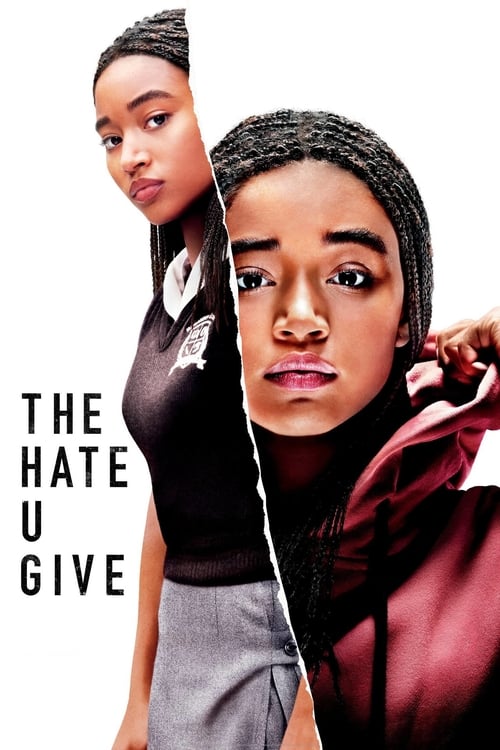
The Hate U Give
A gripping coming-of-age drama where a young woman's voice becomes a weapon against injustice, illuminating the shadows of a fractured society.
The Hate U Give

The Hate U Give

"Two worlds. One voice. No going back."

19 October 2018 United States of America 133 min ⭐ 8.1 (2,174)
Director: George Tillman Jr.
Cast: Amandla Stenberg, Regina Hall, Russell Hornsby, K.J. Apa, Common
Drama Crime
Racism and Police Brutality Identity and Double Consciousness The Power of Activism and Voice Family and Community
Budget: $23,000,000
Box Office: $34,934,009

Overview

"The Hate U Give" tells the story of Starr Carter, a sixteen-year-old girl who navigates two starkly different worlds: her poor, predominantly black neighborhood of Garden Heights and the affluent, mostly white preparatory school she attends, Williamson Prep. This delicate balance is shattered when she witnesses the fatal shooting of her childhood best friend, Khalil, by a white police officer during a traffic stop.

As Khalil's death becomes a national headline, with the media portraying him as a thug and drug dealer, Starr is the sole witness who knows the truth. She faces immense pressure from all sides. The community wants her to speak out for justice, while a local drug lord and even the police intimidate her family to remain silent. Starr must find the courage to let her voice be heard, challenging the systemic racism and police brutality that plague her community, all while grappling with her own identity and place in the world.
Core Meaning

The core meaning of "The Hate U Give" is encapsulated in the Tupac Shakur quote from which it derives its title: "The Hate U Give Little Infants Fucks Everybody" (THUG LIFE). The film posits that the systemic racism, oppression, and neglect inflicted upon marginalized youth creates a destructive cycle of violence and poverty that ultimately harms society as a whole. Director George Tillman Jr. aims to shed light on the Black Lives Matter movement, exploring the painful realities of police brutality, racial injustice, and the immense courage it takes to speak truth to power. The film's central message is a call to activism and the importance of using one's voice to challenge injustice and break the cycle of hate.

Thematic DNA

Racism and Police Brutality 35%
Identity and Double Consciousness 30%
The Power of Activism and Voice 25%
Family and Community 10%

Racism and Police Brutality

This is the central theme, ignited by the unjust killing of Khalil by a white police officer. The film explores the aftermath, from the media's biased portrayal of Khalil as a dangerous thug to the grand jury's failure to indict the officer. It portrays the police as an unsympathetic institution that often uses excessive force against Black individuals. The narrative provides an intimate window into the trauma and injustice faced by Black communities, directly engaging with the principles of the Black Lives Matter movement.

Identity and Double Consciousness

Starr constantly struggles with her dual identity, code-switching between "Garden Heights Starr" and "Williamson Starr." At her predominantly white school, she modifies her speech and behavior to avoid being labeled as "ghetto" or the "angry black girl." This internal conflict is a core part of her journey, as the tragedy forces her to reconcile these two worlds and embrace her authentic self. The film powerfully illustrates the concept of double consciousness, where Black individuals feel the pressure to view themselves through the lens of a racially prejudiced society.

The Power of Activism and Voice

Initially terrified and reluctant to speak, Starr's journey is about finding her voice. Encouraged by activist April Ofrah, she realizes that her testimony is the most powerful weapon against the injustice that took Khalil's life. The film champions the idea that one person's voice can inspire a community and challenge systemic oppression. Starr's evolution from a silent witness to a vocal activist standing on a car with a megaphone is the film's climactic embodiment of this theme.

Family and Community

The Carter family is the film's emotional anchor. Maverick, Starr's father, instills in his children a strong sense of Black pride and knowledge of their rights, drawn from Black Panther teachings. Her mother, Lisa, provides a crucial counterbalance of empathy and a fierce desire for her children's safety. The wider Garden Heights community also plays a vital role, from neighbors fundraising for Khalil's funeral to ultimately standing up against the local gang leader, demonstrating the resilience and strength found in unity.

Character Analysis

Starr Carter

Amandla Stenberg

Archetype: The Hero
Key Trait: Resilient

Motivation

Initially motivated by fear and a desire to protect her family and maintain the separation of her two lives, her primary motivation becomes seeking justice for Khalil. She feels a profound sense of responsibility as the sole witness to tell the truth about his death and challenge the racist narrative being pushed by the media and the police.

Character Arc

Starr begins as a teenager fractured between two identities, afraid to bring her full self into the white spaces she navigates. After witnessing Khalil's death, she is paralyzed by trauma and fear. Her journey is one of finding her voice, moving from a passive witness to a powerful activist. She learns to integrate her two worlds, embrace her Blackness without apology, and use her unique position as a bridge to demand justice, ultimately becoming a leader in her community.

Maverick 'Big Mav' Carter

Russell Hornsby

Archetype: The Mentor
Key Trait: Principled

Motivation

Maverick is driven by a profound love for his family and his community. He is motivated by the principles of the Black Power movement, seeking to instill pride, self-knowledge, and a strong sense of justice in his children. He wants to protect them while also preparing them to fight the systemic racism they will inevitably face.

Character Arc

A former gang member who spent time in prison, Maverick has transformed his life to become a pillar of his community and a devoted family man. He is staunchly committed to staying in Garden Heights to help improve it from within. His arc involves learning to balance his fierce principles with the immediate safety of his family, ultimately agreeing to move after his daughter's life is directly threatened, showing that his love for his children is his highest value.

Lisa Carter

Regina Hall

Archetype: The Heart
Key Trait: Empathetic

Motivation

Lisa's motivation is the unconditional protection and support of her children. She balances Maverick's ideological focus with a grounded understanding of emotional needs and practical dangers. She pushes Starr to be brave but also wants to shield her from harm, embodying the protective instincts of a mother in a dangerous world.

Character Arc

Lisa acts as the family's emotional center and a voice of pragmatism. While she supports Maverick's principles, her primary concern is always the safety and emotional well-being of her children. She is the driving force behind moving out of Garden Heights. Her arc shows her unwavering strength as she supports Starr through immense trauma, offering wisdom and empathy, and ultimately ensuring the family's survival and stability.

Chris

K.J. Apa

Archetype: The Ally
Key Trait: Supportive

Motivation

Chris is motivated by his deep love for Starr. He genuinely wants to understand her world and break down the barriers between them. He is willing to step into uncomfortable situations and confront his own ignorance to be the partner she needs, proving his loyalty is not superficial.

Character Arc

As Starr's wealthy, white boyfriend, Chris is initially unaware of the realities of her life in Garden Heights. His arc is about moving from a colorblind ignorance to a genuine understanding of his privilege and the systemic racism Starr faces. He learns to listen and offer support not by trying to solve her problems, but by simply being present and affirming her identity, demonstrating the potential for true allyship.

Symbols & Motifs

Khalil's Hairbrush

Meaning:

The hairbrush symbolizes the fatal consequences of racial bias and stereotypes. It represents the unarmed Black victims of police violence whose innocent actions or objects are misinterpreted as threats, leading to their deaths. The protest chant, "A hairbrush is not a gun!", directly addresses this injustice.

Context:

During the traffic stop, the white police officer, One-Fifteen, mistakes the hairbrush Khalil picks up for a gun and shoots him three times. This object becomes a central piece of evidence and a rallying cry for protesters demanding justice.

T.H.U.G. L.I.F.E.

Meaning:

An acronym created by rapper Tupac Shakur, it stands for "The Hate U Give Little Infants Fucks Everybody." It serves as the film's core philosophy, explaining how systemic racism and hatred planted in youth perpetuates a destructive cycle of poverty and violence that harms all of society.

Context:

Khalil explains the meaning to Starr moments before he is killed. Later, Starr's father, Maverick, elaborates on the concept, helping Starr understand the societal forces that led to Khalil's death and motivating her to fight against them.

Starr's Sneakers (Jordans)

Meaning:

Her Jordans represent her authentic self and the bridge between her two worlds. They are a part of her Garden Heights identity that she initially tries to keep separate from her Williamson life, but eventually wears proudly, symbolizing her integration of her dual identities.

Context:

Starr is passionate about her sneakers. Her relationship with her white boyfriend, Chris, deepens when he shows genuine interest in them. Wearing them at Williamson becomes a subtle act of defiance and self-acceptance as she stops hiding her Garden Heights self.

Maverick's Garden

Meaning:

Maverick's rose garden symbolizes his role as a nurturer to his family and community. It represents his effort to cultivate life, beauty, and resilience amidst the harsh conditions of Garden Heights. The health of the roses often mirrors the emotional state of the family.

Context:

Maverick is often seen tending to his roses. He tells Starr that gardens need conversation to grow, reflecting his parenting style. The fact that the roses can survive a move to the suburbs signifies that the values he has instilled in his children will also endure.

Memorable Quotes

The Hate U Give Little Infants Fucks Everybody.

— Khalil and Maverick Carter

Context:

Khalil first explains the meaning of "THUG LIFE" to Starr in the car shortly before he is shot. Later, Maverick gives Starr a deeper lesson on the concept, connecting it to the Black Panthers and the societal structures that lead to tragedies like Khalil's death.

Meaning:

This is the central thesis of the film, borrowed from Tupac Shakur. It explains that the systemic hate and oppression directed at marginalized youth creates a self-perpetuating cycle of violence that ultimately poisons all of society, not just the oppressed.

Brave doesn't mean you're not scared. It means you go on even though you're scared.

— Lisa Carter

Context:

Lisa says this to Starr to comfort and strengthen her as she grapples with the immense fear of speaking out about what she witnessed. It becomes a mantra for Starr as she steps into her role as an activist.

Meaning:

This quote redefines courage not as the absence of fear, but as the act of persevering in spite of it. It's a crucial piece of encouragement for Starr, validating her terror while empowering her to act anyway. It encapsulates the emotional intelligence Lisa provides throughout the story.

Slang makes them cool. Slang makes me hood.

— Starr Carter

Context:

This is part of Starr's narration near the beginning of the film, where she explains the rules she has created for "Williamson Starr" to navigate her predominantly white school and avoid being judged.

Meaning:

This line perfectly captures the double standard and hypocrisy Starr faces. It highlights how cultural expressions are judged differently based on race. When her white classmates adopt Black slang, it's seen as trendy, but when she uses it, she fears it will reinforce negative stereotypes and label her as "ghetto."

Sometimes you can do everything right and things will still go wrong. The key is to never stop doing right.

— Lisa Carter

Context:

Lisa shares this wisdom with Starr when Starr blames herself for the chaos and riots erupting in Garden Heights. She uses the story of Starr's difficult birth as an analogy for how things can go wrong despite perfect care, emphasizing the importance of persistent effort.

Meaning:

This quote offers a philosophy for dealing with an unjust world. It acknowledges that positive outcomes are not guaranteed, even with righteous actions, but insists on the moral imperative to continue fighting for what is right regardless. It frees Starr from the burden of guilt over outcomes she cannot control.

Philosophical Questions

What is the nature of bravery and what is the cost of speaking out?

The film dismantles the idea of bravery as fearlessness. Through Lisa's words, "Brave doesn't mean you're not scared. It means you go on even though you're scared," it posits that true courage is action in the face of fear. The film meticulously explores the high cost of this bravery. Starr's decision to speak out results in death threats from a local gang, the loss of friendships, intense media scrutiny, and placing her entire family in danger. It forces the audience to question what we ask of our heroes and witnesses, especially when they are children, and to weigh the personal cost of fighting for a collective good.

How does systemic oppression perpetuate cycles of violence?

Through the "THUG LIFE" acronym, the film presents a clear philosophical stance: hate, in the form of racism, poverty, and lack of opportunity, is a seed that, when planted in the young, grows into a cycle of destructive behavior that affects everyone. The film explores this by showing how characters like Khalil and DeVante are drawn into drug dealing not out of malice, but out of desperation caused by systemic poverty. It challenges the viewer to look beyond individual choices and examine the societal structures that limit those choices, arguing that to end the violence, one must first end the hate that fuels it.

Can a fundamentally unjust system be changed from within?

This question is primarily explored through Maverick and his brother-in-law, Carlos. Maverick believes in changing Garden Heights by staying and investing in the community. Carlos, a Black police officer, represents the idea of reforming the system from the inside. The film leaves this question open. Carlos struggles to reconcile his identity as a Black man with his role as an officer, and the grand jury's decision not to indict Khalil's killer suggests that the system is incredibly resistant to change, regardless of the good people working within it. The film leans towards the idea that external pressure, through protest and activism, is essential.

Alternative Interpretations

While the film's primary message is a clear call for justice and activism, some alternative interpretations and debates have emerged. One perspective focuses on the character of Uncle Carlos, Starr's uncle who is a police officer. His position presents an internal conflict within the narrative's anti-police brutality stance. Some viewers interpret his character as an attempt to show that not all police are bad, a nuance that others feel dilutes the film's critique of the entire system of policing. His defense of his colleague and initial skepticism of Starr's account can be read as a representation of the "blue wall of silence" and the difficulty of reforming a flawed system from within.

Another point of discussion is the film's ending. While Starr finds her voice and the community successfully ousts the gang leader King, the officer who killed Khalil is not indicted. Some interpret this as a brutally realistic and pessimistic conclusion, highlighting the persistence of systemic injustice regardless of individual acts of bravery. An alternative reading sees it as a call to redefine victory. While legal justice was not achieved, the true victory lies in Starr's personal transformation, her family's unity, and the empowerment of the Garden Heights community, suggesting that the fight is long and that building community power is as important as any single legal outcome.

Cultural Impact

Released in 2018, "The Hate U Give" arrived at a critical moment, serving as a cinematic amplifier for the Black Lives Matter movement. The film's creation was a direct response to real-world instances of police brutality, particularly the killing of Oscar Grant, which inspired Angie Thomas's original novel. It translated the complexities of systemic racism, code-switching, and activism for a broad, mainstream audience, particularly young adults.

Critics largely praised the film for its powerful storytelling, emotional depth, and the stellar performance by Amandla Stenberg. It was lauded for refusing to simplify complex issues, presenting a nuanced look at family, community, and the different forms resistance can take. While not a massive box office success, its cultural footprint has been significant. It has become a vital educational tool in schools and communities for discussing racial injustice, white privilege, and the power of youth activism. The film helped solidify the Young Adult genre as a space for potent social and political commentary, proving that stories centered on young Black protagonists could be both commercially viable and culturally resonant.

Audience Reception

Audience reception for "The Hate U Give" was overwhelmingly positive. Viewers praised the film for its emotional power, timely relevance, and honest depiction of complex social issues. The performances, particularly from Amandla Stenberg as Starr and Russell Hornsby as Maverick, were frequently singled out for their depth and authenticity. Many viewers found the film to be an eye-opening and moving exploration of the Black experience in America, commending it as a conversation-starter for families. The central themes of finding your voice and fighting for justice resonated strongly. Criticisms were minor but sometimes pointed to the film occasionally feeling like a "YA movie," employing some familiar genre tropes or overt dialogue to explain its themes, though many felt this made its important message more accessible. Overall, audiences saw it as a powerful, necessary, and impactful film that did justice to its beloved source material.

Interesting Facts

  • The film is based on the debut young adult novel of the same name by Angie Thomas, which was inspired by the Black Lives Matter movement and the 2009 police shooting of Oscar Grant.
  • The title is a reference to Tupac Shakur's concept of "THUG LIFE," which stands for "The Hate U Give Little Infants Fucks Everybody."
  • The role of Starr's boyfriend, Chris, was recast. K.J. Apa replaced Kian Lawley after videos surfaced of Lawley using racially offensive slurs.
  • Screenwriter Audrey Wells passed away from cancer on October 4, 2018, the day before the film's wide theatrical release in the United States.
  • Amandla Stenberg, who plays Starr, is also known for her activism for Black rights in real life.
  • Author Angie Thomas wrote a prequel novel titled "Concrete Rose," which focuses on the backstory of Starr's father, Maverick, as a teenager.
  • The name for the character Maverick was inspired by a line in the book "Roll of Thunder, Hear My Cry," a book that deeply influenced author Angie Thomas.

⚠️ Spoiler Analysis

Click to reveal detailed analysis with spoilers

Frequently Asked Questions

Explore More About This Movie

Dive deeper into specific aspects of the movie with our detailed analysis pages

Comments (0)

Leave a comment

No comments yet. Be the first to share your thoughts!