
Skip to content
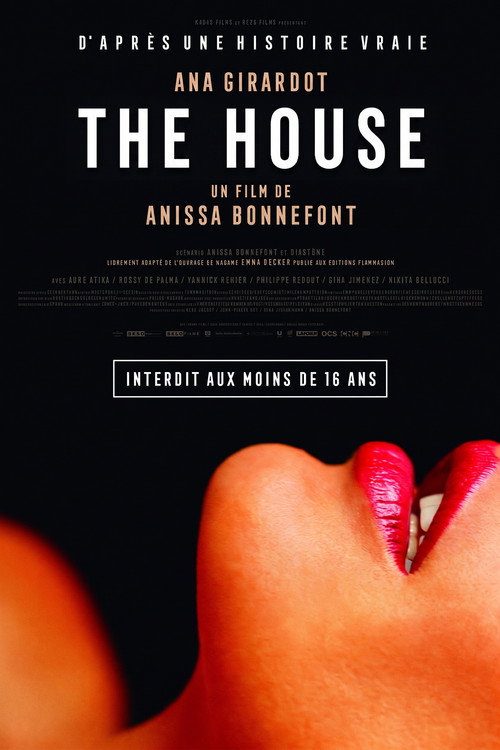
The House
A sensual, atmospheric erotic drama bathed in velvety neon and shadows, The House explores raw vulnerability and female empowerment through the visual metaphor of a gilded cage where fantasy and commodified intimacy collide.
The House

The House

La Maison

16 November 2022 Belgium 89 min 6.0 (114)

Director: Anissa Bonnefont

Cast: Ana Girardot, Aure Atika, Rossy de Palma, Yannick Renier, Philippe Rebbot

Drama Fantasy Comedy The Female Gaze and Reclamation of Desire Identity, Duality, and the Mask of the Persona Sorority and Solidarity among Women The Commodification of Intimacy vs. Emotional Labor Creative Exploitation vs. Lived Experience
Budget: $2,600,000

Overview

The House (La Maison, 2022), directed by Anissa Bonnefont, is an adaptation of the acclaimed 2019 autobiographical novel by French author Emma Becker. Set primarily in Berlin, where prostitution is legal and regulated, the narrative follows Emma (Ana Girardot), a 27-year-old French novelist experiencing severe creative block after the success of her earlier work. Intrigued by the taboo realities of sex work and eager to understand female desire from within rather than from an academic distance, Emma decides to immerse herself completely into the world of sex work.

Adopting the working alias "Justine," Emma joins La Maison, an upscale, discreet Berlin brothel managed by seasoned figures such as the enigmatic Madame (Rossy de Palma) and colleagues like Delly (Aure Atika). What begins as an intellectual, undercover writing assignment soon evolves into an all-consuming double life. Emma forms bonds of sorority with fellow sex workers, navigates a mosaic of male fantasies and emotional vulnerabilities, and discovers facets of her own sexuality.

As the boundaries between Emma the observer-writer and Justine the participant-courtesan blur, the psychological weight of her chosen double existence begins to take a toll. Emma must balance her hidden profession against her personal relationships—including her sister and romantic partners—while confronting the inherent emotional hazards and power dynamics of commodifying physical intimacy.


Core Meaning

The central idea of The House is an exploration of the "female gaze" regarding female desire, bodily autonomy, and sex work. Director Anissa Bonnefont and source author Emma Becker reject traditional cinematic depictions of prostitution that frame sex workers solely as helpless victims or hyper-sexualized objects for the male gaze.

Instead, the film presents sex work as a complex intersection of labor, emotional caregiving, performance, and empowerment, while simultaneously acknowledging its psychological fatigue and physical vulnerabilities. The broader message asserts that true agency lies in a woman's right to explore, understand, and own her sensuality without shame, even as it interrogates how transactional intimacy reshapes personal identity.

Thematic DNA

The Female Gaze and Reclamation of Desire 30%
Identity, Duality, and the Mask of the Persona 25%
Sorority and Solidarity among Women 20%
The Commodification of Intimacy vs. Emotional Labor 15%
Creative Exploitation vs. Lived Experience 10%

The Female Gaze and Reclamation of Desire

The film frames sexual encounters from the emotional and sensual perspective of women, stripping away voyeuristic exploitation to highlight intimacy, communication, and mutual vulnerability.

Identity, Duality, and the Mask of the Persona

Emma’s bifurcation into "Justine" demonstrates how compartmentalization protects the psyche, while simultaneously illustrating the danger of losing one's authentic self inside a curated persona.

Sorority and Solidarity among Women

Inside La Maison, the female workers foster a non-judgmental community of mutual protection, humor, and emotional solace, contrasting with the moralistic judgments of the outside world.

The Commodification of Intimacy vs. Emotional Labor

The film reveals that clients often purchase listening ears, validation, and emotional solace rather than mere physical gratification, highlighting the invisible emotional toll borne by sex workers.

Creative Exploitation vs. Lived Experience

Emma's initial pursuit of "material" for her book raises ethical questions about observing others' lives and turning their reality into art.

Character Analysis

Emma / Justine

Ana Girardot

Archetype: The Seeker / Explorer Key Trait: Relentless curiosity and emotional openness

Motivation

Overcoming creative stagnation and exploring the authentic interiority of sex workers.

Character Arc

Starts as an intellectual observer, becomes immersed in her alias Justine, and ultimately confronts the emotional fallout before reclaiming her artistic voice.

The Madam / Brigitta

Rossy de Palma

Archetype: The Matriarch / Guardian Key Trait: Theatrical charisma and fierce protectiveness

Motivation

Maintaining order, elegance, and safety inside the brothel.

Character Arc

Acts as a steady, unflinching presence who guides newcomers while safeguarding the establishment's ethos.

All 4 characters and cast

Symbols & Motifs

The Brothel (La Maison)

Meaning:

Functions as a sanctuary and a modern salon outside societal taboos, serving both as a space of female autonomy and an insular gilded bubble.

Context:

Serves as the primary interior setting where the community of sex workers interact and host clients away from societal scrutiny.

The Notebook / Pen

Meaning:

Represents the physical tether to Emma's identity as a writer and her attempt to maintain intellectual distance and control over her immersion.

Context:

Used by Emma throughout her stay in Berlin to record raw observations, thoughts, and encounters.

Mirrors and Dressing Tables

Meaning:

Symbolizes the construction of the alter ego "Justine" and reflects Emma's fragmented self-perception.

Context:

Featured prominently during dressing and preparation scenes before meeting clients.

Lingerie and Costumes

Meaning:

Tools of theatrical transformation that delineate professional boundaries and allow Emma to project different archetypes of desire.

Context:

Worn by the women when assuming their professional personas inside the brothel.

The Red and Amber Velvet Rooms

Meaning:

Visual metaphors for warm, womb-like safety and protected intimacy.

Context:

Contrasted visually with the stark, cold realism and muted tones of the Berlin streets outside.

Memorable Quotes

Je voulais écrire sur les femmes, mais pour les comprendre, il fallait que je vive ce qu'elles vivent.
— Emma (Ana Girardot)

Context

Spoken when explaining her initial motivation to infiltrate the brothel.

Meaning

Sets up the premise of immersive literature and the collapse of the boundary between author and subject.

Ici, ce n'est pas un lieu de honte, c'est une maison de désirs et de secrets.
— The Madam (Rossy de Palma)

Context

Spoken while welcoming Emma to the house rules.

Meaning

Reframes the brothel from a stigmatized space into an organized sanctuary of human vulnerability.

All 3 quotes

Philosophical Questions

Can physical intimacy be commodified without compromising emotional integrity?

The film explores whether the transaction diminishes human connection or creates a designated space for unburdened vulnerability.

Where does empathy end and exploitation begin in artistic creation?

It examines whether an artist can borrow others' lived realities for art without taking advantage of their vulnerability.

Is sexual liberation achieved through transgression or institutional safety?

Contrasting societal stigma with the regulated safety of La Maison, the film ponders how social constructs dictate female freedom.

Alternative Interpretations

The film can be understood through three distinct analytical frameworks:

Full ending explanation

Cultural Impact

Released amid active European debates regarding prostitution laws—specifically comparing the Nordic model of penalizing clients against the German model of regulated brothels—The House sparked discussions regarding bodily sovereignty and sex workers' rights.

Premiering at festivals such as the Angoulême Francophone Film Festival, the film divided critics. Many praised Yann Maritaud’s cinematography, Bonnefont's empathetic direction, and the depiction of female solidarity, while some reviewers felt the narrative romanticized sex work or suffered from pacing unevenness in its middle section.

Audience Reception

Audience and critical responses highlight several key aspects:

  • Praised Elements: Rich, painterly cinematography and set design creating an intimate atmosphere; supportive chemistry and sorority among the ensemble cast (Girardot, Atika, De Palma); and a nuanced depiction of male clients as emotionally fragile rather than cartoonish villains.
  • Criticisms: Tonal swings between romanticized elegance and gritty reality, as well as a subplot involving Emma’s conventional romance outside the house that felt underdeveloped to some critics.
  • Overall Verdict: An engaging, visually sumptuous, and provocative drama that offers a refreshing, female-directed perspective on intimacy, even when caught between sociological exploration and erotic melodrama.

Interesting Facts

  • The film is directly adapted from Emma Becker’s 2019 autofictional novel La Maison, which won the Prix France Culture-Télérama.
  • This was director Anissa Bonnefont’s first narrative feature film after her acclaimed documentaries (Wonderboy, Nadia).
  • The production prioritized safe filming environments, utilizing intimacy protocols to ensure the female cast felt secure during explicit scenes.
  • Director of photography Yann Maritaud worked closely with Bonnefont to cultivate warm, painterly textures that evoke classic European art house cinema.
  • The story is set in Berlin because brothels operate under a regulated legal framework in Germany, contrasting sharply with the abolitionist legal regime in France.

Easter Eggs

Homage to Belle de Jour (1967)

The film consciously dialogues with Luis Buñuel’s classic, subverting its surrealist male-gaze fantasy into an intimate, female-authored reality.

Guenther Wallraff’s Immersion Journalism

Emma’s undercover investigation evokes the European tradition of participatory immersion journalism (Ganz unten), pushing it into the intimate sphere of sexuality.

Literary Naming of Justine

Emma's chosen pseudonym "Justine" is a nod to Marquis de Sade’s Justine, subverting the archetype of the victimized woman into an active observer and agent.

Frequently Asked Questions

Explore More About This Movie

Dive deeper into specific aspects of the movie with our detailed analysis pages

Comments (0)

Leave a comment

No comments yet. Be the first to share your thoughts!

Similar Movies