Skip to content
The Last Viking
A pitch-black Danish fable of brotherhood, where a treasure hunt becomes an excavation of the soul — two men digging through Nordic forest and memory for something neither can name.
The Last Viking

The Last Viking

Den sidste viking

09 October 2025 Denmark 116 min 7.3 (235)

Director: Anders Thomas Jensen

Cast: Mads Mikkelsen, Nikolaj Lie Kaas, Sofie Gråbøl, Søren Malling, Bodil Jørgensen

Drama Crime Comedy Brotherhood as obligation Mental illness and the sovereignty of identity Equality, accommodation and the amputated arm Memory, the buried past and the vanished home The worthlessness of the score

Overview

Written and directed by Anders Thomas Jensen, The Last Viking (Den sidste viking) opens on a fairytale: a Viking chieftain decrees that every one of his subjects must lose their left arm, so that all may live as equals. That grotesque little parable hangs over everything that follows.

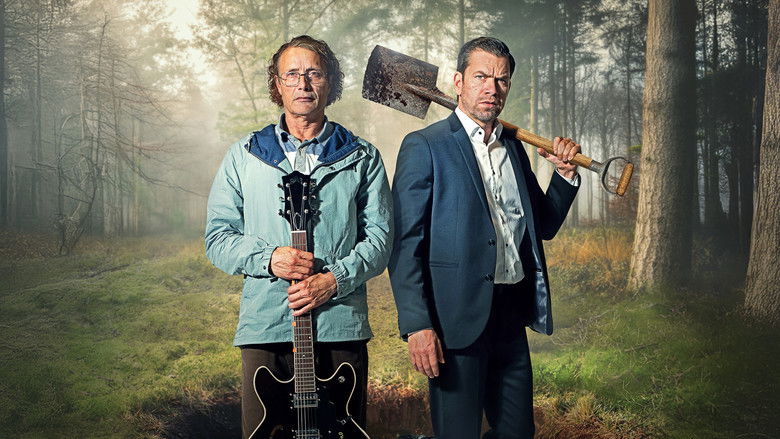
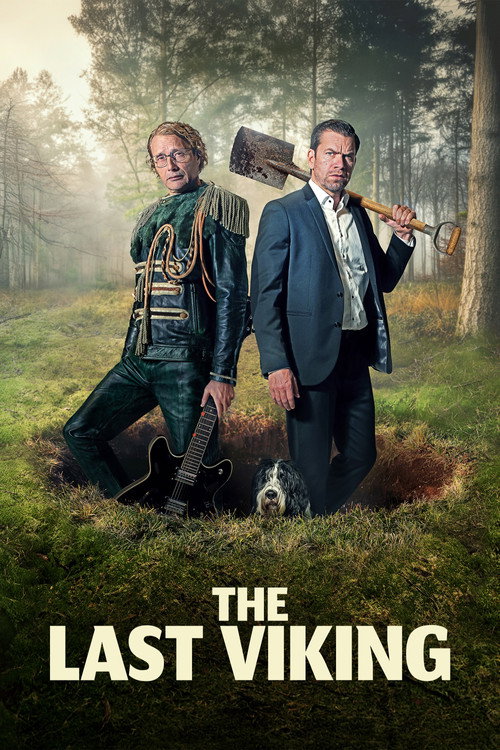
In the present, Anker (Nikolaj Lie Kaas) walks out of prison after fourteen years served for armed robbery. Before going inside, he handed the stolen money to his brother Manfred (Mads Mikkelsen) with one instruction: bury it, and remember where. Manfred, who is mentally ill, is the only living person who knows the hiding place — and he can no longer recall it. What begins as a straightforward reclamation job turns into a road trip through the brothers' shared past, out to the remote house where they grew up.

Jensen's film keeps swerving away from the genre it appears to belong to. A psychiatrist's therapeutic scheme, a pair of strangers now running the family home as an Airbnb, and Manfred's own unshakeable sense of who he is all conspire to turn a heist into something stranger, sadder and far funnier: an argument between two brothers about what one person owes another.

Core Meaning

Jensen uses the shape of a crime caper to ask a moral question that has nothing to do with money: what does it cost to make room for someone who does not fit? The opening fable of the chieftain who amputates the population into equality is the film's thesis stated as absurdist horror — equality enforced by subtraction, by cutting people down to a common size.

Against that, the film offers Manfred, a man whose reality is not negotiable and whose identity cannot be argued away. The buried money is a MacGuffin in the purest sense: the brothers spend the film searching for a suitcase, and what they actually excavate is buried baggage — grief, blame, and the unspoken contract of who was looked after and who was left to carry it.

The message is not that love heals illness. It is that accommodation is the real work of family: you either enter the other person's world or you spend your life resenting them for not entering yours. Jensen, characteristically, refuses to make that lesson sentimental — he delivers it deadpan, with a joke running underneath the ache.

Thematic DNA

Brotherhood as obligation 25%
Mental illness and the sovereignty of identity 25%
Equality, accommodation and the amputated arm 20%
Memory, the buried past and the vanished home 18%
The worthlessness of the score 12%

Brotherhood as obligation

The engine of the film is not affection but debt. Anker gave Manfred a job to do and Manfred failed it; fourteen years of prison sit between them as an unpaid invoice. Jensen writes the relationship as a running negotiation — who sacrificed more, who was protected, who was abandoned — and lets the comedy come from how badly two grown men handle a conversation they have postponed for a decade and a half. The suitcase is only the pretext that finally forces them into the same car.

Mental illness and the sovereignty of identity

Manfred is not a puzzle to be solved. His condition is the film's central fact, and Mikkelsen plays it — as reviewers noted — with humanity rather than caricature, in a register unlike anything in his filmography. The film's boldest move is that Manfred's identity is treated as real on its own terms: the question is never whether he can be corrected, but whether anyone around him is willing to meet him where he actually lives. The psychiatric subplot, in which patients who identify as the other Beatles are gathered together, pushes this from private drama into institutional satire.

Equality, accommodation and the amputated arm

The prologue's chieftain enforces sameness by amputation, and the film spends its runtime testing that logic. Is equality achieved by levelling people down, or by building a world with room for difference? Critics read the film as a confrontation with contemporary conversations about disability and accommodation — but Jensen keeps it uncomfortable rather than didactic, implicating everyone, including the brother who considers himself the reasonable one.

Memory, the buried past and the vanished home

Forgetting is the plot. Manfred cannot retrieve the location of the money, so the brothers must retrieve everything around it: the childhood, the house, the version of the family they agreed to stop discussing. When they reach the remote home, it has been converted into an Airbnb by a middle-aged couple carrying their own latent bitterness — the past is not preserved, it has been rented out to strangers. What is dug up from the ground matters less than what is dug up between them.

The worthlessness of the score

Crime-film grammar promises that the money will resolve everything. Jensen systematically devalues it. The longer the search runs, the more plainly the cash reads as the thing the brothers use to avoid each other — a shared errand standing in for a shared life. The genre expectation of a clean heist payoff is set up precisely so it can be denied.

Character Analysis

Manfred

Mads Mikkelsen

Archetype: Holy fool / sacred innocent Key Trait: Unbudgeable conviction

Motivation

To be believed, and to keep faith with his brother despite a memory that will not cooperate. He wants to be a good brother more than he wants to be understood.

Character Arc

Manfred begins as the obstacle — the brother who lost the money, the problem to be managed — and gradually becomes the film's moral centre. His arc is not recovery; it is recognition. The movement is in how the world reorganises around him once it stops trying to fix him, culminating in a therapeutic scheme that takes his identity as John Lennon seriously enough to build something out of it.

Anker

Nikolaj Lie Kaas

Archetype: Antihero Key Trait: Aggrieved pragmatism

Motivation

To collect the money he considers his by right — and, beneath that, to be compensated for a life he feels was taken from him.

Character Arc

Released after fourteen years for armed robbery, Anker arrives convinced he is the injured party owed a payout and an apology. The journey strips that story from him: the more the search fails, the harder it becomes to maintain that he is the sane one who sacrificed everything. His development is a slow, grudging shift from creditor to caretaker.

All 3 characters and cast

Symbols & Motifs

The severed left arm

Meaning:

Enforced sameness, and the violence hidden inside the word equality. To be equal in the chieftain's kingdom you must be diminished — difference is amputated rather than accommodated.

Context:

Introduced in the opening fairytale about the Viking chieftain who requires all his subjects to give up their left arms. The image is never explained away; it recurs as a moral yardstick against which every choice the brothers make is measured.

The buried suitcase of money

Meaning:

The classic MacGuffin, repurposed as repressed material. What is buried and cannot be located is not the cash but the brothers' own history.

Context:

Hidden by Manfred before Anker's fourteen-year sentence and forgotten. Its absence structures every scene: every dig, every argument, every detour is nominally about recovering it.

John Lennon and the Beatles

Meaning:

Identity as authorship. Being Lennon gives Manfred a biography with meaning, authority and art in it — a self that is coherent in a way his diagnosis is not.

Context:

Mikkelsen's Manfred identifies as John Lennon; a psychiatrist proposes assembling a band from patients who identify as George, Paul and Ringo. The Beatles function both as a running joke and as the film's most serious statement about how people assemble a workable self.

The childhood home turned Airbnb

Meaning:

The past as property — something that can be sold, redecorated and let out by the night. Home is revealed to be a place you cannot return to, only book.

Context:

The brothers arrive at the remote house expecting a confrontation with their own history and instead find a middle-aged couple running it commercially, nursing bitterness of their own.

Digging and the forest

Meaning:

Excavation as therapy. Turning over ground is the film's literalised metaphor for the work the brothers refuse to do in language.

Context:

The search for the money takes the brothers into the Nordic woods — the film's forest sequences were shot near Tollered in Sweden — where holes get dug and nothing that matters is found in them.

The Viking chieftain himself

Meaning:

The title's ironic subject: the last Viking is not a warrior but a man whose conviction cannot be broken by consensus. Stubbornness reframed as a kind of heroism.

Context:

Established in the prologue fable and echoed in Manfred's immovable relationship to his own reality, which the rest of the film keeps trying, and failing, to conquer.

Philosophical Questions

Is equality achieved by removing difference, or by making room for it?

The prologue answers the question in its most brutal form: a chieftain who amputates every left arm so that no one has an advantage. The rest of the film tests softer versions of the same instinct — the impulse to correct, medicate, manage or talk someone out of who they are. Jensen never delivers a verdict from a podium; he simply lets the amputation image sit there while the characters make smaller versions of the same choice.

What do we actually owe the people we did not choose?

Anker's claim on his brother is contractual: I gave you something, you lost it, you owe me. The film dismantles that framing by demonstrating that Manfred cannot enter into contracts of that kind — and asks whether obligation survives when reciprocity is impossible. The answer the film moves toward is that care which requires repayment was never care.

If a self is constructed, does it matter which self you construct?

Manfred's Lennon is treated by the film as an identity with internal coherence, history and moral weight. Set against Anker's self-image as the wronged man who sacrificed fourteen years, it becomes genuinely unclear which brother is living inside the more useful fiction — and the Beatles-reformation subplot suggests that a shared fiction, collectively maintained, is indistinguishable from a community.

Can a memory be recovered, or only rebuilt?

The plot hinges on a location Manfred once knew and can no longer retrieve. Every attempt to recover it involves reconstructing the past instead — revisiting the house, the childhood, the family — which produces something new rather than something restored. Forgetting is shown not as a gap but as a creative act with consequences.

Is comedy a way of avoiding pain or the only honest way of approaching it?

Jensen's method places jokes at the exact moments of greatest hurt, and critics noted the comedy heightens rather than deflates the emotional weight. The film implicitly argues that absurdity is the register in which grief can actually be spoken aloud between two men who have no other vocabulary for it.

Alternative Interpretations

As a crime film that refuses its own genre. One reading takes the setup at face value: the money is real, the search is real, and the film is about how criminal logic collapses when applied to family. Reviewers consistently noted that the expected sequence — return home, find the suitcase, air grievances, escape together — is precisely what does not happen. The heist is a trap set for the audience's expectations.

Full ending explanation

Cultural Impact

The Last Viking arrived as a significant domestic event: after its out-of-competition world premiere at the 82nd Venice International Film Festival on 30 August 2025 and a screening at the 50th Toronto International Film Festival, it opened in Denmark on 9 October 2025 and became a box-office phenomenon, later taking the Audience Award at the Danish Film Awards — a rare alignment of festival profile and mass popularity.

It also consolidates one of European cinema's most durable creative partnerships. This is the sixth film Anders Thomas Jensen has made with both Mads Mikkelsen and Nikolaj Lie Kaas, extending a body of work — The Green Butchers, Adam's Apples, Men & Chicken, Riders of Justice — in which grotesque comedy is used as a delivery system for questions about grief, faith and damage. Critics placed this film at or near the top of that filmography.

Its most discussed contribution is its handling of disability and neurodivergence. By opening with a fable about a chieftain who amputates his subjects into equality, Jensen puts contemporary debates about accommodation directly on screen, and Mikkelsen's performance was singled out for portraying a mentally ill man with humanity rather than as a comic device. Reviewers described the result as darkly funny and unexpectedly moving — a mainstream Danish hit that argues for making room rather than cutting people down to size.

Audience Reception

Overwhelmingly positive, and unusually broad. The film was a box-office phenomenon in Denmark and won the Audience Award at the Danish Film Awards — an endorsement from general audiences rather than only festival crowds. It carries a 7.2 user rating on IMDb.

Most praised: Mads Mikkelsen's performance as Manfred, repeatedly singled out for portraying mental illness with humanity rather than caricature and described by Jensen himself as unlike anything the actor had attempted before. Reviewers also praised the way the comedy amplifies rather than undercuts the drama — the film was widely called darkly funny and bizarrely moving — and the chemistry of the Mikkelsen/Lie Kaas pairing in their sixth film with the director. Several critics ranked it among Jensen's best work.

Points of friction: The film's tonal swerves are deliberate and not to every taste — viewers arriving for a heist comedy encounter a psychiatric drama, a fable about amputation, and a domestic standoff in an Airbnb, and the structure withholds the payoff the setup promises. Its treatment of disability, identity and accommodation is designed to be uncomfortable, which places it inside live cultural debates rather than above them.

Verdict: a rare crowd-pleaser built out of genuinely thorny material — accessible enough to dominate the Danish box office, strange enough to premiere at Venice and Toronto.

Interesting Facts

  • The film marks the sixth collaboration between Anders Thomas Jensen and both Mads Mikkelsen and Nikolaj Lie Kaas; Mikkelsen, Lie Kaas and Nicolas Bro have appeared in almost all of Jensen's films.
  • Principal photography began on 19 August 2024 and ran for roughly seven weeks across Denmark and Sweden, including locations on Funen and in a forest near Tollered.
  • Cinematography is by Sebastian Blenkov. The film runs 116 minutes and was made on a budget of around EUR 7.8 million.
  • It premiered out of competition at the 82nd Venice International Film Festival on 30 August 2025, and then screened at the 50th Toronto International Film Festival.
  • The Danish theatrical release followed on 9 October 2025, where the film became a box-office phenomenon.
  • It won the Audience Award at the Danish Film Awards.
  • Jensen has said he would not have dared attempt Manfred's identification as John Lennon without Mikkelsen in the role, calling it unlike anything the actor had done before.
  • In interviews promoting the film, Mikkelsen and Lie Kaas discussed the Beatles, ABBA and brotherhood as touchstones for the material.
  • Speaking ahead of the Zurich Film Festival premiere, Jensen discussed Mikkelsen's stunt work and the eerie house where a large part of the film takes place.
  • The film holds a 7.2 user rating on IMDb.

Easter Eggs

The 'Psycho' house

Jensen has spoken about the unsettling house in which much of the film takes place, invoking Hitchcock's Psycho in discussing it. The remote family home as a repository of unresolved parental history is one of horror cinema's oldest structures, imported here into a comedy about brothers.

The reassembled Beatles

A psychiatrist's proposal to gather patients who identify as George, Paul and Ringo around Mikkelsen's John Lennon is both the film's funniest conceit and its clearest thesis — a band is a group of people agreeing to take each other's identities seriously.

ABBA alongside the Beatles

Both bands came up repeatedly in the cast's interviews about the film — a very Scandinavian counterweight to the Liverpool mythology, and a reminder that the pop canon here is a shared language between the brothers rather than mere set dressing.

The Jensen repertory company

Mikkelsen, Lie Kaas and Nicolas Bro have appeared across almost all of Jensen's features, from The Green Butchers and Adam's Apples to Riders of Justice. Their recurrence gives the film the quality of a long-running conversation between the same handful of people about faith, violence and damaged men.

The Viking prologue as genre bait

A film titled The Last Viking that opens on Norse myth primes audiences for saga heroics; the immediate pivot to a released convict and a lost suitcase is a deliberate bait-and-switch on Danish national self-image.

Frequently Asked Questions

Explore More About This Movie

Dive deeper into specific aspects of the movie with our detailed analysis pages

Comments (0)

Leave a comment

No comments yet. Be the first to share your thoughts!

Similar Movies