Skip to content
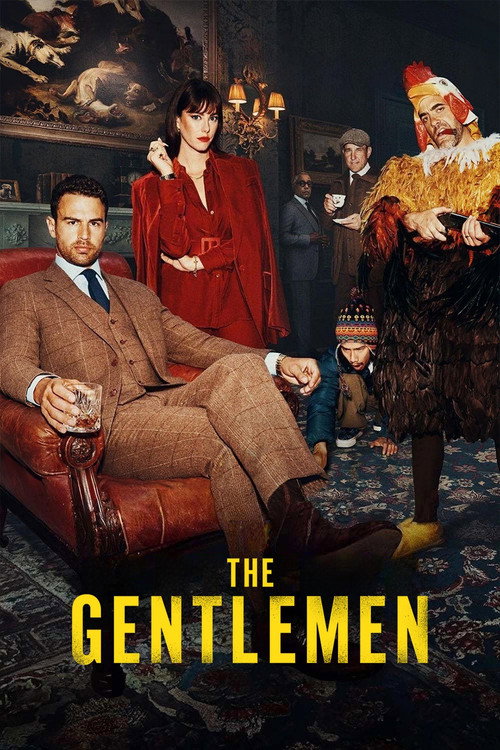
The Gentlemen
A razor-sharp clash of velvet aristocracy and blood-splattered brutality, pulsing with manic swagger and calculating adrenaline, where bespoke tweed collars slowly choke out moral innocence like ivy suffocating a grand country manor.
The Gentlemen

The Gentlemen

"A new class of criminal."

07 March 2024 — 07 March 2024 United Kingdom 2 season 16 episode Returning Series 7.8 (858)

Cast: Theo James, Kaya Scodelario, Daniel Ings, Joely Richardson, Vinnie Jones

Drama Crime Comedy Aristocracy as Organized Gangsterism The Seduction and Corruption of Power (Moral Descent) Kinship, Loyalty, and Dysfunctional Brotherhood The Illusion of Control and Compartmentalization Class Strata, Heritage, and Predatory Capitalism

Overview

The Gentlemen is a British black-comedy crime drama created by Guy Ritchie and developed alongside Matthew Read. Set in the same universe as Ritchie's 2019 feature film, the series follows Edward "Eddie" Horniman, an upright United Nations peacekeeping captain who returns to England upon the death of his aristocratic father, the Duke of Halstead. In a shocking will reading, Eddie skips past his reckless older brother, Freddy, to inherit the title, the sprawling family estate, and a clandestine secret: deep beneath the ancestral dairy farms lies a multi-million-pound industrial cannabis empire managed by the formidable Susie Glass on behalf of her incarcerated kingpin father, Bobby Glass.

Determined to shield his family and untangle his estate from the criminal underworld, Eddie initially attempts to negotiate a clean extraction. However, Freddy’s catastrophic gambling debts, psychopathic drug cartels, eccentric billionaires, traveling boxer syndicates, and cutthroat rivals pull Eddie ever deeper into illicit wheeling and dealing. Rather than remaining an outsider looking for an exit, Eddie discovers an innate talent for tactical duplicity and Machiavellian maneuvering, transforming his relationship with Susie from reluctant truce to a formidable partnership.

As the narrative expands into international territories, political conspiracies, and organized crime dynasties across the continent, the show charts Eddie's moral decline. The struggle shifts from keeping the wolves away from Halstead Manor to Eddie realizing he wants to lead the pack, pitting his family legacy directly against the entrenched violence of modern organized crime.
Core Meaning

The central thesis of The Gentlemen is that the British upper-crust aristocracy and ruthless organized crime syndicates are fundamentally mirror images of one another. As the series explicitly states, historical lords and dukes were merely the original violent conquerors whose illicit gains were legitimized across centuries of land ownership, decorum, and hereditary privilege. Across both seasons, Ritchie highlights how polite social codes, velvet accents, and bespoke tailoring are mere disguises for primal savagery, greed, and conquest. The overarching message is a warning against self-deception: the moment an individual enters the criminal jungle convinced they can remain civilized, their survival instincts will inevitably strip away their conscience, transforming high-minded nobles into cold-blooded predators.

Thematic DNA

Aristocracy as Organized Gangsterism 30%
The Seduction and Corruption of Power (Moral Descent) 25%
Kinship, Loyalty, and Dysfunctional Brotherhood 20%
The Illusion of Control and Compartmentalization 15%
Class Strata, Heritage, and Predatory Capitalism 10%

Aristocracy as Organized Gangsterism

Explores how historical nobility and contemporary underworld kingpins operate by the exact same predatory laws. Nobility is deconstructed not as refined virtue, but as generational piracy grandfathered into legality.

The Seduction and Corruption of Power (Moral Descent)

Follows Eddie’s trajectory from a decorated, principled UN soldier seeking only to protect his ancestral home into a hardened, ruthless cartel strategist who actively chooses the criminal crown.

Kinship, Loyalty, and Dysfunctional Brotherhood

Examines the burden of blood ties. The relationship between Eddie and Freddy subverts traditional primogeniture; Eddie must constantly fix Freddy's chaotic disasters, while Susie's devotion to her imprisoned father tests her independence.

The Illusion of Control and Compartmentalization

Characters continually construct delicate schemes and treaties under the belief that violence can be measured, clean, and rationalized, only for greed and volatile human nature to shatter their boundaries into bloodbaths.

Class Strata, Heritage, and Predatory Capitalism

Analyzes the financial desperation of land-rich, cash-poor estates forced to lease their ground to subterranean illegal markets, highlighting how heritage becomes a commodity in a predatory economic ecosystem.

Character Analysis

Edward "Eddie" Horniman

Theo James

Archetype: The Reluctant Antihero / The Fallen Prince Key Trait: Unflappable tactical calculation and refined command authority.

Motivation

Originally motivated by family preservation and defending Halstead Manor, evolving into an insatiable drive to consolidate power and reclaim ancestral dominance.

Character Arc

Begins as a composed, ethical army captain whose priority is liberating his family from criminal contamination. As external threats escalate, he realizes his military discipline, tactical coldness, and command authority make him an exceptionally lethal kingpin, gradually shedding his moral qualms until he embraces criminal ambition.

Susan "Susie" Glass

Kaya Scodelario

Archetype: The Underworld Sovereign / Femme Fatale Strategist Key Trait: Razor-edged commercial acumen and unflinching brutality masked by high-fashion poise.

Motivation

Maintaining operational stability and expanding the family syndicate while navigating her father's demanding shadow.

Character Arc

Serving as the de facto operational leader of the Glass empire while her father Bobby is incarcerated, Susie is sharp, sartorially impeccably styled, and ruthlessly pragmatic. Through her association with Eddie, she experiences betrayal and shifts between seeing him as an asset, a threat, and an equal partner.

All 5 characters and cast

Symbols & Motifs

Halstead Manor and the Subterranean Weed Farms

Meaning:

Symbolizes Britain's dual identity—stately public prestige hiding illicit wealth beneath the surface.

Context:

Presented through the striking contrast between the sunlit, neoclassical ancestral halls above and the high-tech, fluorescent cannabis hydroponics hidden below the estate.

The Tweed Wardrobe and Bespoke Tailoring

Meaning:

Serves as armor and class signifiers, demonstrating how violence and refined manners are tailored together.

Context:

Worn continuously throughout the series, notably through Eddie’s three-piece tweed suits, shooting jackets, and Susie’s tailored designer coats.

The Chicken Suit

Meaning:

Represents Freddy’s indignity, foolish vulnerability, and the grotesque absurdity of their new criminal reality.

Context:

Appears in Season 1, Episode 1, when Freddy is forced into a humiliating giant chicken suit to dance for forgiveness before shooting debt-collector Tommy Dixon.

The Caged Birds / Gamekeeping Equipment

Meaning:

Represents domestication versus primal predation, paralleling how criminals and aristocratic lords prey upon weaker herds.

Context:

Maintained by the estate's gamekeeper Geoffrey Seacombe, visible through injured animals, raptors, and hedge boundaries around Halstead Manor.

Luxury Spirits and Fine Wine

Meaning:

Symbolizes the aestheticization of corrupt power, showing how criminal empires are run over fine decanters and cigars.

Context:

Manifests in American billionaire Stanley Johnston’s obsession with rare vintages and Bobby Glass’s gourmet prison rooftop steaks and lifestyle.

Memorable Quotes

Do you know what I love about the British aristocracy? They’re the original gangsters. The reason they own seventy-five percent of this country is because they stole it. William the Conqueror was worse than Al Capone.
— Susie Glass

Context

Spoken during an exposition of class power in Season 1, Episode 1 ("Refined Aggression").

Meaning

Establishes the foundational ideological framework of the show by directly equating aristocratic land ownership with brutal criminal conquest.

Four hundred years ago, this estate spread out as far as the eye could see... First came the apologies, then came the shame, then came the contraction. I want it back, Geoff. I want it all back!
— Eddie Horniman

Context

Spoken to Geoffrey Seacombe at Halstead Manor during the opening act of Season 2.

Meaning

Lays bare Eddie’s unbridled, ancestral aristocratic ambition and marks his complete transformation into a predatory conqueror.

All 5 quotes

Episode Highlights

Refined Aggression

S1E1

Duke Archibald Horniman dies, leading Eddie to unexpectedly inherit the dukedom over Freddy, uncover the cannabis labyrinth beneath the estate, and witness Freddy murder cartel debt-collector Tommy Dixon in a chicken suit.

Significance:

Establishes the core premise and ignites the narrative chain reaction that pulls the Horniman family directly into the criminal underworld.

Tackle Tommy Woo Woo

S1E2

Features high-stakes body disposal and negotiations with the Scouse mob led by Gospel John.

Significance:

Showcases Eddie’s lethal physical capabilities and cements the operational baseline for his working partnership with Susie.

An Unsympathetic Gentleman

S1E4

Pits Eddie against eccentric blackmailers and forces him into severe moral compromises.

Significance:

Forces Eddie to stop treating organized crime as a temporary inconvenience and instead recognize it as a lethal, strategic chess match.

Not Without Danger

S1E7

Reaches a boiling point of distrust between Eddie and Susie following massive sabotage orchestrated by Stanley Johnston.

Significance:

Pushes Susie to believe Eddie has betrayed the Glass family, fracturing their alliance and setting up the climactic end-game.

The Gospel According to Bobby Glass

S1E8

Eddie outplays rival bidders including Stanley Johnston and successfully neutralizes outside threats.

Significance:

Instead of walking away cleanly, Eddie chooses to enter into a formal multi-million-pound criminal equity partnership with Bobby and Susie Glass.

The Continental Expansion

S2E1

Eddie and Susie travel to Italy to interface with crime boss Marco Moretti while grappling with British cannabis decriminalization legislation.

Significance:

Re-establishes the central criminal partnership on an international scale and broadens the narrative scope.

The Mad Circus

S2E4

Tracks surreal psychological unraveling, heightened paranoia, and violent territorial clashes as Halstead Manor's security fractures under mercenary pressure.

Significance:

Marks a crucial destabilization point for the estate, shattering the characters' domestic security.

Season Finale

S2E8

Features the bloody aftermath of the assault on Halstead Manor, an interrogation gone rogue, prison-contract assassinations, and Freddy standing with a severed head.

Significance:

Delivers the blood-soaked conclusion to the vengeance arc and confirms Eddie's irreversible moral corruption.

Philosophical Questions

Can power ever be wielded cleanly?

The series consistently investigates whether an individual can apply disciplined, civilized boundaries to inherently illicit enterprises, or whether the mechanics of power always necessitate savagery.

What separates historical legitimacy from contemporary crime?

By constantly juxtaposing hereditary peerages with modern drug lords, the show questions why society views historical territorial conquest as noble heritage while treating modern black markets as vulgar criminality.

Are blood ties an unconditional moral duty or a toxic shackle?

Eddie’s continuous self-sacrifice for Freddy explores whether family loyalty is an honorable virtue or an irrational blind spot that drags everyone into ruin.

Alternative Interpretations

The series and its conclusion invite several distinct readings:

Full ending explanation

Cultural Impact

The Gentlemen emerged during a streaming landscape fascinated by aristocratic satire (such as Succession, Saltburn, and The White Lotus) and British gangster mythologies like Peaky Blinders. Released on Netflix, the series succeeded because it fused high-society costume drama with Guy Ritchie's kinetic, Cockney-laced crime swagger.

Critical reception praised Theo James' magnetic poise and Kaya Scodelario's steely performance, which elevated the material beyond standard crime tropes. Season 1 became a major ratings juggernaut for Netflix, sparking discussions about Theo James as a prime candidate for James Bond. In Season 2, the show shifted into darker, more brutal territory, exploring the psychological toll of ambition and legal corruption. The series demonstrated that Ritchie’s cinema-native style—split-diopters, stylized on-screen text, rapid-fire banter—could translate successfully into an episodic television franchise.

Audience Reception

Aggregated critical and audience reception reflects a dynamic shift across releases:

  • Season 1 Reception: Highly positive reception from both critics and general audiences. Viewers universally lauded the chemistry between Theo James and Kaya Scodelario, Daniel Ings' chaotic comic relief, and Christopher Benstead’s score. Criticisms centered on pacing dips in the middle episodes and familiar Ritchie stylistic trademarks verging on repetition.
  • Season 2 Reception: More polarizing and tonal, characterized as meaner, darker, and more violent. While fans of intense crime thrillers applauded the audacious escalation, the darker descent of Eddie's psyche, and the Mediterranean expansion, some critics noted that the darker mood diminished some of the lighthearted caper comedy that defined the original season.
  • Overall Consensus: Regarded as one of Guy Ritchie's sharpest, most stylistically consistent works in recent years, proving that high-fashion crime capers thrive in long-form television.

Interesting Facts

  • Although Guy Ritchie had made films for three decades, The Gentlemen served as his most expansive television project, personally co-writing the story and directing early episodes to cement its aesthetic template.
  • The show utilized different Directors of Photography across episodes—Ed Wild (episodes 1–2), Björn Charpentier (episodes 3–4), and Callan Green (episodes 5–8)—working with senior Company 3 colorists Jean-Clément Soret and Matthieu Toullet on Baselight to build a distinct cinematic look.
  • Vinnie Jones, famous for playing violent bruisers in Ritchie’s early hits (Lock, Stock and Snatch), was deliberately cast against type as the gentle, bird-loving, contemplative gamekeeper Geoffrey.
  • Filming took place across historic estates in the South East and South West of England (including Badminton House in Gloucestershire representing Halstead Manor), providing authentic architectural grandeur.
  • The infamous scene in Episode 1 where Daniel Ings' character Freddy clucks and squawks in a poultry suit was heavily developed during rehearsals and improvised to elevate its pitch-black humiliation.
  • While sharing the general premise and title of the 2019 film, the production opted for an entirely fresh cast of characters rather than direct cameos, deliberately avoiding reliance on Matthew McConaughey or Charlie Hunnam.

Easter Eggs

Mickey Pearson's Playbook

The foundational concept of hiding underground marijuana farms beneath the estates of cash-strapped British aristocrats is an explicit narrative continuation of Mickey Pearson’s business model from the 2019 feature film.

The Godfather / Corleone Echoes

Theo James explicitly noted that the Horniman family dynamics were modeled after the Corleone family from The Godfather: Freddy represents the weak, erratic Fredo, while Eddie mirrors Michael Corleone, the decorated soldier pulled inexorably into running the criminal family.

Vinnie Jones Reunion

Casting Vinnie Jones operates as a meta-reference to Guy Ritchie’s cinematic breakout in Lock, Stock and Two Smoking Barrels (1998), paying homage to British gangster cinema royalty.

Stanley Johnston's Moniker

Giancarlo Esposito’s character "Stanley Johnston (with a 't')" echoes the film character "Lord George" and classic criminal aristocracy wordplay, paying homage to high-society affectation.

Frequently Asked Questions

Explore More About This Movie

Dive deeper into specific aspects of the movie with our detailed analysis pages

Comments (0)

Leave a comment

No comments yet. Be the first to share your thoughts!

Similar Movies