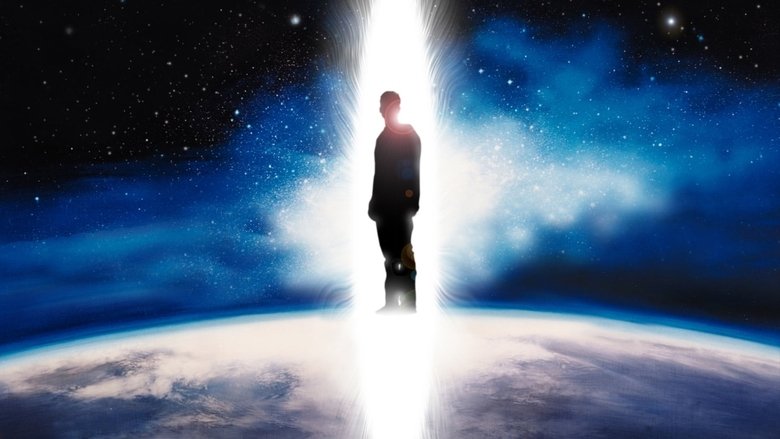
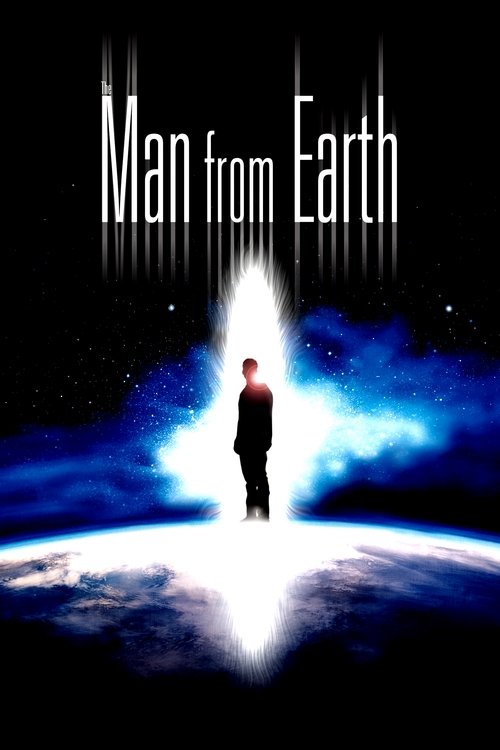
The Man from Earth
"From one of the acclaimed writers of Star Trek and The Twilight Zone comes a story that transcends both time and space..."
Overview
The Man from Earth centers on a spontaneous farewell party for Professor John Oldman, who abruptly resigns from his university post and packs up his life to move away. When his colleagues—a group of esteemed academics spanning various disciplines like biology, anthropology, and theology—press him for an explanation, John reluctantly offers a hypothetical scenario. He asks them to imagine a Cro-Magnon man from the Upper Paleolithic era who simply never aged and survived into the present day.
As the evening progresses, John shifts from speaking in hypotheticals to claiming that this is, in fact, his reality. He weaves a mesmerizing tale of walking the earth for 14,000 years, interacting with historical figures, and witnessing the dawn of human civilization. The single-room setting transforms into an intellectual battleground as his friends use their respective academic expertise to interrogate his claims.
Tensions rise as the group tries to determine if they are witnessing a miraculous truth, an elaborate psychological experiment, or the tragic mental breakdown of a beloved friend. The conversation pushes the boundaries of their lifelong beliefs, leading to a climax that challenges everything they know about science, history, and faith.
Core Meaning
The core meaning of The Man from Earth lies in its exploration of truth, belief, and the subjective nature of human history. Director Richard Schenkman and writer Jerome Bixby use the premise of an immortal man not to showcase epic historical battles, but to deconstruct the myths, religions, and social structures humanity has built to cope with mortality.
The film posits that history is an imperfect game of telephone, where simple truths are distorted by time, politics, and the human desperate need for the divine. Ultimately, it carries the message that eternal life would not be a state of godhood, but one of profound isolation, perpetual loss, and grounded, quiet observation.
Thematic DNA
The Nature of Religion and Myth
The film aggressively deconstructs how religious dogma and mythologies are born from mundane, misunderstood historical events. This is most powerfully revealed when John explains how his attempt to pass on simple Buddhist teachings morphed into the massive, supernatural myth of Jesus Christ.
The Burden of Immortality and Isolation
Unlike superhero narratives, eternal life here is framed as a tragedy. John's immortality forces him into a transient existence where he must abandon his identity and loved ones every ten years, ensuring he remains perpetually isolated from the rest of humanity.
The Subjectivity of Time and Memory
The narrative questions the human measurement of time. Through the academics, we see a rigid, clock-based view of history, while John's perspective highlights that time is merely an experiential flow, blurring the lines between centuries and making human history feel deeply personal and fluid.
Empiricism vs. Faith
The film acts as an intellectual crucible where the empirical methods of the scientists clash with the unprovable nature of John's claims. It reveals the limits of human knowledge, as the academics ultimately realize they can neither scientifically prove nor disprove his story.
Character Analysis
John Oldman
David Lee Smith
Motivation
Driven by an overwhelming sense of loneliness and a desire to say a genuine, truthful goodbye for once in his 14,000-year life.
Character Arc
John moves from guarded secrecy to a rare, vulnerable confession of his true nature. When the truth proves too destructive for his friends, he is forced to retract it, only for the tragic reality to inadvertently reveal itself at the end.
Dan
Tony Todd
Motivation
To intellectually explore the ultimate anthropological case study, regardless of its factual reality.
Character Arc
As an anthropologist, Dan serves as the intellectual anchor of the group. While others panic, he embraces the mental exercise, defending John's right to tell his story and urging the group to explore the possibilities.
Edith
Ellen Crawford
Motivation
To protect her deeply held religious beliefs and the spiritual worldview that gives her life meaning.
Character Arc
She starts as a compassionate friend but becomes deeply distressed, defensive, and ultimately heartbroken when John's narrative threatens the fundamental tenets of her Christian faith.
Dr. Will Gruber
Richard Riehle
Motivation
To expose John as a fraud or a madman in order to cope with his own overwhelming grief and mortality.
Character Arc
Grieving the recent loss of his wife, Will projects his anger and fear of death onto John. He moves from aggressive skepticism to violent confrontation, and finally to a tragic, fatal realization of John's identity.
Sandy
Annika Peterson
Motivation
To connect with John on a profound, emotional level, bypassing academic skepticism for love.
Character Arc
She starts as a colleague with a romantic interest and transitions into the only person who unconditionally accepts his impossible truth. She chooses to leave with him, embracing the fleeting nature of their shared future.
Symbols & Motifs
The Unrecognized Van Gogh Painting
It symbolizes the hidden truth of history and the discrepancy between the perceived value of an object and its mundane origin.
Edith discovers the painting early in the film, assuming it's a brilliant contemporary copy. It subtly foreshadows that John's unbelievable claims possess an authentic, historical reality that academic experts are unable to recognize.
The Moving Boxes
They symbolize transience, the nomadic nature of John's existence, and the perpetual cycle of leaving behind loved ones.
The boxes are present throughout the entire film, framing the living room where the conversation takes place, constantly reminding the audience and characters of John's impending, inevitable departure.
The Clock
It represents the artificial human construct of measuring time, contrasting with the fluid reality of eternity.
Dan explicitly discusses the concept of clocks during a philosophical debate, noting that the objective measure of a clock is only another clock, highlighting how John's perception of time transcends human tools.
Memorable Quotes
Every ten years or so, when people start to notice I don't age, I move on.
— John Oldman
Context:
Said early in his confession to explain the immediate reason for his sudden resignation and departure.
Meaning:
This line establishes the tragedy of his immortality. It reveals that eternal life is not about epic adventures, but a constant, lonely cycle of displacement and hiding.
The objective measure of a clock, is another clock.
— Dan
Context:
Spoken during a philosophical debate about how an immortal being would perceive the passage of time compared to normal humans.
Meaning:
Highlights the human obsession with measuring time and the realization that our concept of time is entirely artificial, self-referential, and subjective.
Piety is not what the lessons bring to people, it's the mistake they bring to the lessons.
— John Oldman
Context:
Delivered when John reveals his identity as the historical figure behind Jesus, explaining how his attempt to share Buddhist philosophy was distorted into a massive religion.
Meaning:
A profound critique of organized religion, suggesting that original teachings of love and simplicity are often corrupted by human ego and the desire to worship.
I never said I was immortal, just old. I might die. And then you could wonder the rest of your incarcerated life what you shot.
— John Oldman
Context:
Said when Dr. Will Gruber holds him at gunpoint, threatening to shoot him to test if he truly cannot die.
Meaning:
Emphasizes John's vulnerability. He isn't a god; he simply hasn't died yet. It brings the lofty sci-fi concept back to stark, fragile reality.
Philosophical Questions
Is time an objective reality or a purely subjective human construct?
The film explores this by contrasting the academics' strict chronological view of history with John's fluid, experiential memory. To a man who lives forever, decades blur into days, suggesting that our rigid measurement of time is merely a coping mechanism for our brief mortality.
How does human desperation for meaning create religious dogma?
Through John's revelation that he was the inspiration for Jesus, the film questions the origins of faith. It posits that humanity's fear of death and desire for a savior can distort simple philosophical teachings into supernatural religions, reflecting our profound need for a higher power.
Would immortality be a blessing or a curse?
Unlike superhero narratives, the film portrays eternal life as a tragic burden. John must endure the perpetual loss of everyone he loves and the exhausting necessity of constantly uprooting his life, suggesting that death is what gives human connections their ultimate value.
Alternative Interpretations
The beauty of the film's script is that it maintains deliberate ambiguity until the very last moments, allowing for multiple viewings and interpretations. One alternative interpretation favored by some viewers is the Psychological Experiment Theory: John Oldman is simply a brilliant, perhaps manipulative professor who orchestrates a grand thought experiment to test the intellectual and emotional boundaries of his peers. He knows their academic specialties and purposefully pushes their buttons to provoke a reaction.
Another reading is the Delusion Theory: John is genuinely suffering from a psychiatric break. In this interpretation, his vast academic knowledge has combined with an existential mid-life crisis, causing him to genuinely believe his own fabricated history. Even the final twist—where he knows the name of Will Gruber's father—could be interpreted as a devastating coincidence or knowledge he acquired through mundane means before the party, though the film's sequel definitively validates his immortality.
Cultural Impact
The Man from Earth represents a unique phenomenon in modern independent cinema. Released in 2007 with virtually no marketing budget, it bypassed traditional critical circuits and found its audience organically, largely fueled by internet piracy and word-of-mouth. The filmmakers' unprecedented embrace of file-sharing platforms transformed the film into a viral cult classic, proving that a high-concept, dialogue-driven story could captivate millions without CGI or action sequences.
Culturally, the film resonated deeply within secular and philosophical communities for its bold deconstruction of the Jesus narrative. By recontextualizing the biblical Christ figure as a Cro-Magnon man trying to pass on Buddhist teachings, it offered a thought-provoking, humanist interpretation of religious origins. The film has since become a staple in college philosophy and theology discussions, and its minimalist brilliance continues to inspire independent filmmakers to focus on strong writing over spectacle.
Audience Reception
The Man from Earth boasts an incredibly stark divide between mainstream critical awareness and audience adoration. On platforms like IMDb, audience scores are overwhelmingly positive. Viewers consistently praise the film's brilliant, thought-provoking screenplay and its ability to maintain gripping tension using only a conversation in a living room. Fans of hard sci-fi consider it a masterpiece of the genre, proving that high concepts don't require high budgets.
However, the film is not without its criticisms. Audiences frequently point out the glaringly low production values, which sometimes give it the feel of a made-for-TV movie or a community theater recording. Some of the acting, particularly in the more emotional outbursts, is often criticized as clunky or melodramatic. Additionally, the film's controversial take on Christianity alienated a subset of religious viewers, and the final twist involving Dr. Gruber is sometimes seen by critics as an unnecessary Hollywood addition to an otherwise perfectly ambiguous narrative.
Interesting Facts
- Acclaimed science fiction writer Jerome Bixby started writing the screenplay in the early 1960s and finally completed it on his deathbed in April 1998.
- The film was produced on a microscopic budget of around $200,000 and shot primarily using two Panasonic digital camcorders.
- After the movie was heavily pirated on BitTorrent networks, the filmmakers publicly thanked the file-sharing community for giving their obscure independent film a massive global audience, which eventually led to a surge in DVD sales and donations.
- The entire narrative is considered a 'bottle film' because it takes place almost exclusively in a single room, relying entirely on dialogue rather than special effects.
- A sequel titled 'The Man from Earth: Holocene' was released in 2017, exploring John Oldman's life in the digital age.
- Due to its single-room setting and dialogue-heavy script, the film was adapted into a widely performed stage play in 2008.
Easter Eggs
John Oldman's Name
The protagonist's surname is a literal, hidden-in-plain-sight pun reflecting his nature as an 'old man' who has lived for 14,000 years.
Historical Timeline Accuracy
John's account of his migrations—from a Sumerian, to a Babylonian, to sailing with Columbus—aligns with real anthropological and historical shifts, serving as an intellectual Easter egg for history buffs.
⚠️ Spoiler Analysis
Click to reveal detailed analysis with spoilers
Frequently Asked Questions
Explore More About This Movie
Dive deeper into specific aspects of the movie with our detailed analysis pages
Comments (0)
No comments yet. Be the first to share your thoughts!