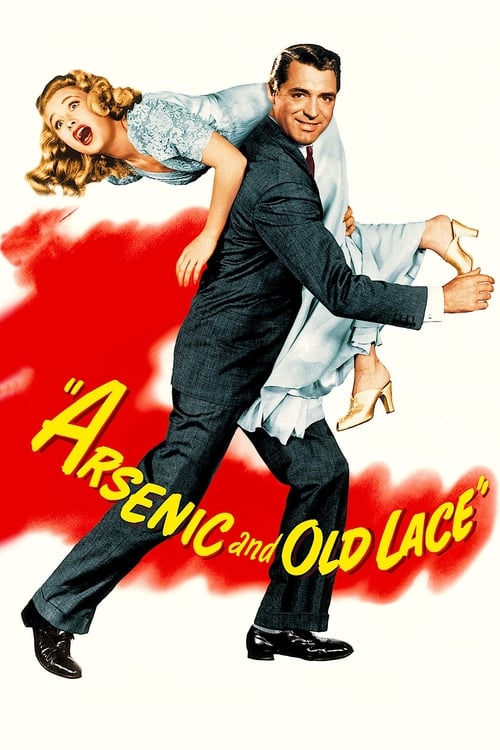
Arsenic and Old Lace
"She Passed Out On Cary! No Wonder . . . She's just discovered his favorite aunts have poisoned their 13th gentleman friend!"
Overview
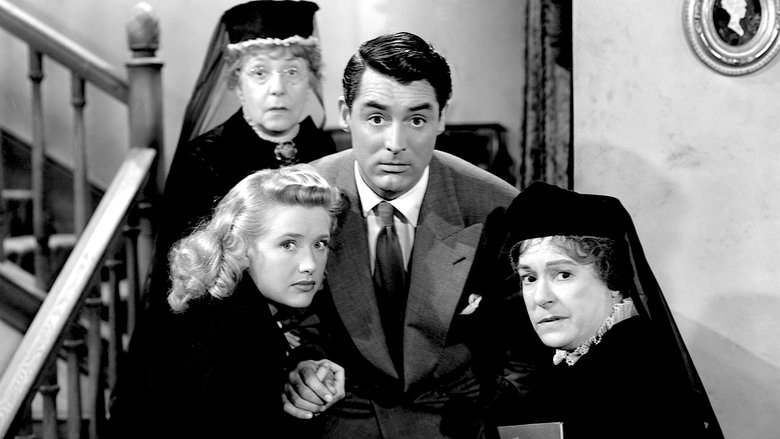
In this frantic dark comedy, Mortimer Brewster, a cynical theater and marriage critic, finally ties the knot with the girl next door, Elaine Harper. Before departing for their honeymoon in Niagara Falls, Mortimer stops by his childhood home in Brooklyn to share the good news with his sweet, elderly aunts, Abby and Martha, who raised him. However, his visit takes a macabre turn when he accidentally discovers a corpse hidden inside the living room window seat.
To Mortimer's absolute horror, his seemingly innocent aunts cheerfully confess that they have been poisoning lonely old men with arsenic-laced elderberry wine as an act of twisted charity. As Mortimer desperately tries to figure out how to handle the situation without sending his beloved aunts to prison, the chaos multiplies. His delusional brother Teddy, who believes he is Theodore Roosevelt, is blissfully digging graves in the cellar, thinking he is excavating the Panama Canal.
The situation escalates from a domestic nightmare to a criminal crisis with the sudden arrival of Mortimer's estranged, murderous brother, Jonathan, and his alcoholic plastic surgeon sidekick, Dr. Einstein. Jonathan brings a corpse of his own and a face that suspiciously resembles Boris Karloff, leading to a wildly entertaining clash between two very different types of killers under one roof.
Core Meaning
At its core, Arsenic and Old Lace is a satirical dismantling of the American ideal of wholesome domesticity and the notion that politeness equates to goodness. Frank Capra, known for his populist, uplifting tales, uses this pitch-black comedy to reveal the monsters lurking behind lace curtains and sweet smiles.
The film suggests that madness and violence are deeply ingrained in the American family tree—literally, as the Brewsters proudly trace their lineage back to the Mayflower and boast of ancestors who scalped Native Americans. By contrasting the polite serial killings of the aunts with the brutal murders committed by Jonathan, the director forces the audience to confront the absurdity of moral double standards, ultimately stating that civilized society often excuses horrific acts as long as they are done with a pleasant demeanor and a cup of tea.
Thematic DNA
The Facade of Civility and Respectability
The film brilliantly exposes the disconnect between outward manners and inner morality. Abby and Martha are the epitome of sweet, charitable, church-going old ladies, yet they are prolific serial killers. The film highlights how society often judges people based on their adherence to polite social norms rather than the actual impact of their actions.
The Absurdity of Morality and Justice
The narrative forces the audience to compare two types of murderers. The aunts kill out of misplaced sympathy, while Jonathan kills out of malice. Despite both having a body count of twelve, Jonathan is treated as a monster bound for prison, while the aunts are gently escorted to a comfortable rest home, satirizing the subjective nature of justice.
Family Legacy and Determinism
Mortimer is terrified of his bloodline, believing that the Brewster madness is an inescapable genetic curse. His frantic attempts to avoid consummating his marriage stem from the fear of passing on his family's insanity. The film plays with the anxiety of inheriting the sins and flaws of one's ancestors.
Sanity vs. Insanity
The film constantly blurs the line between the sane and the mad. Teddy is certifiably insane but completely harmless and happy. The aunts are deeply disconnected from reality but socially functional. Mortimer, the supposedly sane one, acts the most unhinged and frantic throughout the film, questioning what sanity truly looks like.
Character Analysis
Mortimer Brewster
Cary Grant
Motivation
To protect his aunts from going to prison, to get his new wife safely away from his homicidal family, and to prevent himself from succumbing to the Brewster madness.
Character Arc
Mortimer begins as a smug, self-assured intellectual who has just broken his own anti-marriage rules. Upon discovering the bodies, he spirals into absolute panic and physical exhaustion trying to protect his aunts. He ultimately finds salvation when he learns he is not a biological Brewster, allowing him to embrace a happy, sane future.
Abby and Martha Brewster
Josephine Hull and Jean Adair
Motivation
To provide charity and peace to lonely old men who have nothing left to live for, viewing murder as a compassionate public service.
Character Arc
The aunts remain completely static throughout the film, maintaining their cheerful, matronly demeanor from start to finish. Their absolute refusal to acknowledge the horror of their crimes is the anchor of the film's comedy.
Jonathan Brewster
Raymond Massey
Motivation
To find a safe place to undergo plastic surgery, hide from the law, and violently assert dominance over his childhood home and brother.
Character Arc
Jonathan arrives as a terrifying, dominant force seeking a safe haven. As the night progresses, his authority is constantly undermined by the absurdity of his family, until he is finally outsmarted, arrested, and infuriated to learn his aunts tied his murder record.
Dr. Herman Einstein
Peter Lorre
Motivation
Survival, avoiding the police, and finding a drink to steady his constant nerves.
Character Arc
Einstein enters as Jonathan's nervous lackey. As the danger escalates, he acts as the voice of reason and self-preservation, eventually seizing the opportunity to quietly slip away from the madness and escape arrest.
Teddy Brewster
John Alexander
Motivation
To fulfill his duties as the President of the United States, including digging the Panama Canal and attending cabinet meetings.
Character Arc
Teddy experiences no growth; he lives entirely within his own historical delusion, cheerfully carrying out orders and blowing his bugle until he is peacefully relocated to the Happy Dale Sanitarium.
Symbols & Motifs
Elderberry Wine
A symbol of deceptive appearances, misguided charity, and deadly comfort. It represents how evil can be cloaked in the most traditional, welcoming, and polite forms of Americana.
Served by the aunts in their cozy living room from a beautiful decanter, offered specifically to lonely old men under the guise of old-fashioned hospitality.
The Window Seat
It symbolizes the thin, fragile veil separating normal, respectable domestic life from dark, hidden horrors and madness.
Located directly in the center of the charming living room, it acts as a temporary holding cell for corpses before they are moved to the cellar, serving as the physical centerpiece of Mortimer's panic.
The Cellar (The Panama Canal)
It represents the burying of America's dark, violent history. Teddy's delusion of digging the Panama Canal masks the grim reality of mass graves, symbolizing how society sanitizes and hides its ugliest truths under the guise of progress and patriotism.
Teddy spends the film cheerfully digging graves in the basement, unknowingly assisting his aunts in covering up their serial murders.
Memorable Quotes
Insanity runs in my family... It practically gallops.
— Mortimer Brewster
Context:
Mortimer says this to Elaine in a moment of sheer panic while trying to push her out of the house to protect her from discovering his murderous aunts.
Meaning:
This is the definitive line of the film, perfectly encapsulating Mortimer's dread of his family's genetic disposition for madness and violence.
I'm not a Brewster. I'm the son of a sea-cook! Ha! Ha! Chaaaaarrrge!
— Mortimer Brewster
Context:
Shouted in the final scene as Mortimer joyously runs out of the house, mimicking Teddy's signature bugle charge, to embrace his new bride.
Meaning:
This exclamation represents Mortimer's absolute joy and relief at discovering he is illegitimate, meaning he won't inherit the family madness. The original stage line was "I'm a bastard!" but was changed due to the Hollywood Production Code.
The gentleman died because he drank some wine with poison in it.
— Abby Brewster
Context:
Abby politely explains the situation to a horrified Mortimer after he discovers the body in the window seat, completely failing to understand his alarm.
Meaning:
A perfect showcase of the aunts' complete disconnect from the horrific nature of their actions. The line is delivered with the casual, helpful tone of someone sharing a cooking recipe.
He said I looked like Boris Karloff!
— Jonathan Brewster
Context:
Jonathan angrily complains about a man who gave them a ride, explaining why he murdered him and brought his body into the house.
Meaning:
A brilliant meta-joke. Jonathan is deeply offended by the comparison to the famous horror star, unaware that the audience knows Karloff originated the role on Broadway.
You got twelve, they got twelve. The old ladies is just as good as you are!
— Dr. Einstein
Context:
Dr. Einstein points this out to a furious Jonathan after discovering the bodies in the cellar, deflating Jonathan's ego as a master murderer.
Meaning:
This quote highlights the absurdity of the moral scales in the film, pointing out that the sweet old ladies are just as prolific at killing as the hardened, terrifying criminal.
Philosophical Questions
Does a polite demeanor and good intentions excuse monstrous actions?
The film explores this by contrasting the aunts' charitable murders with Jonathan's malicious ones. Because the aunts are sweet and believe they are doing a good deed, the audience and the other characters instinctively want to protect them, raising questions about how much weight we give to intent versus the horrific outcome of an action.
Are we doomed by our genetics and family history?
Mortimer spends the entire film in dread of his own bloodline, convinced that the Brewster madness will inevitably consume him. The film asks whether individuals have free will to break away from toxic family legacies, a question famously resolved here by a convenient loophole of illegitimacy rather than a philosophical triumph.
What separates harmless eccentricity from dangerous insanity?
Teddy is completely delusional but poses no direct threat, while his aunts seem socially functional but are prolific killers. The film challenges the viewer to define what truly makes someone a danger to society, highlighting how polite society often ignores quiet, systematic violence.
Alternative Interpretations
An Allegory for America's Violent Past: Many cultural critics interpret the Brewster home as a microcosm of the United States. The family's colonial lineage (tracing back to the Mayflower), Teddy's imperialist delusions regarding the Spanish-American War, and the literal burying of bodies in the cellar serve as a metaphor for a nation that masks its violent history beneath a veneer of polite, civilized innocence.
A Critique of the Justice System: The film's conclusion presents a stark double standard. Jonathan, who is scarred and looks like a monster, is sent to a harsh prison for his crimes. Meanwhile, the sweet-looking aunts, who have the exact same body count, are gently sent to a comfortable sanitarium. This can be read as a cynical commentary on how privilege, appearance, and social standing dictate the severity of justice.
Spiritual vs. Psychological Evil: Some analyses question the nature of the aunts' crimes. Are they truly evil, or simply insane? By having them committed to a rest home rather than facing trial, the film leans into a psychological explanation, arguably letting the audience off the hook so they can continue to laugh without confronting the reality of serial murder.
Cultural Impact
Historical Context: Filmed on the brink of America's entry into World War II but released at its height in 1944, Arsenic and Old Lace provided a highly effective, cathartic release for audiences. Its lighthearted, macabre treatment of death offered a much-needed escape from the grim, real-world casualty reports of the war, demonstrating that society could still find humor in the darkest of subjects.
Influence on Cinema: The film remains a foundational pillar of the black comedy genre. Frank Capra, typically associated with sentimental Americana (such as It's a Wonderful Life or Mr. Smith Goes to Washington), proved that subversive, morbid material could be a massive mainstream success. It laid the groundwork for the blend of the macabre and the mundane that would later popularize properties like The Addams Family and The Munsters.
Critical Reception and Legacy: The film was a massive commercial and critical hit. Cary Grant's frantic, highly physical performance became legendary, defining the archetype of the exasperated, manic protagonist in a screwball farce. Today, it is universally recognized as a definitive Halloween classic and one of the sharpest, most impeccably paced comedies of Hollywood's Golden Age.
Audience Reception
Praise and Highlights: Audiences and critics have historically heaped praise on the film's breakneck pacing, razor-sharp dialogue, and phenomenal ensemble cast. Cary Grant's athletic, double-taking physical comedy is widely regarded as the driving engine of the film. Supporting performances, particularly Peter Lorre's nervous Dr. Einstein and Josephine Hull's cheerfully lethal Aunt Abby, are frequently cited as scene-stealing masterpieces.
Criticisms: The primary point of criticism, interestingly shared by Cary Grant himself, is that Mortimer's panic can sometimes veer into exhausting overacting. Some modern viewers find the manic energy slightly overwhelming, and a few note that the film's stage origins are obvious due to the static single-set location.
Overall Verdict: Despite minor critiques of its theatricality, Arsenic and Old Lace is universally beloved as a masterpiece of dark screwball comedy. It currently holds a near-perfect rating on aggregate sites and remains a highly re-watchable staple for classic film fans, proving that a brilliant script and impeccable timing never age.
Interesting Facts
- The film was shot in late 1941, but Warner Bros. agreed to delay its theatrical release until the Broadway play finished its run. Because the play was a massive hit, the film wasn't released to the general public until 1944.
- During the delay, Jack Warner allowed the film to be screened for American soldiers stationed overseas to boost morale. Soldiers were watching and laughing at the film long before domestic audiences.
- Boris Karloff originated the role of Jonathan Brewster on Broadway. Capra wanted him for the film, but the play's producers refused to let him out of his contract, fearing it would hurt ticket sales. Raymond Massey was cast instead, heavily made up to look like Karloff.
- Cary Grant notoriously hated his performance in the film. He felt his acting was overly frantic and forced, though critics and audiences later celebrated it as a masterclass in physical comedy.
- Cary Grant donated his entire $160,000 salary for the film to the war effort, splitting it between the USO, the American Red Cross, and British war relief funds.
- The plot was loosely inspired by a real-life series of murders. Amy Archer-Gilligan, who ran a nursing home in Connecticut, poisoned dozens of her elderly residents with arsenic and strychnine between 1907 and 1917.
Easter Eggs
The 'Archie Leach' Tombstone
During a scene in the cemetery next to the Brewster house, one of the tombstones clearly bears the name Archie Leach. This is Cary Grant's actual birth name, serving as a brilliant, macabre inside joke about his Hollywood reinvention.
Constant Boris Karloff References
The film features a running gag where characters tell Jonathan Brewster that he looks exactly like Boris Karloff. This is a massive meta-joke, as Boris Karloff originally played Jonathan in the Broadway play and was an investor in the production, profiting from the joke even while absent from the screen.
George Washington Slept Here
Officer O'Hara jokingly asks if George Washington ever slept in the Brewster home. This is an inside nod to Warner Bros. studios, as the massive, expensive Brewster house set was later remodeled and reused for the 1942 film George Washington Slept Here.
⚠️ Spoiler Analysis
Click to reveal detailed analysis with spoilers
Frequently Asked Questions
Explore More About This Movie
Dive deeper into specific aspects of the movie with our detailed analysis pages
Comments (0)
No comments yet. Be the first to share your thoughts!