Warning: full spoilers, including the outcome of the case.
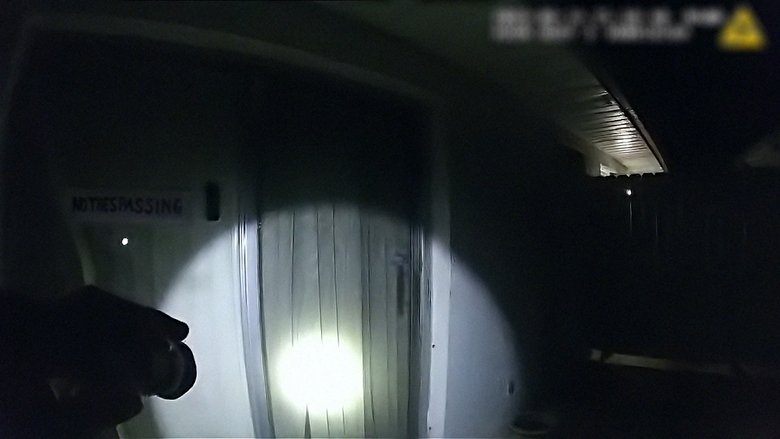
The escalation. Over roughly two years in Ocala, Florida, Susan Lorincz — a 58-year-old white woman renting a home beside an open grassy lot — repeatedly calls the Marion County Sheriff's Office about the Black and mixed-race children who play there, including the four children of her neighbor Ajike 'AJ' Owens, a 35-year-old Black mother. The film presents these contacts chronologically through body-cam footage. Deputies come, listen, mediate, and leave. Neighbors describe Lorincz using racial slurs and hurling objects. Nothing in the system registers the accumulation as a pattern requiring action.
June 2, 2023. Lorincz throws a pair of roller skates at Owens's nine-year-old son. Owens walks to Lorincz's home to confront her about it. Moments after Owens arrives at the doorstep, Lorincz — behind a dead-bolted front door — fires through it, striking and killing Owens in front of one of her children. The detail of the locked door is the case's fulcrum: it makes any claim of imminent, unavoidable danger physically implausible.
The delay and the interrogation. Lorincz is not immediately arrested; Florida's Stand Your Ground law obliges investigators to weigh her self-defense claim, and the film's dread in this stretch comes from the real possibility she will never be charged — the exact fear that prompted producer Nikon Kwantu to start documenting the case. The film's centerpiece is the roughly twenty-minute, uncut police interview. Lorincz builds and rebuilds her story in real time; her account of the threat she faced shifts, and it is contradicted both by physical evidence and by neighbors' statements. Gandbhir refuses to cut it into incriminating highlights, letting the unraveling happen at its own pace so the audience reaches the conclusion unprompted.
Charges and verdict. On June 7, 2023, Lorincz is charged with manslaughter with a firearm, culpable negligence, battery and two counts of assault. She is convicted. Judge Robert Hodges sentences her to 25 years in prison, finding that she was under no imminent threat and calling the shooting 'completely unnecessary.'
The ending's meaning. The formal shock is that the four-day trial — the natural climax of any conventional true-crime film — is compressed by editor Viridiana Lieberman into a two-minute sequence that plays over the closing credits. This is the film's thesis delivered structurally: the conviction is a footnote. What matters is the ninety minutes preceding it, in which every warning sign was recorded, witnessed and legally unactionable. A system that documents a killing perfectly and prevents it not at all has not succeeded; it has merely archived its own failure.
What becomes clear only in retrospect. On a second viewing, the early nuisance calls stop reading as petty and start reading as a paper trail being assembled — a record of 'fear' that could later be deployed as a defense. The deputies' patient de-escalations, initially reassuring, become the mechanism by which the situation was repeatedly returned to its unstable baseline. And the footage of AJ Owens scattered through the film, which first registers as incidental context, is revealed as the only record of her that will survive — the film's quiet counter-purpose, using the surveillance archive to give a woman back the personhood the case would otherwise have erased. Pamela Dias's grief, which frames the aftermath, is the film's insistence that four children, not a legal principle, are what was actually lost.