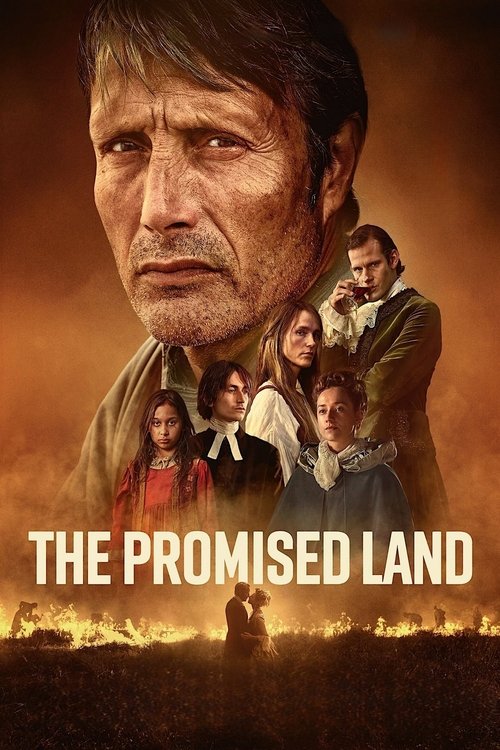
The Promised Land
A visceral Nordic Western set on the unforgiving Jutland heath, where a stoic soldier's burning ambition to tame the wild clashes with sadistic nobility. A tale of potatoes, blood, and the realization that love blooms in the harshest soil.
The Promised Land

The Promised Land

Bastarden

"A captain’s ambition, a ruthless rival, and a land that defies them both."

05 October 2023 Denmark 127 min ⭐ 7.7 (525)
Director: Nikolaj Arcel
Cast: Mads Mikkelsen, Amanda Collin, Simon Bennebjerg, Kristine Kujath Thorp, Gustav Lindh
Drama History Action
Man vs. Nature Class and Social Mobility Found Family Order vs. Chaos
Budget: $8,500,000
Box Office: $2,246,680

Overview

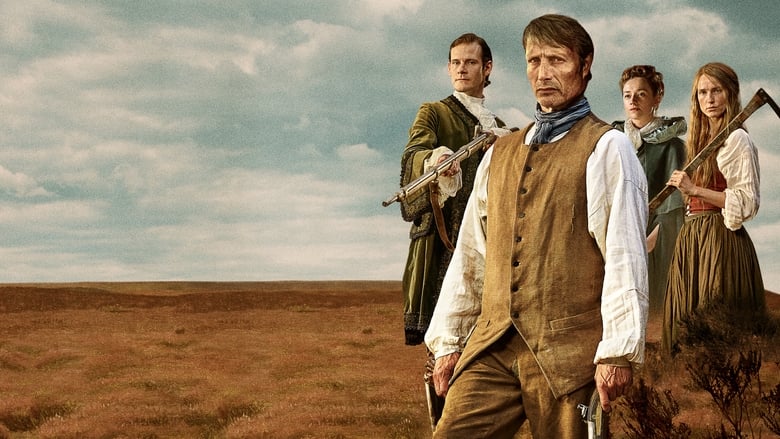
In 1755, the destitute but proud Captain Ludvig Kahlen arrives on the barren Jutland heath with a single-minded goal: to follow the King's call to cultivate the land and earn a noble title. The heath is a desolate expanse of heather and sand, considered untamable by locals, but Kahlen is armed with stubborn discipline and a secret weapon—the potato. He establishes a fragile homestead, recruiting a runaway serf couple, Johannes and Ann Barbara, and reluctantly taking in a reviled Romani orphan, Anmai Mus.

His efforts draw the ire of the merciless local landowner, Frederik De Schinkel, who views the heath as his personal property despite the King's decree. De Schinkel unleashes a campaign of terror, humiliation, and violence to drive Kahlen away. As Kahlen battles the brutal elements and De Schinkel's cruelty, he must decide if his lifelong pursuit of a title is worth the sacrifice of the makeshift family that has grown around him.
Core Meaning

At its heart, The Promised Land is a deconstruction of ambition versus connection. Director Nikolaj Arcel presents a world where the pursuit of status (the noble title) and order (cultivating the heath) is ultimately hollow without human warmth. The film argues that true nobility is not granted by a King but is found in the courage to protect those you love. It juxtaposes the Enlightenment ideal of taming nature with the chaotic reality of human cruelty, suggesting that while the earth can be subdued, the human heart requires a different kind of cultivation.

Thematic DNA

Man vs. Nature 30%
Class and Social Mobility 25%
Found Family 25%
Order vs. Chaos 20%

Man vs. Nature

The heath acts as a formidable antagonist—a barren, windswept void that resists Kahlen's plow. It represents the indifference of the natural world to human ambition. The film explores the Enlightenment era's obsession with imposing order and 'civilization' upon the wild, symbolized by Kahlen's grid-like maps and the resilient potato.

Class and Social Mobility

The original title, Bastarden, highlights the central conflict of legitimacy. Kahlen, a bastard son of a nobleman and a maid, strives to 'earn' his stripes and transcend his station. This is contrasted with De Schinkel, who inherited everything yet possesses no honor. The film critiques the rigidity of the 18th-century class system.

Found Family

Kahlen starts as a solitary figure but inadvertently builds a family with Ann Barbara and Anmai Mus. The film charts his slow transformation from viewing them as tools for his success to recognizing them as his true 'promised land.' It challenges the definition of family, moving beyond bloodlines to bonds forged in shared hardship.

Order vs. Chaos

Kahlen represents stoic order, discipline, and the belief that rules can tame the world. De Schinkel represents pure, sadistic chaos and entitlement. Their conflict is philosophical as well as physical: the belief that the world makes sense versus the belief that 'life is chaos' and power is the only truth.

Character Analysis

Ludvig Kahlen

Mads Mikkelsen

Archetype: The Stoic Hero / The Builder
Key Trait: Unwavering Determination

Motivation

To obtain a noble title and wipe away the stain of his illegitimate birth (being a 'bastard').

Character Arc

Starts as a rigid, solitary man obsessed with status and 'taming' the land. Through suffering and loss, he learns that his ambition is a prison. He evolves from a servant of the King to a protector of his found family, ultimately choosing love over the title he spent his life seeking.

Ann Barbara

Amanda Collin

Archetype: The Survivor / The Avenger
Key Trait: Fierce Resilience

Motivation

Survival and later, vengeance for her husband Johannes.

Character Arc

Begins as a fleeing serf defined by her husband's fate, but emerges as the film's moral and physical spine. She transforms suffering into ferocious agency, delivering the ultimate justice to the villain and forcing Kahlen to see what truly matters.

Frederik De Schinkel

Simon Bennebjerg

Archetype: The Tyrant / The Sadist
Key Trait: Petulant Cruelty

Motivation

To maintain absolute power and prove that 'life is chaos' and he is its master.

Character Arc

A static character representing pure entitlement and chaos. He devolves into increasing madness and cruelty as his control is challenged, ultimately meeting a violent end brought about by his own hubris.

Anmai Mus

Melina Hagberg

Archetype: The Outcast / The Catalyst
Key Trait: Innocent Wisdom

Motivation

To find a home and acceptance.

Character Arc

A marginalized Romani girl who forces Kahlen to confront his own prejudices and capacity for care. She is the bridge between Kahlen's cold ambition and his dormant heart.

Symbols & Motifs

The Potato

Meaning:

Symbolizes resilience, innovation, and survival against the odds. It is the humble vessel for Kahlen's grand ambition, thriving in soil where nothing else can grow, mirroring Kahlen's own stubborn nature.

Context:

Kahlen guards his sacks of German potatoes with his life, planting them in the frozen ground. The first sprout is a moment of triumph akin to a military victory.

The Heath

Meaning:

Represents the untamable, indifferent void. It is a visual metaphor for the emptiness of ambition without love and the harsh reality that strips away social pretenses.

Context:

Dominates the visual landscape with wide, bleak shots of purple heather and grey skies, constantly threatening to swallow the characters' efforts.

The Stripe

Meaning:

A visual representation of honor, legitimacy, and the King's favor. It embodies Kahlen's desperate need for external validation of his worth.

Context:

Kahlen meticulously polishes his uniform and references his rank. The promise of the noble title (and the stripe that comes with it) drives his entire journey until he ultimately rejects it.

Boiling Water

Meaning:

Symbolizes the ultimate cruelty and the fragility of the human body against tyranny. It represents the chaotic destruction De Schinkel brings.

Context:

Used by De Schinkel to torture and kill Johannes, a horrific act that catalyzes Ann Barbara's path to vengeance.

Memorable Quotes

The heath cannot be tamed.

— Local Official

Context:

Said to Kahlen at the Royal Treasury when he proposes his plan to cultivate the Jutland heath.

Meaning:

Establish the central conflict: the impossible nature of Kahlen's task and the skepticism of the world.

I can subdue the earth.

— Ludvig Kahlen

Context:

Kahlen's response to the officials, asserting his will against the barren landscape.

Meaning:

Highlights Kahlen's Enlightenment-era hubris and his belief that discipline can conquer nature.

Life is chaos.

— Frederik De Schinkel

Context:

De Schinkel lecturing Kahlen during a dinner, justifying his arbitrary cruelty.

Meaning:

Summarizes the villain's nihilistic worldview, which stands in direct opposition to Kahlen's desire for order.

We are not leaving.

— Ludvig Kahlen

Context:

After De Schinkel attacks the settlement and kills the workers, Kahlen refuses to retreat.

Meaning:

Demonstrates Kahlen's extreme stubbornness, even when faced with death and ruin.

Philosophical Questions

Does the end justify the means?

Kahlen is willing to use people, risk lives, and sacrifice his own happiness to achieve his 'great work.' The film asks whether the legacy of the settlement is worth the blood spilled to build it.

Can order truly exist in a chaotic world?

Kahlen tries to impose geometric order (surveying lines, planted rows) on a chaotic world (the heath, De Schinkel's madness). The film suggests that true order is an illusion, and life's beauty lies in accepting the messy, uncontrollable connections between people.

What defines a family: blood or bond?

The film starkly contrasts De Schinkel's blood-relation claim to power (which produces a monster) with Kahlen's makeshift family of outcasts (which produces love and loyalty), arguing that blood is irrelevant to true kinship.

Alternative Interpretations

Some critics view the film as a Biblical Allegory, with Kahlen as a Job-like figure tested by God (or Nature) with endless suffering before finding his true purpose. Others interpret it as a Critical Western, where the 'civilizing' of the frontier is shown not as heroic progress, but as a violent, destructive act that alienates man from nature and himself. The ending is often debated: is it a 'happy ending' where he chooses love, or a tragic resignation that a man like him can never truly change the system, only escape it?

Cultural Impact

The Promised Land revitalized the 'Nordic Western' genre, drawing comparisons to American classics like Shane or There Will Be Blood but transposed to the Scandinavian heath. It sparked cultural conversations in Denmark about the country's feudal history, the harsh reality of the serfdom era (Stavnsbåndet), and the treatment of the Romani people ('Taterne'). Internationally, it cemented Mads Mikkelsen's reputation as one of the world's premier leading men, capable of carrying a film with minimal dialogue. It swept the European Film Awards, winning Best Actor for Mikkelsen and Best Cinematography.

Audience Reception

Audience reception has been overwhelmingly positive, with a 96% Fresh rating on Rotten Tomatoes. Viewers praised the visceral cinematography and Mikkelsen's commanding, stoic performance. The 'old school' epic filmmaking style was a major highlight, with many appreciating the tangible, practical sets over CGI. However, some audience members criticized the film's brutality, particularly the torture scenes, finding them difficult to watch. A minority felt the villain was too cartoonishly evil, lacking nuance compared to Kahlen's complexity.

Interesting Facts

  • The film's original Danish title is 'Bastarden' (The Bastard), referring to Kahlen's illegitimate birth, but was changed to 'The Promised Land' for international markets to evoke a more epic, biblical feel.
  • Though set in the Danish Jutland heath, the film was shot primarily in the Czech Republic and Germany to find landscapes that matched the uncultivated 18th-century look.
  • Based on the 2020 bestseller 'The Captain and Ann Barbara' by Ida Jessen.
  • Director Nikolaj Arcel and Mads Mikkelsen previously collaborated on the Academy Award-nominated 'A Royal Affair' (2012).
  • Historically, the real Ludvig von Kahlen did try to cultivate the heath, but unlike the movie's romanticized ending, he eventually gave up and left after years of failure.
  • The intense scene where Johannes is boiled to death uses a practical effects rig; the actor was safe, but the visceral nature of the scene shocked test audiences.
  • Mads Mikkelsen learned to ride horses and use 18th-century surveying tools for the role to ensure authenticity.
  • The film was Denmark's official submission for the Best International Feature Film at the 96th Academy Awards and made the December shortlist.

Easter Eggs

Barry Lyndon Lighting

The interior scenes at De Schinkel's manor are lit almost exclusively by candlelight, a direct visual homage to Stanley Kubrick's Barry Lyndon, emphasizing the period authenticity and the oppressive atmosphere of the nobility.

The 'Heroic Bastard' Trope

The film plays with the literary trope where a 'bastard' character possesses more natural nobility than the legitimate heirs. De Schinkel mocks Kahlen for being a bastard, yet acts with zero honor himself, inverting the social hierarchy.

Reference to 'A Royal Affair'

The film serves as a thematic 'spiritual sequel' or mirror to Arcel's previous film A Royal Affair. While the former focused on the court bringing Enlightenment to the people, this film focuses on the outskirts where the Enlightenment ideas (Kahlen's science) clash with feudal brutality.

⚠️ Spoiler Analysis

Click to reveal detailed analysis with spoilers

Frequently Asked Questions

Explore More About This Movie

Dive deeper into specific aspects of the movie with our detailed analysis pages

Comments (0)

Leave a comment

No comments yet. Be the first to share your thoughts!