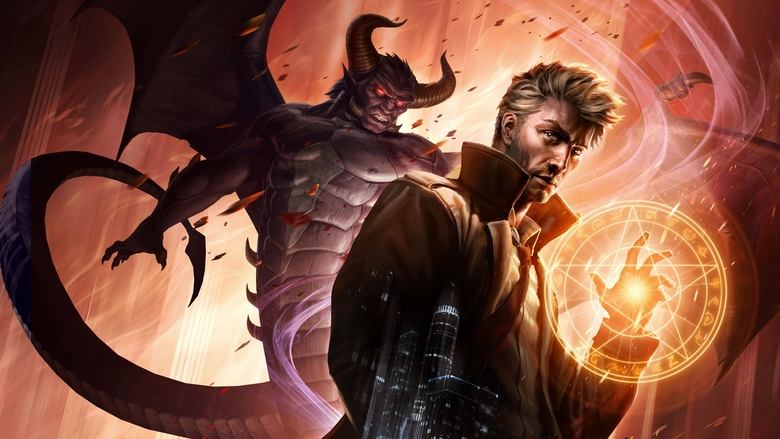
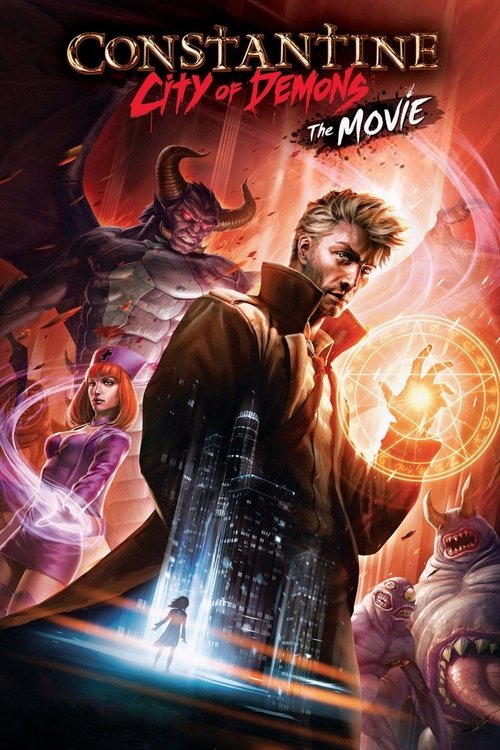
Constantine: City of Demons - The Movie
A dark fantasy noir plunging into the occult underbelly of Los Angeles, where magic is a transaction paid in blood and memories. The film juxtaposes the glitz of Hollywood with rotting demonic corruption, using the visual metaphor of literal inner demons to externalize the protagonist's crushing guilt.
Constantine: City of Demons - The Movie

Constantine: City of Demons - The Movie

"To stop a devil, you must summon a bigger one."

04 October 2018 United States of America 90 min ⭐ 7.7 (644)
Director: Doug Murphy
Cast: Matt Ryan, Robin Atkin Downes, Laura Bailey, Rachel Kimsey, Jim Meskimen
Animation Fantasy Action Horror
The Cost of Magic Guilt and Inner Demons Friendship vs. Duty Surface vs. Rot

Overview

Decades after a tragic mistake in Newcastle cost a young girl her soul, occult detective John Constantine is drawn back into the fray when his oldest friend, Chas Chandler, seeks help for his comatose daughter, Trish. Constantine discovers that Trish's soul has been stolen by a powerful demon named Beroul, who is operating out of a mansion in Los Angeles. To save her, John and Chas must travel to the "City of Angels," only to find it teeming with hellspawn and dark magic.

As they navigate the neon-lit corruption of L.A., they form an uneasy alliance with the enigmatic Nightmare Nurse and the brutal Aztec death god Mictlantecuhtli. However, the mission reveals a deeper conspiracy: Beroul is merely a disguise for Constantine's arch-nemesis, Nergal, the very demon responsible for John's original trauma. In a high-stakes gambit to outsmart the devil, Constantine is forced to make an impossible choice that will save the innocent but cost him the only real human connection he has left.
Core Meaning

The film explores the inescapable nature of guilt and the transactional reality of magic. Unlike typical superhero narratives where victory is absolute, this story posits that every supernatural act demands a balance. The director uses Constantine's journey to show that true heroism often requires a sacrifice far greater than physical death: the erasure of love and memory. Ultimately, it argues that redemption is not a destination, but a continuous, painful burden that must be carried alone.

Thematic DNA

The Cost of Magic 35%
Guilt and Inner Demons 25%
Friendship vs. Duty 20%
Surface vs. Rot 20%

The Cost of Magic

Magic is depicted not as a superpower but as a dangerous trade with consequences. Every spell extracts a toll, culminating in the Camdever Curse, which saves a life but destroys the emotional bonds of a family, emphasizing that there are no "happy endings" in Constantine's world.

Guilt and Inner Demons

John's psychological trauma is literalized through the manifestation of miniature, trench-coated "inner demons" that physically attack him. His entire motivation is driven by the guilt of the Newcastle incident, proving he is fighting his past as much as the actual demons.

Friendship vs. Duty

The bond between John and Chas is the emotional core of the film. John is willing to damn himself to help his friend, yet his "duty" as a magus forces him to betray that friendship by erasing Chas's memories to protect him, highlighting the isolating nature of his path.

Surface vs. Rot

Los Angeles is presented as a duality: a city of hope and glamour on the surface, but built on a foundation of suffering and demonic corruption. This mirrors the villain Beroul, who masks his true, horrific identity (Nergal) behind a facade of business-like civility.

Character Analysis

John Constantine

Matt Ryan

Archetype: Tragic Anti-Hero
Key Trait: Ruthless Pragmatism

Motivation

To atone for the "Newcastle Incident" (damning Astra) and to protect his only friend, Chas, from the magical world.

Character Arc

Starts as a reclusive cynic haunted by his past; reluctantly helps his friend; ends up making a ruthless, self-sacrificing decision that saves the day but leaves him more isolated than ever.

Chas Chandler

Damian O'Hare

Archetype: The Loyal Companion / Everyman
Key Trait: Unwavering Loyalty

Motivation

To save his daughter Trish from a supernatural coma.

Character Arc

Begins as a desperate father willing to do anything for his daughter; proves his bravery alongside John; ends as a tragic figure who is saved but stripped of his memories of his best friend.

Nergal (Beroul)

Jim Meskimen

Archetype: The Deceiver / Arch-Villain
Key Trait: Hubris

Motivation

To expand his dominion by creating a branch of Hell on Earth in Los Angeles.

Character Arc

Initially appears as the grotesque businessman Beroul; reveals himself as the demon lord Nergal; is ultimately destroyed by his own arrogance and the power of love he underestimated.

Asa (The Nightmare Nurse)

Laura Bailey

Archetype: The Healer / Mystic Ally
Key Trait: Mystical Competence

Motivation

To preserve the balance and protect the innocent from demonic predation.

Character Arc

Serves as a supernatural medic and guide; aids Constantine despite knowing his reputation; reinforces the theme that magic requires community and support.

Symbols & Motifs

The Inner Demons

Meaning:

They symbolize John's fracturing psyche and the specific guilt of damning Astra Logue to Hell. They are his self-loathing made flesh.

Context:

Early in the film, John is attacked in his apartment by tiny, grotesque versions of himself, which he must reabsorb into his subconscious.

Beroul's Pool of Corpses

Meaning:

Represents the predatory nature of Hollywood and the "City of Angels," where dreams literally decay into a cesspool of death.

Context:

Inside the villain's mansion, John stumbles upon a literal pool filled with rotting bodies, contrasting with the luxury of the estate.

The Camdever Curse

Meaning:

Symbolizes the ultimate sacrifice of love. It represents the idea that safety and ignorance are purchased at the cost of emotional truth.

Context:

Used in the climax to destroy Nergal, the spell is powered by the sacrifice of Trish and Renee's love for Chas, and Chas's memory of John.

Memorable Quotes

Abraca-fucking-dabra.

— John Constantine

Context:

Said during a moment of casting a spell, highlighting his blue-collar approach to wizardry.

Meaning:

Encapsulates John's cynical, irreverent attitude toward the mystical arts. He treats magic as a dirty job rather than a divine gift.

No price is too high when it comes to my little girl.

— Chas Chandler

Context:

Chas pleading with John to help him save Trish at the beginning of the film.

Meaning:

Sets up the central tragedy of the film. Chas is willing to pay any price, unaware that the price will be his own memories of his family's love.

Tell me that after you've paid it, mate.

— John Constantine

Context:

John's grim response to Chas's declaration that he would pay any price.

Meaning:

Foreshadows the heartbreaking ending. John knows from experience that the "price" of magic is always higher and more personal than anyone expects.

This is on you, John Constantine.

— Chas Chandler

Context:

When the situation looks dire and they are trapped by demons.

Meaning:

A moment of accusation that pierces John's armor, reinforcing his guilt and responsibility for the danger his friends are in.

Philosophical Questions

Is a life saved worth a life forgotten?

The film asks if physical survival is meaningful without the emotional connections that define humanity. By saving Trish at the cost of her memories of her father, Constantine forces a utilitarian outcome that feels like a spiritual defeat.

Can one ever truly make amends for the past?

John's entire existence is a penance for Newcastle. The film suggests that redemption is impossible; one can only mitigate future harm. His 'inner demons' are not just metaphors but realities, implying that guilt is a permanent constituent of the self.

Alternative Interpretations

Some critics view the film not just as a supernatural thriller, but as a critique of Hollywood. The villain Beroul is a producer-like figure who literally consumes souls to build his empire, and the "City of Angels" is revealed to be run by demons. The ending can be interpreted as a deconstruction of the "love conquers all" trope; here, weaponizing love destroys the relationships it is meant to save, suggesting that in a corrupt world, purity is a liability that must be sacrificed for survival.

Cultural Impact

Constantine: City of Demons solidified Matt Ryan as the definitive modern incarnation of the character, bridging the gap between live-action and animation. Released during a resurgence of interest in R-rated superhero content (following Logan and Deadpool), it demonstrated that DC animation could handle mature, horror-centric themes without dilution. Culturally, it helped keep the Hellblazer property alive after the cancellation of the NBC show, paving the way for Constantine's integration into the Arrowverse and the Justice League Dark animated films. It is praised by fans for being closer to the grit and cynicism of the original Vertigo comics than many other adaptations.

Audience Reception

The film received generally positive reviews from fans and critics, holding a fresh rating on review aggregators. Audiences praised the R-rated tone, allowing for the gore and dark magic essential to the Hellblazer identity. Matt Ryan's voice performance was universally acclaimed. Criticism was mostly directed at the animation quality, which some found stiff or budget-constrained compared to theatrical releases, and the pacing issues resulting from its origin as a stitched-together web series.

Interesting Facts

  • The film is a loose adaptation of the graphic novel Hellblazer: All His Engines by Mike Carey.
  • Originally released as a web series on CW Seed consisting of five short episodes, then compiled and expanded into a feature-length R-rated movie.
  • Matt Ryan, who voices Constantine, also played the character in the live-action NBC series and Legends of Tomorrow.
  • Rachel Kimsey voices Angela (the spirit of L.A.); she ironically voiced Wonder Woman in the kid-friendly Justice League Action.
  • In the original comic, Beroul is the main villain, but the movie retcons him as a disguise for Nergal to tie it into Constantine's origin story.
  • Laura Bailey voices both the innocent victim Trish and the powerful Nightmare Nurse (Asa).
  • The movie features a specific reference to Benedict Cumberbatch, implying the Marvel Cinematic Universe exists as fiction within this DC universe.

Easter Eggs

Benedict Cumberbatch Reference

John sarcastically mentions the actor, a nod to Cumberbatch playing Dr. Strange, another master of the mystic arts, acknowledging the rival franchise.

The Newcastle Incident

The film depicts the summoning of Nergal and the loss of Astra Logue. This is a foundational event in Hellblazer lore, though the specific details here (flashbacks) differ slightly from the live-action TV show's version.

Mictlantecuhtli

The Aztec god of the dead appears as a major character. This is a direct lift from the All His Engines graphic novel, showcasing the film's deep cuts into Vertigo lore.

Ravenscar Psychiatric Facility

Mentioned as the place John was committed to after the Newcastle tragedy, a key location in both the comics and the TV series.

⚠️ Spoiler Analysis

Click to reveal detailed analysis with spoilers

Frequently Asked Questions

Explore More About This Movie

Dive deeper into specific aspects of the movie with our detailed analysis pages

Comments (0)

Leave a comment

No comments yet. Be the first to share your thoughts!