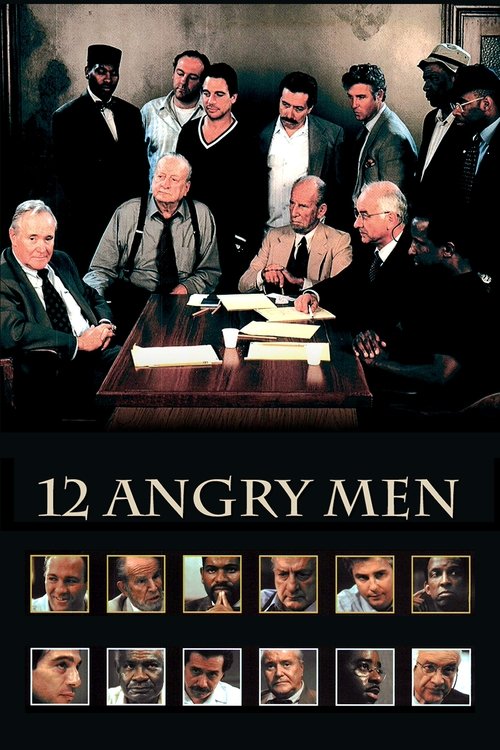
12 Angry Men
Courtroom Drama / Claustrophobic Thriller. A sweltering pressure cooker of conflicting morals and hidden biases, where a single voice of doubt cuts through the thick air of prejudice like a switchblade, forcing twelve men to confront their own reflections.
12 Angry Men

12 Angry Men

17 August 1997 United States of America 117 min ⭐ 7.7 (420)
Director: William Friedkin
Cast: Courtney B. Vance, Ossie Davis, George C. Scott, Armin Mueller-Stahl, Dorian Harewood
Drama TV Movie
The Universality of Prejudice Reasonable Doubt vs. Certainty Personal Trauma Projecting as Justice Classism and Social Indifference
Budget: $1,750,000
Box Office: $2,000,000

Overview

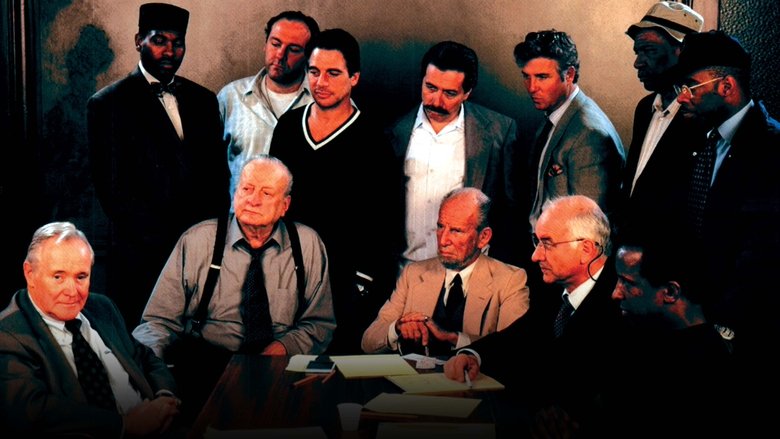
In this intense 1997 adaptation of the classic teleplay, twelve jurors are locked in a stifling deliberation room to decide the fate of a Hispanic teenager accused of stabbing his abusive father to death. What begins as an open-and-shut case with an 11-1 vote for conviction quickly unravels into a psychological war of attrition.

Led by the dissenting Juror #8 (Jack Lemmon), who harboring reasonable doubt, the group is forced to re-examine the evidence piece by piece. As the temperature rises, the facade of civility crumbles, revealing the jurors' deep-seated prejudices, personal traumas, and indifference. The deliberation becomes less about the facts of the crime and more about the character of the men deciding the verdict.

Director William Friedkin updates the setting and cast to reflect a more diverse, modern America, yet the core conflict remains timeless. The film explores the fragility of justice when it rests in the hands of flawed human beings, culminating in a tense emotional breakdown that exposes the true motivation behind the final holdout's vote.

Core Meaning

The film posits that justice is not automatic but a strenuous, active process that requires empathy, reason, and the courage to stand alone. It serves as a mirror to society, suggesting that the legal system's integrity depends entirely on the citizens who uphold it. By diversifying the cast, this version specifically highlights that prejudice is a universal human flaw, not limited to any single race or background, and that reasonable doubt is the essential safeguard against the tyranny of the majority.

Thematic DNA

The Universality of Prejudice 30%
Reasonable Doubt vs. Certainty 30%
Personal Trauma Projecting as Justice 20%
Classism and Social Indifference 20%

The Universality of Prejudice

Unlike the original, which focused on white-on-white bias, this version creates a complex web of racial and class tension. Juror #10 (Mykelti Williamson), a Black man, launches a bigoted tirade against the Hispanic defendant, illustrating that racism and xenophobia can exist within any community. The film argues that bias is a human condition that must be constantly checked.

Reasonable Doubt vs. Certainty

The central conflict is the shift from the lazy certainty of 'facts' to the difficult work of doubt. Juror #8 demonstrates that democracy requires patience and the willingness to question authority. The film shows how 'irrefutable' evidence (the knife, the witness testimony) can degrade under scrutiny, symbolizing the difference between truth and legal proof.

Personal Trauma Projecting as Justice

Through Juror #3 (George C. Scott), the film explores how personal vendettas distort objective judgment. His desire to punish the defendant is revealed to be a misplaced desire to punish his own estranged son. This theme serves as a warning that 'justice' can often be a mask for personal revenge.

Classism and Social Indifference

Several jurors, particularly Juror #7 (Tony Danza) and Juror #12 (William Petersen), treat the trial as an inconvenience, prioritizing baseball games or their careers over a human life. The film critiques the apathy of the privileged (or merely distracted) classes toward the plight of the marginalized.

Character Analysis

Juror #8

Jack Lemmon

Archetype: The Moral Crusader / The Catalyst
Key Trait: Empathy

Motivation

To prevent a miscarriage of justice through the rigorous application of reasonable doubt.

Character Arc

Starts as the lone dissenter, not asserting innocence but demanding discussion. He systematically dismantles the prosecution's case through logic and empathy. He evolves from a quiet architect to the conductor of the jury's conscience.

Juror #3

George C. Scott

Archetype: The Antagonist / The Tragic Bully
Key Trait: Rage

Motivation

Retribution against his estranged son, projected onto the young defendant.

Character Arc

A loud, aggressive businessman who dominates the room with intimidation. His arc is a slow psychological stripping; as his arguments are debunked, he is left with only his raw pain, culminating in a tearful breakdown where he confuses the defendant with his own son.

Juror #10

Mykelti Williamson

Archetype: The Bigot
Key Trait: Prejudice

Motivation

Tribalism and bigotry; the belief that 'those people' are inherently criminal.

Character Arc

A former Nation of Islam member whose prejudice drives his guilty vote. He devolves from valid arguments into a hateful, incoherently racist diatribe against 'them' (Hispanics), eventually isolating himself from even the other guilty voters.

Juror #11

Edward James Olmos

Archetype: The Observer / The Patriot
Key Trait: Integrity

Motivation

Respect for democracy and the privilege of civic duty.

Character Arc

An immigrant watchmaker who deeply respects the American justice system. He moves from quiet observation to becoming the voice of democratic idealism, chastising those who treat the law lightly.

Juror #4

Armin Mueller-Stahl

Archetype: The Logician
Key Trait: Rationality

Motivation

Logic and order; he wants the correct result based on the data presented.

Character Arc

A stoic stockbroker who relies purely on cold, hard facts. He is the most formidable opponent to Juror #8 because his bias is intellectual, not emotional. He flips only when presented with rational evidence regarding the eyeglasses.

Symbols & Motifs

The Switchblade

Meaning:

A symbol of perceived reality vs. actual possibility. It represents the prosecution's 'unique' evidence until Juror #8 produces an identical one, shattering the illusion of certainty.

Context:

Introduced dramatically when Juror #8 jams an exact duplicate of the murder weapon into the table, instantly visually validating the concept of reasonable doubt.

The Eye Glasses

Meaning:

Symbolizes clarity and blindness. The physical act of seeing is linked to the intellectual act of understanding. It represents the key to unlocking the truth behind the eyewitness testimony.

Context:

Juror #9 notices Juror #4 rubbing the marks on his nose, realizing the key witness likely wore glasses and couldn't have seen the murder clearly without them. This revelation turns the tide for the rational Juror #4.

The Electric Fan

Meaning:

Represents the rising and cooling of tensions. The heat mirrors the jurors' anger; when the fan finally works (or the rain starts), it signals a shift in the room's dynamic and a cooling of tempers.

Context:

The jurors struggle with the broken fan in the stifling heat during the most heated arguments; its eventual activation coincides with the momentum shifting toward acquittal.

The Baseball Tickets

Meaning:

Symbolizes triviality and civic apathy. It highlights the dangerous indifference of those who view civic duty as an obstacle to their personal entertainment.

Context:

Juror #7 constantly checks his watch and references the Yankees game, showing he would condemn a man to death simply to not miss the first pitch.

Memorable Quotes

It's not easy for me to raise my hand and send a boy off to die without talking about it first.

— Juror #8 (Jack Lemmon)

Context:

Spoken at the very beginning when he is the only one to vote 'Not Guilty', stalling the immediate verdict the others expected.

Meaning:

The film's thesis statement. It emphasizes that due process is a moral burden that requires time and thought, rejecting the haste of the majority.

We have a reasonable doubt, and this is a safeguard that has enormous value in our system. No jury can declare a man guilty unless it's sure.

— Juror #8 (Jack Lemmon)

Context:

During the mid-point deliberation as the tide begins to turn and the concept of 'doubt' gains traction.

Meaning:

Defines the legal and philosophical core of the story: the protection of the innocent is more important than the punishment of the guilty.

You don't really mean you'll kill me, do you?

— Juror #8 (Jack Lemmon)

Context:

Spoken calmly to Juror #3 after deliberately provoking him into screaming 'I'll kill him!', proving that people say things in anger they don't mean.

Meaning:

exposes the difference between literal intent and hyperbole, undermining the prosecution's argument that the boy's shout of 'I'm gonna kill you' was a definitive statement of intent.

Rotten kids. You work your life out...!

— Juror #3 (George C. Scott)

Context:

The climax of the film, as Juror #3 tears up the photo of his son and collapses, finally changing his vote to 'Not Guilty'.

Meaning:

The final, broken admission that reveals his true motivation. He isn't talking about the defendant anymore; he is mourning the relationship with his own son.

Philosophical Questions

Is 'Reasonable Doubt' a flaw or a feature?

The film asks whether it is better to let a guilty man go free than to convict an innocent one. It explores the moral threshold of certainty required to take a human life, suggesting that 'doubt' is the highest form of civilized justice.

Can true objectivity ever exist?

Every juror interprets the 'facts' through the lens of their own past—slums, sports, business, or family. The film questions if objective truth is attainable, or if a verdict is always just a consensus of subjective biases.

What is the responsibility of the individual in a democracy?

Through Juror #8, the film posits that democracy is not passive. It argues that citizenship requires courage—the courage to be the 'one' against the 'eleven' and to disrupt the comfortable status quo for the sake of what is right.

Alternative Interpretations

The 'Guilty' Theory: Some viewers and critics argue that the boy did actually kill his father, and Juror #8 simply manipulated the group dynamics to secure an acquittal based on possibilities rather than probabilities. This reading suggests the film is about the power of persuasion rather than the discovery of truth.

The Ghost of the Son: Juror #3's breakdown can be interpreted not just as anger, but as a form of vicarious suicide. By condemning the boy, he is metaphorically killing the son who rejected him; by letting him go, he is finally accepting the loss of his own child.

Cultural Impact

While overshadowed by the monumental status of the 1957 Sidney Lumet original, the 1997 remake holds significant cultural weight for its modernization of the American jury. By introducing a racially diverse cast (including four Black jurors) and a female judge, it updated the dialogue on prejudice to reflect the complexities of the late 20th century. It is often used in educational settings alongside the original to discuss evolving social dynamics and the timeless nature of the judicial process. Critics praised the powerhouse performances, particularly George C. Scott's, noting that the film successfully translated the stage play's claustrophobia for a modern TV audience, proving that the story's core themes of justice and civic responsibility are ageless.

Audience Reception

General Consensus: The film is widely regarded as a worthy and well-acted remake that justifies its existence through its updated cast and intense performances.

Praised: Viewers universally acclaim the performances of Jack Lemmon and George C. Scott, with many finding Scott's emotional collapse more visceral than the original. The modernization of the dialogue and diversity was also seen as a necessary update.

Criticized: Purists often compare it unfavorably to the 1957 masterpiece, citing the TV-movie cinematography and sometimes 'shouty' acting as less subtle than the original. Some felt the updated racial dynamics were occasionally heavy-handed.

Verdict: A solid 7/10, seen as an excellent acting showcase even if it lives in the shadow of the original.

Interesting Facts

  • This was one of George C. Scott's final performances; he passed away two years later in 1999. His portrayal of the rage-filled Juror #3 was acclaimed as a fitting capstone to a legendary career.
  • William Friedkin directed this version with a faster, more kinetic pace than the original, often using handheld cameras to create a 'documentary' feel similar to episodes of 'Homicide' or 'Law & Order'.
  • The Judge in this version is a woman (Mary McDonnell), marking a significant update from the all-male legal authority presence in the 1957 film.
  • Juror #11, played by Edward James Olmos, is changed from a European refugee (in the original) to an immigrant watchmaker, allowing for a modern commentary on the 'American Dream'.
  • Jack Lemmon and George C. Scott had previously co-starred in the 1960 classic 'The Apartment' (though they shared no scenes) and widely in theater, making their confrontation here a clash of acting titans.
  • Unlike the 1957 original where Juror #10 is a white nativist, Mykelti Williamson's Juror #10 is portrayed as a bitter former Nation of Islam member, flipping the racial dynamic to explore prejudice within minority groups.
  • James Gandolfini (Juror #6) was cast in this film just two years before his breakout role as Tony Soprano in 'The Sopranos'.

Easter Eggs

Casting of William Petersen

William Petersen plays Juror #12, an advertising executive who is easily swayed. Petersen would later become famous for playing Gil Grissom in CSI: Crime Scene Investigation, a character defined by his unshakeable dedication to forensic evidence—the exact opposite of his character here.

The fan malfunction

The fan not working for most of the movie is a direct homage to the original film, serving as a persistent metaphor for the heated atmosphere. Its sudden activation acts as a release valve for the audience's tension.

⚠️ Spoiler Analysis

Click to reveal detailed analysis with spoilers

Frequently Asked Questions

Explore More About This Movie

Dive deeper into specific aspects of the movie with our detailed analysis pages

Comments (0)

Leave a comment

No comments yet. Be the first to share your thoughts!