Skip to content
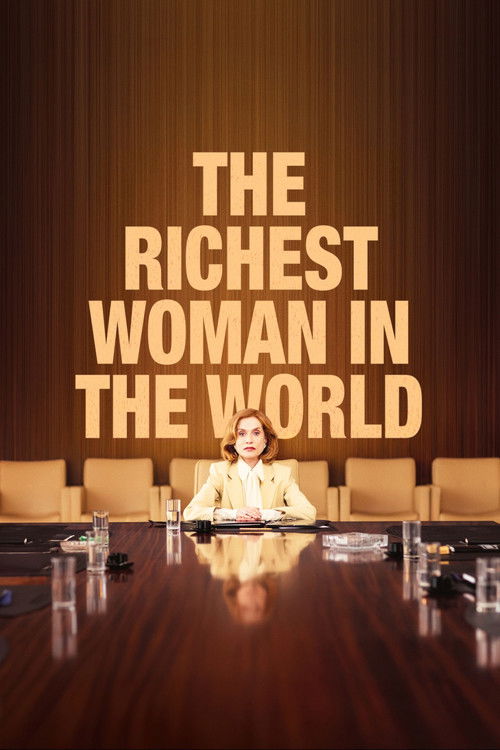
The Richest Woman in the World
A gilded, satirical bourgeois melodrama where suffocating dynastic loneliness clashes with predatory flamboyance—capturing cold, marble corridors slowly unraveled by manic laughter, velvet eccentricities, and the bitter reckoning of ancestral guilt.
The Richest Woman in the World

The Richest Woman in the World

La Femme la plus riche du monde

29 October 2025 France 121 min 6.2 (138)

Director: Thierry Klifa

Cast: Isabelle Huppert, Laurent Lafitte, Marina Foïs, Raphaël Personnaz, André Marcon

Drama Comedy The Transactional Nature of Affection and Loneliness Dynastic Entitlement vs. Familial Estrangement The Grotesque Absurdity of the Bourgeoisie Historical Complicity, Guilt, and Secrets
Box Office: $7,740,474

Overview

The Richest Woman in the World (La Femme la plus riche du monde), directed and co-written by Thierry Klifa alongside Cédric Anger and Jacques Fieschi, is a satirical comedy-drama inspired by the notorious real-life Bettencourt affair. The narrative centers on Marianne Farrère (Isabelle Huppert), the fabulously wealthy matriarch and principal shareholder of the international cosmetics titan Windler Group. Trapped in an emotionally sterile marriage to her conservative politician husband Guy (André Marcon) and surrounded by sycophantic corporate advisors, Marianne leads a life that is meticulously curated yet devoid of vitality.

Everything changes when Marianne agrees to a rare media photoshoot designed to humanize her public standing. There, she crosses paths with Pierre-Alain Fantin (Laurent Lafitte), an irreverent, openly gay photographer and writer whose vulgarity, boundary-pushing insolence, and flamboyant theatricality instantly shatter her dreary routine. Captivated by his vivacity, Marianne draws Pierre-Alain into her inner sanctum, lavishing him with astronomical financial gifts, luxury estates, and life insurance policies.

This sudden alliance sends shockwaves through the Farrère dynasty. Marianne’s estranged, anxious daughter Frédérique (Marina Foïs) views Pierre-Alain as a manipulative parasite taking advantage of an aging matriarch’s vulnerability. Frédérique initiates a legal and personal crusade to protect the family empire, triggering a high-stakes psychological war observed quietly by the family's discreet butler, Jérôme Bonjean (Raphaël Personnaz).


Core Meaning

Thierry Klifa explores how obscene dynastic wealth acts not merely as a privilege, but as an emotional prison and an insulator against reality. The film highlights the tragic absurdity of ultra-rich domestic life, where genuine human connection cannot exist without a financial transaction attached. Through Marianne and Pierre-Alain’s transaction of money for companionship and amusement, Klifa questions the line between affection and exploitation, while dissecting the generational transmission of trauma and ancestral secrets within high-bourgeois dynasties built on murky moral foundations.

Thematic DNA

The Transactional Nature of Affection and Loneliness 30%
Dynastic Entitlement vs. Familial Estrangement 25%
The Grotesque Absurdity of the Bourgeoisie 25%
Historical Complicity, Guilt, and Secrets 20%

The Transactional Nature of Affection and Loneliness

The core dynamic between Marianne and Pierre-Alain illustrates how extreme wealth commodifies intimacy. Marianne does not simply give gifts out of delusion; she willingly pays an exorbitant retainer to purchase vitality, amusement, and an escape from domestic gloom.

Dynastic Entitlement vs. Familial Estrangement

The mother-daughter conflict between Marianne and Frédérique exposes the breakdown of genuine emotional communication, which has been entirely replaced by legal procedures, forensic audits, and corporate damage control.

The Grotesque Absurdity of the Bourgeoisie

Channeling French theatrical traditions such as Molière's Tartuffe and Claude Chabrol's social satires, the film skewers the manners, hypocrisy, and emotional paralysis of France's industrial elite.

Historical Complicity, Guilt, and Secrets

Beneath the comedic friction lies an examination of how French industrial fortunes accrued dark ancestral secrets, including wartime compromises and institutionalized prejudices, that resurface when the dynasty turns on itself.

Character Analysis

Marianne Farrère

Isabelle Huppert

Archetype: Matriarch / Tragic Sovereign Key Trait: Cutting wit masked behind aristocratic composure

Motivation

To escape the suffocating propriety of her life and experience spontaneous, uncurated joy before her mental faculties decline.

Character Arc

Transitions from an untouchable, meticulously polished industrialist into a defiant yet deteriorating woman who chooses to squander her fortune out of spite and amusement.

Pierre-Alain Fantin

Laurent Lafitte

Archetype: Flamboyant Jester / Manipulative Charlatan (Tartuffe figure) Key Trait: Unapologetic insolence and infectious theatrical energy

Motivation

To live grandly, fund his artistic ambitions, and establish unshakeable dominion over high society.

Character Arc

Evolves from an eccentric social-climbing artist into an aggressive, indispensable companion whose brazenness brings him to the verge of legal destruction.

All 5 characters and cast

Symbols & Motifs

The Camera / Photographic Portraits

Meaning:

Serves as a tool of seductive flattery and vulnerability. It captures Marianne not as an aging corporate figurehead, but as an aesthetic muse, granting her the illusion of eternal youth and artistic relevance.

Context:

Introduced during their initial photoshoot meeting and recurring as Pierre-Alain photographs Marianne in intimate, theatrical settings.

The Signature / Checkbook

Meaning:

Represents the commodification of power, autonomy, and affection, functioning both as an instrument of control and a weapon of personal spite against heirs.

Context:

Shown repeatedly as Marianne transitions from signing routine corporate documents to willingly signing away vast portions of her fortune to Pierre-Alain.

The Gilded Mansion / Closed Estate

Meaning:

Represents emotional petrification, isolation, and domestic imprisonment amidst immense luxury.

Context:

The Farrère private residence, framed as an insulated fortress and museum where family members pace like caged animals.

Secret Audio Recordings

Meaning:

Signifies the complete destruction of privacy and the invisible, simmering class conflict within the high-bourgeois household.

Context:

Planted secretly by the butler Jérôme in Marianne's private salon on the orders of her daughter Frédérique.

Memorable Quotes

« La femme la plus riche du monde a le droit de s’amuser, non ? »
— Marianne Farrère

Context

Delivered when confronted about the exorbitant gifts and financial assets she lavishes upon Pierre-Alain.

Meaning

Highlights Marianne's unapologetic defiance and her conscious decision to view her immense wealth as a means to purchase personal amusement.

« Vous n’avez pas besoin d’un héritier de plus, Marianne. Vous avez besoin d’un peu de folie. »
— Pierre-Alain Fantin

Context

Spoken during an intimate exchange to solidify his indispensability in Marianne's life.

Meaning

Defines the terms of their transactional relationship, framing his presence not as greed but as an antidote to existential despair.

All 3 quotes

Philosophical Questions

Can unconditional love or companionship exist when vast sums of money are involved?

Explored through the ambiguous bond between Marianne and Pierre-Alain, where genuine warmth is indistinguishable from financial incentivization.

Where does eccentric personal liberty end and mental incapacity begin?

Examined through the family's legal battle regarding abus de faiblesse (abuse of weakness) and whether squandering an inheritance constitutes legal insanity.

Does an heir have an innate moral right to an inherited dynastic fortune, or belongs it entirely to the person who holds it?

Depicted through the bitter war between Frédérique's sense of dynastic entitlement and Marianne's absolute defiance in distributing her wealth.

How do family institutions curate historical memory to wash away ancestral guilt?

Addressed via the unearthing of hidden bank accounts, political influence peddling, and historical complicities buried beneath aristocratic decorum.

Alternative Interpretations

The film supports multiple readings:

  • Transactional Liberation: Marianne is fully cognizant of Pierre-Alain's opportunism and purposefully uses her wealth to purchase vital companionship and escape domestic despair.
  • The Tragedy of Elder Parasitism: Pierre-Alain operates as a calculating predator exploiting cognitive decline and familial estrangement for astronomical enrichment.
  • The Purging of Dynastic Rot: Pierre-Alain acts as an anarchic agent of chaos who exposes the buried hypocrisies, anti-Semitism, and moral bankruptcy of an aristocratic industrial family.

Full ending explanation

Cultural Impact

The film addresses the historical Bettencourt scandal that captivated French society and politics during the late 2000s and 2010s. By reframing the saga into an intimate psychological chamber drama, the film emphasizes high-bourgeois decay and emotional isolation over courtroom technicalities. The movie grossed approximately $7.3 million across European theatrical markets following its October 2025 release.

Audience Reception

Audience and critical reception highlighted the following key points:

  • Praised Elements: The comedic and dramatic chemistry between Isabelle Huppert and Laurent Lafitte, Lafitte's award-winning performance, Hichame Alaouié's elegant cinematography, and sharp dialogue.
  • Criticisms: A somewhat repetitive middle-act pacing and a tendency to soften the broader political scale of the real scandal in favor of domestic drama.
  • Verdict: Regarded as a sophisticated, bitingly funny French tragicomedy anchored by a stellar ensemble cast.

Interesting Facts

  • The film reunites Isabelle Huppert and Laurent Lafitte, who previously starred opposite each other in Paul Verhoeven's acclaimed thriller Elle (2016).
  • The film celebrated its world premiere Out of Competition at the 78th Festival de Cannes on May 18, 2025.
  • Laurent Lafitte won the César Award for Best Actor (Meilleur acteur) at the 51st César Awards in February 2026 for his performance.
  • Director Thierry Klifa co-wrote the screenplay with acclaimed French writer-directors Cédric Anger and Jacques Fieschi.
  • The original score was composed by Alex Beaupain, a frequent collaborator of Thierry Klifa.
  • The project was produced by Mathias Rubin via Récifilms as a Franco-Belgian co-production with Versus Production, RTBF, and Haut et Court.

Easter Eggs

Parallels to the Real-Life Bettencourt Affair

The fictional Windler Group mirrors cosmetics titan L’Oréal, Marianne Farrère represents Liliane Bettencourt, Pierre-Alain Fantin parallels François-Marie Banier, and Frédérique represents Françoise Bettencourt-Meyers.

Molière's Tartuffe Structure

The narrative arc mirrors classical French theatrical farce, where an audacious outsider ingratiates himself with a wealthy figure while the desperate family attempts to expose his deceit.

Homage to Claude Chabrol

The satirical dissection of bourgeois decay, household surveillance, and domestic betrayal directly pays tribute to Chabrol's social thrillers such as La Cérémonie.

Frequently Asked Questions

Explore More About This Movie

Dive deeper into specific aspects of the movie with our detailed analysis pages

Comments (0)

Leave a comment

No comments yet. Be the first to share your thoughts!

Similar Movies