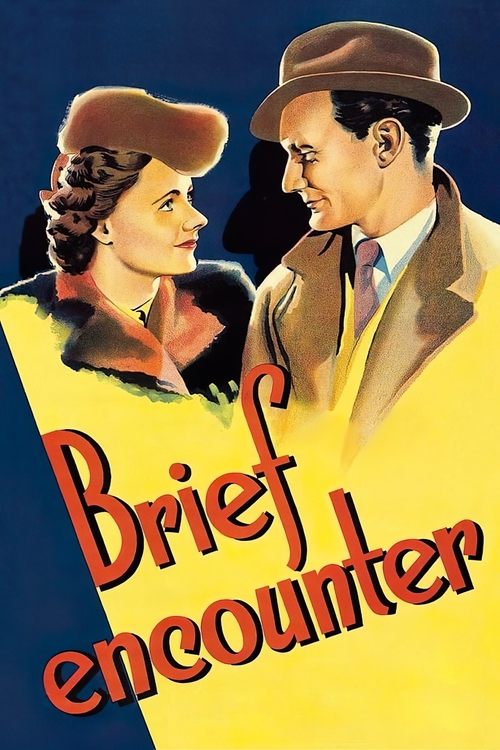
Brief Encounter
"A story of the most precious moments in a woman's life!"
Overview
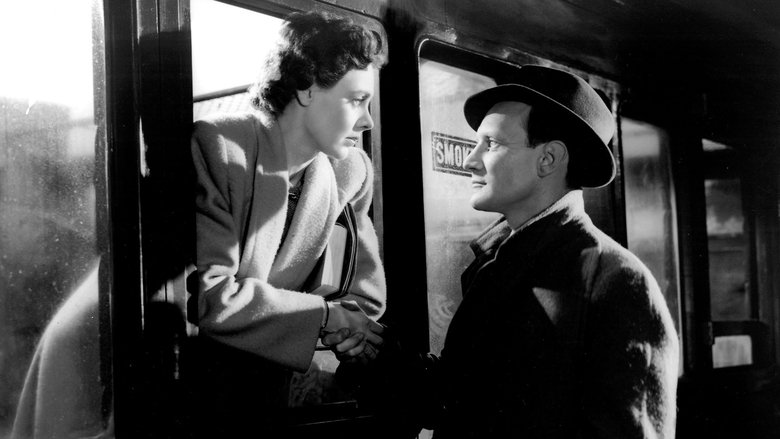
Laura Jesson (Celia Johnson) is a respectable middle-class housewife living a contented but mundane life in the suburbs. Her weekly routine changes forever when she meets Dr. Alec Harvey (Trevor Howard) in the refreshment room of Milford Junction railway station after he removes a piece of grit from her eye. What begins as a casual acquaintance over tea quickly blossoms into an intense emotional affair, played out in the brief intervals between their trains.
Narrated by Laura as a mental confession to her husband while he sits oblivious in their living room, the film traces the couple's spiraling romance. They share innocent outings to the cinema and countryside, but the pressure of their growing love collides with their overwhelming sense of decency and moral obligation. As the guilt of their emotional infidelity mounts and the risk of exposure grows, they are forced to make a heart-wrenching decision about their future.
Core Meaning
The Triumph of Decency over Desire: Brief Encounter is not merely a romance, but a tragedy of ordinary people confronting 'violent' emotions they are ill-equipped to handle. Director David Lean and writer Noël Coward argue that for the British middle class of the era, personal happiness is secondary to moral integrity and social responsibility. The film suggests that the most profound love is sometimes demonstrated not by seizing what you want, but by letting it go to preserve the dignity and stability of others.
Thematic DNA
Duty vs. Desire
The central conflict of the film. Laura and Alec are torn between their undeniable passion for each other and their deep-seated loyalty to their spouses and families. The film explores the agony of having to choose 'right' over 'happy'.
The Mundane vs. The Romantic
The film constantly juxtaposes the banality of everyday life (shopping, tea, gossiping acquaintances) with the heightened reality of the lovers' internal world. The intrusion of the mundane (like Dolly Messiter) is what ultimately suffocates their romance.
Guilt and Middle-Class Morality
Social judgment looms large. Laura's paranoia about being seen and her internal shame drive the narrative. The fear is not just of being caught, but of becoming 'sordid' and losing one's self-respect.
Transience and Time
The railway setting emphasizes that their time is borrowed and fleeting. The clock on the platform is a constant reminder that their moments are numbered, reinforcing the theme that nothing beautiful can last in their reality.
Character Analysis
Laura Jesson
Celia Johnson
Motivation
She seeks to reconcile her sudden, overwhelming love for Alec with her identity as a virtuous wife and mother.
Character Arc
She moves from contentment to turbulent awakening, then to guilt-ridden despair, and finally returns to resignation. Her journey is entirely internal, traveling from the safety of routine to the precipice of emotional destruction and back.
Dr. Alec Harvey
Trevor Howard
Motivation
He is driven by a connection that transcends his professional and domestic dissatisfaction, yet is bound by his code of honor.
Character Arc
Alec experiences a similar awakening but is more proactive in pursuing the relationship. However, his fundamental decency eventually forces him to accept that he must leave to save them both from shame.
Fred Jesson
Cyril Raymond
Motivation
To maintain a stable, comfortable home life.
Character Arc
He remains static throughout, representing the safety and dullness of home. However, his final gesture reveals a depth of understanding previously hidden.
Dolly Messiter
Everley Gregg
Motivation
To gossip and fill the silence.
Character Arc
She serves as a plot device, unwittingly destroying the couple's final moment together. She represents the trivial, chattering world that has no space for tragedy.
Symbols & Motifs
The Railway Station
A place of transition and limbo. It represents the 'brief' nature of their encounter—a space where they are suspended between their real lives (home) and their fantasy life (together).
Almost all key moments—the meeting, the developing romance, and the final goodbye—occur at Milford Junction, amidst the steam and noise.
Grit in the Eye
The catalyst for intimacy. It represents how a tiny, irritation or accident can penetrate one's defenses and alter the course of a life.
The affair begins physically when Alec touches Laura to remove the grit, breaching the social distance between strangers.
The Express Train
Uncontrollable passion and danger. It disrupts the quiet domesticity of the station and represents the violent emotions Laura fears.
The express train rushes through the station, shaking the ground. In the climax, it becomes a symbol of the death impulse as Laura briefly considers suicide.
Rachmaninoff's Piano Concerto No. 2
The turbulent internal landscape of Laura's heart. It provides the emotional release that the repressed characters cannot verbally express.
Used throughout the soundtrack, often swelling during Laura's internal monologues or moments of high romantic tension.
Memorable Quotes
I fell in love. I'm an ordinary woman. I didn't think such violent things could happen to ordinary people.
— Laura Jesson
Context:
Spoken in Laura's internal narration as she reflects on the affair while sitting at home.
Meaning:
This quote encapsulates the film's central thesis: that intense passion is not reserved for the melodramatic heroes of fiction, but can strike (and devastate) regular people.
I want to die. If only I could die...
— Laura Jesson
Context:
Laura's internal thought during the agonizing final scene in the refreshment room while Dolly chatters on.
Meaning:
Expresses the absolute despair of the parting. The pain of separation is equated with death.
You've been a long way away.
— Fred Jesson
Context:
The very last line of the film, spoken by Fred after Laura returns from her near-suicide attempt.
Meaning:
A line of immense empathy. It suggests Fred knows something happened, or at least that Laura withdrew emotionally, and he is welcoming her back without judgment.
It’s cold. It’s shockingly cold.
— Alec Harvey
Context:
Spoken on the platform as they try to maintain composure in public.
Meaning:
A coded remark masking their true feelings. They are discussing the weather, but the 'cold' reflects the bleakness of their situation and the shock of their reality.
Philosophical Questions
Is unconsummated love more profound than realized love?
The film suggests that by denying their physical impulses, Laura and Alec preserve their love in a state of perfect, tragic purity, untarnished by the realities of an affair or a scandalous life.
Does moral duty supersede personal happiness?
The film posits that personal happiness purchased at the cost of betrayal and shame is toxic. It argues that integrity is a higher form of existence than satisfaction, a stoic philosophy deeply rooted in the era's culture.
Alternative Interpretations
The Queer Subtext: Many critics argue that the film, written by the closeted Noël Coward, serves as a metaphor for gay romance in the 1940s. The lovers' need for secrecy, the shame, the fear of police (the bench scene), and the impossibility of their union mirror the gay experience of the era.
The Fantasy/Dream Reading: Some interpretations suggest the entire affair is a hallucination or daydream of the bored Laura. The film begins and ends with her sleeping/waking in the chair, and the heightened, feverish nature of the narration could imply it is a projection of her desires onto a stranger.
Feminist Critique: The film can be viewed as a tool of patriarchal reinforcement, where a woman's desire is punished with guilt and she is ultimately 'corrected' back into the domestic sphere.
Cultural Impact
Brief Encounter is widely regarded as one of the greatest British films ever made. Historical Context: Released in 1945, it resonated deeply with a post-war audience familiar with separation, transient romances, and the 'stiff upper lip' mentality. Influence: It defined the 'repressed romance' genre, directly influencing films like The Remains of the Day, Carol, and Wong Kar-wai's In the Mood for Love. Sofia Coppola cited it as a major influence for Lost in Translation. Reception: While it won the Grand Prix at Cannes in 1946, it was initially seen by some British working-class audiences as too bourgeois. Over time, however, it has been re-evaluated as a masterpiece of emotional realism and visual storytelling, regularly appearing in top 10 lists by the BFI and critics worldwide.
Audience Reception
Modern Verdict: Universally acclaimed as a masterpiece. Audiences praise the exquisite cinematography, the heartbreaking performance of Celia Johnson, and the emotional devastation of the ending.
Criticisms: Some modern viewers find the 'posh' accents and extreme restraint frustrating or dated. The class dynamics (the working-class characters are treated as comic relief) are occasionally criticized.
Legacy: It holds a very high rating on review aggregators (e.g., Rotten Tomatoes, IMDb) and is considered the gold standard for romantic dramas.
Interesting Facts
- The film was shot at Carnforth railway station in Lancashire because it was far enough north to be safe from blackout regulations and German air raids during early 1945.
- Director David Lean cast Trevor Howard (his first major role) after seeing him play a supporting role in 'The Way to the Stars'.
- The famous Rachmaninoff score was chosen by David Lean personally; the film's composer Muir Mathieson originally objected but eventually conducted it.
- Noël Coward, who wrote the original play 'Still Life', makes a voice cameo as the station announcer.
- Billy Wilder was so inspired by the character of Stephen Lynn (the friend who lends his apartment) that he wrote the film 'The Apartment' (1960) based on the premise of the guy who lends his flat for affairs.
- At the first preview screening in Rochester, the audience laughed during the romantic scenes, causing David Lean deep distress. He almost wanted to burn the negative.
- Celia Johnson was actually pregnant during the filming of the movie.
Easter Eggs
Noël Coward's Voice
The writer of the source material, Noël Coward, provides the voice for the station announcements heard over the tannoy system.
Flames of Passion
The fictional film Laura and Alec watch at the Palladium cinema is titled Flames of Passion. The melodramatic trailer contrasts sharply with the restrained, realistic nature of their own affair.
Keats Poem
Fred asks Laura for help with a crossword clue: 'When I behold, upon the night’s starr’d face...' This is from Keats' When I have Fears that I may Cease to Be, a poem about dying before one has fully loved or created—mirroring Laura's internal state.
⚠️ Spoiler Analysis
Click to reveal detailed analysis with spoilers
Frequently Asked Questions
Explore More About This Movie
Dive deeper into specific aspects of the movie with our detailed analysis pages
Comments (0)
No comments yet. Be the first to share your thoughts!