
Skip to content
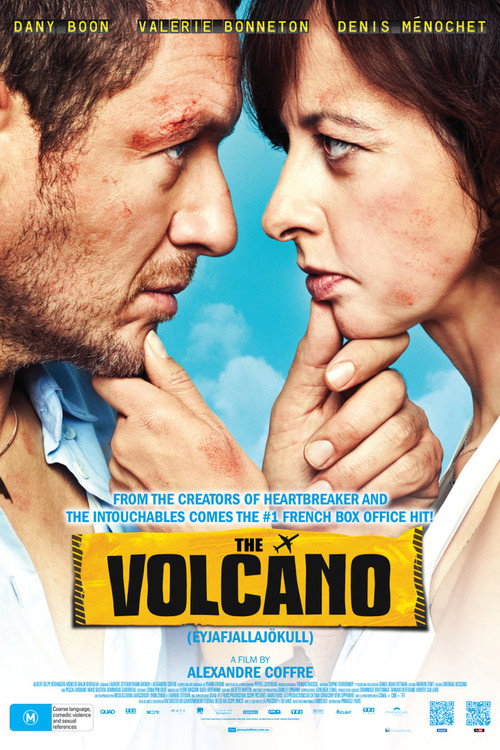
The Volcano
A road-trip comedy in which an ash cloud over Europe becomes the perfect excuse for two divorced people to collide again — a slow-burning eruption of old grudges chasing a wedding across a continent.
The Volcano

The Volcano

Eyjafjallajökull

02 October 2013 Belgium 92 min 5.6 (689)

Director: Alexandre Coffre

Cast: Valérie Bonneton, Dany Boon, Denis Ménochet, Bérangère McNeese, Albert Delpy

Comedy Divorce as unfinished business Parenthood and the debt owed to a child Chaos, chance and the loss of control The journey as forced intimacy Europe as an obstacle course

Overview

Alain is a driving instructor who raised his daughter largely alone after his marriage collapsed. Valérie, a veterinarian, is the ex-wife who left soon after that daughter was born. They have spent years successfully avoiding each other — until both book seats on the same Athens-bound flight to attend their daughter's wedding in a small Greek village, and discover, to their mutual horror, that they are travelling companions.

Then the Icelandic volcano Eyjafjallajökull erupts. With European airspace shut down and planes grounded across the continent, the ceremony's clock starts running and the only route left is overland. What follows is a scramble southeast by any means available — on foot, by car, by hitchhiking, by increasingly questionable improvisation — with two people who cannot be in the same room forced into the same passenger seat for hundreds of kilometres.

Directed by Alexandre Coffre in his second feature after Une pure affaire (2011), the film pairs Dany Boon and Valérie Bonneton in a large-scale French comedy that uses a real 2010 news event as the engine of a very old comic form: the ex-spouses who must cooperate, sabotage each other, and cross a continent before the bride says yes.


Core Meaning

Beneath the slapstick, the film argues that divorce ends a marriage but never finishes a relationship. Alain and Valérie have signed the papers and divided the years, yet they remain bound by a daughter whose wedding forces them into the same frame — and the volcano simply makes literal what was already true: their lives are grounded, stuck, waiting for an ash cloud that has hung over them since the separation.

Coffre uses the road-movie structure as a therapy session neither character consented to. Every breakdown, detour and act of sabotage strips away one more layer of the performance each has built — Alain's martyred devotion as the parent who stayed, Valérie's brisk self-justification as the parent who left. The destination is the wedding; the actual journey is toward an honest account of what happened between them.

Its message is finally generous rather than cynical: people do not have to like each other to be family, and the obligation to show up for a child can outlast every reason two adults have for staying apart.

Thematic DNA

Divorce as unfinished business 30%
Parenthood and the debt owed to a child 22%
Chaos, chance and the loss of control 18%
The journey as forced intimacy 17%
Europe as an obstacle course 13%

Divorce as unfinished business

The premise is a machine for reopening a closed wound. Alain and Valérie's marriage ended years earlier, yet the film shows that the accounting was never settled: he raised the child, she left, and neither has forgiven the other's version of events. Confined to shared cars, shared rooms and shared crises, they relitigate the divorce mile by mile, and the comedy comes from how fresh the resentment still is.

Parenthood and the debt owed to a child

Neither ex would cross a continent for the other; both will do it for their daughter. The wedding functions as the one obligation strong enough to override total mutual hostility, and the film keeps asking what each parent actually owes the young woman waiting in Greece — presence, honesty, or simply the decency to not ruin her day.

Chaos, chance and the loss of control

Alain teaches people to drive — to master rules, signals and right of way — and the volcano cancels all of it. A geological accident thousands of kilometres away dictates his itinerary, his budget and his dignity. The film repeatedly places its characters at the mercy of forces indifferent to their plans, and their growth is measured by how they improvise once control is gone.

The journey as forced intimacy

Classic road-movie logic: the vehicle is a cage. Every mode of transport the pair improvises — car, hitchhiked ride, whatever else the crisis offers — shrinks the physical distance between two people organised around avoiding each other, and the film mines both the farce and the reluctant tenderness of that proximity.

Europe as an obstacle course

The grounded-airspace premise turns a continent of easy flights into a patchwork of borders, languages and improvised transit. Crossing it on the ground exposes how thin the modern convenience of travel really is, and the pair's scramble southeast becomes a comic tour of a Europe suddenly returned to its distances.

Character Analysis

Alain

Dany Boon

Archetype: Reluctant hero / aggrieved everyman Key Trait: Stubborn, rule-bound decency curdled into resentment

Motivation

To reach his daughter's wedding, and — just as urgently — to arrive as the good parent, the one who was there, in front of the one who wasn't.

Character Arc

Begins as the parent who stayed — a driving instructor who raised his daughter after the marriage ended, and who has organised his sense of grievance around that fact. The journey strips the martyrdom from him: forced to improvise, break rules and depend on the woman he blames, he loses the comfortable role of the wronged party and has to meet his ex-wife as a peer rather than a verdict.

Valérie

Valérie Bonneton

Archetype: Antiheroine / abrasive foil Key Trait: Ferocious, unapologetic combativeness

Motivation

To be present at the wedding of a daughter she has not fully earned — and to refuse to concede a single point to her ex-husband on the way.

Character Arc

The veterinarian who quit the marriage soon after the child was born, and who has spent years constructing a defence for it. Thrown into forced proximity with Alain, her brisk self-justification cracks under the sheer duration of the trip; the closer she gets to the daughter she left, the less her explanation covers. Widely singled out by critics as the film's strongest performance.

All 3 characters and cast

Symbols & Motifs

The volcano and its ash cloud

Meaning:

An eruption that grounds a continent is the film's image of buried pressure finally venting. Like the marriage, it was dormant, invisible and assumed harmless, until it paralysed everything downwind.

Context:

Never confronted directly by the characters — it exists as news, as cancelled departure boards, as a word nobody can pronounce. Its remoteness is the joke: the thing wrecking their lives is a mountain in Iceland they will never see.

The grounded aircraft

Meaning:

Stalled flight stands for two lives that stopped moving at the moment of the divorce. The plane can no longer carry them; they must travel at ground level, slowly, in each other's company.

Context:

The Athens-bound flight is where the exes discover each other, and its grounding is the inciting event that converts a two-hour hop into a continental ordeal.

The driving lesson

Meaning:

Alain's profession — instructing others in control, caution and correct procedure — becomes ironic commentary on a man with no control over his own life.

Context:

Established as his identity before departure, and quietly undercut by every stretch of the improvised route, where rules of the road are the first casualty of the deadline.

The wedding

Meaning:

A ceremony founding a new couple, pursued by the wreckage of an old one. It symbolises the optimism of beginnings measured against the evidence of endings.

Context:

The destination and the clock. It stays offscreen for most of the film, existing as a deadline that gives every delay its comic weight.

The map and the moving border

Meaning:

The overland route southeast represents the distance between the parents themselves — every kilometre closed on Greece is a kilometre closed between them.

Context:

Structures the whole picaresque: the film is organised as a sequence of countries crossed and transport modes lost.

Philosophical Questions

Does divorce actually end a relationship, or only change its terms?

The film's entire structure is an argument that separation is administrative rather than emotional. Alain and Valérie are legally finished and practically inseparable, bound by a daughter whose life keeps generating occasions where both must appear. The comedy depends on the audience recognising that the marriage's grievances have gone on functioning perfectly well without the marriage.

What do parents owe a child they raised unequally?

One parent stayed; one left. The film refuses to make this a simple moral scoreboard — Alain's devotion has soured into self-pity, and Valérie's absence is not presented as monstrous — and it lets the wedding stand as the test: whatever the past accounting, both are required to show up and behave.

How much of a life is actually within our control?

The protagonist's profession is teaching control of a vehicle; the plot is a sustained demonstration that control is borrowed. A distant geological event overrides every plan, and the characters' dignity is measured not by whether they master circumstance but by how they behave once they clearly cannot.

Can shared hardship substitute for forgiveness?

The journey forces cooperation without ever requiring apology. The film tests whether people who have not resolved anything can still be changed by simply surviving something together — and leaves open whether what develops between the exes is genuine repair or merely exhaustion.

Alternative Interpretations

As a reconciliation comedy. The most straightforward reading takes the journey at face value: two people who have wronged each other are forced together, endure a shared ordeal, and arrive at the wedding changed — the volcano as accidental marriage counsellor, and the daughter's new union as proof that the old one's failure need not be inherited.

Full ending explanation

Cultural Impact

The film belongs to a very specific moment in European memory. The April 2010 eruption of Eyjafjallajökull grounded flights across the continent and stranded millions of travellers, producing a shared experience of sudden immobility that was still fresh three years later. Coffre's film is one of the few narrative features to convert that news event into popular comedy, treating a geological disruption not as catastrophe but as a farcical inconvenience visited upon ordinary family obligations.

It also sits inside the industrial story of French comedy after Bienvenue chez les Ch'tis. Dany Boon's record-breaking 2008 hit reset expectations for what a French comedy could earn, and the following years were dominated by attempts — his own included — to catch that lightning again. Eyjafjallajökull was one such attempt, mounted at a budget of around $25.2 million, and its worldwide gross of roughly $19.2 million left it short of that ambition. The Hollywood Reporter, reviewing it as The Volcano, described a slickly made, sporadically funny and highly expensive production, and judged that it was unlikely to return Boon to the A list.

Its lasting cultural function is smaller and more affectionate: it preserved, in broad comic form, the strange spring when a word almost nobody in Europe could pronounce became the reason they could not go home.

Audience Reception

Overall verdict: mixed. The film holds a modest 5.6 user rating on IMDb, consistent with a comedy that entertained a broad audience without winning much affection from critics or generating strong word of mouth.

Praised: Valérie Bonneton's performance is the near-universal high point — reviewers called her franchement épatante, and much of the film's energy is credited to her willingness to play the ex-wife as genuinely abrasive rather than lovably prickly. The premise itself was widely admired as a clever hook, and the production values were acknowledged as slick and expensive by the standards of French comedy.

Criticised: the dominant complaint is unevenness. The Hollywood Reporter's review described an uneven, stop-go adventure that cracks a smile now and then but little more, and other reviewers found the film formulaic — a strong setup serviced by episodic gags that arrive and depart without building. The scale of the budget also drew scepticism, with the money visible onscreen but not obviously translating into laughs.

The contested point is Dany Boon himself. For his large audience he remains a reliable comic presence; for critics, the film was another entry in a five-year run of attempts to recapture the phenomenal success of Bienvenue chez les Ch'tis, and it was not judged the one that would do it. Commercially the picture landed in an awkward middle — around $19.2 million against a budget of roughly $25.2 million — which colours much of its reputation.

Interesting Facts

  • The film was the second feature directed by Alexandre Coffre, after Une pure affaire (2011).
  • It was released in French cinemas on 2 October 2013.
  • The production carried a budget of roughly $25.2 million and grossed about $19.2 million worldwide, making it an expensive undertaking by French comedy standards.
  • The story is built around a real news event: the April 2010 eruption of Iceland's Eyjafjallajökull, which shut down large parts of European airspace and stranded millions of travellers.
  • Dany Boon came to the project still working in the shadow of Bienvenue chez les Ch'tis; The Hollywood Reporter noted that he had struggled for five years to reproduce that phenomenal success and doubted this film would restore him to the A list.
  • Valérie Bonneton's performance drew the warmest notices, singled out by reviewers as the standout element of an otherwise uneven picture.
  • The film was distributed internationally under the English title The Volcano, since the Icelandic original title is famously unpronounceable for non-Icelandic speakers.
  • It carries a modest 5.6 user rating on IMDb, reflecting the mixed reception it met on release.

Easter Eggs

The signage in the supposed Ljubljana Airport sequence is in Dutch (Flemish) rather than Slovenian.

A detail spotted by attentive viewers that quietly gives away the production's real geography: the Slovenian airport scenes were in fact shot in Belgium. It is an accidental map of how a continental road movie was actually assembled from a much smaller set of locations.

Frequently Asked Questions

Explore More About This Movie

Dive deeper into specific aspects of the movie with our detailed analysis pages

Comments (0)

Leave a comment

No comments yet. Be the first to share your thoughts!

Similar Movies