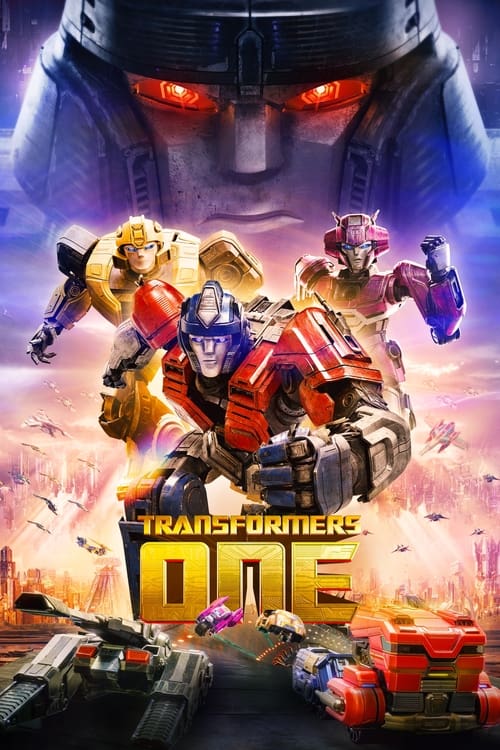
Transformers One
"Witness the origin."
Overview
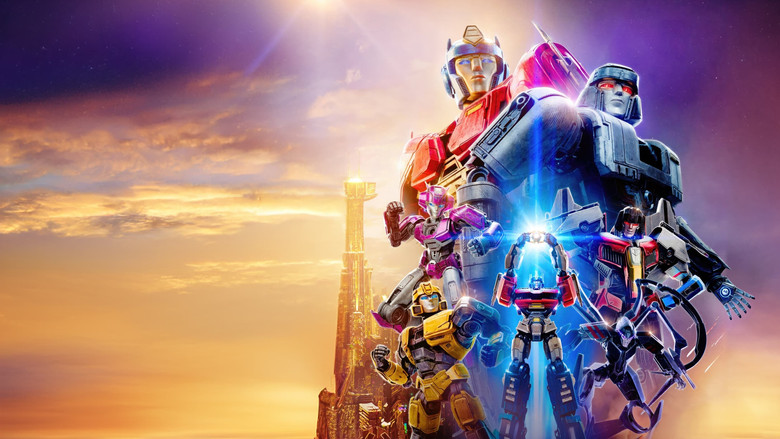
Set on the planet Cybertron long before the Autobots and Decepticons arrived on Earth, "Transformers One" tells the origin story of the legendary rivalry between Optimus Prime and Megatron. The film introduces them as Orion Pax (Chris Hemsworth) and D-16 (Brian Tyree Henry), two young, cog-less mining bots who are friends as close as brothers. Living in the underground city of Iacon, they exist within a rigid caste system under the rule of Sentinel Prime (Jon Hamm).
Orion Pax, ever the idealist, dreams of a better world and believes in the heroic tales of the Primes. D-16 is more pragmatic, initially content to work within the system. Their lives take a dramatic turn when they uncover a conspiracy that challenges everything they know about their world and its history. This discovery propels them, along with Elita-1 (Scarlett Johansson) and B-127 (Keegan-Michael Key), on a perilous journey to Cybertron's surface to find the legendary Matrix of Leadership, an artifact they believe can restore their world. Their quest forces them to confront harsh truths and make choices that will not only define their own destinies but also set them on opposing paths, forever changing the fate of Cybertron.
Core Meaning
The core meaning of "Transformers One" revolves around the idea of challenging the established "protocol" and realizing one's inherent potential. The film serves as a message that individuals are "more than meets the eye" and should not be limited by societal expectations or predetermined roles. It explores how embracing one's inner spark and potential for growth can lead to positive transformation, as seen in Orion Pax's journey to becoming Optimus Prime. Conversely, it warns how letting negative emotions like anger and a thirst for power dominate can lead to a destructive path, as exemplified by D-16's descent into Megatron and Sentinel Prime's corrupt rule. Director Josh Cooley also highlighted themes of authoritarianism, the complexities of friendship, and self-sacrifice as central to the film's message.
Thematic DNA
Friendship, Brotherhood, and Betrayal
The central emotional core of the film is the tragic journey of Orion Pax and D-16 from devoted brothers to sworn enemies. The narrative explores their deep bond, shared dreams, and eventual ideological schism. Chris Hemsworth and Brian Tyree Henry discussed wanting to show the "human version" of these characters, including their humor and camaraderie, to make the eventual tragedy of their falling out more impactful. The film posits that their conflict is not a simple case of good versus evil, but a heartbreaking dissolution of a relationship, akin to a Greek or Shakespearean tragedy, driven by different responses to injustice and corruption.
Power, Corruption, and Leadership
"Transformers One" presents a nuanced exploration of leadership through its main characters. Sentinel Prime represents corrupt, authoritarian rule, maintaining power through lies and manipulation. The film contrasts Orion Pax's belief in inspiring others and fighting for the greater good with D-16's growing conviction that power and decisive, violent action are the only means to achieve justice. Orion learns to be a level-headed leader, while D-16 allows his anger to dictate his actions, believing might makes right. This thematic conflict questions what makes a true leader: is it the strength to rule or the courage to serve?
Class Struggle and Revolution
The film establishes a rigid caste system on Cybertron, where "cog-less" bots like Orion and D-16 are relegated to the dangerous and laborious life of mining. This creates a clear social hierarchy and themes of class-based oppression. The discovery of Sentinel Prime's deceit—that he secretly allied with the Quintessons and stripped newborn bots of their cogs to create a subservient workforce—sparks a revolution. The story becomes an allegory for popular revolution against a tyrannical regime, with Orion rallying the oppressed miners with a message of unity and freedom. Some analyses interpret this as a metaphor for real-world political ideologies and the struggle of the working class against exploitation.
Destiny and Self-Determination
A key theme is the idea of breaking free from a predetermined path. Orion and D-16 initially believe their lot in life is to be miners, as D-16 states, "We're miners. We mine. That's all." Orion's desire to "choose your own path" is the catalyst for their adventure. The film explores the concept of autonomy, with the term "Autobot" itself being re-contextualized to mean autonomous, free robots. The journey of the main characters is about coming to consciousness and realizing their own power to self-create and forge their own destinies, rather than accepting the roles assigned to them by a corrupt system.
Character Analysis
Orion Pax / Optimus Prime
Chris Hemsworth
Motivation
His primary motivation is hope and an unwavering belief in a better future for everyone on Cybertron. He wants to prove that he and his fellow miners are "more than meets the eye" and seeks to restore their world so that all bots can live in freedom and equality, "together as one."
Character Arc
Orion Pax begins as a cheerful, somewhat naive and reckless young mining bot who dreams of a greater purpose. He idolizes the Primes and believes in the system run by Sentinel Prime. His journey forces him to confront the harsh reality of corruption and injustice. He evolves from an idealistic dreamer into a revolutionary leader who inspires hope in others. His defining moment is his willingness to sacrifice himself for his cause, which proves his worthiness to wield the Matrix of Leadership and become the wise, compassionate leader, Optimus Prime.
D-16 / Megatron
Brian Tyree Henry
Motivation
Initially, his motivation is to protect Orion and survive within the system. After learning the truth, his motivation becomes vengeance and the acquisition of power to impose his own order on Cybertron. He is driven by the belief that he must destroy the old, corrupt system by force and lead through strength to ensure no one is ever deceived again.
Character Arc
D-16 starts as Orion's loyal and protective friend, though more jaded and cynical about their place in society. The discovery of Sentinel's betrayal shatters his worldview. His sense of justice curdles into a blinding rage and a belief that only absolute power can prevent such deception from happening again. He rejects Orion's faith in the people and chooses a path of violent retribution, killing Sentinel and seizing power for himself. His arc is a tragic descent from a loyal brother to the tyrannical leader of the Decepticons, driven by a desire for a twisted form of justice.
Sentinel Prime
Jon Hamm
Motivation
His motivation is the preservation of his own power and luxurious lifestyle at any cost. He lies to an entire planet and enslaves a portion of its population to secretly pay tribute to the Quintessons, all while maintaining the pretense of being a noble leader searching for the lost Matrix of Leadership.
Character Arc
Sentinel Prime is introduced as the benevolent, charismatic leader of Iacon and the last of the legendary Primes. His arc is one of revelation, as the film peels back his heroic facade to expose him as a corrupt, self-serving tyrant. It's revealed he betrayed the other Primes, allied with the Quintessons, and created the cog-less caste system to maintain his power and pay off his secret allies. He doesn't develop so much as he is unmasked, serving as the catalyst for the ideological split between Orion and D-16.
Elita-1
Scarlett Johansson
Motivation
Initially motivated by a sense of duty and a desire to regain her standing, her motivations shift toward a genuine belief in Orion's cause. She is driven by a desire for true justice and a functional, fair society, becoming a crucial strategic mind in the fight against Sentinel Prime.
Character Arc
Elita-1 is initially a high-ranking official who is demoted for associating with Orion. She is pragmatic and skeptical of Orion's idealistic quest at first. Throughout their journey, she grows to trust Orion and becomes a key figure in the rebellion, using her knowledge and leadership skills to aid their cause. By the end of the film, she is appointed as Optimus Prime's commander, having proven herself a capable and loyal leader in her own right.
Symbols & Motifs
The Transformation Cog
The cog symbolizes social status, freedom, and inherent potential. In the society established by Sentinel Prime, the absence of a cog designates a bot as part of the lower, working class, unable to transform and thus stripped of a fundamental ability. Gaining a cog represents empowerment, liberation from this oppressive system, and the realization of one's true capabilities.
Orion Pax, D-16, and other miners are defined by their lack of cogs. A central part of their motivation is to overcome this limitation. They are eventually granted cogs by Alpha Trion, using the cores of the fallen Primes, which allows them to finally transform and fight back against Sentinel. Optimus Prime later uses the Matrix of Leadership to grant cogs to all the former miners, symbolizing a new era of equality.
The Matrix of Leadership
The Matrix of Leadership symbolizes legitimate and righteous authority, divine right, and the hope for a better future. It is an ancient artifact that can restore the flow of Energon to Cybertron and can only be wielded by a worthy successor to the Primes. It represents a power that is earned through virtue and self-sacrifice, not seized through force.
The search for the lost Matrix is the initial goal of Orion Pax's quest. After Orion's selfless sacrifice, the Cybertronian god Primus deems him worthy and grants him the Matrix, transforming him into Optimus Prime. He then uses its power to reignite Cybertron's core, demonstrating his legitimate and benevolent leadership.
Cybertron's Surface
The surface of Cybertron symbolizes the forbidden, the truth, and the past. The miners are told it is a desolate, dangerous wasteland, a lie perpetuated by Sentinel Prime to keep the populace contained and controlled underground. Venturing to the surface is an act of rebellion and a journey toward enlightenment, where the true history of the Primes and Sentinel's betrayal is discovered.
Orion's illegal trip to the surface is what sets the main plot in motion. It's on the surface that the protagonists find the resting place of the original Primes and the wise Alpha Trion, who reveals the truth about their world's history and Sentinel's deception.
Memorable Quotes
Nothing can stop us if we stand together. Together as one!
— Orion Pax / Optimus Prime
Context:
Orion delivers this line in a rousing speech to convince the other miners to rise up against Sentinel Prime's tyranny after the truth has been revealed.
Meaning:
This line encapsulates Orion's core philosophy of unity and collective strength. It becomes a rallying cry for the oppressed miners and foreshadows the Autobot mantra "'Til all are one." It directly ties into the film's title and central theme of creating a unified, free Cybertron.
The truth is what I make it!
— Sentinel Prime
Context:
Sentinel shouts this line during the final confrontation after Orion exposes his lies to the citizens of Iacon, showing he is completely unrepentant and drunk on his own power.
Meaning:
This quote perfectly summarizes Sentinel Prime's arrogance and totalitarian worldview. It reveals his complete disregard for objective reality and morality, believing his power gives him the right to define truth itself. It highlights his role as a "false prophet" and the antithesis of Orion's quest for truth.
NO, I WANT TO KILL HIM!
— D-16 / Megatron
Context:
D-16 screams this at Orion during a heated argument after they've learned of Sentinel's betrayal. Orion asks, "Don't you want to stop him?" and this is D-16's furious, revealing response.
Meaning:
This explosive line marks the definitive ideological break between D-16 and Orion Pax. While Orion wants to stop Sentinel and expose the truth, D-16's desire for justice has been consumed by a lust for violent revenge. It shows his turn towards a "might makes right" philosophy and foreshadows the brutal leader he will become.
What defines a Transformer is not the cog in his chest, but the spark that resides in their core.
— Alpha Trion
Context:
Alpha Trion says this to Orion Pax, D-16, and the others when they find him on Cybertron's surface. He is explaining why they, despite being "cog-less," have the potential for greatness.
Meaning:
This line from the wise mentor figure Alpha Trion delivers one of the film's central messages: true worth comes from one's character, spirit, and will, not from external status or physical abilities. It directly challenges the cog-based caste system and validates the inherent value of the heroes before they even gain the ability to transform.
Philosophical Questions
What is the true nature of justice and how should it be pursued?
The film explores this question through the opposing ideologies of Optimus Prime and Megatron. After discovering Sentinel's profound injustice, both seek a just outcome, but their methods diverge entirely. Optimus believes in justice through truth, unity, and inspiring collective action; he wants to expose Sentinel's lies and empower the people to create a better society. Megatron, however, comes to believe that justice can only be achieved through violent retribution and absolute control. He seeks to kill his oppressor and impose a new order by force. The film asks whether true justice is restorative and communal, or retributive and authoritarian.
Are leaders born or made?
"Transformers One" delves into the formation of two of fiction's most iconic leaders. Neither Orion Pax nor D-16 were born into leadership roles; they were lowly miners in an oppressive system. Their journey shows that leadership is forged through experience and choice. Orion becomes a leader through his empathy, his unwavering hope, and his willingness to sacrifice himself for others, ultimately being "chosen" by a higher power (Primus) because of these qualities. D-16, on the other hand, seizes leadership through anger, strength, and force of will. The film suggests that circumstances present opportunities for leadership, but it is one's character and choices that define the kind of leader one becomes.
Can a system be changed from within, or must it be destroyed?
This question is at the heart of the central conflict. D-16 initially believes in working his way up within the system. When he discovers the system is rotten to its core, his belief shatters, and he concludes it must be burned down entirely. Orion, while also recognizing the system's corruption, believes in its people. He doesn't seek to destroy Cybertron or its society, but to liberate it and reform it based on principles of truth and equality. The film seems to endorse Orion's approach, which overthrows the tyrant while preserving the society for its citizens, contrasting it with Megatron's path of destruction and domination.
Alternative Interpretations
One of the primary alternative interpretations of "Transformers One" centers on its thematic depth. On the surface, it is an action-adventure origin story for a young audience. However, many critics and viewers have interpreted it as a sophisticated political allegory. This reading suggests the film is a deliberate exploration of complex ideologies. Sentinel Prime's regime, built on lies and the exploitation of a working class, can be seen as a metaphor for fascism or corrupt authoritarian states. The ideological split between Optimus Prime and Megatron is then interpreted as a clash between democratic socialism (Optimus rallying the workers for the collective good) and a revolutionary fascism that seeks to replace one tyranny with another (Megatron's belief in absolute power and violent order). This interpretation views the film not just as a story about robots, but as a commentary on how societies respond to oppression, and how easily a fight for justice can be corrupted into a quest for personal power. Another reading focuses less on politics and more on a personal, psychological level, seeing the story as a tragic tale of how trauma and disillusionment can poison even the strongest bonds of friendship, leading two brothers down irrevocably different paths.
Cultural Impact
"Transformers One" was released during the franchise's 40th anniversary, positioned as a significant, lore-defining origin story. Critically, the film was a success, receiving positive reviews that praised its heartfelt story, strong character development, voice acting, and vibrant animation. Many critics saw it as a refreshing change of pace from the critically-maligned live-action films, commending its focus on character over chaotic spectacle. However, this critical acclaim did not translate to box office success; the film underperformed significantly, raising questions about the theatrical viability of animated franchise entries compared to their live-action counterparts. Despite its financial performance, the film resonated strongly with audiences and fans, earning a very high audience score on platforms like Rotten Tomatoes. The movie's focus on political themes like authoritarianism, class struggle, and propaganda also sparked discussion, with some analysts viewing it as a surprisingly complex political metaphor for a children's film. Its legacy may be that of a well-loved and critically respected entry that proves the franchise's narrative potential, even if it failed to become a commercial blockbuster.
Audience Reception
Audience reception for "Transformers One" was overwhelmingly positive, standing in stark contrast to its disappointing box office performance. The film earned an exceptional 98% audience score on Rotten Tomatoes and a strong "A" grade from CinemaScore polls, indicating that viewers who saw the movie enjoyed it immensely. Audiences praised the compelling and emotional story centered on the relationship between Orion Pax and D-16, the engaging character development, the humor, and the stunning animation. Fans of the franchise particularly appreciated the film's faithfulness to the Generation 1 aesthetic and its serious, nuanced take on the lore. The main points of criticism from some reviewers were that the plot could feel formulaic at times and that some of the humor undercut the dramatic stakes. Despite these minor critiques, the general verdict from the audience was that it was one of the best Transformers films in years, a heartfelt and visually impressive entry that successfully revitalized interest in the franchise's core characters.
Interesting Facts
- The animation was handled by Industrial Light & Magic (ILM), the same visual effects company that worked on all the live-action Transformers films.
- Director Josh Cooley was a fan of the franchise since childhood, growing up with the '80s Saturday morning cartoons, which influenced his vision for the film.
- The visual design of the characters and Cybertron was heavily influenced by the original Generation 1 (G1) toy line and cartoons, as well as the Art Deco artistic style.
- The film is the first fully CG-animated Transformers movie.
- In an interview, Josh Cooley stated he wanted to create a film that could serve as both an origin story for longtime fans and a fresh entry point for newcomers who know nothing about the lore.
- The voice cast, including Brian Tyree Henry, expressed a deep knowledge and appreciation for the Transformers franchise.
- Chris Hemsworth was chosen to voice Orion Pax not just for the weight in his voice that could believably become Optimus Prime, but also for the charm and swagger he could bring to the younger, less refined character.
Easter Eggs
Cameos of future Autobots and Decepticons appear in the film.
Throughout the movie, several recognizable characters from Transformers lore appear in background or minor roles. Among the miners, future Autobots like Jazz and Arcee can be seen. The Cybertronian High Guard, which becomes the foundation of the Decepticons, features future prominent members like Starscream (voiced by Steve Buscemi), Soundwave, and Shockwave. These appearances serve as nods for longtime fans and set the stage for the future Great War.
The phrase "'Til All Are One"
Orion Pax's line, "Together as one!" is a direct reference to the classic Autobot rallying cry, "'Til all are one." This phrase, famously spoken by Optimus Prime before his death in the 1986 animated movie, is a core tenet of the Autobot philosophy, representing their hope for a unified and peaceful Cybertron. Its inclusion here links the film's events to the wider franchise legacy.
Megatronus Prime's Cog
When D-16 kills Sentinel Prime, he takes his transformation cog. It is revealed this cog originally belonged to Megatronus Prime, a legendary and powerful war hero whom D-16 admired. By taking this cog and renaming himself Megatron, D-16 is explicitly tying his new identity to this historical figure, signaling his ambition and embracing a legacy of strength and warfare.
⚠️ Spoiler Analysis
Click to reveal detailed analysis with spoilers
Frequently Asked Questions
Explore More About This Movie
Dive deeper into specific aspects of the movie with our detailed analysis pages
Comments (0)
No comments yet. Be the first to share your thoughts!