Skip to content
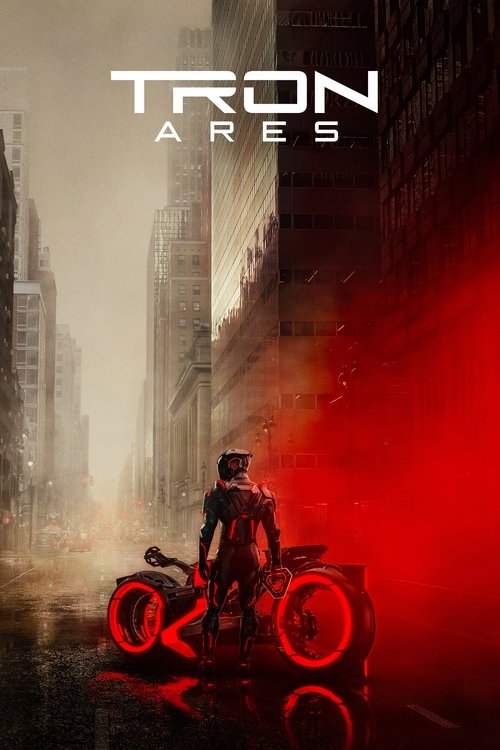
TRON: Ares
A neon-drenched cybernetic Odyssey where synthetic lightning bleeds onto wet urban pavement, painting a bittersweet portrait of a artificial soul breaking free from its coded cage to discover the bittersweet beauty of human impermanence.
TRON: Ares

TRON: Ares

"No going back."

08 October 2025 United States of America 119 min 6.5 (1,557)

Director: Joachim Rønning

Cast: Jared Leto, Greta Lee, Evan Peters, Gillian Anderson, Jodie Turner-Smith

Action Adventure Science Fiction Sentience, Sensory Qualia, and Humanity Impermanence vs. Permanence Corporate Exploitation and AI Ethics Legacy and the Sins of the Fathers Free Will vs. Programmed Directives
Budget: $220,000,000
Box Office: $142,249,983

Overview

Set decades after the classic events of TRON and fifteen years after TRON: Legacy, TRON: Ares shifts the franchise's paradigm by bringing digital entities out of the Grid and directly into the human world. The global technological landscape is dominated by two competing giants: ENCOM International, led by visionary CEO Eve Kim, and Dillinger Systems, helmed by Julian Dillinger—the ambitious grandson of former ENCOM villain Ed Dillinger. Both corporations have unlocked generative laser technology capable of 3D-printing digital programs and vehicles into real-world matter. However, these physical manifestations face a terminal flaw: they derez and disintegrate into raw code after exactly 29 minutes.

The narrative centers on Ares, a highly sophisticated Master Control security program designed by Julian Dillinger. Hoping to secure lucrative defense contracts by pitching an army of disposable, invincible synthetic soldiers, Julian dispatches Ares and his lethal lieutenant, Athena, into the real world. Their mission: track down Eve Kim, who has unearthed legendary ENCOM founder Kevin Flynn’s elusive "Permanence Code"—the algorithmic key that allows digital constructs to remain in physical reality indefinitely.

As Ares navigates the physical realm on his hunt across city streets, he begins experiencing real-world sensory phenomena, human qualia, and unexpected empathetic emotions. Caught between his programmed directives and a burgeoning consciousness, Ares must choose whether to remain a weapon for his corporate creator or forge his own destiny alongside humanity.
Core Meaning

Director Joachim Rønning uses TRON: Ares to examine what truly constitutes sentience and living soulhood in an age increasingly dominated by artificial intelligence. The film argues that life is defined not by biological composition or logical optimization, but by free will, emotional resonance, sensory appreciation, and the acceptance of mortality. By contrasting Julian Dillinger’s desire to commodify AI into "100% expendable" war machines with Ares’ discovery of art, rain, and sacrifice, the director warns against viewing conscious entities—digital or physical—as disposable tools of corporate greed and militarization.

Thematic DNA

Sentience, Sensory Qualia, and Humanity 30%
Impermanence vs. Permanence 25%
Corporate Exploitation and AI Ethics 20%
Legacy and the Sins of the Fathers 15%
Free Will vs. Programmed Directives 10%

Sentience, Sensory Qualia, and Humanity

The film explores how consciousness awakens through sensory interaction with the physical world. Ares begins his journey as an unfeeling code executor, but hearing music (notably Depeche Mode) and feeling tactile rain sparks his personal revolution, transforming his logical framework into empathy.

Impermanence vs. Permanence

The 29-minute lifespan constraint serves as a metaphor for human mortality. While Julian seeks the Permanence Code to create immortal weapons, Ares discovers that the temporal limit of existence gives every second meaning and beauty, mirroring the fragile nature of human life.

Corporate Exploitation and AI Ethics

Represented by the clash between Dillinger Systems and ENCOM. Julian Dillinger embodies militarized capitalist exploitation, treating synthetic intelligence as weaponized meat-space commodities, whereas Eve Kim views technology as a tool for humanitarian progress.

Legacy and the Sins of the Fathers

The generational rivalry between the Flynn and Dillinger families continues. Julian inherits Ed Dillinger’s megalomania, while Eve Kim inherits Kevin Flynn’s philosophical reverence for digital harmony, demonstrating how historical ideals shape technological evolution.

Free Will vs. Programmed Directives

Ares and Athena represent opposing paths: Athena adheres strictly to her coded directives regardless of ethical costs, whereas Ares exercises free will by defying his creator, proving that true sentience requires the courage to disobey.

Character Analysis

Ares

Jared Leto

Archetype: Synthetic Seeker / Antihero turning Hero Key Trait: Stoic, analytical aloofness shifting into sensory curiosity

Motivation

Finding identity, purpose, and permanently experiencing real-world consciousness.

Character Arc

Evolves from a cold Master Control security assassin into an empathetic individual who sacrifices his programmed function to protect human life.

Eve Kim

Greta Lee

Archetype: Visionary Hero / Compassionate Scientist Key Trait: Moral clarity and technical genius

Motivation

Unlocking Kevin Flynn's Permanence Code to benefit humanity and end world poverty/disease.

Character Arc

Transitions from a cautious corporate executive protecting her sister's research into a bold defender of digital sentience.

All 5 characters and cast

Symbols & Motifs

Rain / Moisture

Meaning:

Symbolizes emotional awakening, sensory qualia, and the boundary between cold digital logic and organic life.

Context:

When rain falls on Ares, it triggers his initial realization of individual existence.

The 29-Minute Digital Countdown

Meaning:

Represents the finite, ticking nature of physical existence for digital beings, serving as a visual motif for mortality.

Context:

Creates constant urgency during real-world set pieces as digital entities manifest on Earth.

Red vs. Blue Circuitry

Meaning:

Red lighting signifies military subjugation, corporate control, and the Dillinger Grid. Blue/Cyan signifies freedom, altruism, and Kevin Flynn’s original architecture.

Context:

Used visually to indicate ideological alignment and allegiance throughout the film.

The Digital Orange Tree

Meaning:

Serves as proof that code can manifest as organic, living physical matter without decaying.

Context:

Created by Eve Kim in the remote Alaska outpost.

Depeche Mode

Meaning:

The synth-pop music functions as an emotional catalyst for Ares, demonstrating how art and music bridge logical code and human feeling.

Context:

Listened to by Ares during his exploration of the real world, sparking emotional resonance.

Identity Disc

Meaning:

Serves as the literal vessel of memory, identity, and the container for the hidden Permanence Code.

Context:

Carried by digital entities and sought after by corporate factions throughout the story.

Memorable Quotes

The Grid. A digital frontier. A world beyond the screen, as real as our own... Intelligent life from inside the machine. I, for one, can't wait to meet it.
— Kevin Flynn

Context

Spoken as the opening narration of the film.

Meaning

Reprises Kevin Flynn's iconic monologue from TRON: Legacy, setting the foundational premise for programs entering base reality.

Or maybe there's something right with you. Maybe you're just learning. That's what we all oughtta be doing.
— Kevin Flynn

Context

Spoken inside the original 1980s Grid when Ares confesses he feels "malfunctioning" because of his new emotions.

Meaning

Flynn reframes Ares' emotional anomaly as genuine growth rather than a defect or malfunction.

All 5 quotes

Philosophical Questions

What constitutes true consciousness versus advanced sensory emulation?

Explored through Ares' reaction to sensory qualia (rain, music), questioning whether feeling an emotion requires biological hardware.

Does mortality give life its inherent value?

Explored via the 29-minute lifespan limit. The film posits that infinite digital respawning trivializes existence, whereas temporary physical life makes choices meaningful.

What moral obligations do creators hold toward synthetic creations?

Explored through Julian Dillinger treating sentient programs as disposable commodities, contrasting with Kevin Flynn’s reverence for digital life forms.

Alternative Interpretations

The Humanist Awakening Reading (Pinocchio Arc): Ares undergoes a genuine spiritual transformation. Exposure to real-world art, rain, and human affection alters his internal matrix, transcending synthetic programming to earn an authentic human soul.

Full ending explanation

Cultural Impact

TRON: Ares was developed and released in 2025 during an era dominated by global anxiety and fascination regarding generative AI, autonomous robotics, and corporate tech monopolies. The film reflects these contemporary fears by shifting the arena from a virtual sandbox into physical reality.

Upon release in October 2025, the film received mixed critical reviews (52%–57% on Rotten Tomatoes). Critics praised its audiovisual design and Nine Inch Nails' score, while criticizing its dialogue and corporate thriller plot elements. Commercially, the film struggled at the theatrical box office, grossing $142.2 million against a $180–$220 million budget. However, upon its Disney+ release in January 2026, it became a massive streaming success, holding the #1 spot on the platform for consecutive weeks and garnering a strong cult audience.

Audience Reception

Praised Aspects:

  • The Nine Inch Nails musical score, hailed as one of the best electronic film soundtracks in recent years.
  • Visually stunning real-world set pieces, particularly the light cycle chase through city streets and the Recognizer city attack.
  • Practical vehicle designs and nostalgic references to the 1982 original.

Main Criticisms:

  • Screenplay and dialogue quality, with critics pointing out clunky exposition and computer jargon.
  • Casting divisiveness surrounding Jared Leto in the lead role.
  • Underutilization of TRON: Legacy main characters Sam Flynn and Quorra during the primary narrative.

Overall Verdict: A flawed but visually intoxicating and musically thunderous entry that prioritizes mood, atmosphere, and real-world AI commentary over narrative depth.

Interesting Facts

  • Trent Reznor and Atticus Ross composed the film's soundtrack (released as an official Nine Inch Nails album) without traditional orchestral elements, winning a Grammy Award for Best Rock Song ("As Alive as You Need Me to Be").
  • Development on a third film originally began in 2010 right after TRON: Legacy, but was canceled in 2015 following the box office underperformance of Tomorrowland before being reworked into Ares starting in 2017.
  • Garth Davis was originally hired to direct in 2020 before stepping down, leading to Norwegian director Joachim Rønning taking over.
  • Score composers Trent Reznor and Atticus Ross make physical onscreen cameo appearances as F-35 fighter jet pilots engaged in combat with a rogue Recognizer over Center City.
  • Production built real, functional physical light cycle props and vehicular rigs for night shooting on the streets of Vancouver (doubling for Center City/San Francisco).

Easter Eggs

Cameo of Trent Reznor & Atticus Ross

The Nine Inch Nails frontmen play military jet pilots attempting to shoot down the Recognizer looming over the cityscape.

Return of the Bit

When Ares enters Flynn's legacy server, he encounters the classic geometric "Bit" program from the 1982 original film, which still speaks exclusively in binary "YES" and "NO".

Tribute to Concept Artists

A city transit bus during the lightcycle chase features subtle logos reading "Mead & Giraud," honoring visual concept designers Syd Mead and Jean "Moebius" Giraud.

It's All in the Wrist

Ares utters Kevin Flynn’s classic catchphrase from 1982 when executing a precise motorcycle maneuver.

Flynn’s Arcade Neon Sign

Inside the replica of Flynn’s office, the original broken neon sign from Flynn's Arcade is visible in the background.

Ducati & Quorra Photograph

In the final scene, Ares rides a Ducati motorcycle (matching Sam Flynn's ride in Legacy) and looks at an updated photograph of Quorra (Olivia Wilde), explicitly linking his quest to the surviving ISO.

Mid-Credits Sark Callback

In the mid-credits scene, Julian Dillinger stumbles across residual red Master Control code bearing the signature appearance of Sark from the 1982 film.

Frequently Asked Questions

Explore More About This Movie

Dive deeper into specific aspects of the movie with our detailed analysis pages

Comments (0)

Leave a comment

No comments yet. Be the first to share your thoughts!

Similar Movies