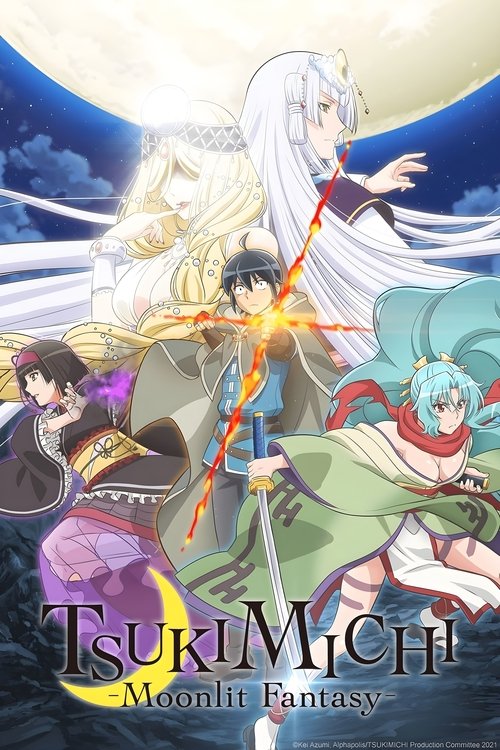
TSUKIMICHI -Moonlit Fantasy-
月が導く異世界道中
Overview
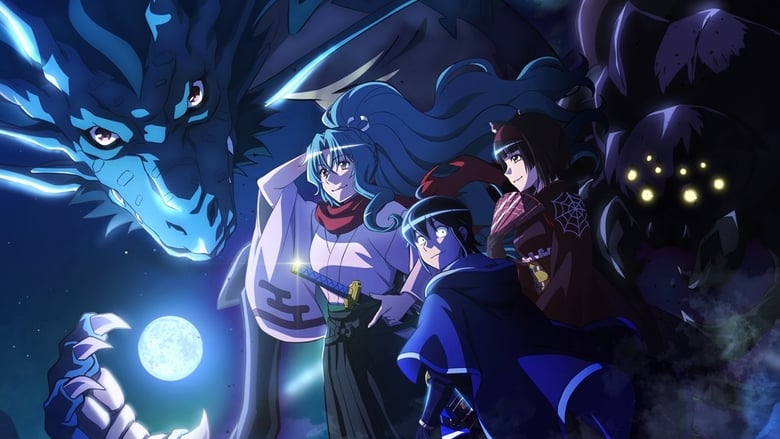
TSUKIMICHI -Moonlit Fantasy- follows Makoto Misumi, an ordinary high school student who is abruptly summoned to another world to be its hero. The reason for his summoning is a pact his parents, who were originally from this world, made with a god. However, the world's resident Goddess rejects him outright, deeming him too "ugly" to be her champion. She banishes him to the most remote and dangerous part of the world, the Wasteland, after bestowing upon him the ability to understand all languages except the common human tongue as a cruel parting gift.
Left to fend for himself, Makoto discovers that the blessings from the god of his original world have made him incredibly powerful, far surpassing the common sense of this new reality. In the desolate wilderness, he befriends and forms pacts with various non-human species, or "demi-humans," including a calamity-class dragon named Tomoe and a black spider of disaster named Mio, who become his devoted followers. Together, they establish a thriving, multicultural community in a pocket dimension called the Demiplane (or Asora), creating a sanctuary for those rejected by the Goddess and the human societies. The series chronicles Makoto's journey as he navigates this new world, grappling with his immense power, building his community, and occasionally getting entangled in the conflicts between humans and demons that he was originally supposed to resolve.
Core Meaning
The core message of TSUKIMICHI -Moonlit Fantasy- revolves around the themes of prejudice, acceptance, and the creation of one's own community. The series critiques superficial value judgments, exemplified by the Goddess's rejection of Makoto based solely on his appearance. It posits that true worth and strength are not defined by conventional standards. Makoto, an outcast, finds kinship not with the "beautiful" and "accepted" humans, but with the monstrous and demi-human races who are also marginalized. The central narrative champions the idea of building a sanctuary—the Demiplane—where diversity is celebrated and those who are different can live in peace and prosperity, suggesting that a true hero is not one who conforms to a predetermined ideal, but one who builds a world where everyone has a place to belong.
Thematic DNA
Subversion of Isekai Tropes
The series actively parodies and subverts common clichés of the isekai genre. Unlike typical heroes who are celebrated upon arrival, Makoto is immediately rejected and cast aside for not meeting aesthetic standards. The Goddess, usually a benevolent figure, is portrayed as a vain, antagonistic force. While Makoto is overpowered, a staple of the genre, his power makes him an object of fear among humans, forcing him into the role of an outsider rather than a celebrated champion. The narrative often uses these subversions for comedic effect, poking fun at the formulaic nature of many isekai stories.
Prejudice and Acceptance
The foundational conflict of the series is rooted in prejudice. The Goddess's rejection of Makoto for his looks is the inciting incident that drives the entire plot. This theme is expanded upon through the societal structure of the new world, where humans are often depicted as arrogant and prejudiced against demi-humans and monsters. Makoto's journey is one of finding acceptance among the outcasts. He builds a society in the Demiplane where orcs, lizardmen, and other "monstrous" races are treated as equals, directly contrasting with the discriminatory human kingdoms.
Community and Nation-Building
A significant portion of the series focuses on Makoto's efforts to create and manage a new society in his pocket dimension, the Demiplane. This goes beyond mere adventuring and delves into logistics, governance, and cultural exchange as different species come together under his leadership. The development of this new town, from establishing agriculture to creating trade goods, is a central plotline, making the series comparable to other nation-building isekai like That Time I Got Reincarnated as a Slime. It explores the idea of creating a utopia from scratch, founded on principles of mutual respect.
The Burden of Power
Makoto is gifted with immense magical power, but it often proves to be more of a curse than a blessing in his interactions with the world. His overwhelming magical aura makes humans perceive him as a threat, akin to a demon lord, which isolates him further. He constantly has to suppress his abilities to avoid causing catastrophic damage or drawing unwanted attention. This explores the idea that absolute power doesn't solve all problems and can create new ones, particularly social alienation and the moral responsibility of its use.
Character Analysis
Makoto Misumi
Natsuki Hanae
Motivation
Initially, Makoto's motivation is simply to survive and possibly find a way to live peacefully. This evolves into a powerful desire to protect the community he has built in the Demiplane. He seeks to create a safe and prosperous home for all the outcasts who have pledged their loyalty to him. A secondary, long-term goal is to trace the path his parents took in this world.
Character Arc
Makoto begins as a typical, well-meaning teenager thrust into a fantasy world. His initial arc is defined by survival and confusion after being rejected by the Goddess. He quickly transitions from a victim to a powerful leader, but one who is isolated from human society. Across the seasons, he grapples with the morality of his immense power and the responsibility of leading a growing nation of non-humans. A key turning point occurs late in the first season when a tragedy causes him to act with cold ruthlessness, revealing a much darker potential. His journey is about reconciling his innate kindness with the harsh realities of the world and the necessity of using his power to protect his own, even if it means becoming a figure of fear to others.
Tomoe
Ayane Sakura
Motivation
Tomoe is motivated by her endless curiosity and her devotion to Makoto. She is fascinated by Earth's culture and constantly tries to replicate it in the Demiplane. Her primary drive is to serve Makoto and witness the interesting future he will create, often pushing him into actions he would otherwise avoid.
Character Arc
Tomoe is first introduced as Shen, a powerful and ancient dragon who Makoto defeats. After forming a pact, she becomes his first follower. Her initial interest in Makoto is driven by fascination with his memories of Earth, particularly samurai dramas. Her arc involves evolving from a curious, detached being into a fiercely loyal and capable second-in-command. She takes the initiative in creating the Demiplane and often drives the plot forward with her schemes and boundless enthusiasm. While primarily a source of comic relief, her power and dedication to Makoto are absolute.
Mio
Akari Kito
Motivation
Mio's primary motivation is her unwavering devotion and love for Makoto, who she sees as her entire world. She is driven by a desire to be useful to him and to be acknowledged as his primary partner, leading to a constant, comedic rivalry with Tomoe. Her past hunger is replaced by a love for good food and a hunger for Makoto's affection.
Character Arc
Mio, originally the Black Spider of Calamity, is a terrifying monster driven by eternal hunger. After Makoto defeats her by sating her appetite with his immense magic, she forms a pact with him and gains a humanoid form. Her arc is one of transformation from a mindless force of destruction to a devoted, albeit possessive and sometimes yandere-like, follower. She learns to channel her power and develops a deep, affectionate bond with Makoto, seeing him as the one who saved her from her curse of hunger. Her development involves tempering her more extreme instincts and learning to coexist with Tomoe and the other residents of the Demiplane.
Shiki
Taku Yashiro
Motivation
Shiki is motivated by a thirst for knowledge and the opportunity to serve a master with limitless potential for magical discovery. He is deeply grateful to Makoto for giving him a new purpose and a more 'human' existence. He strives to support Makoto's goals through research, teaching, and magical support.
Character Arc
Introduced later, Shiki was formerly a lich who conducted research on humans. After being defeated and granted a humanoid form by Makoto, he becomes his third follower. Shiki's arc involves him moving past his detached, research-obsessed nature to become a loyal and integral part of Makoto's camp. He takes on the role of a mentor and magic instructor to Makoto, helping him understand and control his powers more effectively. He provides a more level-headed and analytical perspective compared to the often-eccentric Tomoe and Mio.
Symbols & Motifs
The Demiplane (Asora)
The Demiplane symbolizes a sanctuary, a utopia, and a world of possibilities free from the prejudice of the Goddess's world. It is a physical manifestation of Makoto's desire to create a place where the rejected and marginalized can belong and thrive. Its growth and development mirror the growth of Makoto's found family and his ideals.
Created by his follower Tomoe, the Demiplane starts as an empty space but is quickly populated by various demi-human races that Makoto saves or befriends, such as Highland Orcs and Elder Dwarves. It becomes the center of his operations and the home for his followers, evolving into a bustling town that showcases a successful multicultural society in stark contrast to the human world.
Makoto's Power-Suppressing Rings
The rings Makoto wears symbolize his alienation and the need to hide his true self to navigate human society. They represent the suppression of his potential and the burden of his immense power, which prevents him from interacting normally with the world. Their eventual breaking or removal often signifies a moment where Makoto is forced to unleash his true strength, often with destructive consequences.
Makoto must wear these magic-absorbing rings to keep his overwhelming magical presence in check, which would otherwise terrify or harm those around him. In a pivotal moment in Season 1, the destruction of one of these rings leads to a tragic accident, which in turn causes Makoto to display a ruthless and vengeful side, showing the dangerous power he keeps constrained.
Episode Highlights
Hero, But Rejected
The first episode establishes the core premise and comedic, satirical tone of the series. It efficiently introduces Makoto, his summoning, and his immediate, unceremonious rejection by the beautiful but cruel Goddess for being "ugly." This episode sets the stage for the entire series by subverting the traditional isekai hero's welcome.
This episode is foundational, as it establishes the main conflict between Makoto and the Goddess and defines his status as an outcast, which is central to his character and the plot. It immediately signals that the show will play with and lampoon genre conventions.
Black Spider of Calamity
This episode introduces Mio, the second of Makoto's powerful followers. Her debut as the terrifying, all-consuming Black Spider of Calamity showcases the scale of threats in the wasteland. Makoto's method of defeating her—by feeding her his immense magical power until she is satisfied—is unconventional and establishes his unique approach to problem-solving. It also solidifies the comedic dynamic of his growing monstrous harem.
Mio's introduction completes Makoto's core trio of followers. Her addition establishes the rivalry dynamic with Tomoe for their master's affection, a recurring source of humor and plot development throughout the series.
Goodbye
This episode marks a significant and jarring tonal shift for the series. After adventurers invade his temporary settlement, a magical accident results in the death of a friendly orc and a clone of Tomoe. In response, Makoto hunts down the person responsible and executes her with brutal, cold-blooded efficiency, a stark contrast to his previously easy-going nature.
This event is a critical turning point for Makoto's character. It reveals a ruthless, darker side and establishes a hard line that he will cross to protect his people. It shatters the purely comedic tone of the series and introduces a much more serious, antiheroic dimension to his character that carries forward.
Guided by the Moon
In the season finale, Makoto confronts two powerful adventurers, Sofia Bulga and Mitsurugi, who are revealed to be connected to the Dragon Slayers. This is Makoto's first major battle against formidable human opponents. The fight showcases the incredible extent of his powers when he is forced to get serious, and it introduces key antagonists for the future.
This episode concludes the first major arc of Makoto's journey, moving him from a survivor to a significant, albeit hidden, power in the world. It sets up the primary external conflict for the second season and solidifies the threat posed by the world's established powers.
The Notorious Kuzunoha Company
The finale of the second season features the conclusion of the major conflict in the academy city of Rotsgard. It includes the climax of the fight between Makoto's followers and the powerful adventurer Sofia Bulga, who sought revenge. The episode resolves the arc of Makoto posing as a merchant and student, while also setting up his next move and the looming larger conflicts with the Goddess and the demon army.
This episode brings a long and complex season arc to a close, demonstrating the growth of Makoto's followers and the expanding influence of his company. It solidifies his reputation in the world (under his alias) and transitions the story from a phase of hiding and information-gathering to preparing for more direct confrontations with the world's major factions.
Philosophical Questions
What defines beauty and worth?
The series constantly challenges conventional standards of beauty and value. The Goddess, representing a superficial, deity-level authority, judges Makoto as worthless based on his earthly appearance. However, Makoto finds acceptance and builds a powerful faction with races like orcs and lizardmen, who are also considered 'ugly' and monstrous by human society. The series explores the idea that worth is defined by character, action, and community, rather than by conforming to an arbitrary aesthetic ideal.
Does absolute power corrupt, or does it merely reveal one's true nature?
Makoto is granted near-limitless power, and the series examines his struggle to wield it responsibly. For much of the show, he remains a kind and somewhat naive individual. However, when pushed to his emotional limit, he demonstrates a capacity for extreme cruelty. This raises the question of whether his power is a corrupting influence or if it simply gives him the means to enact a ruthless justice that was always a part of his character. The series suggests that power amplifies one's core traits, and Makoto's arc is a continuous test of his fundamental morality.
Alternative Interpretations
One of the main alternative interpretations of the series revolves around Makoto's morality and whether he is a hero or an anti-heroic figure. While he is generally kind and protective of his followers, his actions in Season 1, Episode 11, where he coldly tortures and kills an enemy, suggest a darker, more utilitarian worldview. This has led to discussions on whether Makoto is truly a good person or simply a powerful being who is benevolent only to those within his small, accepted circle. His creation of the Demiplane can be seen not just as a noble act of creating a utopia, but also as an isolationist act, turning his back on the world's problems to create a personal paradise. From the perspective of the humans in the series, his immense, uncontrolled power and alliance with 'monsters' legitimately position him as a potential demon lord in the making, regardless of his intentions.
Cultural Impact
TSUKIMICHI -Moonlit Fantasy- emerged during a peak in the popularity of the isekai genre and established itself as both an indulgence in and a satire of the genre's common tropes. Its premise directly parodies the "isekai summoning" cliché by having its hero immediately rejected, a comedic twist that resonated with audiences tired of self-insert power fantasies with flawless protagonists. The series' initial publication as a web novel on Shōsetsuka ni Narō places it within a major movement of Japanese amateur fiction that has produced numerous other isekai hits like Re:Zero and Mushoku Tensei.
Critics and audiences have received the series as a generally entertaining, if somewhat formulaic, entry in the genre that is elevated by its strong cast of characters and its comedic timing. However, it has also been noted for its sudden and jarring shifts in tone, particularly the moment of brutal violence from Makoto at the end of the first season, which sparked considerable discussion among viewers about the show's identity as a comedy. While perhaps not as revolutionary as some of its predecessors, TSUKIMICHI has found a solid niche as a comfort-food isekai that is self-aware enough to poke fun at itself while still delivering the expected elements of power progression, community building, and fantasy action.
Audience Reception
Audience reception for TSUKIMICHI -Moonlit Fantasy- has been generally positive, with many viewers finding it to be a fun and engaging, if not groundbreaking, take on the isekai genre. The series is frequently praised for its comedic elements and its satirical subversion of common tropes, particularly the 'rejected hero' premise. The main characters, especially the dynamic between the overpowered but socially awkward Makoto and his two powerful, quirky followers, Tomoe and Mio, are often cited as a major strength of the show.
Points of criticism often center on the inconsistent animation quality, particularly in the middle parts of the seasons where action is less of a focus. The most controversial aspect among viewers is the dramatic tonal shift near the end of the first season, where the lighthearted comedy gives way to a moment of brutal, dark violence from the protagonist. Some viewers found this shift jarring and out of place, while others appreciated the added depth and complexity it gave Makoto's character. Overall, it's considered a solid entry for fans of the genre who enjoy a mix of comedy, action, and nation-building elements.
Interesting Facts
- The anime is based on a light novel series of the same name, written by Kei Azumi. Before being published as a light novel, it originated as a web novel on the user-generated content site Shōsetsuka ni Narō in 2012.
- There was a change in the animation studio between seasons. Season 1 was animated by C2C, while the much longer Season 2 was handled by J.C.Staff.
- The series is often compared to 'That Time I Got Reincarnated as a Slime' due to shared themes of an overpowered protagonist building a nation of monsters and non-humans.
- The author, Kei Azumi, has stated that Makoto is meant to have a plain or even ugly appearance by the standards of the fantasy world, which is a direct contrast to the bishōnen (beautiful boy) heroes often featured in isekai.
- A third season of the anime has been officially announced following the conclusion of Season 2.
⚠️ Spoiler Analysis
Click to reveal detailed analysis with spoilers
Frequently Asked Questions
Explore More About This Movie
Dive deeper into specific aspects of the movie with our detailed analysis pages
Comments (0)
No comments yet. Be the first to share your thoughts!