The Familiar of Zero
A chaotic fantasy romance where explosive magic and heartfelt emotion collide, like a flurry of cherry blossoms caught in a whirlwind of fire and steel.
The Familiar of Zero

The Familiar of Zero

ゼロの使い魔

03 July 2006 — 24 March 2012 Japan 4 season 49 episode Ended ⭐ 8.5 (582)
Cast: Rie Kugimiya, Satoshi Hino, Nanako Inoue, Yuka Inokuchi, Yui Horie
Animation Sci-Fi & Fantasy Action & Adventure Comedy
Social Class and Nobility Love and Jealousy Destiny and Self-Worth Fish Out of Water (Isekai)

Overview

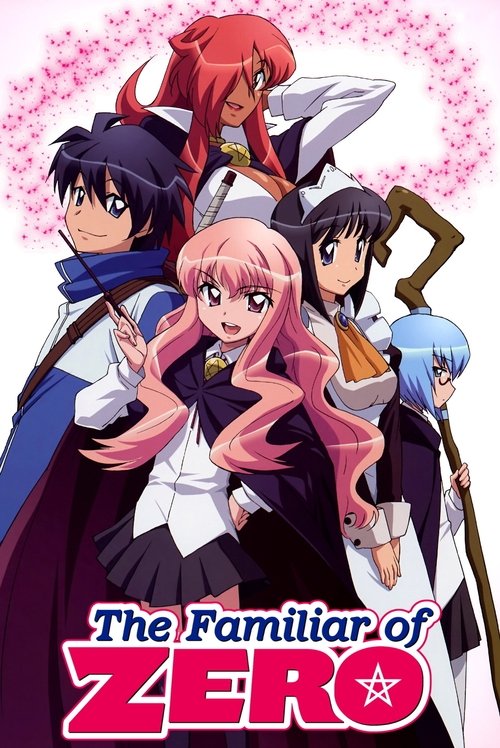
"The Familiar of Zero" follows Louise Françoise Le Blanc de La Vallière, a young noble at the Tristain Academy of Magic who is ridiculed by her peers for her complete inability to cast spells successfully, earning her the nickname "Louise the Zero". During a crucial summoning ritual where students conjure their magical familiars, Louise unleashes a massive explosion and summons an ordinary teenage boy from modern-day Tokyo, Saito Hiraga. Bound by a powerful magical contract, Saito becomes Louise's familiar, forced to endure her aristocratic arrogance and explosive temper while navigating a world of magic, political intrigue, and warfare.

Across four seasons, the series chronicles their tumultuous relationship as it evolves from a master-servant dynamic into a deep and complicated romance. Saito discovers he possesses the legendary power of the "Gandalfr," allowing him to master any weapon, which makes him a crucial asset in the wars threatening the kingdom of Tristain. As Louise grapples with her own hidden, immense magical potential as a rare "Void Mage," she and Saito face numerous battles, romantic rivals, and personal sacrifices, forcing them to repeatedly confront their feelings and decide what they truly mean to one another. Their journey is a blend of action, comedy, and romance, exploring themes of social class, destiny, and the nature of love against the backdrop of a brewing continental war.

Core Meaning

The core meaning of "The Familiar of Zero" revolves around the idea that true worth and love are found in acceptance and mutual respect, transcending social status, origin, and preconceived expectations. Louise, a noble who feels worthless due to her magical failures, and Saito, a commoner stripped of his identity in a new world, are both considered "zeros" by their society. Their journey together is a testament to the power of a bond that sees beyond these superficial labels. The series posits that love is not about finding a perfect, powerful partner, but about finding someone who complements your weaknesses, stands by you in the face of adversity, and helps you discover the inherent power you possessed all along. It champions the idea that even those deemed insignificant can change the world when united by love and loyalty.

Thematic DNA

Social Class and Nobility 35%
Love and Jealousy 30%
Destiny and Self-Worth 25%
Fish Out of Water (Isekai) 10%

Social Class and Nobility

The series is built upon a rigid feudal class structure where magic-wielding nobles rule over non-magical commoners. Louise's initial treatment of Saito as a mere "dog" is a direct reflection of this societal norm. Throughout the series, this theme is explored as Saito, a commoner, repeatedly proves his worth through bravery and skill, challenging the aristocracy's belief that power is solely determined by bloodline. His eventual elevation to the status of a chevalier (knight) is a significant, albeit contested, subversion of these entrenched social hierarchies.

Love and Jealousy

The central romance between Louise and Saito is characterized by extreme jealousy and a classic "tsundere" dynamic, where Louise masks her affection with verbal and physical abuse. This theme drives much of the comedic and dramatic conflict, as Saito's encounters with other female characters—such as the curvaceous Kirche, the devoted maid Siesta, or Princess Henrietta—invariably trigger Louise's explosive rage. As the seasons progress, this jealousy evolves, forcing both characters to confront the immaturity of their reactions and build a relationship based more on trust than possession, though the trope remains a constant element of their dynamic.

Destiny and Self-Worth

Both protagonists struggle with their sense of self-worth tied to a destiny they initially reject. Louise is derided as "Louise the Zero" but is destined to be one of the most powerful Void Mages in existence. Saito is an ordinary boy who finds he is the legendary Gandalfr, a familiar with the power to change the course of history. The series explores how they grow into these destined roles, with their journey highlighting that destiny isn't a fixed path but something that is realized through courage, sacrifice, and the strength they draw from each other.

Fish Out of Water (Isekai)

As one of the pioneering series of the modern isekai genre, "The Familiar of Zero" heavily relies on the "fish out of water" theme. Saito's initial shock, confusion, and attempts to return home are central to the early plot. His modern sensibilities often clash with the feudal, magical society of Halkeginia, leading to both comedic misunderstandings and moments where his perspective offers a unique advantage. This theme diminishes over time as Saito assimilates, but his connection to Earth remains a significant plot point throughout the series.

Character Analysis

Louise Françoise Le Blanc de La Vallière

Rie Kugimiya

Archetype: The Tsundere Heroine
Key Trait: Explosive Insecurity

Motivation

Initially, Louise's primary motivation is to prove that she is not a failure—a "Zero." She desperately wants to cast a single spell correctly and earn the respect of her peers and family. As the series progresses, her motivation shifts entirely to protecting Saito and the people she cares about, particularly Princess Henrietta and the kingdom of Tristain. Her love for Saito becomes her central driving force, compelling her to master her destructive powers for a purpose greater than her own validation.

Character Arc

Louise begins the series as an arrogant, insecure, and abusive noble who masks her feelings of magical inadequacy with a harsh demeanor. Her entire identity is tied to the noble status she feels she doesn't deserve, leading her to treat Saito as an outlet for her frustrations. Across the four seasons, her arc is defined by her gradual acceptance of her own unique power as a Void Mage and her deepening love for Saito. She slowly learns to trust him, show vulnerability, and move beyond her prideful nature. While she never completely sheds her fiery temper, she matures from a girl who punishes Saito for talking to other women into a woman who is willing to sacrifice her own life for his, culminating in her choosing a life with him over her noble duties.

Saito Hiraga

Satoshi Hino

Archetype: The Reluctant Hero
Key Trait: Unwavering Resilience

Motivation

At first, Saito's sole motivation is to find a way back to Japan. This desire is gradually replaced by a powerful protective instinct, first for himself and then for others, especially Louise. He is driven by a strong sense of justice, often standing up to arrogant nobles who abuse their power. Ultimately, his main motivation becomes his love for Louise; he fights to protect her, to be worthy of her, and to build a future with her, no matter the cost.

Character Arc

Saito starts as an ordinary, somewhat lecherous Japanese high school student suddenly thrown into a world he doesn't understand. Initially treated as a slave, his arc is one of empowerment and adaptation. He discovers his latent abilities as the Gandalfr and grows from a bewildered kid into a brave and legendary warrior. His journey forces him to find a new purpose beyond simply returning home. He develops a fierce loyalty to Louise and Tristain, repeatedly risking his life in battle. Over the series, he matures from a perverted teenager into a selfless hero who understands the weight of his power and the depth of his love for Louise, eventually choosing his new life with her over his old one.

Tabitha / Charlotte Hélène d'Orléans

Yuka Inokuchi

Archetype: The Quiet Intellectual (Kuudere)
Key Trait: Stoic Intelligence

Motivation

Initially, Tabitha's motivation is veiled and personal, seemingly focused on her studies and protecting her only friend, Kirche. As her backstory unfolds, her motivation becomes to avenge her father and save her mother. After achieving this, her drive shifts to being a just and wise ruler for her kingdom, a responsibility she takes on with quiet determination. She also develops a subtle and unrequited love for Saito, which motivates some of her protective actions towards him.

Character Arc

Tabitha is introduced as a quiet, stoic, and bookish student who rarely shows emotion. She is often seen reading and provides quiet support to her friends. Her arc deepens significantly when her tragic past is revealed: her real name is Charlotte, the princess of Gallia, and her mother was driven insane after being poisoned, leading to her father's death at the hands of her uncle, the king. She eventually confronts her uncle, reclaims her throne, and becomes Queen of Gallia. Her journey is about reclaiming her identity and finding the strength to lead her people, a path she is encouraged to take through her friendship with Louise and Saito.

Kirche Augusta Frederica von Anhalt-Zerbst

Nanako Inoue

Archetype: The Seductress Rival
Key Trait: Fiery Passion

Motivation

Kirche's initial motivation is driven by her passionate nature and family tradition: "Love and fire are the destinies of the Von Zerbst family." She seeks passion, excitement, and to best her rival, Louise. Over time, her motivations mature. The safety and happiness of her best friend, Tabitha, become paramount, and she develops a strong sense of camaraderie with her classmates, fighting alongside them to protect the kingdom.

Character Arc

Kirche starts as Louise's primary rival, a confident, voluptuous, and flirtatious fire mage from a family with a long-standing feud with the La Vallières. She relentlessly teases Louise about her lack of magical talent and flat chest, and she makes numerous attempts to seduce Saito. Her character arc involves moving from a simple rival to a genuine friend and ally. While she never loses her flirtatious nature, she demonstrates deep loyalty to her friends, especially Tabitha, and plays a crucial role in many battles. Her development is about seeing beyond petty rivalries and using her strengths for the good of her comrades.

Symbols & Motifs

The Gandalfr Runes

Meaning:

The runes magically inscribed on Saito's left hand symbolize his bond to Louise, his destiny, and his power as the legendary familiar, Gandalfr. They represent his servitude but also his unique and heroic purpose in the new world. The fading and reappearance of the runes at various points in the story directly reflect the state of his life force and his connection to Louise.

Context:

The runes appear during the initial summoning in Season 1, Episode 1. They glow whenever Saito activates his ability to master weaponry. In Season 3, the runes fade when Saito is temporarily killed and revived, signifying the loss of his familiar status, which is later restored, reaffirming his unbreakable bond with Louise.

Explosions

Meaning:

Louise's frequent, uncontrolled explosions symbolize her frustration, emotional volatility, and suppressed magical power. Initially seen as a sign of her failure as a mage, the explosions are later revealed to be manifestations of her incredibly rare and powerful Void magic. They represent her journey from being an outcast to one of the most powerful figures in her world.

Context:

Explosions are a recurring motif from the very first episode. They are used for comedic effect when she punishes Saito, but also become a critical weapon in major battles, particularly in the season finales where she learns to channel her power more effectively, such as during the war with Albion.

The Two Moons

Meaning:

The two moons in the sky of Halkeginia symbolize the alien and fantastical nature of the world Saito has been transported to. They are a constant visual reminder that he is no longer on Earth and serve as a backdrop to the series' magical setting. The second season is even titled "Knight of the Twin Moons."

Context:

The moons are visible in many nighttime scenes throughout the series. When Saito first arrives, the sight of the two moons is what makes him realize he is in another world. They are a consistent element of the world-building, establishing the fantasy setting.

Memorable Quotes

So what if you're an aristocrat?! Dying for the sake of honor is something an idiot does!

— Saito Hiraga

Context:

Saito shouts this at Louise during an early conflict in Season 1. Louise insists that it is an honor for an aristocrat to die for their people, a sentiment Saito finds utterly foolish, reflecting the deep cultural divide between them.

Meaning:

This quote encapsulates Saito's modern, pragmatic worldview clashing with the feudal ideals of Halkeginia. It highlights his rejection of the nobility's often self-destructive code of honor and establishes his core motivation: to live and protect, rather than to die for an abstract concept.

Death comes at the very end, doesn't it? Until that time comes, do your best at living!

— Louise Françoise Le Blanc de La Vallière

Context:

Louise says this in a later season, likely Season 3 or 4, during a moment of crisis. It demonstrates how Saito's influence has changed her perspective on honor, duty, and sacrifice, showing her will to fight for life alongside him.

Meaning:

This quote signifies a major turning point in Louise's character development. It shows her adopting some of Saito's philosophy on life, moving away from the noble ideal of a glorious death towards a newfound appreciation for the struggle of life itself. It reflects her growing maturity and love for Saito.

The more you rush, the less careful you become. Even a cautious rat will show its tail.

— Henrietta de Tristain

Context:

Henrietta offers this advice during a council of war or a discussion about political maneuvering, likely in Season 1 or 2. It highlights her role as a thoughtful and capable leader, contrasting with the more impulsive actions of other characters.

Meaning:

This quote reflects Princess Henrietta's calm, strategic, and wise nature as a ruler. It speaks to the themes of political intrigue and warfare in the series, emphasizing patience and careful observation as key virtues in leadership and conflict.

Episode Highlights

Louise the Zero

S1E1

The episode that started it all. Louise, mocked as "Louise the Zero" for her magical failures, attempts the sacred familiar summoning ritual. Instead of a magical creature, she summons Saito Hiraga, an ordinary boy from Tokyo, binding him to her service and setting the entire series in motion.

Significance:

This episode establishes the core premise, the main characters, the central conflict of their master-servant relationship, and the isekai nature of the show. It perfectly sets the tone, blending fantasy, comedy, and the beginnings of a complex romance.

The Thief's True Identity

S1E6

Louise, Saito, Kirche, and Tabitha pursue the infamous thief Fouquet, who has stolen a powerful artifact. During a battle with Fouquet's golem, Louise's confidence is shattered, and Saito, moved by her tears, fiercely attacks the golem in her name, showcasing his growing feelings and protective instincts.

Significance:

A pivotal moment for Louise and Saito's relationship. It's one of the first times Saito fights purely for Louise's honor rather than for survival, and Louise shows a deep vulnerability that moves beyond her usual arrogant facade.

The Zero Secret Treasure

S1E12

Saito discovers a World War II-era Japanese Zero Fighter plane, believing it's his ticket home. His potential departure forces both him and Louise to confront the depth of their feelings for each other. Louise is heartbroken at the thought of him leaving, while Saito begins to question if returning home is what he truly wants anymore.

Significance:

This episode presents the first major test of their bond. The choice between returning home and staying with Louise becomes a central theme, and Saito's decision to ultimately stay (after the plane is destroyed) solidifies his commitment to his new life.

The Farewell Wedding Ceremony

S2E12

Facing an overwhelming army of 70,000 soldiers, Saito decides to stay behind and fight to the death to allow Louise and her friends to escape. Believing it to be their last moment together, Louise performs a mock wedding ceremony and kisses him, asking him to remember her. Saito is seemingly killed in the ensuing battle but is resurrected by an elf.

Significance:

This episode represents the emotional climax of the second season. It is the ultimate expression of their love and sacrifice for one another. Saito's apparent death is a shocking and powerful moment, and his subsequent resurrection introduces the character of Tiffania, who becomes important in later seasons.

The Familiar of Zero

S4E12

In the series finale, Saito battles an ancient dragon to save the world. Using a fighter jet summoned from his world, he defeats the dragon but is left stranded. Louise, using her Void magic, opens a portal to Earth, where they are reunited and finally visit Saito's home. They then return to Halkeginia to be married, bringing the series to a conclusive and satisfying end.

Significance:

This episode provides a definitive and happy conclusion to the entire saga. It resolves the long-standing question of Saito's return to Earth by allowing him to briefly visit before choosing to live with Louise. Their marriage solidifies their bond, offering fans a fulfilling end to their tumultuous love story.

Philosophical Questions

What defines a person's worth: birthright or actions?

The series constantly explores this question through the contrast between Louise and Saito. Louise is a high-born noble who feels worthless because she cannot meet the magical expectations of her class. Saito is a commoner with no status who becomes a legendary hero through his bravery and actions. The narrative repeatedly demonstrates that true value lies not in one's lineage or inherent abilities, but in one's character, courage, and willingness to sacrifice for others. Saito's rise and Louise's eventual acceptance of her unique, albeit unconventional, power underscore the idea that worth is earned, not inherited.

Can love truly blossom in a relationship founded on power imbalance and abuse?

This question lies at the heart of the central romance. The relationship begins with Louise holding absolute power over Saito as his master, subjecting him to constant humiliation and violence. The series presents their journey as one where love gradually overcomes this toxic dynamic, with both characters maturing and learning to respect each other. However, it also leaves the question open to interpretation. Does their eventual love justify or erase the abusive foundation? The show walks a fine line, exploring whether mutual dependence and shared trauma can evolve into genuine affection, forcing the audience to grapple with the complexities of their deeply flawed but ultimately devoted bond.

Alternative Interpretations

While the series is primarily a fantasy romance, some viewers interpret it through a more critical lens, focusing on the themes of abuse and Stockholm syndrome. From this perspective, Louise's constant physical and verbal abuse of Saito is not merely a comedic "tsundere" trope but a depiction of a genuinely toxic and abusive relationship. Saito's eventual love for Louise can be seen as a result of his complete dependency on her in a hostile world where he has no rights or allies. This interpretation challenges the romanticized portrayal of their dynamic, suggesting that Saito's affection is a coping mechanism for his traumatic situation rather than a healthy, developing love.

Another interpretation focuses on the political and social commentary. The strict class divide between nobles and commoners, the rampant arrogance of the aristocracy, and the themes of political marriage and warfare can be read as a critique of feudal systems and the inherent injustices of societies built on hereditary power. Saito, as an outsider from a modern, more egalitarian society, acts as a catalyst who implicitly challenges these norms simply by asserting his own worth and dignity.

Cultural Impact

"The Familiar of Zero" holds a significant place in anime history, primarily for its role in pioneering and popularizing the modern isekai genre. While the concept of being transported to another world was not new, the series, along with fan fiction based on it, helped establish the template of an ordinary Japanese teenager summoned to a fantasy world where they become a powerful hero. This formula became a cornerstone of light novel, manga, and anime production in the following decade.

The show is also renowned for perfecting the "tsundere" character archetype through Louise, voiced by the "Queen of Tsundere," Rie Kugimiya. Louise's explosive yet secretly caring personality became a benchmark for the archetype, influencing countless characters in subsequent anime. The series arrived at a time when this character type was at its peak popularity, contributing to the show's widespread appeal.

Upon its release, the first season was met with considerable popularity, though critical and audience reception varied across its four seasons. Many praised its blend of comedy, fantasy action, and romance, but it also drew criticism for its repetitive gags, overuse of fan service, and Louise's often extreme abuse of Saito. Despite these criticisms, the series maintained a dedicated fanbase, largely due to the compelling development of the central romance. The final season was generally seen as a satisfying conclusion for long-time fans, providing closure to the main storyline. Today, "The Familiar of Zero" is remembered as a classic of its era—a highly influential, if flawed, series that left a lasting mark on the isekai and tsundere genres.

Audience Reception

Audience reception for "The Familiar of Zero" was generally positive over its run, though it evolved with each season and often sparked polarized opinions. The first season was widely popular, praised for its unique fantasy setting, comedic timing, and the engaging "love-hate" dynamic between Saito and Louise. It successfully established the series as a staple of the 2000s anime scene.

As the series progressed into its second and third seasons, opinions became more divided. While many fans remained invested in the central romance and the expanding plot, a common point of criticism was the repetitive nature of the gags, particularly Louise's tsundere violence and Saito's involvement in harem/ecchi situations. Some viewers felt that the character development stalled, with Louise and Saito often regressing to their initial behaviors at the start of each new season.

The fourth and final season, "The Familiar of Zero F," was largely seen as a return to form and a satisfying conclusion for fans who had followed the series for years. It was praised for finally advancing the relationship between the leads in a meaningful way and providing a conclusive, happy ending. Despite its flaws, the series is remembered fondly by many for its memorable characters, emotional depth, and its significant influence on the isekai genre.

Interesting Facts

  • The original light novel author, Noboru Yamaguchi, passed away from cancer in 2013 before he could finish the series.
  • The final two volumes of the light novel were completed by a different author, Yū Shimizu, based on extensive notes left behind by Yamaguchi.
  • The fourth and final season of the anime, "The Familiar of Zero F," features an original ending that differs from the light novels, as it was produced before the final novels were published.
  • The series is considered a foundational work in the modern isekai genre, popularizing many of the tropes seen in later shows, such as a normal person being transported to a fantasy world and gaining immense power.
  • The voice actress for Louise, Rie Kugimiya, is famous for portraying other iconic tsundere characters, such as Taiga in "Toradora!" and Shana in "Shakugan no Shana," leading fans to group them as the "Four Tsundere Wonders."
  • The anime was produced by the studio J.C.Staff, which is also known for other popular series like "Toradora!," "A Certain Scientific Railgun," and "Food Wars!".
  • The character name "Saito Hiraga" may be a reference to Hiraga Gennai, a famous Edo-period Japanese polymath and inventor.

⚠️ Spoiler Analysis

Click to reveal detailed analysis with spoilers

Frequently Asked Questions

Explore More About This Movie

Dive deeper into specific aspects of the movie with our detailed analysis pages

Comments (0)

Leave a comment

No comments yet. Be the first to share your thoughts!