The wraparound — Diet Phantasma. Bryan M. Ferguson's frame is set in 1982 at the Octagon Company, where the revolutionary new soda being prepared for market is made from the extract of captured poltergeists. That single detail reframes the entire anthology on a rewatch: this is not a film about ghosts, it is a film about a supply chain that includes ghosts. COO Dr. Blaine Rothschild initiates a series of taste tests to verify the product's viability before public release, and those tests kill the testers in escalating, increasingly grotesque ways. Crucially, the deaths are never treated as a reason to stop — only as data points. The structural gag is that the frame narrative functions as advertising interstitials: the anthology is literally a commercial break for a product that murders its consumers, which retroactively positions every interior segment as another instance of something being marketed to people who will be destroyed by it.
Fun Size (Casper Kelly). A pumpkin-headed confectioner turns trick-or-treaters into candy. The horror is processual rather than sudden — children are not simply killed but manufactured, the Willy Wonka mythos stripped of its moral framing so that the factory's whimsy is exposed as machinery for converting bodies into product. Read alongside the wraparound, it is the same business model at a smaller scale: sourcing raw material from people who came to you voluntarily, seeking sweetness.
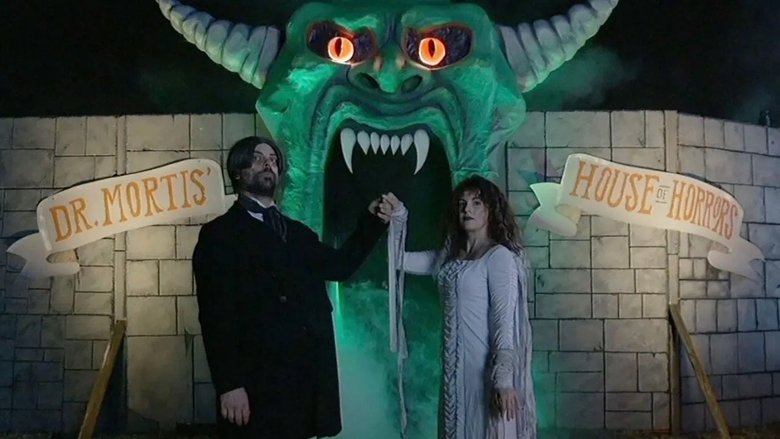
Home Haunt (Micheline Pitt-Norman and R.H. Norman). Shot on a purpose-built set at Zio Studios in Burbank, this one exploits the essential ambiguity of the amateur haunted attraction — a space where screaming is expected, distress is part of the show, and therefore genuine distress is indistinguishable from performance. The construction of the set as a controlled environment is the point: the victims cannot get help because everyone watching assumes the terror is scripted.
Kidprint (Alex Ross Perry). The volume's most disturbing and divisive entry. It takes place in the early 1990s and is built on the real National Center for Missing and Exploited Children Kidprint program, which offered free child-identification services including recorded video interviews conducted at local Blockbuster Video stores. The segment's hidden meaning is an inversion: a database created to recover missing children is, in structure, also a catalogue of available children. The apparatus of protection and the apparatus of predation are the same apparatus, differing only in who holds the camera. The short then follows that logic into torture and mutilation of children — the choice that provoked the film's central critical argument. What lingers after viewing is not the violence but the recognition that the recording itself, the well-meaning tape, was the mechanism of harm all along.
Ut Supra Sic Infra (Paco Plaza). Co-written with Alberto Marini, it follows the sole survivor of a massacre, taken back to the original crime scene by police to help reconstruct the events of that night. The setup is a classic unreliable-narrator engine: a reconstruction is only as true as the person reconstructing it, and the only witness is the only person who cannot be corroborated. The Latin title — roughly as above, so below — is the tell, signaling both occult correspondence and structural mirroring: what the survivor describes above ground and what actually occurred are two versions of one event, and the walkthrough is the mechanism by which they are made to match.
Coochie Coochie Coo (Anna Zlokovic). High-school seniors Lacie (Samantha Cochran) and Kaleigh (Natalia Montgomery), dressed as adult-sized babies, go out for one final trick-or-treat run despite having heard the stories of \"mommy,\" the local legend who makes unruly teenagers disappear on Halloween night. They end up inside a mysterious house by a park — a claustrophobic labyrinth of a dilapidated home, decorated with a birthday cake crawling with housefly larvae — and confront a motherly spirit and her grotesque creations, rendered in extensive practical effects. The costume is the trap: they dressed as infants in order to keep claiming a child's entitlements, and \"mommy\" simply takes the costume at its word. The larvae-covered birthday cake is the segment's thesis object — a celebration of another year of life that has already begun to rot and feed something else.
What links it all. Nothing plot-mechanical connects the segments; the unity is thematic and it is about processing. Ghosts into soda, children into candy, fear into attraction, a safety program into a hunting ground, a survivor's memory into an official record. In every case something living is converted into something consumable, and in every case the conversion is filmed. The final implication of the wraparound is the bleakest joke in the volume: Diet Phantasma reached the testing stage, which means someone still intends to put it on shelves.