Skip to content
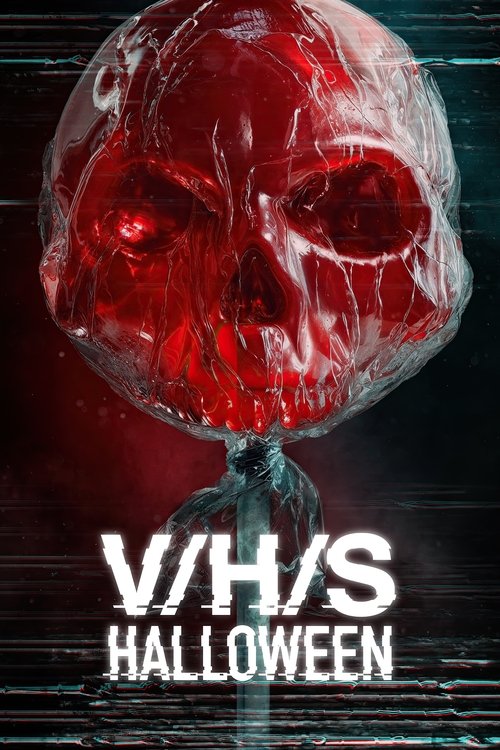
V/H/S/Halloween
Six Halloween nights spliced onto degraded tape, where candy, costumes and corporate promises rot into something feral — a holiday mixtape recorded over the screams of everyone who answered the door.
V/H/S/Halloween

V/H/S/Halloween

19 September 2025 United States of America 115 min 6.3 (242)

Director: Bryan M. Ferguson, Casper Kelly, Micheline Pitt-Norman, R.H. Norman, Alex Ross Perry, Paco Plaza, Anna Zlokovic

Cast: Samantha Cochran, Natalia Montgomery Fernandez, Elena Musser, Adam Carr, Charlotte Mae Curtis

Thriller Horror The mask as permission Consumption and the commodification of fear The camera as complicit witness Nostalgia as a trap Cruelty and the limits of fun

Overview

V/H/S/Halloween (2025) is the latest entry in Shudder's long-running found-footage anthology franchise, released on the streamer on October 3, 2025 after a festival premiere run that included Fantastic Fest. Where earlier volumes anchored themselves to a year — V/H/S/94, V/H/S/99, V/H/S/85 — this one anchors itself to a night, letting every segment drink from the same well of masks, porch lights, sugar and permission to be someone else for a few hours.

The framing device, Diet Phantasma, directed by Bryan M. Ferguson, drops us into 1982 and the offices of the Octagon Company, which is preparing to launch a revolutionary soft drink distilled from the extract of captured poltergeists. Under a determined COO, Dr. Blaine Rothschild, the corporation runs taste tests to confirm the product is ready for the public. The results are not encouraging, and the footage of those trials threads between the other stories like a commercial break from hell.

Around that spine sit five shorts from a deliberately mismatched roster: Casper Kelly's Fun Size, a pumpkin-headed confectioner's twisted riff on the Willy Wonka mythos; Micheline Pitt-Norman and R.H. Norman's Home Haunt; Alex Ross Perry's Kidprint, built around the real early-'90s child-safety program that recorded kids on video at Blockbuster stores; Paco Plaza's Ut Supra Sic Infra, in which the lone survivor of a massacre is walked back through the crime scene by police; and Anna Zlokovic's Coochie Coochie Coo, following two high-school seniors in adult-sized baby costumes who go looking for one last haul of candy and find the urban legend they'd been warned about. The tones swing wildly — gleeful, cruel, absurd, genuinely upsetting — which is both the anthology's design and its central argument.
Core Meaning

The film's governing idea is that Halloween is a licensed suspension of the social contract — and that the license, once granted, is very hard to revoke. Every segment begins with someone using the holiday as cover: a corporation testing an unsafe product under festive branding, teenagers aging out of trick-or-treating but claiming the costume anyway, a haunted-house hobbyist blurring the line between show and harm, a children's safety initiative that records kids for their own protection.

The directors, working independently, converge on the same suspicion: the mask does not disguise the person, it authorizes them. Found footage is the perfect delivery system for that thesis, because the camera is itself a mask — it turns cruelty into content, and content into something watchable. The recurring image across the anthology is consumption: candy, soda, bodies, footage. Someone is always being processed into something to be enjoyed.

Underneath the gore there's also a melancholy about growing out of the holiday. Several stories are about people who want one more year of it — one more trick-or-treat run, one more Halloween in the old neighborhood, one more tape — and the anthology keeps punishing that nostalgia, suggesting that the ritual only protects children, and that everyone else who steps into it is trespassing.

Thematic DNA

The mask as permission 25%
Consumption and the commodification of fear 22%
The camera as complicit witness 20%
Nostalgia as a trap 18%
Cruelty and the limits of fun 15%

The mask as permission

Costume is never concealment here; it is disinhibition. The pumpkin-headed confectioner of Fun Size commits atrocities behind a jack-o'-lantern grin, and the teenagers of Coochie Coochie Coo dress as giant babies precisely so they can demand to be treated as children again. The anthology repeatedly shows that once a face is covered, the person underneath stops negotiating with the world.

Consumption and the commodification of fear

The wraparound literalizes it: Octagon captures poltergeists, extracts them, and bottles the result as Diet Phantasma — the supernatural rendered as a beverage with a diet label. Fun Size turns trick-or-treaters into the candy they came for. The pattern is consistent: the holiday's appetite for sweetness is inseparable from an appetite for bodies, and corporations are happy to meet both.

The camera as complicit witness

As found footage, every horror is filmed by someone who chose not to stop filming. Kidprint is built on a recording apparatus designed to protect children and turns it into an instrument of harm; Ut Supra Sic Infra stages a police reconstruction in which a survivor is walked through their own worst night for the record. The anthology asks what the act of documenting does to the documented.

Nostalgia as a trap

Segments are scattered across the 1980s and 1990s — the Octagon boardroom of 1982, the video-store grime of the early '90s — and the period detail is affectionate right up until it isn't. Characters reach backward for a safer, sweeter version of the holiday and are devoured by it, which is also a sly comment on a franchise built entirely on analog longing.

Cruelty and the limits of fun

The anthology deliberately tests how much nastiness a party can hold. Several critics flagged Kidprint as jarring against the otherwise playful tone, and that friction is the point: the film keeps offering treats and then asking whether the audience will keep eating. It is an anthology about the moment a prank stops being a prank.

Character Analysis

Lacie

Samantha Cochran

Archetype: Reluctant final girl Key Trait: Ironic bravado masking a real fear of growing up

Motivation

One last run at the candy machine before adulthood closes the door, and, underneath that, the refusal to admit that the safe, sweet version of Halloween is over for her.

Character Arc

Begins as the more grounded half of a pair of high-school seniors who know they're too old for trick-or-treating and go anyway. Her arc runs from ironic participation — treating the holiday as a joke she's in on — to total sincerity, as the night strips away the performance and leaves her genuinely fighting to survive the thing she treated as a story.

Kaleigh

Natalia Montgomery Fernandez

Archetype: Instigator / doomed companion Key Trait: Fearless up to the exact moment fearlessness stops being useful

Motivation

Thrill, transgression and proof — she wants the legend to be real, because a real monster would make the night matter.

Character Arc

The friend who pushes for the dare, drawn to the "mommy" legend as a story worth testing rather than a warning worth heeding. Her trajectory is the anthology's thesis in miniature: curiosity about a local myth escalates into an encounter that the myth turns out to have described accurately.

All 4 characters and cast

Symbols & Motifs

Diet Phantasma (the bottled poltergeist)

Meaning:

The perfect emblem of the supernatural domesticated into product. A ghost is terror with unfinished business; bottling it and slapping "diet" on the label is capitalism's promise that you can consume the dangerous thing in a guilt-free, zero-calorie form. The deaths of the taste testers are the invoice.

Context:

Runs through the 1982 wraparound as the Octagon Company, led by Dr. Blaine Rothschild, conducts escalating taste tests before a planned public launch. The soda bridges every other segment like an ad break.

Candy

Meaning:

The holiday's currency and its moral test — the reward for performing childhood correctly. When candy and bodies become interchangeable, the anthology exposes the transactional logic under the ritual: something must be given up so that someone else can be satisfied.

Context:

Most literal in Fun Size, where a pumpkin-headed confectioner processes trick-or-treaters into confection in a warped homage to the Willy Wonka mythos, and implicit in Coochie Coochie Coo, where the entire plot is two teenagers chasing one last haul.

The videotape / recording device

Meaning:

Memory that can be recorded over. The tape is both evidence and weapon — it preserves what happened and, in doing so, keeps it happening every time it is played. It symbolizes the franchise's core anxiety: to be filmed is to be trapped.

Context:

Structural to the whole anthology, and thematically sharpest in Kidprint, where the early-'90s National Center for Missing and Exploited Children program — free video interviews of children recorded at Blockbuster Video stores — becomes the film's most disturbing premise.

The adult-sized baby costume

Meaning:

A grotesque image of arrested development — the desire to be mothered, fed and forgiven made visible and slightly obscene. It marks its wearers as too old for the ritual while begging for its protections, which is exactly the transgression the story punishes.

Context:

Worn by high-school seniors Lacie and Kaleigh throughout Coochie Coochie Coo as they seek out "mommy," the local legend said to make unruly teenagers disappear on Halloween night.

The house as labyrinth

Meaning:

The suburban home — the safest, most ordinary structure in American iconography, and the one Halloween asks you to walk up to and knock on — reimagined as a digestive tract. It represents the domestic sphere as predator, hospitality inverted into entrapment.

Context:

Realized in Coochie Coochie Coo's claustrophobic, dilapidated home by the park, with its rooms opening into one another and a birthday cake crawling with housefly larvae, and again in Home Haunt, where a purpose-built set turns a haunted attraction into an inescapable architecture.

The crime-scene reconstruction

Meaning:

The ritual of making sense of horror — and the film's doubt that it works. Walking a survivor back through the scene is supposed to produce truth; instead it produces repetition. It symbolizes testimony as a second victimization.

Context:

The engine of Paco Plaza's Ut Supra Sic Infra, in which the sole survivor of a massacre is brought back to the original site by police to help piece together the night's events.

Philosophical Questions

Does a mask conceal who we are, or reveal it?

The anthology stacks the deck toward revelation. Costumes here are never successful disguises — they are permission slips. The pumpkin-headed confectioner isn't hiding from anyone; the mask simply relieves him of the obligation to be a person. The film's uncomfortable suggestion is that identity is largely a function of accountability, and that removing the possibility of being recognized removes most of what we call character.

Is it possible to witness suffering on camera without participating in it?

Every frame is recorded by someone who kept recording. Ut Supra Sic Infra makes this explicit by staging a survivor's return to a massacre site for the purposes of documentation, and Kidprint weaponizes a recording program designed to protect the vulnerable. The film offers no innocent operator — and since we are watching the results, it declines to offer us an innocent seat either.

What happens to a ritual when it is monetized?

Octagon's attempt to bottle poltergeists is the question in its purest form: the sacred and the terrifying converted into SKU. The anthology tracks the same conversion through candy, haunted attractions and branded safety services, arguing that commerce doesn't destroy a ritual's power — it redirects that power toward whoever owns the trademark.

Do we tell urban legends to warn each other, or to summon what we describe?

Lacie and Kaleigh have heard the stories about "mommy" and go looking anyway. The warning functions as an invitation, which is how folklore has always worked — a legend survives because people are drawn to test it. The film treats storytelling as a summoning ritual with a very high success rate.

How much cruelty can be justified by calling it entertainment?

The volume's most divisive segment deliberately exceeds the tolerance of an audience that showed up for holiday fun, and critics registered the shock as a genuine breach. That breach is the experiment: the film hands you treats until it hands you something you don't want, then leaves you to notice that you accepted everything up to that point without asking what you were eating.

Alternative Interpretations

As a satire of consumer capitalism. The most direct reading takes the wraparound as the key to everything: Diet Phantasma is literally a corporation extracting the dead and selling them as refreshment, and every other segment is a variation on the same extraction. Under this view the monsters are incidental and the actual antagonist is the marketing department — Halloween as the annual festival in which a culture agrees to pay for its own consumption.

Full ending explanation

Cultural Impact

V/H/S/Halloween arrived as the franchise's most critically acclaimed installment to date. On release it posted a perfect 100% on Rotten Tomatoes from its first 18 reviews — surpassing the 90% of V/H/S/94 and briefly making it one of the best-reviewed horror films of 2025 — before settling at 90% from 67 reviews as wider coverage came in. That trajectory mattered for Shudder, which has built its annual calendar around the series and now has a title it can point to as evidence that a found-footage anthology, twelve years and seven volumes in, can still be a critical event rather than a content obligation.

Its structural innovation was to abandon the year-based framing that defined V/H/S/94, V/H/S/99 and V/H/S/85 in favor of a holiday. That shift moves the series from media nostalgia toward ritual nostalgia, placing it in a lineage that runs through Trick 'r Treat and the seasonal anthology tradition — stories bound not by a tape format but by a single night when the rules are different. It also let the filmmakers work in a shared iconography of costumes, candy and porch lights without coordinating plots.

The director roster was the other statement. Putting Alex Ross Perry, an American independent filmmaker best known for acerbic character studies, next to Paco Plaza, co-creator of [REC] and a foundational figure in found footage, alongside absurdist Casper Kelly and genre newcomers, signaled that the franchise now functions as a prestige commission — a place where directors from outside horror-for-hire come to make something deliberately extreme. Perry's Kidprint in particular generated the volume's most heated conversation, with critics split between calling it the most genuinely frightening thing the series has produced in years and calling it an act of tonal sabotage.

Culturally, the film also works as an artifact about artifacts. Its evocations of the Blockbuster-era video store, the 1982 corporate boardroom and the analog child-safety tape are addressed to an audience that experienced those institutions and has watched them vanish. The anthology's implicit argument — that the objects of our nostalgia were never as safe as we remember — is the most contemporary thing about it.

Audience Reception

The critic/audience gap is the headline. Critics embraced the film almost unanimously at first — a perfect 100% Rotten Tomatoes score from its opening 18 reviews, the highest the franchise had ever achieved, settling at 90% from 67 reviews. General audiences were markedly cooler: a 51% Popcornmeter and an IMDb average of roughly 5.7. Few entries in the series have produced so wide a split.

What was praised. Reviewers consistently cited the practical effects and creature work, particularly in Coochie Coochie Coo, where the monster design and the labyrinthine production of the derelict house drew repeated admiration. Paco Plaza's Ut Supra Sic Infra was widely named a standout, as was Alex Ross Perry's Kidprint for a premise critics called more grounded and genuinely frightening than anything the franchise had attempted in years. The Casper Kelly candy-factory segment won points for its gleeful Wonka-inversion gore. Several outlets described the volume as one of the best in the series, continuing a strong run.

The main criticisms. The dominant complaint was tonal inconsistency. Kidprint, which involves the torture and mutilation of children, was singled out by multiple reviewers as jarring against an otherwise light-hearted, candy-colored volume — affronting rather than frightening, in the view of critics who felt it broke the anthology's contract with its audience. Slant characterized the film as devilishly mean-spirited; IndieWire called the volume uneven overall, with the strongest work concentrated in a few segments. Others noted that even a good V/H/S volume doesn't reach the franchise's all-time peaks.

Controversy. Kidprint is the flashpoint. Its use of a real child-safety initiative as a horror premise, combined with its depiction of harm to children, divided viewers into those who saw a brutal and formally rigorous piece of horror and those who saw cruelty deployed for its own sake — and that division plausibly accounts for much of the soft audience score.

Verdict. A critically validated, confidently nasty entry that gave the series its best reviews ever while alienating a meaningful slice of its general audience. Enthusiastically recommended to viewers with a high tolerance for mean horror; a harder sell as casual Halloween-night viewing.

Interesting Facts

  • The film was announced on July 23, 2025, with its full director roster revealed at once: Bryan M. Ferguson, Casper Kelly, Micheline Pitt-Norman and R.H. Norman, Alex Ross Perry, Paco Plaza, and Anna Zlokovic.
  • It premiered on the festival circuit — including Fantastic Fest — before arriving on Shudder on October 3, 2025, timed to the Halloween season the title promises.
  • Production took place in Pomona, California, and at Zio Studios in Burbank, California, where a dedicated set was constructed for the 'Home Haunt' segment.
  • Alex Ross Perry's 'Kidprint' is built on a real initiative: in the early 1990s the National Center for Missing and Exploited Children ran a Kidprint program offering free child-identification services, including recorded video interviews with children at local Blockbuster Video stores.
  • For 'Kidprint,' a local record store was dressed and transformed into a vintage Halloween paradise — a small space chosen to capture the segment's distinctive early-'90s grime.
  • Paco Plaza, co-creator of the Spanish found-footage landmark [REC], directed 'Ut Supra Sic Infra' from a script he co-wrote with Alberto Marini.
  • Anna Zlokovic's 'Coochie Coochie Coo' leaned heavily on practical creature effects and production design, including a claustrophobic labyrinth built inside a dilapidated home and a birthday cake swarming with housefly larvae.
  • Casper Kelly's segment about a pumpkin-headed confectioner turning trick-or-treaters into candy was widely read by critics as a deliberately twisted homage to the Willy Wonka mythos.
  • On release the film debuted with a perfect 100% approval rating on Rotten Tomatoes from its first 18 reviews — at that moment the best score in the history of the V/H/S franchise, beating the 90% earned by V/H/S/94.
  • As the review count grew, the Tomatometer settled at 90% from 67 reviews, while the audience Popcornmeter sat at 51% and IMDb users averaged around 5.7 — one of the widest critic/audience splits in the series.

Easter Eggs

The Willy Wonka homage in Casper Kelly's candy-factory segment

A pumpkin-headed confectioner processing trick-or-treaters into confection is a direct inversion of Roald Dahl's Charlie and the Chocolate Factory and its 1971 film adaptation — a story in which greedy children are also, notably, consumed by the machinery of a whimsical factory. The segment makes explicit the cruelty that Dahl's fable kept in the realm of moral fable.

The Blockbuster Video Kidprint program

Not a fictional conceit but a genuine early-1990s child-safety service run through video-rental stores. Using a real, well-meaning institution as the vector for horror is the segment's sharpest move: viewers old enough to remember it recognize the setting instantly, which makes the betrayal land as personal history rather than invention.

Paco Plaza's return to police-and-camera framing

Plaza co-created [REC], the film that defined a whole strain of European found footage. Handing him a segment about official personnel escorting a camera through a scene of carnage is a franchise nod to his own legacy, and to the genre's habit of using authority figures as an excuse to keep the lens rolling.

The Octagon Company and 1982

Setting a corporate-conspiracy wraparound in 1982 places it in the exact commercial moment of the analog video boom and the diet-soda wars, when a product could be sold as both revolutionary and calorie-free. The period choice is a joke about branding as a form of haunting.

The 'diet' in Diet Phantasma

A one-word satire of the wellness-adjacent marketing that promises consumption without consequence. In a franchise obsessed with degraded media, a ghost marketed as a low-calorie beverage is the purest possible statement of what the series thinks commerce does to fear.

Frequently Asked Questions

Explore More About This Movie

Dive deeper into specific aspects of the movie with our detailed analysis pages

Comments (0)

Leave a comment

No comments yet. Be the first to share your thoughts!

Similar Movies