
Skip to content
X-Men: Apocalypse
An apocalyptic superhero epic where ancient divinity clashes with mortal trauma, illuminating a fractured world through a kinetic kaleidoscope of shattering steel, psychic infernos, and the burning crucible of cosmic rebirth.
X-Men: Apocalypse

X-Men: Apocalypse

"Only the strong will survive."

18 May 2016 United States of America 144 min 6.5 (13,992)

Director: Bryan Singer

Cast: James McAvoy, Michael Fassbender, Jennifer Lawrence, Nicholas Hoult, Oscar Isaac

Fantasy Action Science Fiction Totalitarian Power vs. Free Will & Community Grief, Trauma, and the Cycle of Vengeance Mentorship, Leadership, and the Next Generation Fear of the Uncontrollable Self / Inner Darkness False Idols and Blind Faith
Budget: $178,000,000
Box Office: $543,934,787

Overview

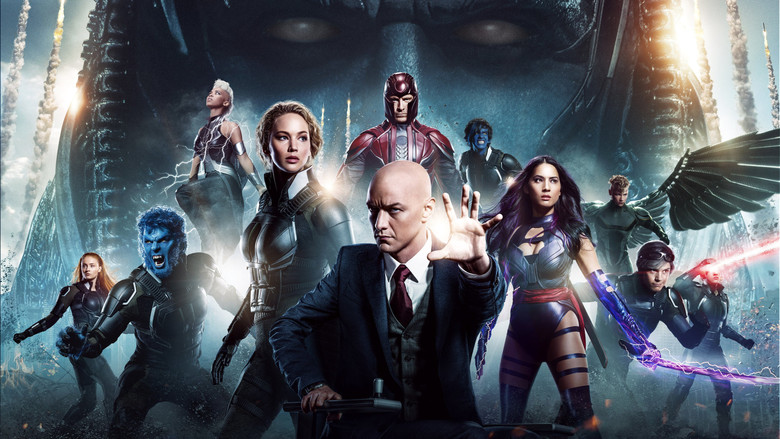
Set in 1983, a decade after the reality-altering events of X-Men: Days of Future Past, X-Men: Apocalypse opens with the awakening of En Sabah Nur (Oscar Isaac), an ancient, near-omnipotent mutant worshipped as a god since the dawn of human civilization. Disgusted by the decay, political fractures, and nuclear brinkmanship of the modern world, he resolves to purge humanity and build an unyielding order ruled only by the strong. To achieve this global purification, he gathers four formidable mutants as his modern "Horsemen"—including a grief-stricken Magneto (Michael Fassbender)—and imbues them with enhanced powers.

Meanwhile, Charles Xavier (James McAvoy) oversees a thriving sanctuary for young mutants at his Westchester school, striving to guide them toward peaceful integration with human society. When Xavier is targeted by Apocalypse for his unparalleled telepathic abilities, the sanctuary is thrown into chaos, leaving Raven/Mystique (Jennifer Lawrence) and Hank McCoy/Beast (Nicholas Hoult) to mentor an untrained generation of mutants—including Scott Summers (Tye Sheridan), Jean Grey (Sophie Turner), and Nightcrawler (Kodi Smit-McPhee).

As the planet stands on the brink of complete annihilation, this nascent team of X-Men must unite their disparate gifts, overcome personal doubts, and confront a seemingly invincible deity before civilization is reduced to ashes.


Core Meaning

Director Bryan Singer and screenwriter Simon Kinberg use the myth of the ancient god-king to interrogate the clash between totalitarian social Darwinism and compassionate collectivism. The film asserts that true power does not reside in tyrannical domination, physical invincibility, or the ruthless culling of the vulnerable, but in empathy, communal solidarity, and the courage to master one's internal darkness. In contrast to Apocalypse's ideology of fear and subjugation, Xavier’s philosophy proves that vulnerability, human connection, and mentorship are the ultimate catalysts for humanity's and mutantkind's survival.

Thematic DNA

Totalitarian Power vs. Free Will & Community 30%
Grief, Trauma, and the Cycle of Vengeance 25%
Mentorship, Leadership, and the Next Generation 20%
Fear of the Uncontrollable Self / Inner Darkness 15%
False Idols and Blind Faith 10%

Totalitarian Power vs. Free Will & Community

Apocalypse represents absolute authoritarianism, operating on the dogma that only the fittest deserve to live. The film systematically deconstructs this by demonstrating that his Horsemen are subjugated pawns, whereas Xavier's students operate out of mutual love and chosen loyalty, proving that decentralized unity outperforms solitary omnipotence.

Grief, Trauma, and the Cycle of Vengeance

Explored primarily through Erik Lehnsherr, who attempts a peaceful life in Poland under the name Henryk Górski. The accidental loss of his wife and daughter reignites his wrath, highlighting how unhealed historical and personal trauma leaves individuals susceptible to radicalization and destruction.

Mentorship, Leadership, and the Next Generation

Raven struggles with being an idolized symbol of mutant liberation, while Charles nurtures students' potential. The film focuses on the passing of the torch to young mutants like Cyclops and Jean Grey, showing that leadership requires empowering others rather than demanding worship.

Fear of the Uncontrollable Self / Inner Darkness

Jean Grey is terrified of the apocalyptic power slumbering within her mind. Rather than suppressing or fearing destructive potential, the narrative demonstrates that self-actualization comes from accepting and unleashing one's authentic strength in the service of protection.

False Idols and Blind Faith

Apocalypse exploits disenfranchised mutants (Storm, Psylocke, Angel) by offering them validation, status, and physical enhancements, mirroring real-world cult dynamics and ideological exploitation.

Character Analysis

Charles Xavier / Professor X

James McAvoy

Archetype: The Mentor / Idealist Key Trait: Unshakable empathy and mental fortitude.

Motivation

To protect mutantkind and foster peaceful coexistence with humanity through education and understanding.

Character Arc

Strives to build a world where humans and mutants coexist. He faces total vulnerability when co-opted by Apocalypse, learning that protecting his students means preparing them to fight.

Erik Lehnsherr / Magneto

Michael Fassbender

Archetype: The Tragic Antihero Key Trait: Profound grief channeling immense magnetism.

Motivation

Driven by devastating grief and vengeance after the slaughter of his wife and daughter.

Character Arc

After losing his new family in Poland, he succumbs to vengeance as Apocalypse's Horseman of War, before rediscovering his bond with Charles and Mystique.

All 5 characters and cast

Symbols & Motifs

The Blindfold / Visor (Cyclops' Vision)

Meaning:

Symbolizes the double-edged nature of raw power; uncontrolled, it destroys everything in sight, but when focused through guidance and discipline (the ruby-quartz lenses), it becomes a precise shield for others.

Context:

Used by Scott Summers to manage and direct his destructive optic blasts safely.

The Phoenix (Flames / Fiery Silhouette)

Meaning:

Represents rebirth through destruction. Demonstrates that profound creation and liberation often require the burning away of ancient, calcified tyrannies.

Context:

Manifests as a flaming raptor around Jean Grey when she unleashes her full psionic power against Apocalypse.

Cerebro

Meaning:

Serves as the nexus of global empathy and mental connection, highlighting the dual potential of mass communication and mental reach.

Context:

When Charles uses it, it bridges minds; when Apocalypse co-opts it, it becomes a weapon of mass psychic disarmament.

Metal Locket / Family Relic

Meaning:

Represents Erik's fragile tether to humanity.

Context:

Carried by Erik in Poland; its destruction and Erik's subsequent shaping of metal into weapons signify his descent into nihilism before turning back to forge Xavier's school at the end.

Pyramids and Monolithic Architecture

Meaning:

Represent the hubris of ancient rulers and the desire to impose geometric, rigid order over organic human existence.

Context:

Featured during the ancient Egyptian collapse and reconstructed by Apocalypse in modern Cairo.

Memorable Quotes

You are all my children, and you're lost because you follow blind leaders. No more false gods. I'm here now.
— Apocalypse (En Sabah Nur)

Context

Delivered when recruiting his Horsemen.

Meaning

Crystallizes his messianic delusion and manipulation of vulnerable mutants.

Whatever you think you saw in me, I buried it with my family.
— Magneto (Erik Lehnsherr)

Context

Spoken to Raven in the ruins of Auschwitz.

Meaning

Demonstrates his absolute despair and severance of faith in humanity following the tragic murder of his wife and child.

All 5 quotes

Philosophical Questions

Is human conflict an inevitable evolutionary dead end?

Apocalypse sees nuclear weapons as evidence of humanity's incurable self-destruction, posing the question of whether a flawed species requires authoritarian intervention or if self-determination is worth the risk of extinction.

Can justice exist without retribution?

Erik’s arc examines whether an individual who has repeatedly suffered systemic injustice can ever truly find peace within legal and societal frameworks, or if revenge remains an inescapable psychological compulsion.

What defines true divinity: power or empathy?

The narrative juxtaposes Apocalypse’s definition of godhood (uncontested might, immortality, and fear) against Xavier's ethos (connection, self-sacrifice, and mutual empowerment).

Alternative Interpretations

  • Secularism vs. Religious Fundamentalism: Some critics interpret Apocalypse not merely as an alien mutant, but as an allegorical critique of violent dogma and the dangers of fundamentalist cults that weaponize the trauma of marginalized outcasts to wage holy war.
  • The Inevitability of Mutant Militarization: While Charles advocates for peaceful education, the ending reveals the X-Men donning combat suits in the Danger Room facing Sentinels. This can be read as Charles tacitly admitting that Magneto’s worldview—that peace requires military readiness—was ultimately justified.
  • Psychological Manifestation of Repression: Jean Grey's Phoenix power can be read as a metaphor for feminine rage and psychological trauma, which when suppressed leads to internal anguish, but when embraced becomes the ultimate transformative force.

Full ending explanation

Cultural Impact

Released in May 2016, X-Men: Apocalypse landed during the peak era of cinematic universe expansions, competing directly with Captain America: Civil War and Batman v Superman: Dawn of Justice. While it achieved solid box office returns ($543.9M), critical reception was polarizing.

The film signaled a shift in audience appetite away from bloated, city-destroying CGI third acts toward more character-driven or subversively stylized superhero narratives (exemplified by the massive success of Deadpool earlier that year). Nonetheless, its aesthetic treatment of 1980s pop culture, vibrant comic-accurate suits in the Danger Room finale, and the standout Quicksilver rescue sequence left an indelible mark on superhero action choreography.

Audience Reception

Critical Reception (Rotten Tomatoes: ~47%):

  • Praised: The breathtaking Quicksilver sequence; Michael Fassbender's performance in the Polish forest; the nostalgic 1980s musical cues; and the emergence of the Phoenix.
  • Criticisms: An overstuffed cast with underdeveloped supporting Horsemen (notably Psylocke and Angel); excessive CGI city devastation in the third act; and Oscar Isaac’s makeup design drawing unflattering comparisons to campy villains.

Audience Consensus (Rotten Tomatoes Audience Score: ~65%): Audiences enjoyed the blockbuster spectacle, action set pieces, and younger cast chemistry (Sophie Turner and Tye Sheridan), but acknowledged that it lacked the narrative precision and emotional weight of X-Men: Days of Future Past and X-Men: First Class.

Interesting Facts

  • The three-minute mansion explosion sequence set to Eurythmics' "Sweet Dreams (Are Made of This)" took approximately 30 days to shoot, utilizing custom high-speed Phantom cameras filming at 3,000 frames per second on elaborate mechanical rigs.
  • Oscar Isaac had to wear a 40-pound suit layered with extensive makeup, prosthetics, and an internal cooling mechanism that pumped ice water between takes to prevent heat exhaustion.
  • To portray the classic bald Professor X, James McAvoy shaved his head on camera, with original Professor X actor Patrick Stewart observing via FaceTime.
  • Principal photography took place primarily in Montreal, Quebec, Canada (including Mel’s Cité du Cinema studios), from April to August 2015.
  • The film was produced on a net budget of approximately $178 million and grossed $543.9 million worldwide.

Easter Eggs

Weapon X Carnage (Hugh Jackman Cameo)

Logan appears in his comic-accurate Weapon X gear (designed by Barry Windsor-Smith), complete with headgear and sensory apparatus, tearing through Stryker's soldiers at Alkali Lake.

Essex Corp Post-Credits Scene

Operatives collect vials of Weapon X blood into a briefcase stamped "ESSEX CORP," foreshadowing Nathaniel Essex (Mister Sinister) and the cloning experiments that yielded X-23 in Logan (2017).

Return of the Jedi Meta-Joke

When Scott, Jean, Jubilee, and Nightcrawler exit a cinema playing Star Wars: Episode VI – Return of the Jedi (1983), Jean quips: "At least we can all agree the third one is always the worst," referencing both Return of the Jedi and Bryan Singer's feelings regarding Brett Ratner’s X-Men: The Last Stand (2006).

Stan Lee Cameo

Stan Lee makes a cameo alongside his real-life wife, Joan Lee, looking up at the sky in terror as the world's nuclear arsenals are launched into space.

Star Trek on Television

When Apocalypse visits Storm's home in Cairo, the television plays the Star Trek: The Original Series episode "Who Mourns for Adonais?", which revolves around an ancient god-like entity demanding worship.

Homage to Land of the Pharaohs

The opening sequence depicting ancient Egyptian collapse and sliding megalithic blocks was directly influenced by Howard Hawks' 1955 film Land of the Pharaohs.

Frequently Asked Questions

Explore More About This Movie

Dive deeper into specific aspects of the movie with our detailed analysis pages

Comments (0)

Leave a comment

No comments yet. Be the first to share your thoughts!

Similar Movies