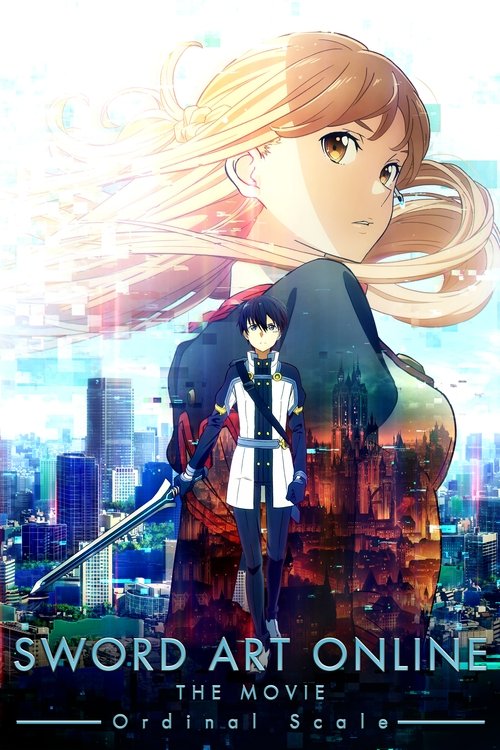
Sword Art Online the Movie: Ordinal Scale
劇場版 ソードアート・オンライン -オーディナル・スケール-
"It's just a game... Or so I thought—"
Overview
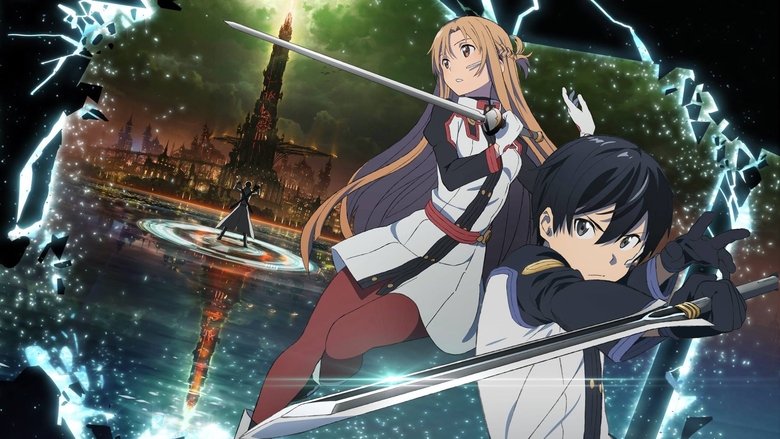
In the year 2026, a new augmented reality device called the Augma is released to the public, competing with the full-dive AmuSphere. The Augma allows players to remain conscious while gaming, overlaying virtual elements onto the real world. The most popular game for this system is Ordinal Scale (OS), an ARMMORPG where players increase their rank by collecting items and defeating monsters in real-world locations. Kirito, initially uninterested in a game requiring physical athleticism, is drawn into the fray when bosses from the original Sword Art Online (SAO) begin appearing as special events.
As the former SAO survivors engage these bosses, a mysterious plot unfolds involving Eiji, the second-ranked player in OS, and Yuna, the game's AI idol mascot. It is revealed that whenever an SAO survivor is defeated by an OS boss, their memories of Aincrad are forcibly scanned and stolen. When Asuna loses her precious memories of her time in SAO after protecting her friends, Kirito vows to reclaim them. He discovers that the game's developer, Dr. Shigemura, is harvesting these memories to reconstruct an AI consciousness of his daughter, Yuuna, who died in the original death game.
Kirito trains rigorously to master the AR mechanics and climb the rankings to confront Eiji and Shigemura. The conflict culminates in a massive battle where Kirito and his friends must defeat the Level 100 boss of Aincrad to stop the scanning process that threatens to kill the survivors. With the help of an unexpected digital ally and the gathered strength of his friends, Kirito fights to save not just the past, but the future he promised to Asuna.
Core Meaning
The sanctity of memory and the acceptance of trauma. The film argues that our identity is constructed not just from happy moments, but also from our struggles and pain. While the antagonist seeks to sanitize the past or resurrect the dead by stealing memories, the protagonist fights to preserve them—even the traumatic ones—because they are proof of life and the foundation of his bonds. It also explores the evolving relationship between humanity and technology, suggesting that while AR blurs the lines of reality, the human heart remains the ultimate anchor.
Thematic DNA
The Value of Painful Memories
The central conflict revolves around whether it is better to forget trauma or embrace it. Dr. Shigemura believes erasing the survivors' traumatic memories is a mercy that serves a greater good (resurrecting his daughter). In contrast, Kirito and Asuna value these memories, however painful, because they contain the roots of their love and personal growth.
Augmented Reality vs. Virtual Reality
The film contrasts the total immersion of VR (AmuSphere) with the physical integration of AR (Augma). It explores how technology can overlay the real world, making 'reality' gamified and potentially dangerous, while also questioning if digital experiences are less 'real' than physical ones.
Identity and Self-Worth
Eiji's character arc explores the desperate need for validation. Having been a 'failure' in SAO who couldn't fight due to fear, he uses the Augma to artificially inflate his strength and rank, linking his self-worth entirely to a number on a leaderboard rather than genuine strength of character.
Grief and Letting Go
Through Dr. Shigemura and the AI Yuna, the film examines the destructive nature of unprocessed grief. Shigemura's refusal to accept his daughter's death leads him to monstrous acts, whereas the AI Yuna ultimately accepts her fate, teaching that true love involves letting go.
Character Analysis
Kirito (Kazuto Kirigaya)
Yoshitsugu Matsuoka
Motivation
To protect Asuna and restore her stolen memories; to prevent the erasure of the past that defined them.
Character Arc
Starts as physically unmotivated and skeptical of AR, preferring the familiarity of VR. However, when Asuna is threatened, he is forced to train his physical body and adapt. He evolves from a 'beater' who relies on game mechanics to a warrior who fights with real-world resolve, ultimately merging his digital prowess with physical determination.
Asuna Yuuki
Haruka Tomatsu
Motivation
To protect her friends and preserve the bond she shares with Kirito.
Character Arc
Begins as a capable and enthusiastic OS player. Her arc takes a tragic turn when she sacrifices herself to save Silica, losing her memories of SAO. She spends the middle act grappling with the loss of her identity and connection to Kirito, before regaining her strength and joining the final battle.
Eiji (Nautilus)
Yoshio Inoue
Motivation
To redeem his past cowardice and resurrect the woman he loved, Yuna.
Character Arc
A former member of the Knights of the Blood Oath who was paralyzed by fear in SAO (FNC - Full Non-Conformity). He uses the Augma suit to cheat and gain artificial strength, seeking to prove his worth and revive Yuna. He is eventually defeated by Kirito, stripped of his suit, and forced to confront his own weakness.
Yuna
Sayaka Kanda
Motivation
To sing for everyone and prevent further suffering caused by her father's grief.
Character Arc
An AI recreation of Shigemura's daughter. She exists as both a cheerful pop idol and a sorrowful guide. She ultimately defies her creator's programming to help Kirito, choosing to fade away rather than exist at the cost of others' lives.
Symbols & Motifs
The Augma Headset
Symbolizes the blurring line between the digital and physical worlds. Unlike the NerveGear which isolated players, the Augma integrates the game into daily life, representing how technology has become inseparable from modern reality.
Worn by almost every character in public; used for everything from fitness to combat, showing the ubiquity of the digital overlay.
Glowing Memory Orbs
Represent the fragmentation of the self. They are physical manifestations of the survivors' experiences, glowing warmly but fragile, easily stolen by the cold machinery of the drones.
Seen floating away from characters like Asuna and Klein after they are defeated by bosses, physically signifying the theft of their past.
The Engagement Ring
A symbol of the future and a promise that transcends the virtual world. It anchors Kirito and Asuna's relationship in physical reality, contrasting with the ephemeral nature of the game.
Kirito struggles to give this to Asuna throughout the film; its final acceptance under the meteor shower signifies the restoration of their bond and memories.
Yuna's Hood
Represents mystery and the 'ghost' in the machine. It separates the AI Yuna (the idol) from the White Yuna (the sorrowful spirit/data fragment), hiding her true nature and sadness.
The 'White Yuna' appears silently to Kirito in parks, guiding him towards the truth while hiding her face.
Memorable Quotes
This is a game. Or so I thought...
— Kirito
Context:
Kirito's realization as he uncovers the conspiracy behind the memory loss.
Meaning:
A callback to Kayaba Akihiko's infamous line, 'This may be a game, but it's not something you play.' Kirito realizes that the stakes of Ordinal Scale are just as real and dangerous as SAO, despite the lack of a death game mechanic.
Ranking is everything. If you're number one, you're invincible.
— Eiji
Context:
Eiji taunting Klein and his guild before defeating them brutally.
Meaning:
Encapsulates the villain's philosophy and the gamification of worth. Eiji believes the system's assigned value is superior to genuine human skill or spirit.
I just want to know... the song she sang at the very end.
— Dr. Tetsuhiro Shigemura
Context:
Shigemura explaining his motivation for scanning the survivors' memories.
Meaning:
Reveals the depth of the antagonist's grief. He isn't just a mad scientist; he is a father desperate to hear his daughter's final moments, driving his entire villainous plot.
I promise. I'll get Asuna's memories back.
— Kirito
Context:
Kirito speaking to Asuna after she loses her memory and fears forgetting him.
Meaning:
The turning point for Kirito's character in the film. It marks his transition from a passive player to an active protector, setting up the film's second half.
Philosophical Questions
Is an AI reconstruction of a person the same as the person?
The film asks if Yuna, built from data and memories, possesses a soul. While she starts as a program, her actions—choosing self-sacrifice—suggest she developed a genuine consciousness, challenging the definition of life.
Do we have the right to forget?
Dr. Shigemura forces memory loss on the survivors, believing he is doing them a favor by removing their trauma. The film argues that even painful memories are essential to identity, and removing them without consent is a violation of the self.
Does technology enhance or impede human connection?
Augma is shown to bring people together in public spaces (unlike the isolation of the NerveGear), yet it also distracts them from immediate danger and allows corporations to harvest their personal data (memories). The film presents AR as a double-edged sword.
Alternative Interpretations
Some critics view the film as a critique of nostalgia culture. The villain literally mines the past (memories) to reconstruct a dead ideal (Yuna), which destroys the present well-being of the survivors. This can be read as a warning against being unable to move on from the 'glory days' (or in this case, the trauma that defined them). Additionally, the film can be interpreted as a deconstruction of the 'gamer' identity; Eiji represents the toxic side of gaming—using cheats and gear to mask insecurity—while Kirito represents the 'pure' gamer who eventually learns that physical reality is just as important as digital skill.
Cultural Impact
Ordinal Scale was a pivotal moment for the franchise, proving that Sword Art Online could sustain a global theatrical release. It arrived at the height of the Pokemon GO craze, making its commentary on Augmented Reality (AR) incredibly timely and resonant with audiences who were seeing digital overlays in public parks for the first time. The film bridged the gap between the 'Mother's Rosario' arc and the massive 'Alicization' arc, keeping the fandom alive and engaged. Commercially, it was a massive success for Aniplex, grossing over 4.3 billion yen globally, and critically, it was praised for elevating the animation quality of A-1 Pictures, setting a new standard for the series' visual battles.
Audience Reception
Praised: Fans and critics universally acclaimed the animation quality, particularly the final battle sequence which is considered one of the best in the franchise. The soundtrack by Yuki Kajiura and songs by LiSA and Sayaka Kanda were huge hits. The emotional focus on Kirito and Asuna's relationship was also a high point for shippers.
Criticized: Some viewers felt the plot relied too heavily on convenience (e.g., specific memories being targeted). Others found the villain's motivation slightly cliché. A common minor gripe was Kirito gaining physical fitness and AR proficiency somewhat too quickly given his initial laziness.
Verdict: Widely considered one of the best entries in the SAO franchise, satisfying longtime fans while offering a spectacular visual experience.
Interesting Facts
- The film features an original story by Reki Kawahara, the author of the light novels, rather than adapting an existing arc.
- The 'Level 100 Boss' of Aincrad, An Incarnation of the Radius, is finally revealed in this movie; it was never seen in the original anime series because the game ended early at Level 75.
- A post-credits scene shows Dr. Shigemura being recruited by Kikuoka for a project at 'Rath,' directly teasing the 'Alicization' arc of Season 3.
- The character Yuna is voiced by Sayaka Kanda, a famous Japanese actress and singer who tragically passed away in 2021. Her songs in the movie became very popular.
- Sony released a limited edition of real-life high-resolution headphones that looked exactly like the ones Kirito uses in the final battle.
- To prepare for the movie, the production team scouted real-world locations in Tokyo, including Yoyogi Park and Akihabara, to recreate them accurately in the animation.
- The movie grossed over $38 million worldwide, becoming a significant box office success for a late-night anime franchise film.
Easter Eggs
Mother's Rosario / Yuuki's Spirit
During the final battle, when Asuna uses her 11-hit combo 'Mother's Rosario,' the spirit of Yuuki Konno (who died in Season 2) appears as a purple silhouette to guide her hand. It symbolizes that Yuuki is always with her.
The 'Switch' Mechanic
Eiji whispers 'Switch' during a battle, a mechanic specific to SAO. This is the first clue to Asuna that he is an SAO survivor, specifically from a high-level guild.
Cameos of GGO and ALO Players
Characters like Sinon (from Gun Gale Online) and Leafa (from ALfheim Online) appear to help in the final raid. Leafa's absence for most of the movie is explained by her being at a kendo training camp.
Restaurant Aincrad
The restaurant where the characters meet is named 'Wagnaria,' a reference to the anime Working!!, which shares the same character designer, Shingo Adachi.
⚠️ Spoiler Analysis
Click to reveal detailed analysis with spoilers
Frequently Asked Questions
Explore More About This Movie
Dive deeper into specific aspects of the movie with our detailed analysis pages
Comments (0)
No comments yet. Be the first to share your thoughts!