Skip to content
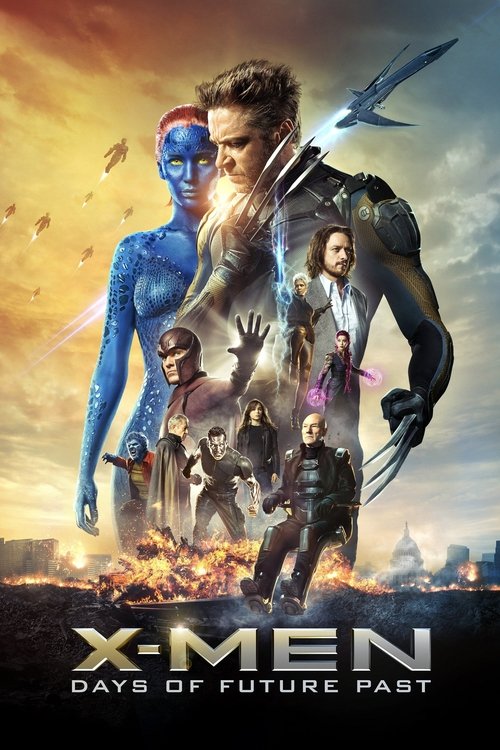
X-Men: Days of Future Past
A melancholic, time-fracturing sci-fi epic steeped in existential grief and stubborn hope, where dying embers of the future clash against the amber hues of the past to unbend the tragic arc of destiny.
X-Men: Days of Future Past

"To save the future, they must alter the past."

15 May 2014 United States of America 132 min 7.5 (16,567)

Director: Bryan Singer

Cast: Hugh Jackman, James McAvoy, Michael Fassbender, Patrick Stewart, Ian McKellen

Action Adventure Science Fiction Hope, Forgiveness, and Redemption Determinism vs. Free Will Fear of the Other and Escalation of Violence The Cost of Escapism vs. Embracing Pain
Budget: $250,000,000
Box Office: $748,045,700

X-Men: Days of Future Past — Ending Explained

⚠️ Spoiler Analysis

Mystique was originally captured in Paris in 1973 after killing Trask; her genetic makeup gave Sentinels the power to replicate any mutant ability, guaranteeing mutant extinction. In the climax in 1973 Washington D.C., Magneto hijacks the Sentinels by weaving metal into their polymer frames, lifts RFK Stadium to barricade the White House, and attempts to execute President Nixon on live television.

Simultaneously in 2023, Sentinels breach the monastery, killing Storm, Bishop, Colossus, Sunspot, Blink, and Iceman one by one while Magneto is mortally wounded. Just as Magneto prepares to strike in 1973, young Charles telepathically connects with Raven, pleading with her to spare Trask. Raven chooses mercy, disarms Magneto, and walks away.

Consequently, the 2023 apocalyptic timeline dissolves seconds before the Sentinels can kill Wolverine and Kitty. Wolverine wakes up at the Xavier Institute in a rewritten, peaceful future where Cyclops, Jean Grey, and the original X-Men are alive and well. In the final 1973 twist, Wolverine’s body is fished out of the Potomac River by William Stryker—who is revealed to be Mystique in disguise, retaining Wolverine's autonomy for a little while longer.

Alternative Interpretations

The film can be analyzed through several distinct thematic frameworks:

  • The Metaphor for Social Justice and Minority Struggle: As with classic X-Men narratives, the mutant struggle is interpreted as an allegory for Civil Rights and LGBTQ+ movements, where the Sentinels represent systematic state oppression and bigotry.
  • The Franchise Reset / Canon Erasure: Critics and fans interpret the ending as an in-universe editorial retcon, neatly scrubbing away controversial franchise events (such as the events of X-Men: The Last Stand and X-Men Origins: Wolverine) and creating a hopeful, clean slate.
  • The Psychological Reading (Xavier’s Recovery): An internal psychological interpretation frames the entire narrative around Charles’s battle with trauma, depression, and addiction; the dystopian timeline is an externalization of his despair, which can only be undone when he reconciles with his inner self.

Explore More About This Movie

Dive deeper into specific aspects of the movie with our detailed analysis pages

Similar Movies