Skip to content
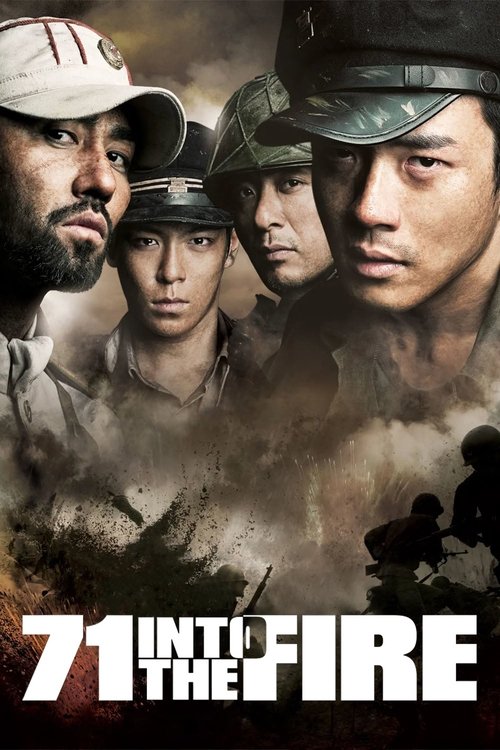
71: Into the Fire
A smoke-choked war drama in which boys in oversized uniforms hold a schoolhouse against a tide of steel. It is grief and stubborn courage together, with childhood fading like chalk dust in the shockwaves.
71: Into the Fire

71: Into the Fire

포화 속으로

"The day that courage came of age."

16 June 2010 South Korea 120 min 7.6 (222)

Director: John H. Lee

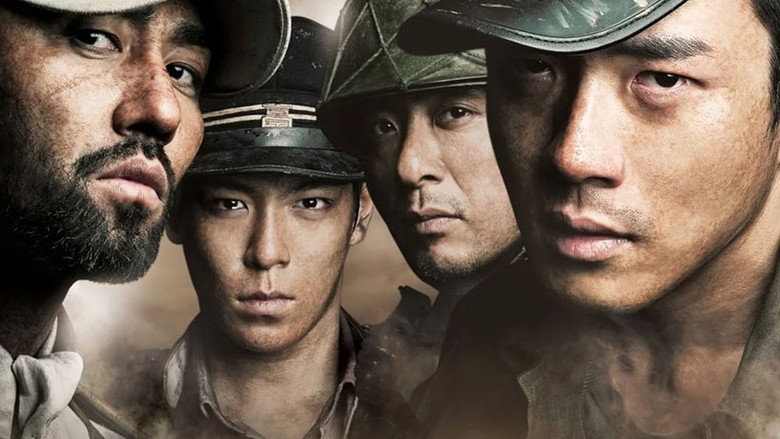
Cast: Kwon Sang-woo, Choi Seung-hyun, Kim Seung-woo, Cha Seung-won, Kim Hye-seong

War Loss of Innocence Leadership and self-doubt Brotherhood and redemption Sacrifice for the nation The humanity of the enemy
Budget: $10,400,000
Box Office: $20,967,660

Overview

Early in the Korean War, the South Korean army is falling back toward the Nakdong River to hold the last line of defense. That leaves the town of Pohang almost empty, guarded only by 71 student-soldiers. They are teenagers with almost no training, and they are posted at a girls' middle school. Oh Jang-beom, one of the few who has seen real combat, is put in command. Gap-jo, a hardened tough who was given the chance to fight, refuses to take orders from him.

The students beat back a couple of small enemy patrols. They then realize a much larger attack is coming and call for help, but the main front is under heavy bombardment. The North Korean 766th Unit is led by Major Park Mu-rang. He is a cold, disciplined commander and also a father, and he offers the boys a way out if they surrender. The school becomes a pressure chamber of fear, loyalty and pride.

Directed by John H. Lee, the film is based on the real defense of the Pohang girls' middle school. It mixes large-scale battle spectacle with quieter scenes of camaraderie, humor and fear among the young recruits.
Core Meaning

The film is a tribute to young people who were pushed into a war they did not choose, and it is also an elegy for them. Its core idea is that courage is not the absence of fear. It is what boys find in themselves when they are out of options and each other is all they have. The leadership lesson is that a leader earns followers through sincerity rather than rank.

The film also humanizes the enemy. Park is ruthless but not a cartoon, and the story pays attention to the cost of war on both sides. It was released for the 60th anniversary of the war, and it asks that these sacrifices be remembered.

Thematic DNA

Loss of innocence 30%
Leadership and self-doubt 25%
Brotherhood and redemption 22%
Sacrifice for the nation 13%
The humanity of the enemy 10%

Loss of innocence

The students are untrained boys who learn that war is not a game. Their schoolyard banter gives way to killing, mercy-killing and death, and the school setting underlines how childhood is overrun.

Leadership and self-doubt

Jang-beom blames himself for the death of an officer and is made leader only because he has some combat experience. His growth from an unsure student into a commander is the emotional spine of the film.

Brotherhood and redemption

The delinquent Gap-jo and the by-the-book Jang-beom start as rivals and end as comrades fighting back to back. Gap-jo's outsider status gives way to belonging and sacrifice.

Sacrifice for the nation

The boys' stand buys time for reinforcements, framing their deaths as a patriotic gift. The film ties this to family, home and country rather than to ideology alone.

The humanity of the enemy

Major Park is a father who offers the boys mercy, yet he is also ruthless. Reviewers noted that the film does not simply demonize the North Korean side.

Character Analysis

Oh Jang-beom

Choi Seung-hyun (T.O.P)

Archetype: Reluctant hero Key Trait: Quiet conscience

Motivation

To protect his comrades and to atone for the death of the officer he failed to save.

Character Arc

He starts as a shaken survivor who blames himself for an officer's death. He is placed in command, clashes with Gap-jo and then grows into a leader the others follow. He fights to the end on the school's rooftop.

Gap-jo

Kwon Sang-woo

Archetype: Rebel turned hero Key Trait: Rough, defiant loyalty

Motivation

Survival at first, then loyalty to the boys who accepted him as one of them.

Character Arc

A defiant tough who first refuses orders and leaves the school after a brawl with Jang-beom. He returns and reconciles with him. In the final battle he fights beside him and dies in the attack.

All 4 characters and cast

Symbols & Motifs

The school building

Meaning:

A place meant for learning and childhood that turns into a fortress and then a graveyard.

Context:

The student-soldiers defend the Pohang girls' middle school, and the final battle destroys its classrooms and corridors.

The white flag versus the national flag

Meaning:

Surrender and survival versus defiance and identity.

Context:

Park tells the students that if they raise a white flag they will be spared. They raise the South Korean flag instead, and the attack begins.

Gap-jo's switchblade

Meaning:

His rough, outsider identity, which becomes a source of skill and pride.

Context:

While the untrained students miss their targets in training, Gap-jo, who prefers knives, throws his switchblade into the bullseye.

The student uniform and Gap-jo's age

Meaning:

The gap between who the boys are and what war demands of them.

Context:

Gap-jo looks older than the others and is not a real student, but he fights alongside the others as one of the 71. Jang-beom tells him he is a student.

Grenade traps in the schoolyard

Meaning:

Improvised cleverness, with the weak outwitting the strong.

Context:

The students set grenade traps in the playground before the assault, which inflict heavy damage on the first wave of North Korean troops.

Philosophical Questions

What makes someone a hero when they have no choice?

The boys are conscripted into a hopeless position, yet they choose to stay and fight. The film asks whether courage is defined by choice or by how one responds to an impossible situation.

Can a leader be defined by sincerity rather than skill?

Jang-beom has little experience, but he is advised to lead with a pure heart, and the others follow him. The film explores whether trust, not competence, is what holds people together.

Is mercy possible in war?

Park offers the boys a chance to live if they surrender, but he is also prepared to destroy them. The film asks whether mercy can exist alongside the logic of war.

How It Ends

Alternative Interpretations

Some viewers read the film as a patriotic tribute that honors self-sacrifice for the nation. Others see it as an anti-war statement, because the story emphasizes how pointless and cruel it is to send untrained boys into battle. One reviewer noted that the film does not take sides in the usual propagandistic way and that it does not demonize the North Korean army. Others found it clearly partisan and focused on the heroic South Korean side.

Full ending explanation

Cultural Impact

The film was released in 2010, the 60th anniversary of the start of the Korean War, and was seen as a tribute to the young soldiers who died. It was a major domestic hit, drawing about 3.3 million admissions and ranking among the top Korean releases of that year. Its box office total reportedly reached about $20 million.

The casting of T.O.P, a K-pop star, brought extra attention to the film, and some critics attributed his casting to publicity, though other viewers praised his performance. The film joined a wave of modern Korean war films that combine large-scale action with melodrama. It has stayed in discussion as a popular introduction to a lesser-known battle of the war.

Audience Reception

Viewers praised the realistic, intense battle sequences, the production values, and the emotional impact of the finale. T.O.P's performance was often singled out as the heart of the film, along with Cha Seung-won's menacing Major Park and Kwon Sang-woo's gangster swagger. IMDb users rate it about 7.3/10, and Letterboxd users about 3.3/5.

Criticism focused on the slow build-up, with one reviewer noting that it takes about an hour and a half before the action really begins. Some found the editing choppy, and one critic called the film hollow and predictable, rating it 1.5 out of 4. Some also felt it was partisan. Overall, it is considered a competent, moving war film.

Interesting Facts

  • The film is based on the real defense of the Pohang girls' middle school on August 11, 1950, where 71 student-soldiers held off the North Korean 766th Unit for 11 hours.
  • The film's first working title was simply '71', followed by 'Into the Gunfire'.
  • Filming began on December 1, 2009 and finished on April 13, 2010.
  • Yu Seung-ho and Kim Beom were originally cast in the lead roles, but when Taewon Entertainment took over production, Kwon Sang-woo and T.O.P were cast instead.
  • A letter found on one of the deceased student-soldiers reportedly inspired the movie.
  • It was the feature film debut of T.O.P of the K-pop group Big Bang. He was reportedly injured during filming and taken to hospital.
  • It opened in South Korea on June 16, 2010, and drew about 3.36 million admissions, making it one of the highest-grossing Korean films of 2010.
  • The film was reportedly made on an estimated budget of about $10 million.

Frequently Asked Questions

Explore More About This Movie

Dive deeper into specific aspects of the movie with our detailed analysis pages

Comments (0)

Leave a comment

No comments yet. Be the first to share your thoughts!

Similar Movies