Skip to content
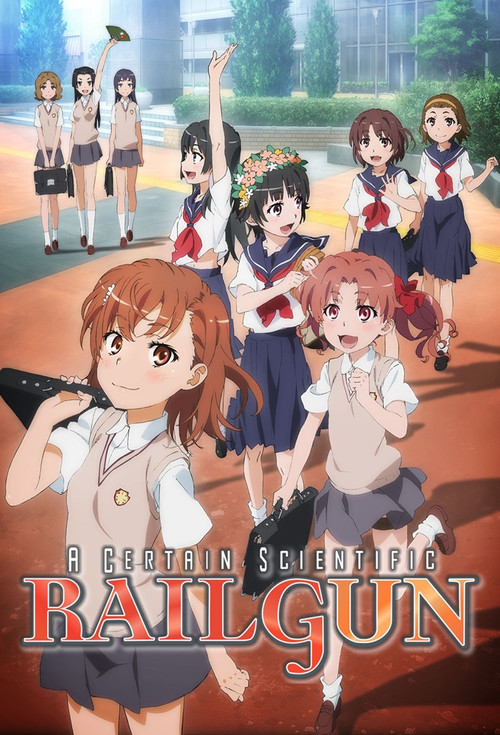
A Certain Scientific Railgun
A vivid juxtaposition of effervescent youth and chilling cybernetic dystopia. Through neon-lit alleys and arcade coin-flips, it captures the ache of isolation colliding with the fierce, crackling warmth of found family beneath Academy City's sterile steel skies.
A Certain Scientific Railgun

A Certain Scientific Railgun

とある科学の超電磁砲

02 October 2009 — 25 September 2020 Japan 4 season 73 episode Ended 7.4 (133)

Cast: Rina Sato, Satomi Arai, Aki Toyosaki, Kanae Itou, Atsushi Abe

Animation Sci-Fi & Fantasy Action & Adventure Comedy The Dehumanization of Utilitarian Science and Ethics Arbitrary Hierarchies vs. Inherent Self-Worth The Burden of Solitary Heroism vs. Interdependence The Duality of Surface Utopias and Hidden Systemic Evil

Overview

Set in the sprawling, hyper-advanced metropolis of Academy City—where 80% of the population consists of students undergoing cognitive development programs to awaken psychic powers known as esper abilities—A Certain Scientific Railgun follows Mikoto Misaka, ranked third among only seven "Level 5" espers in the city. Alongside her spirited circle of friends (her devoted Judgment junior roommate Kuroko Shirai, the introverted technological prodigy Kazari Uiharu, and the powerless "Level 0" Ruiko Saten), Mikoto navigates ordinary school life, student committee duties, and urban mysteries.

However, beneath the gleaming veneer of scientific wonder lies a ruthless corporate and academic underbelly. As the girls uncover various urban legends—from power-boosting audio frequencies and brainwave manipulation networks to weaponized child experimentation—they repeatedly stumble into Academy City’s sinister "Dark Side".

Across multiple overarching story arcs, the series shifts from lighthearted slice-of-life camaraderie into high-stakes technological espionage, existential horror, and moral warfare. Mikoto and her companions must confront calculating scientists, rival mercenary factions, and city-wide conspiracies, continually risking their lives to defend human dignity, preserve their friendships, and protect the vulnerable from becoming collateral damage in the pursuit of absolute power.

Core Meaning

Across its complete narrative run, A Certain Scientific Railgun serves as a powerful critique of unrestrained utilitarianism, institutional hierarchy, and the commodification of human potential. The creators deliver a core message: an individual's worth is not defined by arbitrary metrics, numerical ranks, or societal utility, but by their capacity for empathy, agency, and human connection.

Academy City's system rigidly stratifies children from Level 0 (powerless) to Level 5 (godlike), systematically cultivating inferiority complexes, psychological alienation, and predatory scientific experimentation. Against this backdrop, the series champions the idea that true strength stems not from solitary supremacy, but from the willingness to reach out, share one's burdens, and stand in solidarity with those whom systemic hierarchies have deemed disposable.

Thematic DNA

The Dehumanization of Utilitarian Science and Ethics 30%
Arbitrary Hierarchies vs. Inherent Self-Worth 25%
The Burden of Solitary Heroism vs. Interdependence 25%
The Duality of Surface Utopias and Hidden Systemic Evil 20%

The Dehumanization of Utilitarian Science and Ethics

Introduced in Season 1 via the Level Upper and Child Error experiments, this theme explodes into existential tragedy during the Sisters Arc (Season 2), where tens of thousands of human clones are mass-produced solely to be slaughtered for scientific data. It evolves further in Season 3 (Railgun T) through the Indian Poker cards and the soul-swapping, cybernetic creation of Ryōko Kuriba’s cyborg doppelgänger, questioning what constitutes human personhood and the moral limits of scientific inquiry.

Arbitrary Hierarchies vs. Inherent Self-Worth

The City's power scale (Levels 0 through 5) creates systemic oppression. In Season 1, Ruiko Saten’s feelings of uselessness drive her toward dangerous shortcuts. Over the show's run, the narrative consistently demonstrates that non-powered espers and lower ranks—such as Saten with her resourcefulness and Uiharu with her computational genius—are indispensable, repeatedly outmaneuvering or grounding the city's highest-ranked anomalies.

The Burden of Solitary Heroism vs. Interdependence

Initially, Mikoto Misaka attempts to solve Academy City’s darkest crises alone, believing her immense Level 5 status obligates her to shoulder every sacrifice to keep her friends safe. This messiah complex nearly breaks her psychologically during the Sisters Arc. Through the Daihasei Festival and subsequent arcs, she learns to accept vulnerability, trust her allies, and embrace collective strength rather than martyrdom.

The Duality of Surface Utopias and Hidden Systemic Evil

Academy City presents itself to the world as an immaculate educational haven of technological marvels. As each season peels back another layer of the municipal infrastructure (from black-ops groups like ITEM and MEMBER to the board of directors and rogue researchers like Gensei Kihara), the show explores how civilization constructs comfortable illusions atop exploitation and institutional neglect.

Character Analysis

Mikoto Misaka

Rina Satō (Japanese) / Brittney Karbowski (English)

Archetype: Reluctant Hero / Tragic Protector Key Trait: Relentless sense of justice and fierce loyalty beneath a tsundere exterior.

Motivation

Protecting the peace of her loved ones and taking personal responsibility for the fallout of her genetic legacy.

Character Arc

Begins as a confident, somewhat short-tempered Level 5 ace who enjoys normal school life. Her world shatters when she discovers her childhood DNA was exploited to create 20,000 clone sisters destined for slaughter. After confronting despair, isolation, and self-destructive guilt, she transforms into a mature, empathetic protector who values shared vulnerability and views the Sisters as her legitimate family.

Kuroko Shirai

Satomi Arai (Japanese) / Alison Viktorin & Kayli Mills (English)

Archetype: The Loyal Enforcer / Foil Companion Key Trait: Uncompromising sense of duty and teleportation combat prowess.

Motivation

Upholding law and civic peace through Judgment while unconditionally supporting Mikoto.

Character Arc

Transitions from an eccentric, infatuated roommate who provides comic relief into an exceptionally brave and astute officer of Judgment. Even when her memories of Mikoto are erased by Shokuhou Misaki in Season 3, her instinctual morality and drive to protect justice and Mikoto remain completely intact.

All 5 characters and cast

Symbols & Motifs

The Arcade Coin (Arcade Token)

Meaning:

Bridges the mundane, joyful world of a normal adolescent girl with destructive, weaponized scientific power, representing Mikoto Misaka's dual nature as a middle schooler and an apex weapon.

Context:

The primary projectile and visual signature of Mikoto Misaka’s signature Railgun attack.

Gekota (The Frog Mascot)

Meaning:

Serves as a persistent motif representing childhood innocence, sentimental vulnerability, and Mikoto’s attachment to ordinary girlhood, contrasting sharply with the grim, mechanized reality of Academy City.

Context:

A popular merchandise character and collectible brand beloved by Mikoto across multiple seasons.

Wind Turbines (Propellers of Academy City)

Meaning:

Visually symbolize the clean, renewable facade of scientific progress, while their erratic spinning during climatic battles mirrors electromagnetic disturbances and the city's volatile equilibrium.

Context:

Lining the cityscape's skyline, wind turbines are omnipresent throughout every season of the series.

The Goggles / Visors of the Sisters

Meaning:

Represent the mechanized dehumanization forced upon the clones by researchers, treating human beings as combat hardware until Mikoto and Touma help restore their personal agency.

Context:

Worn by the clones of the Misaka Network as standard military night-vision equipment during the Level 6 Shift experiments.

The Judgment Armband

Meaning:

Signifies grassroots justice, ethical civic duty, and the determination of student youth to protect their community without resorting to institutional corruption.

Context:

Worn on the arms of student officers like Kuroko Shirai and Kazari Uiharu, emblazoned with a green shield and scale motif.

Memorable Quotes

あんたの幻想なんて、私がこの手で全部ぶち壊してやるわ!
— Mikoto Misaka

Context

Spoken during climatic confrontations, echoing Touma Kamijou's core philosophy.

Meaning

Marks Mikoto’s determination to tear down the deterministic calculations of Academy City's researchers by adopting an uncompromising, rebellious stance.

ジャッジメントですの!
— Kuroko Shirai

Context

Kuroko’s recurring battle cry across all seasons when apprehending criminals in the line of duty.

Meaning

Asserts student authority, civic duty, and moral law over chaotic violence in Academy City.

All 4 quotes

Episode Highlights

AIM Diffusion Fields

S1E12

The climax of the Level Upper arc where Mikoto confronts Harumi Kiyama and discovers the tragic reality of the coma-stricken Child Error students.

Significance:

Establishes Academy City's systemic moral corruption and shifts the show from lighthearted mysteries to dark institutional critique.

Poltergeist

S1E24

The season finale uniting Mikoto, Kuroko, Uiharu, and Saten to defeat Therestina Kihara Lifeline and rescue Kiyama’s comatose students.

Significance:

Consolidates the core quartet’s bond and affirms that Level 0s and Level 5s fight equally for justice.

Absolute Simulation Project

S2E5

Mikoto discovers the grim reality of the Level 6 Shift Project and witnesses Accelerator brutally slaughtering clone Misaka 9982 in a back alley.

Significance:

Pivots the anime into dark psychological horror and kicks off the high-stakes emotional core of the Sisters Arc.

The AIM Stalker

S2E9

Mikoto conducts a desperate solitary infiltration of research facilities, culminating in a ruthless tactical battle against the dark-side mercenary team ITEM.

Significance:

Highlights Mikoto's isolation, tactical limits, and the desperate burden of attempting solitary heroism against Academy City's underworld.

Kamijou Touma

S2E15

Mikoto reaches her emotional breaking point and prepares to sacrifice her life, but Touma Kamijou intervenes to challenge Accelerator on the train tracks.

Significance:

Marks the turning point of the Sisters Arc, challenging Mikoto's fatalistic martyr complex with irrational altruism.

Join the Battle

S3E10

Kongou Mitsuko is brutally assaulted by Baba while protecting Misaka 10032’s black cat, triggering an emotional intervention by Wannai and Awatsuki.

Significance:

Serves as the mid-climax of the Daihasei Festival arc, highlighting the courage, loyalty, and thematic dignity of supporting characters.

Dragon Strike

S3E14

Mikoto is forcibly mutated toward Level 6 by Gensei Kihara, requiring Touma, Gunha Sogiita, and Misaki Shokuhou to coordinate their powers to save her.

Significance:

The kinetic action climax of the Daihasei Festival arc, showcasing collaborative heroism to avert city-wide annihilation.

Soul Extraction

S3E24

Mikoto battles the cybernetic Doppelgänger atop an industrial complex using a massive iron-sand construct.

Significance:

The climax of the Dream Ranker arc, resolving core philosophical dilemmas regarding artificial souls, consciousness, and human rights.

Philosophical Questions

What Defines a Human Soul in an Age of Biological Replication?

Explored through the Misaka Sisters and the cyborg Doppelgänger: if human consciousness and memories can be mass-produced, cloned, or coded into machinery, does personhood stem from biological origin or subjective experience and agency?

Is Utilitarian Progress Justifiable if Built on Human Sacrifice?

Through the Level 6 Shift experiments justified by researchers as a pathway to divine knowledge for the betterment of civilization, the series asks whether any intellectual breakthrough remains valid when achieved through systematic atrocity.

Can Arbitrary Metrics Measure Human Value?

Through Level 0 characters repeatedly outsmarting and grounding elite Level 5 anomalies, the series questions whether institutional scales and meritocracies can ever measure the true capacity of human spirit, creativity, and moral resolve.

Alternative Interpretations

The Political/Institutional Critique Reading: Interprets Academy City as an allegory for unrestrained, deregulated techno-capitalism where the Board of Directors operates above international law, treating children as experimental human capital and demonstrating how corporate scientific monopolies breed systemic fascism.

Full ending explanation

Cultural Impact

Premiering in 2009, Railgun bridged the gap between moe slice-of-life schoolgirl anime and hardcore cyberpunk sci-fi, establishing a benchmark for dynamic, all-female ensemble action shows.

Mikoto Misaka became a cultural phenomenon, dominating the Kono Light Novel ga Sugoi! best female character poll for nearly a decade by capturing the #1 spot ten times, a record in Japanese media history.

The series explored themes of CRISPR-like gene-editing, neuro-link networks, and AI rights during the dawn of modern real-world bioethics debates. Furthermore, it anchored the Toaru universe as one of Japan's highest-grossing multimedia franchises, spawning spin-offs like Astral Buddy and A Certain Scientific Dark Matter.

Audience Reception

Season 1 (Railgun, 2009–2010): Received warmly for its charming blend of slice-of-life humor, memorable character interactions, and crisp action set pieces. While some critics voiced mild frustration with anime-original filler pacing in the second cour, the Level Upper climax received universal praise.

Season 2 (Railgun S, 2013): Universally hailed as the pinnacle of the franchise. The first 16 episodes adapting the Sisters Arc are widely regarded as a masterpiece of suspense, emotional pacing, and dark sci-fi direction, though the anime-original Silent Party arc received mixed reactions due to a perceived tonal drop.

Season 3 (Railgun T, 2020): Praised for adhering strictly to the manga canon (the Daihasei Festival and Dream Ranker arcs), delivering blockbuster sakuga animation, and balancing an expanded ensemble cast of Level 5s and dark-side operatives.

Overall Verdict: Regarded as one of the definitive anime sci-fi spin-offs that surpassed its parent series in thematic execution, emotional resonance, and consistent character development.

Interesting Facts

  • Director Tatsuyuki Nagai was specifically chosen for his ability to helm sensitive human dramas (such as Toradora! and Anohana), bringing grounded emotion and visual pacing to the series.
  • Despite being a spin-off of Kazuma Kamachi’s flagship A Certain Magical Index light novel series, Railgun frequently received higher critical acclaim, greater animation budgets at J.C.Staff, and better disc sales.
  • Several storylines—including the Poltergeist arc (Season 1) and Silent Party arc (Season 2)—were anime-original expansions supervised by the creative staff to allow the manga time to progress.
  • Synth-pop duo fripSide (fronted by Yoshino Nanjō) performed every major opening theme for the series, with 'only my railgun' becoming an enduring gold-certified anime anthem across Japan.
  • Seven full years elapsed between the conclusion of Railgun S (2013) and Railgun T (2020), primarily due to waiting for the manga source material to finish the Daihasei Festival and Dream Ranker arcs.

Easter Eggs

Bilibili Brand Origin

The massive Chinese video-sharing platform Bilibili was directly named after Mikoto Misaka's nickname ("Biri-Biri"), with its website features, buttons, and anniversary milestones directly referencing the character and series.

Index Timeline Synchronicity

Background events from A Certain Magical Index continually unfold in the periphery, such as Index wandering lost in restaurant backgrounds during Season 1 and the Sisters Arc meticulously matching the timeline of Index I.

Level 5 Cameo Roster in Season 3

The first episode of Railgun T explicitly showcases six of the seven Level 5 espers (Accelerator, Kakine Teitoku, Misaka Mikoto, Mugino Shizuri, Shokuhou Misaki, and Sogiita Gunha), establishing the city's power hierarchy.

Shaft/Gainax Animation Tributes

Key fight sequences, such as Kuroko Shirai versus Awaki Musujime and the ITEM raids, featured key-frame guest cuts inspired by vintage mecha and avant-garde staging techniques.

Frequently Asked Questions

Explore More About This Movie

Dive deeper into specific aspects of the movie with our detailed analysis pages

Comments (0)

Leave a comment

No comments yet. Be the first to share your thoughts!

Similar Movies