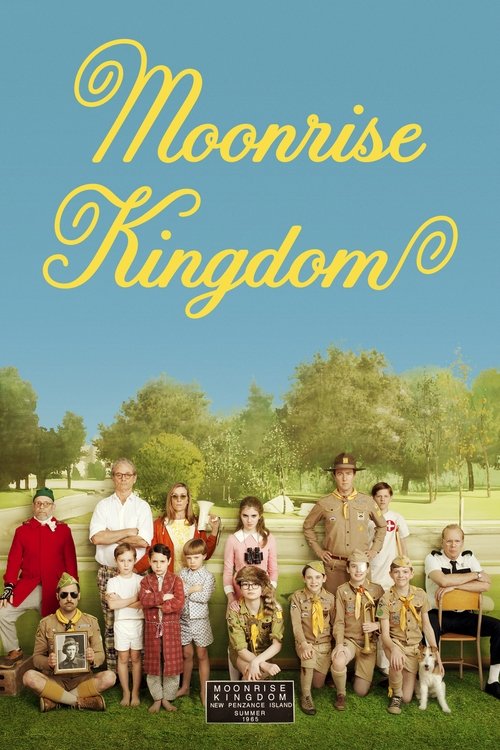
Moonrise Kingdom
A whimsical, nostalgic coming-of-age fable painted in shades of khaki and summer gold. It blends the melancholy of misunderstood childhood with the fierce seriousness of first love, creating a symmetric, storybook world that feels like a bittersweet memory.
Moonrise Kingdom

Moonrise Kingdom

16 May 2012 United States of America 94 min ⭐ 7.7 (6,203)
Director: Wes Anderson
Cast: Jared Gilman, Kara Hayward, Bruce Willis, Edward Norton, Bill Murray
Drama Comedy Romance
The Seriousness of Young Love Dysfunctional Families & Chosen Kin Innocence vs. Experience Order vs. Wilderness
Budget: $16,000,000
Box Office: $68,263,166

Overview

Set on the fictional New England island of New Penzance in the summer of 1965, the film follows two twelve-year-olds who feel alienated from their respective worlds. Sam Shakusky, an orphan and unpopular Khaki Scout, and Suzy Bishop, a troubled girl with a penchant for fantasy novels, have been secret pen pals for a year. They execute a meticulous plan to run away together into the wilderness, prompting a frantic search party composed of Suzy's dysfunctional parents, a lonely police captain, and a dedicated but overwhelmed Scout Master.

As the young lovers hike towards a secluded cove they name "Moonrise Kingdom," a violent hurricane approaches the island. The adults' pursuit exposes their own broken lives and failures, contrasting sharply with the children's direct and serious commitment to one another. The story builds to a dramatic confrontation atop a church steeple during the storm, where the community must come together to save the runaways and, in the process, heal their own fractured relationships.


Core Meaning

Moonrise Kingdom is an ode to the intensity and seriousness of childhood emotions, suggesting that children often understand loyalty and love better than the jaded adults who govern them. Director Wes Anderson explores the idea of the "chosen family" and the melancholy realization that growing up involves compromise. The film validates the feelings of the "outsider," portraying their escape not just as rebellion, but as a necessary quest for a place where they truly belong.

Thematic DNA

The Seriousness of Young Love 30%
Dysfunctional Families & Chosen Kin 25%
Innocence vs. Experience 25%
Order vs. Wilderness 20%

The Seriousness of Young Love

Unlike many films that dismiss puppy love as fleeting, this film treats Sam and Suzy's romance with profound gravity. They are committed, make vows, and are willing to risk their lives for each other. Their relationship is the most functional one in the movie, contrasting with the adulterous and unhappy marriages of the adults around them.

Dysfunctional Families & Chosen Kin

The film juxtaposes biological families with found families. Suzy feels like a stranger in her own home, while Sam is an orphan rejected by foster parents. Ultimately, characters find belonging outside of blood ties, culminating in Captain Sharp—a lonely man himself—becoming the father figure Sam desperately needs.

Innocence vs. Experience

The narrative explores the threshold between childhood and adulthood. The children mimic adult behaviors (smoking, marriage, detailed planning) to gain agency, while the adults often act with childish pettiness. The encroaching storm symbolizes the inevitable loss of innocence and the uncontrollable chaos of the adult world crashing into their idyllic sanctuary.

Order vs. Wilderness

Visually and narratively, the film contrasts the rigid, symmetrical structures of the Scouts and the Bishop household with the wild, untamed nature of the island. Sam uses his scouting skills (order) to survive in the woods (chaos), symbolizing the attempt to impose structure on the messy emotional landscape of adolescence.

Character Analysis

Sam Shakusky

Jared Gilman

Archetype: The Romantic Outcast / The Orphan
Key Trait: Meticulous competence

Motivation

To find a place where he belongs and to be with the one person who understands him (Suzy).

Character Arc

Sam starts as an unwanted orphan rejected by both his foster family and his scout troop. Through his journey with Suzy, he finds self-worth and courage. By the end, he transitions from a state of homelessness to finding a true father figure in Captain Sharp, shedding his "emotionally disturbed" label.

Suzy Bishop

Kara Hayward

Archetype: The Misunderstood Rebel
Key Trait: Melancholic intensity

Motivation

To escape her depressed, dysfunctional home life and live out the fantasy adventures she reads about in books.

Character Arc

Suzy begins as an angry, isolated girl with violent outbursts, feeling invisible in her family. Her relationship with Sam validates her emotions. Although she returns home, she is no longer alienated; she has a secret inner world and a continued connection with Sam, softening her anger.

Captain Sharp

Bruce Willis

Archetype: The Sad Mentor / The Surrogate Father
Key Trait: Gentle melancholy

Motivation

To do the right thing and cure his own profound loneliness.

Character Arc

Sharp is initially a lonely, passive figure involved in an unhappy affair with Mrs. Bishop. The crisis with Sam awakens his sense of responsibility and empathy. He evolves from a sad authority figure into a protective parent, risking his career to save Sam from the orphanage.

Scout Master Ward

Edward Norton

Archetype: The Dutiful Leader
Key Trait: Earnest dedication

Motivation

To be a good leader and uphold the honor of the Khaki Scouts.

Character Arc

Ward starts as a rule-obsessed leader who loses his troop. He undergoes a crisis of competence but proves his worth by rescuing the commander during the storm. He learns to prioritize the children's safety over strict adherence to protocol.

Symbols & Motifs

Suzy's Binoculars

Meaning:

They symbolize Suzy's feeling of distance from those around her and her desire to observe the world without participating in it. They are her "magic power" to see things up close while remaining emotionally removed.

Context:

Suzy uses them constantly, even indoors. She looks at her family from afar, highlighting her alienation. Later, she offers them to Sam, inviting him into her perspective.

Maps and Cartography

Meaning:

Maps represent the desire to define, control, and understand one's world. They symbolize the adventure of charting a new life and the innocence of believing the world can be neatly navigated.

Context:

Sam is an expert cartographer. The film features animated maps to track their journey. The cove they find is an "unmapped" inlet, which they name, effectively claiming it as their own private reality.

The Flood / Noye's Fludde

Meaning:

A biblical reference to cleansing and rebirth. It mirrors the emotional turmoil of the characters and the washing away of the old, stagnant order to make way for a new family dynamic.

Context:

The film opens with a performance of Benjamin Britten's opera Noye's Fludde (Noah's Flood), where Sam and Suzy first meet. The climax involves a massive hurricane and flood that forces the entire community into the ark-like safety of the church.

The Khaki Scout Uniform

Meaning:

A symbol of belonging, rules, and the performative nature of masculinity and growing up. For Sam, it is initially a costume of the group that rejects him, which he later repurposes for his own survival.

Context:

Sam wears his uniform with pride throughout his rebellion, using the skills he learned to sustain his life with Suzy. He eventually modifies it, shedding the official badges for his own created identity.

Memorable Quotes

I love you, but you don't know what you're talking about.

— Sam Shakusky

Context:

Spoken during their time at the cove when Suzy says she wishes she was an orphan because her life is special, and Sam, being an actual orphan, corrects her romanticized view of tragedy.

Meaning:

This quote encapsulates the dynamic of their relationship: Sam is pragmatic and literal, while Suzy is more emotional and pessimistic. It shows Sam's confidence in his feelings and his refusal to accept Suzy's self-loathing.

We're in love. We just want to be together. What's wrong with that?

— Suzy Bishop

Context:

Suzy says this to the adults when they are finally caught and separated, defending their actions against the judgment of her parents and the authorities.

Meaning:

A simple, defiant declaration that cuts through the adults' complicated bureaucratic and social objections. It highlights the purity and directness of their motivation.

Was he a good dog? ... Who's to say? But he didn't deserve to die.

— Suzy Bishop & Sam Shakusky

Context:

After the confrontation in the woods where the scout dog, Snoopy, is accidentally killed by an arrow during the skirmish.

Meaning:

This exchange reflects the children's unsentimental but moral view of the world. They acknowledge complexity ("Who's to say?") but uphold a basic sense of justice, even for a dog that was tracking them.

I want to go on adventures, I think. Not get stuck in one place.

— Suzy Bishop

Context:

Suzy explains to Sam why she brought her binoculars and what she wants from life as they sit by the campfire.

Meaning:

Expresses the core desire of the film's protagonists to break free from the stagnation of their current lives. It foreshadows the journey they undertake.

Philosophical Questions

Does society protect children or suppress them?

The film presents institutions (Scouts, Social Services, family law) as obstacles to the children's happiness. It questions whether the "protection" offered by adults—who are often incompetent or unhappy themselves—is actually beneficial, or if children possess a wisdom and capability that society ignores.

What constitutes a 'real' family?

Through Sam's rejection by his foster parents and his acceptance by Captain Sharp, the film argues that family is defined by loyalty and choice (emotional bonds) rather than biology or legal obligation. The Bishops are a 'real' family on paper but are emotionally estranged, whereas Sam and Suzy create a bond stronger than blood.

Is the innocence of childhood a weakness or a strength?

The adults in the film are paralyzed by regret and melancholy. The children, conversely, act with decisive moral clarity. The film suggests that the 'innocence' of childhood is actually a form of courage—the bravery to pursue what you love without the cynicism of experience.

Alternative Interpretations

While generally viewed as a straightforward narrative, critics have offered deeper readings:

  • The Memory/Fantasy Theory: Some interpret the film as a nostalgic memory of the narrator or an adult Sam. The hyper-stylized, storybook visual quality suggests that we are seeing the events not as they happened, but as they are remembered—idealized, colorful, and more dramatic than reality.
  • Magical Realism: The film can be seen as a "tall tale." Elements like the improbable survival of the lightning strike and the heightened abilities of the children suggest the story operates within the logic of a child's fantasy world rather than strict reality.
  • The "Compromise" Ending: The ending isn't a total victory; the cove is washed away, and the children return to society. This can be read as a metaphor for the necessary death of childhood freedom to survive in the adult world—they keep the memory (the painting) but lose the physical place.

Cultural Impact

Moonrise Kingdom is widely considered the film that perfected Wes Anderson's signature "twee" aesthetic, bringing it to a broader audience. It revitalized the coming-of-age genre by blending magical realism with emotional sincerity.

  • Visual Influence: The film's color palette (mustard yellow, moss green, faded red) and costume design (Suzy's pink dress and knee socks, the Khaki Scout uniforms) became iconic, heavily influencing hipster fashion and Instagram aesthetics in the early 2010s.
  • Critical Success: It was nominated for the Academy Award for Best Original Screenplay and was included in the BBC's poll of the 100 Greatest Films of the 21st Century (ranking 95th).
  • Career Impact: It marked a resurgence for Anderson after the mixed reception of The Darjeeling Limited, proving that his stylized approach could carry deep emotional weight. It also introduced Jared Gilman and Kara Hayward, whose performances were critically acclaimed.

Audience Reception

Moonrise Kingdom was a critical and commercial darling, holding a 93% rating on Rotten Tomatoes.

  • Praised: Audiences loved the unique visual style, the soundtrack (Alexandre Desplat and Hank Williams), and the chemistry between the two young leads. The film's sweet, melancholic tone resonated deeply with viewers.
  • Criticized: Some detractors found the film "too precious" or "style over substance," a common critique of Anderson's work. A minority of viewers expressed discomfort with the sexualization of the pre-teen characters (the underwear scene and French kissing), though most critics defended it as an honest portrayal of adolescent curiosity.
  • Verdict: It is widely regarded as one of Wes Anderson's best and most accessible films, striking a perfect balance between his formalist style and genuine emotional storytelling.

Interesting Facts

  • The kiss between Jared Gilman (Sam) and Kara Hayward (Suzy) was not rehearsed and was the first kiss for both actors in real life.
  • The books Suzy reads in the film (e.g., 'The Girl from Jupiter', 'Disappearance of the 6th Grade') are fictional; Wes Anderson wrote passages for them and had artists create the covers.
  • Bill Murray's character's pants were too short in the film because Murray arrived on set and they didn't have pants that fit him, so they just decided to make it a character trait.
  • Jared Gilman was instructed by Wes Anderson to watch Clint Eastwood in 'Escape from Alcatraz' to prepare for his role as the stoic Sam.
  • The film was shot on 16mm film (specifically Super 16) rather than digital or 35mm to achieve the grainy, vintage texture of the 1960s.
  • The map of New Penzance Island was created by the U.S. Geological Survey specifically for the movie, though the island itself does not exist.
  • Tilda Swinton's character is credited only as 'Social Services', emphasizing her role as the embodiment of a bureaucratic institution rather than a person.
  • Wes Anderson keeps the budget low on his films; the cast, including stars like Bruce Willis and Edward Norton, worked for scale pay and lived in rented houses together during the shoot.

Easter Eggs

Noye's Fludde

The opera performed at the beginning is Noye's Fludde by Benjamin Britten. This foreshadows the climactic flood that hits the island at the end of the film.

Reference to 'Melody' (1971)

The film's plot of two pre-teens falling in love and running away to get 'married' is a direct homage to the 1971 British film Melody (also known as S.W.A.L.K.).

The 400 Blows Homage

The shot of Sam escaping the camp and some of the themes of juvenile delinquency are nods to François Truffaut's French New Wave classic The 400 Blows.

Commandant Pierce Cameo

Harvey Keitel makes a brief appearance as Commandant Pierce. This is a recurring collaboration, as Keitel has appeared in several Anderson films (e.g., The Grand Budapest Hotel, Isle of Dogs).

⚠️ Spoiler Analysis

Click to reveal detailed analysis with spoilers

Frequently Asked Questions

Explore More About This Movie

Dive deeper into specific aspects of the movie with our detailed analysis pages

Comments (0)

Leave a comment

No comments yet. Be the first to share your thoughts!