
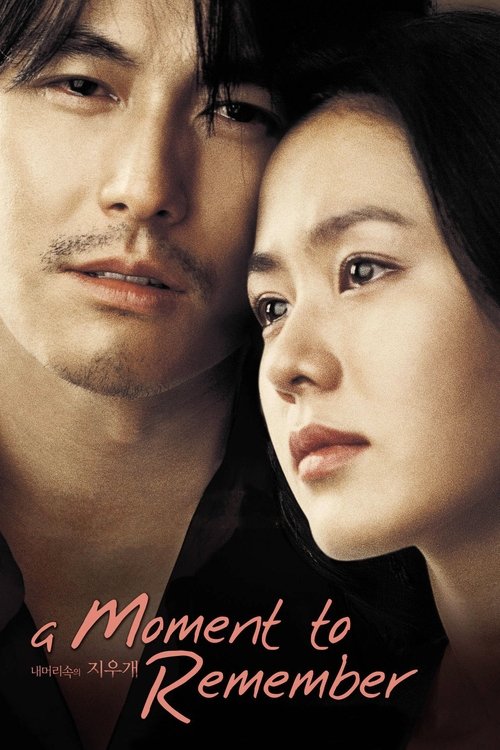
A Moment to Remember
내 머리 속의 지우개
"Everything passes away, but I wish I could remember my love forever."
Overview
A Moment to Remember follows the serendipitous meeting and passionate romance between Su-jin, a delicate fashion designer, and Chul-soo, a rugged construction foreman with aspirations of becoming an architect. Their relationship begins with a series of charming misunderstandings—most notably a shared can of Coca-Cola—and blossoms into a deeply committed marriage that transcends their vastly different social backgrounds.
The narrative takes a devastating turn when Su-jin begins to exhibit severe symptoms of forgetfulness, leading to a diagnosis of early-onset Alzheimer's disease at the age of twenty-seven. As her memories of their life together slowly dissolve, Chul-soo is forced to become the sole guardian of their shared past, fighting a losing battle against the 'eraser' in her head. The film explores the profound emotional toll of caring for a loved one who no longer recognizes you, while emphasizing the resilience of a bond forged in the heart.
Core Meaning
The core message of the film is that true love is a spiritual force that persists even when the mind fails. Director John H. Lee explores the terrifying notion that our identity is tethered to our memories—if we forget our past, do we still exist? Through Su-jin's tragedy, the film argues that while memories define the 'self' in a social and cognitive sense, the capacity to love and be loved resides in an indestructible 'soul' or 'heart' that transcends biological decay. Chul-soo’s decision to remain by her side despite being forgotten serves as a testament to unconditional devotion, suggesting that love is not just a collection of shared moments, but a continuous choice of the spirit.
Thematic DNA
The Fragility of Identity and Memory
The film posits that human identity is a construct of memory. As Su-jin loses her ability to recall her name, her family, and her husband, she grapples with the loss of her soul. This is famously summarized in her line: 'As my memory disappears, my soul will too.'
Unconditional Devotion
Chul-soo’s transformation from a gruff, detached loner into a tender, unwavering caregiver represents the peak of romantic sacrifice. He becomes the 'living memory' for both of them, proving that love's value isn't diminished just because it isn't reciprocated with recognition.
Social Class and Redemption
The first act highlights the friction between Su-jin’s upper-class upbringing and Chul-soo’s working-class background. Their marriage serves as a bridge between these worlds, while Su-jin's father eventually learns to respect Chul-soo’s character over his status.
Forgiveness and Family Reconciliation
Parallel to the main romance are subplots involving Su-jin’s father forgiving her for a past affair and Chul-soo reconciling with his estranged mother. The film suggests that making peace with the past is essential before facing a future where the past may vanish.
The Mercy of Forgetting
While memory loss is the primary antagonist, the film occasionally touches on the idea that forgetting can be a form of release from past pain (like Su-jin's heartbreak or Chul-soo's childhood trauma), though it comes at an unbearable price.
Character Analysis
Kim Su-jin
Son Ye-jin
Motivation
Initially motivated by a desire for a fresh start after a failed affair; later motivated by a desire to protect Chul-soo from her own deterioration.
Character Arc
Su-jin evolves from a vibrant, somewhat flighty fashion designer who is prone to small lapses in memory into a woman facing a terrifying cognitive decline. Her arc is one of descent into darkness, marked by her selfless attempt to leave her husband to spare him the pain of her illness.
Choi Chul-soo
Jung Woo-sung
Motivation
A deep-seated need to provide stability and protection for Su-jin, fueled by his own childhood abandonment issues.
Character Arc
Starts as a rough, cynical carpenter who refuses to believe in the permanence of anything. Through Su-jin, he learns to open his heart and becomes a man of infinite patience and unwavering commitment, eventually fulfilling his dream of becoming an architect.
Seo Young-min
Baek Jong-hak
Motivation
Driven by selfish desire and regret over his failed affair with Su-jin.
Character Arc
Su-jin's former lover who serves as a reminder of her past mistakes and class-related struggles. His presence in her fading memory causes one of the film's most painful moments when she calls Chul-soo by his name.
Symbols & Motifs
The Coca-Cola Can
Represents the 'meet-cute' and the start of their relationship. Su-jin 'steals' Chul-soo's drink because she forgot she didn't have her own, a playful omen of the tragic forgetfulness to come.
Used in the opening scene at the convenience store and recreated in the final act as a way to spark a moment of recognition for Su-jin.
Sunglasses
A symbol of Chul-soo's stoicism and his attempt to protect Su-jin from the pain of his own grief.
Chul-soo puts on sunglasses when he visits Su-jin in the care facility to hide his tears so she can only see a smiling, strong version of him.
The Post-it Notes
These represent the physical manifestation of memory and Chul-soo's desperate attempts to anchor Su-jin to reality.
Their home becomes covered in colorful notes labeling common objects and providing instructions as Su-jin's condition worsens.
The Dream House
Symbolizes their future and Chul-soo's evolution from a simple builder to a visionary architect, driven by his love for Su-jin.
Chul-soo designs and builds a house for them, but just as the physical structure is completed, the mental structure of Su-jin's world begins to crumble.
The Sunset
Symbolizes the 'twilight' of Su-jin's consciousness and the peaceful, if tragic, acceptance of their fate.
The final scene shows them driving into the sunset, emphasizing that while the day is ending, there is still beauty in the remaining light.
Memorable Quotes
If you drink this, we're dating.
— Choi Chul-soo
Context:
Said in a smoky bar during their courtship as Su-jin challenges Chul-soo's aloofness.
Meaning:
This iconic line transforms a casual drink into a binding contract of the heart. It establishes the power of small moments and is the definitive quote of the film's romantic first half.
I met you because I was forgetful, I'm leaving you because I'm forgetful.
— Kim Su-jin
Context:
Written in a farewell letter to Chul-soo when she decides to enter a care facility to spare him from her decline.
Meaning:
A heartbreaking summary of her journey. It frames her illness not just as a tragedy, but as the very thing that brought them together and now pulls them apart.
I'm your memory. I'm your heart.
— Choi Chul-soo
Context:
Said to Su-jin during a moment of high distress as she fears her soul is disappearing.
Meaning:
Reassures Su-jin that even if her brain fails, their connection is safe within him. It highlights the theme of one person holding the 'self' of another.
Philosophical Questions
Is the soul dependent on memory?
The film directly asks if a person exists once their memories are gone. Su-jin believes her soul is disappearing, but Chul-soo’s love suggests that a person’s essence remains in their emotional impact on others.
Does unrequited recognition diminish love's value?
The film explores whether love is still 'real' if only one person is conscious of it. Chul-soo’s devotion implies that love is a unilateral commitment to another's well-being, regardless of their ability to acknowledge it.
Alternative Interpretations
While most viewers see the film as a straightforward tragedy, some critics argue for a Merciful Release interpretation. In this view, Su-jin's memory loss eventually frees her from the heavy social burdens and past traumas (her affair, her family's pressure), leaving her in a state of 'pure' being. Another interpretation focuses on the Cyclical Ending: the final scene in the convenience store can be read as a temporary victory or a tragic delusion—a 'moment' that they will have to endlessly repeat to maintain their bond, suggesting that their love is now a performance rather than a lived reality.
Cultural Impact
A Moment to Remember is widely considered one of the 'Big Three' defining Korean melodramas of the early 2000s, alongside The Classic and My Sassy Girl. It solidified Son Ye-jin's status as the 'Nation's First Love' and established Jung Woo-sung as a leading romantic figure. Culturally, it brought early-onset Alzheimer's into the public consciousness in Korea, shifting the perception of the disease from one only affecting the elderly to a tragic possibility for the young. Its massive success in Japan paved the way for the 'Hallyu' (Korean Wave) to dominate Japanese entertainment markets for years to come.
Audience Reception
The film received overwhelming praise for the palpable chemistry between Son Ye-jin and Jung Woo-sung, with many calling it one of the most effective 'tearjerkers' ever made. Audiences were particularly moved by the transition from the lighthearted first half to the heavy second act. Critics, however, were more divided; while praising the performances and visual style, some criticized the plot for being contrived and emotionally manipulative, noting that it hits every possible 'melodrama trope' (terminal illness, social gap, accidental meetings) to force a reaction from the viewer. Nevertheless, it remains a beloved classic with a near-permanent place on 'best of' lists for the genre.
Interesting Facts
- The film is based on the 2001 Japanese television drama 'Pure Soul'.
- It was the 5th highest-grossing film of 2004 in South Korea and broke records for Korean films in Japan at the time.
- Director John H. Lee (Lee Jae-han) attended New York University, and his westernized cinematic style is visible in the film's glossy aesthetics.
- The film has been remade multiple times, including the Turkish hit 'Evim Sensin' (2012) and the Hindi film 'Saiyaara'.
- John H. Lee and Kim Young-ha won Best Adapted Screenplay at the 2005 Grand Bell Awards.
Easter Eggs
The Coca-Cola Product Placement as a Motif
While blatant product placement, the director turns the Coke can into a vital narrative motif. The slow-motion shot of Su-jin guzzling the drink is an homage to commercial filmmaking styles that mirrors the director's own background in commercials.
Nessun Dorma and Spanish Boleros
The soundtrack is unusual for a Korean melodrama of the era, featuring Puccini's 'Nessun Dorma' and Spanish songs like 'La Paloma.' This 'global' sound palette reflects the characters' aspirations for a life beyond their immediate social confines.
⚠️ Spoiler Analysis
Click to reveal detailed analysis with spoilers
Frequently Asked Questions
Explore More About This Movie
Dive deeper into specific aspects of the movie with our detailed analysis pages
Comments (0)
No comments yet. Be the first to share your thoughts!