Infernal Affairs
無間道
"Loyalty. Honor. Betrayal."
Overview
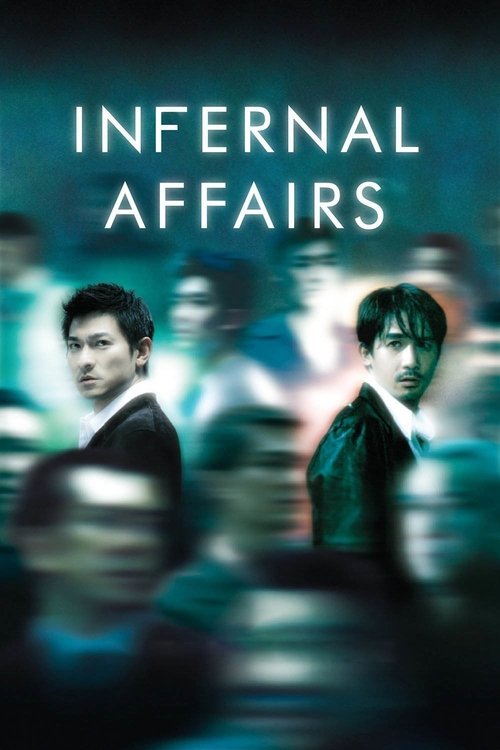
Infernal Affairs is a seminal 2002 Hong Kong crime thriller that redefined the genre by shifting focus from kinetic gunplay to psychological warfare. The story follows two men living parallel, stolen lives: Chan Wing-yan (Tony Leung), a weary police officer who has spent a decade deep undercover within the Triads, and Lau Kin-ming (Andy Lau), a high-ranking police officer who is secretly a mole for the same criminal organization.
As both the police and the Triads realize they have a 'traitor' in their ranks, a high-stakes race begins to unmask the rival mole. The tension escalates through a series of tactical maneuvers and narrow escapes, primarily set against the sleek, modern backdrop of urban Hong Kong. Both men struggle with the erosion of their true identities, yearning for an escape from their respective double lives while knowing that exposure means certain death.
Core Meaning
The core of Infernal Affairs lies in its exploration of the Buddhist concept of Avici Hell (the 'Continuous Hell'), the lowest level of suffering where life begins and ends in the same place without respite. The directors used this as an allegory for the psychological torment of the undercover life. The film suggests that the ultimate punishment is not death, but the survival of a fractured soul forced to live a lie for eternity, trapped by their own karma and the inability to reclaim a 'good' self.
Thematic DNA
Identity Crisis and Duality
The film examines the thin line between the 'mask' and the 'man.' Chan and Lau are mirror images; one is a good man pretending to be a criminal, the other is a criminal pretending to be a pillar of justice. Over time, these roles consume their original selves, leading to a profound sense of alienation and the question of whether an identity can ever truly be reclaimed once it is surrendered.
Moral Ambiguity and Karma
Rejecting traditional 'good vs. evil' tropes, the film operates in a moral grey zone. Characters are bound by their choices and the weight of their past actions (Karma). While the 'villain' seeks redemption, he finds that he cannot simply choose to be 'good' without confronting the consequences of his betrayal.
Isolation and Trust
Living as moles, both protagonists are fundamentally alone. Their relationships with mentors (Superintendent Wong and Hon Sam) are paternal but founded on exploitation. The tragedy is that the only person who could truly understand their struggle is their adversary.
Post-Colonial Anxiety
Critics often interpret the moles as symbols of the Hong Kong identity following the 1997 handover—caught between two systems, living a double life, and uncertain of where their true loyalties or future belong.
Character Analysis
Chan Wing-yan
Tony Leung Chiu-wai
Motivation
To regain his true identity and prove he is a 'good man' by taking down the Triad boss, Hon Sam.
Character Arc
Chan begins the film as a man exhausted by ten years of undercover work, clinging to the hope of reclaiming his status as a cop. He finds a brief sense of peace with his psychiatrist, but ultimately sacrifices his life for the truth.
Lau Kin-ming
Andy Lau
Motivation
To fully transition into a 'good man' by erasing his past, even if it requires further acts of betrayal.
Character Arc
Lau starts as a successful officer enjoying the trappings of a 'good life.' However, he becomes desperate to erase his criminal ties. He 'wins' by surviving, but is condemned to a living hell of permanent deception.
Wong Chi-shing
Anthony Wong
Motivation
To dismantle Hon Sam's empire and protect the undercover agents he has put in harm's way.
Character Arc
A stern but caring superintendent who serves as Chan's only link to the real world. His death is the catalyst for the final conflict.
Hon Sam
Eric Tsang
Motivation
To expand his criminal empire and maintain control by rootting out any internal threats.
Character Arc
A ruthless Triad boss who treats his subordinates with a mix of generosity and extreme suspicion. He believes he can manipulate fate, but is ultimately betrayed by the very man he planted in the police force.
Symbols & Motifs
Rooftops
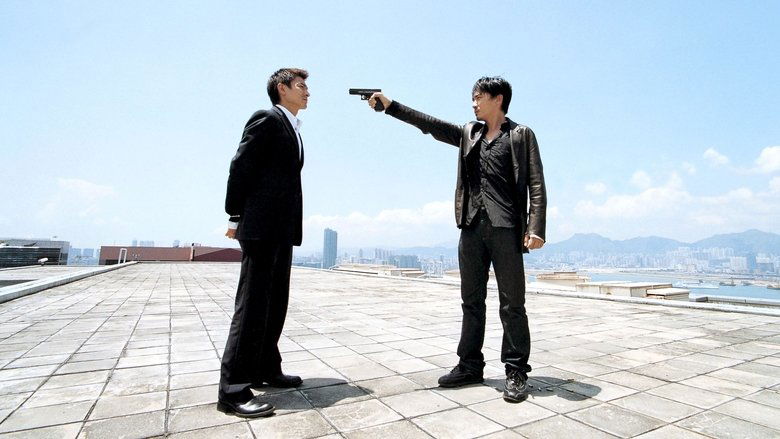
Symbolizes limbo and moral clarity. It is the only place where the characters can 'see' the whole city and confront each other in the light, yet they are still pinned against a confined urban structure.
Used for the iconic final confrontation between Chan and Lau, and as a recurring meeting place for Chan and his handler, Superintendent Wong.
The Audio Store / 'Forgotten Time'
Represents lost innocence and a fleeting moment of shared humanity. The song 'Forgotten Time' by Tsai Chin evokes nostalgia for a simpler past before their identities were compromised.
The scene where Chan and Lau meet as strangers and bonded over high-end speakers, unaware of their adversarial roles.
Morse Code
Symbolizes the fragility of truth. Communication is reduced to rhythmic taps—a hidden language that is easily missed by the world but carries the weight of a person's life.
Chan uses Morse code on a window or a rhythmic finger-tap to transmit information to the police during a triad deal.
The Envelope
A physical manifestation of fate and identity. It contains the evidence that can either restore a soul or destroy a life.
The envelope containing Chan's file, which Lau discovers and later uses to manipulate or erase Chan's existence.
Memorable Quotes
Sorry, I am a cop.
— Chan Wing-yan
Context:
Spoken to Lau during the final rooftop confrontation while holding him at gunpoint.
Meaning:
The ultimate reclamation of his identity. In the face of his adversary, he finally vocalizes his true self, even if it makes him vulnerable.
I want to be a good man.
— Lau Kin-ming
Context:
Lau's plea to Chan on the rooftop, asking for a chance to start over.
Meaning:
Highlight's Lau's tragic delusion; he believes he can 'choose' a new moral standing by simply killing his past, ignoring the inherent corruption required to get there.
Who knows?
— Lau Kin-ming
Context:
His rebuttal to Chan's statement that he is a cop.
Meaning:
A chilling response that underscores the theme of identity as a social construct. If no one knows you are a criminal, do you remain one?
He who is in Continuous Hell never dies. Longevity is a big hardship in Continuous Hell.
— Opening/Closing Sutra
Context:
The final line of text displayed on the screen as the film ends.
Meaning:
Encapsulates the film's philosophy: that surviving a life of deception and guilt is a far greater punishment than death.
Philosophical Questions
Can a person truly change their nature through choice alone?
The film explores this through Lau, who desperately wants to be 'good' but finds that his previous 'bad' choices have created a momentum (Karma) that forces him into more evil acts to maintain his new persona.
What defines identity: our internal conviction or the world's perception?
Chan knows he is a cop, but without the file in the computer, the world sees him as a criminal. The film asks if an identity exists if there is no one left to witness or verify it.
Is death a punishment or a release?
By framing the story within the Buddhist Avici Hell, the film posits that 'longevity' (living on) is the ultimate hardship for the guilty, making death a form of mercy or escape.
Alternative Interpretations
Beyond the literal crime story, many critics view the film as a political allegory for Hong Kong's status after 1997. Chan and Lau represent the 'split personality' of a city that must navigate two different systems (the Triad world/the Police force) while its true history is slowly erased. Another interpretation focuses on psychological disintegration, suggesting that the characters aren't just moles, but manifestations of the same person struggling to reconcile their darker impulses with their public persona. Some audiences also argue that Chan Wing-yan is the only one who truly 'wins'; through death, he escapes the unceasing cycle of suffering, while Lau is left in the 'Avici Hell' of his own success.
Cultural Impact
Infernal Affairs is widely considered one of the most influential films in Asian cinema history. It transitioned the Hong Kong crime genre away from the stylized 'heroic bloodshed' of John Woo toward a more restrained, cerebral, and psychological style of noir. Its most famous legacy is serving as the source material for Martin Scorsese's 2006 film The Departed, which won the Academy Award for Best Picture. Culturally, the term 'Wu Jian Dao' became a common slang in Hong Kong and Mainland China to describe anyone living a double life or a situation with no escape. The film also explored the collective 'identity crisis' of Hong Kong residents during the post-handover era, resonating deeply with an audience caught between British colonial history and Chinese sovereignty.
Audience Reception
Upon its release, Infernal Affairs was a massive critical and commercial success across Asia. Audiences praised the slick, high-contrast cinematography and the powerhouse performances of the two leads. It was particularly lauded for its 'intelligent' script that didn't rely on excessive action. Some viewers initially found the 'bad guy wins' ending controversial, but it has since been recognized as the film's most profound strength. In Western markets, it was initially a 'cult hit' among cinephiles before exploding into mainstream consciousness following the success of The Departed. Most fans today maintain that the original is superior for its philosophical depth and poetic atmosphere.
Interesting Facts
- The film was shot in only 22 to 24 days but went on to become the highest-grossing Hong Kong film of 2002.
- The iconic rooftop showdown dialogue was partially improvised and refined on set by Tony Leung and screenwriter Felix Chong.
- Both Andy Lau and Tony Leung recorded the film's melancholic theme song together.
- The film is credited with revitalizing the Hong Kong film industry after a multi-year slump following the 1997 handover and the SARS outbreak.
- Directors Andrew Lau and Alan Mak originally struggled to find funding because investors thought the 'double mole' plot was too complicated for audiences.
- The title 'Wu Jian Dao' refers to the lowest level of Buddhist hell (Avici), where suffering is unceasing and lacks 'intermission' (no way out).
Easter Eggs
Men in Black II Reference
In the cinema scene where Lau meets Hon Sam, a poster for Men in Black II is visible. This is a subtle nod to another film about agents living hidden lives among an oblivious population.
John Woo Inspiration
The script was originally inspired by John Woo's Face/Off, but the writers decided to remove the sci-fi elements to focus on the psychological realism of swapped identities.
Avenue of the Stars
The handprints of Andy Lau and Tony Leung on Hong Kong's Avenue of the Stars are often visited by fans as a pilgrimage site for this specific film.
⚠️ Spoiler Analysis
Click to reveal detailed analysis with spoilers
Frequently Asked Questions
Explore More About This Movie
Dive deeper into specific aspects of the movie with our detailed analysis pages
Comments (0)
No comments yet. Be the first to share your thoughts!