A Movie of Eggs
Una película de huevos
Overview
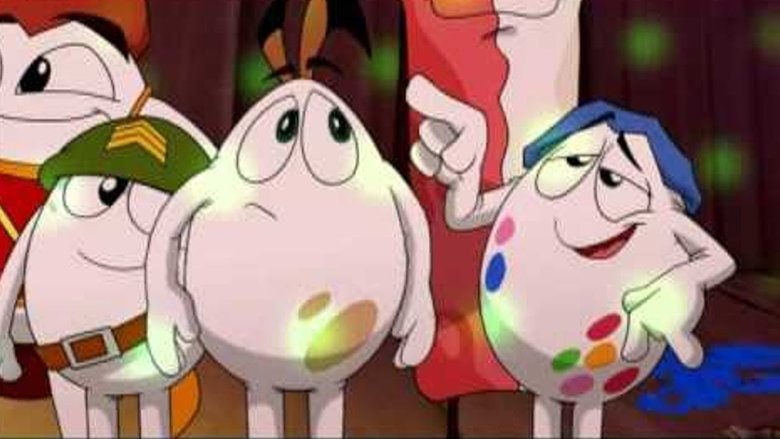
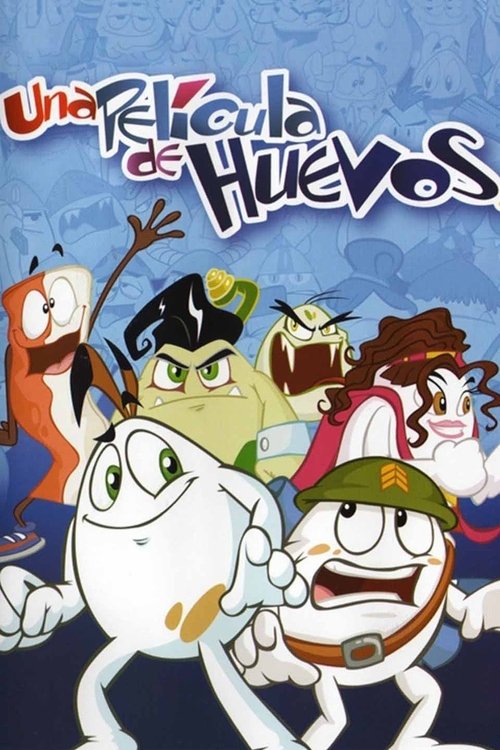
Una película de huevos (2006) follows the adventurous journey of Toto, a small, idealistic egg who is determined to fulfill his destiny of becoming a rooster rather than ending up as a side dish on a breakfast plate. After being taken from his mother and delivered to a suburban kitchen, Toto manages to escape the frying pan with the help of Willy, a self-proclaimed military sergeant egg, and Tocino, a silent but expressive strip of bacon.
The unlikely trio embarks on a perilous road trip across the human world to reach "Granjas El Pollón," a legendary farm where eggs are allowed to hatch. Along the way, they must navigate a landscape filled with dangers, including hungry rats, household pets, and a rival gang of reptile eggs led by the dramatic Coco. The film balances high-stakes adventure with the signature double-entendre humor that made the Huevocartoon brand a cultural phenomenon in Mexico.
Core Meaning
The core message of the film centers on the struggle for self-determination against predestination. In the world of the film, an egg's fate is usually decided by humans (as food), but Toto represents the internal drive to define one's own purpose. The director emphasizes that courage ("huevos") is not just about bravado, but about the persistence required to pursue a dream that society deems impossible. It is a story about finding the "chicken inside"—the latent potential within everyone to transform into something greater.
Thematic DNA
Destiny vs. Choice
The film explores whether one is born for a single purpose (breakfast) or if one can choose a different path (life as a chicken). Toto’s refusal to accept his utilitarian fate drives the narrative forward.
The Nature of Courage
Through the character of Willy, the film deconstructs the idea of bravery. Willy pretends to be a tough soldier to hide his fear of loneliness and death, eventually finding real courage through friendship.
Solidarity and Teamwork
The bond between Toto, Willy, and Tocino shows that marginalized individuals (the "ingredients") are stronger when they work together, overcoming internal differences to survive external threats.
Social Satire
The film uses its characters to parody various archetypes in Mexican and global culture, from military tropes to hippie spirituality (represented by the Cascarones).
Character Analysis
Toto
Bruno Bichir
Motivation
To escape the fate of being eaten and fulfill his biological and spiritual destiny of becoming a rooster.
Character Arc
Starts as a naive, fearful egg taken from his mother; matures into a determined leader who successfully reaches the farm and hatches.
Willy
Carlos Espejel
Motivation
To belong to a group and overcome his deep-seated fear of being alone.
Character Arc
Initially hides behind a military persona and cynical jokes; eventually learns to be vulnerable and finds true purpose in protecting his friends.
Bibi
Angélica Vale
Motivation
To help Toto and Willy while maintaining her own independence as a performer.
Character Arc
A circus egg who provides technical skills (acrobatics) and emotional support to the group, proving her worth beyond her "show" appearance.
Coco
Rodolfo Riva Palacio Alatriste
Motivation
To earn the respect of his father, a large crocodile.
Character Arc
Leader of the reptile eggs who tries to crush Toto's group; eventually realizes his father's expectations are wrong and finds common ground with the chicken eggs.
Tocino
Miguel Guerrero
Motivation
Simple survival and a quiet, steadfast loyalty to Toto and Willy.
Character Arc
Remains silent throughout, but his actions consistently save the group from physical danger.
Symbols & Motifs
The Egg
Symbolizes fragility and untapped potential. The hard shell represents the barriers to self-actualization, while the yolk is the essence of life and identity.
Every character is an egg, emphasizing their shared vulnerability in a world designed to consume them.
The Frying Pan
Represents stagnation and death. It is the ultimate end of potential and the failure to achieve one's dreams.
The kitchen scenes use the heat and oil of the pan as a looming threat that the characters must constantly evade.
Granjas El Pollón
Symbolizes the Promised Land or Heaven. It is the place where the characters' nature can finally be realized.
It serves as the destination for Toto's "Hero's Journey," representing the successful completion of his character arc.
Tocino (Bacon)
Represents non-verbal loyalty and utility. He is the "glue" of the group who doesn't need words to demonstrate character.
As a strip of bacon, he is physically different from the eggs but shares their fate, highlighting cross-cultural or cross-identity alliances.
Memorable Quotes
¡A huevo!
— Multiple characters
Context:
Used as a rallying cry throughout the film's climax.
Meaning:
A classic Mexican slang term meaning "By force" or "Heck yeah!" In the film, it serves as a recursive pun on the characters' physical forms.
Yo no quiero ser un desayuno, yo quiero ser un pollo.
— Toto
Context:
Spoken when Toto first escapes the refrigerator in the kitchen.
Meaning:
The definitive statement of self-determination over societal utility.
¡Soy el Sargento Willy de las fuerzas especiales de la cocina!
— Willy
Context:
Used during the initial escape to assert authority over Toto.
Meaning:
Highlights Willy's defense mechanism of creating an imaginary military hierarchy to cope with the fear of being eaten.
Philosophical Questions
Is identity inherent or earned?
The film asks if Toto is a chicken from birth because of his DNA, or if he becomes a chicken only through the act of surviving and striving to reach the farm.
What is the value of a 'useless' life?
The human characters view the eggs as objects. The film challenges this by giving the eggs internal lives, asking the viewer to reconsider the value of things deemed purely utilitarian.
Alternative Interpretations
Some critics have interpreted the film as a metaphor for the Mexican migrant experience. The eggs' journey from a sterile, dangerous "modern" environment (the city kitchen) toward a rural paradise (the farm) reflects a search for dignity and roots. Alternatively, the film can be seen as a critique of industrial food systems, where the protagonists represent the 'living' soul trapped within a commodity-driven world that only values them as raw material for consumption.
Cultural Impact
Una película de huevos marked a turning point for the Mexican animation industry. Historically, Mexican animation struggled to compete with Hollywood giants, but this film proved that local humor and cultural references could dominate the domestic box office. It launched a massive franchise including four sequels and video games. It also normalized the use of adult-oriented wordplay in children's films, a staple of Mexican "picaresque" comedy, allowing it to appeal to a broad demographic of both children and nostalgic adults who grew up with the website shorts.
Audience Reception
The film was overwhelmingly praised by Mexican audiences for its sharp wit, cultural relevance, and clever use of puns. Critics noted that while the animation quality was not at the level of Pixar, the heart and humor more than compensated. Some controversy arose regarding the 'edgy' nature of the humor in a film rated for children, but this ultimately helped its box office by attracting teenagers and adults. It holds a legacy as a 'cult classic' that defined 2000s Mexican pop culture.
Interesting Facts
- It was the first animated feature film from Huevocartoon Producciones, which started as a popular web series.
- The film became one of the highest-grossing Mexican films in history, earning over 142 million pesos.
- It won the Ariel Award for Best Animated Feature Film in 2007, the Mexican equivalent of the Oscars.
- Despite its family-friendly marketing, the film contains numerous 'albur' (double-entendre) jokes aimed at adults.
- The animation was a hybrid of 2D digitized traditional techniques and some 3D elements.
- The directors, Rodolfo and Gabriel Riva Palacio Alatriste, also voiced multiple characters in the film.
Easter Eggs
HueBond
A recurring character in the bloopers/marketing that parodies James Bond, complete with a tux and gadget-laden shell.
Matrix Parody
The training and escape sequences feature slow-motion 'bullet time' effects referencing The Matrix (1999).
The 'Poete-huevos'
During the credits, the iconic drunken egg poets from the original web series make a cameo, maintaining the franchise's continuity.
⚠️ Spoiler Analysis
Click to reveal detailed analysis with spoilers
Frequently Asked Questions
Explore More About This Movie
Dive deeper into specific aspects of the movie with our detailed analysis pages
Comments (0)
No comments yet. Be the first to share your thoughts!