The Phantom Carriage
A haunting morality play where ghostly double-exposures bridge the gap between the living and the dead, following a cruel drunkard's spectral journey toward redemptive maturity on a chilling New Year's Eve.
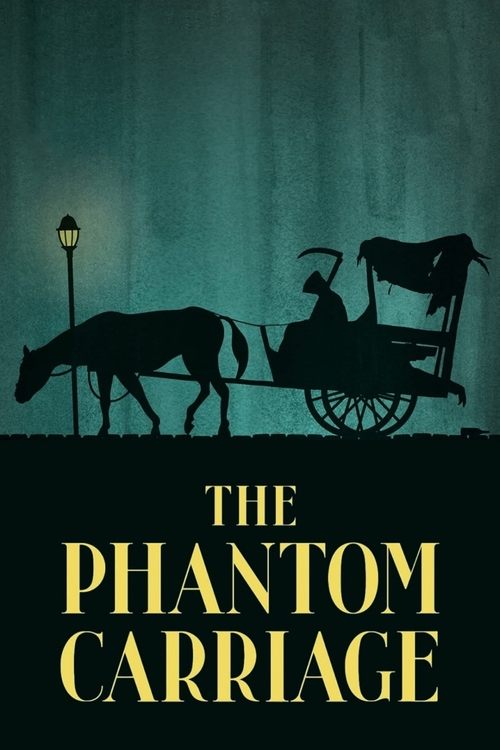
The Phantom Carriage

The Phantom Carriage

Körkarlen

"Do the Dead Come Back? Can Your Soul Leave Your Body...And Return Again?"

01 January 1921 Sweden 106 min ⭐ 7.8 (344)
Director: Victor Sjöström
Cast: Victor Sjöström, Hilda Borgström, Tore Svennberg, Astrid Holm, Concordia Selander
Drama Fantasy Horror
Redemption and Atonement Alcoholism and Social Decay Sacrifice and Selflessness Inevitability of Death

Overview

Based on the 1912 novella Körkarlen by Nobel laureate Selma Lagerlöf, The Phantom Carriage is a cornerstone of Swedish silent cinema. Set on New Year's Eve, the story revolves around the grim legend that the last sinner to die at the stroke of midnight is doomed to drive Death's carriage for the following year, collecting the souls of the deceased. The protagonist, David Holm, is a misanthropic alcoholic who has spent years destroying his life and the lives of those around him, including his suffering wife and the selfless Salvation Army worker, Sister Edit.

As David sits in a graveyard toasting the new year, a violent brawl leaves him near death just as the clock strikes twelve. He is visited by the current driver of the carriage—his former friend Georges, who died exactly one year prior. Through a series of complex, layered flashbacks, Georges forces David to witness the wreckage of his past actions and the impending tragedy of his family's future, leading to a harrowing confrontation with his own mortality and the possibility of spiritual salvation.
Core Meaning

At its heart, the film is a profound meditation on redemption and social responsibility. Director Victor Sjöström wanted to convey that no soul is beyond the reach of grace, but that such grace requires an agonizingly honest confrontation with the pain one has caused others. It serves as a humanitarian plea for compassion, highlighting the interconnectedness of human lives and the idea that our moral failures 'infect' society just as physically as the tuberculosis depicted in the film. The core message is encapsulated in the prayer that the soul should reach 'maturity'—meaning a state of empathy and self-awareness—before it is harvested by death.

Thematic DNA

Redemption and Atonement 35%
Alcoholism and Social Decay 25%
Sacrifice and Selflessness 20%
Inevitability of Death 20%

Redemption and Atonement

The film follows a classic Dickensian structure where a character is given a chance to view their life from an outside perspective to facilitate a moral turnaround. David Holm's redemption is not depicted as easy or certain; it requires the absolute breaking of his ego and a genuine desire for the welfare of others over his own survival.

Alcoholism and Social Decay

Serving partly as a 'temperance film,' it portrays alcoholism not just as a personal vice but as a corrosive force that destroys the family unit and spreads misery across generations. The film explores the cycle of poverty and the way social neglect fuels personal ruin.

Sacrifice and Selflessness

Revealed through the character of Sister Edit, whose dying wish is to see David Holm. Her 'infinite love' and refusal to give up on David, despite his cruelty, act as the catalyst for his spiritual awakening. The film contrasts her divine-like patience with David's demonic selfishness.

Inevitability of Death

Death is personified as a 'strict master' and a servant of a higher moral law. The phantom carriage serves as a visual metaphor for the transition between states of being, reminding the audience that every second brings one closer to the final accounting of their soul.

Character Analysis

David Holm

Victor Sjöström

Archetype: Antihero
Key Trait: Callousness

Motivation

Initially driven by spite and a desire to punish the world for his own failures; eventually motivated by the desire to save his family from his own legacy.

Character Arc

Develops from a cynical, abusive drunkard who actively tries to infect others with his misery into a man capable of genuine remorse and prayer for mercy.

Sister Edit

Astrid Holm

Archetype: The Martyr
Key Trait: Altruism

Motivation

To save David's soul and ensure that her prayers for him were not in vain, believing that no one is beyond help.

Character Arc

Remains steadfast in her faith and love for David, even as she dies from the very disease he brought into her life.

Georges

Tore Svennberg

Archetype: The Herald
Key Trait: Regret

Motivation

To fulfill his duty as the driver and perhaps find peace by witnessing the redemption of the man he once corrupted.

Character Arc

A former friend who led David into alcoholism, now serving as the grim servant of Death who must educate David on the consequences of his sins.

Anna Holm

Hilda Borgström

Archetype: The Victim
Key Trait: Resilience

Motivation

To protect her children from the physical and moral influence of her husband.

Character Arc

Transitions from a hopeful wife to a woman driven to the brink of despair and murder-suicide by her husband's abuse.

Symbols & Motifs

The Phantom Carriage

Meaning:

Represents the bridge between the material and spiritual worlds and the relentless passage of time.

Context:

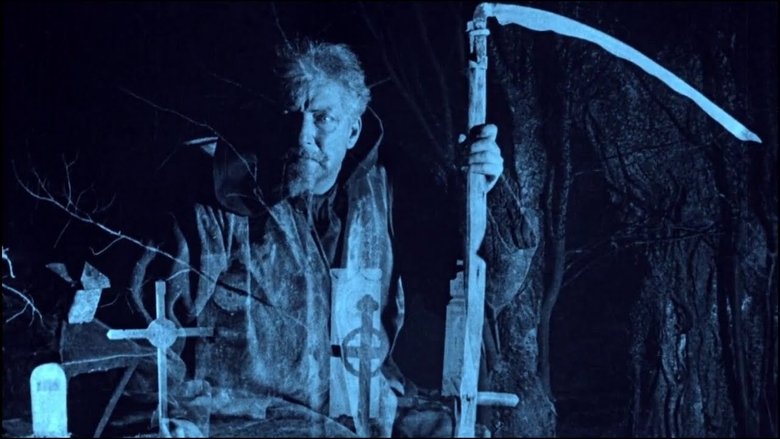
It appears at the deathbeds of characters, driven by the 'last soul' of the year. It is visually transparent, emphasizing its ethereal, inescapable nature as it travels across land and sea.

The Scythe

Meaning:

A symbol of the harvest and finality; it represents the 'reaping' of souls regardless of their readiness.

Context:

Held by Georges, the driver, it is used to claim those whose time has run out, appearing both menacing and deeply somber.

The Axe

Meaning:

A symbol of domestic violence and the physical manifestation of David's rage and spiritual brokenness.

Context:

In a pivotal scene, David uses an axe to break into a room where his wife and children are hiding, symbolizing the total destruction of the home and safety.

Tuberculosis (Consumption)

Meaning:

Symbolizes the physical manifestation of spiritual and social decay.

Context:

Both David and Sister Edit suffer from the disease; in David, it mirrors his inner rot, while in Edit, it represents her self-sacrificing nature as she caught it while trying to help him.

Memorable Quotes

Herre, låt min själ komma till mognad, innan den skördas.

— David Holm (repeating Georges' prayer)

Context:

Spoken (via intertitle) at the film's conclusion as David repents and seeks a new life.

Meaning:

The central philosophical plea of the film: a request for time to become a better person before facing the finality of death.

The last soul to die each year is doomed to drive Death's carriage and collect the souls of all who die the following year.

— Intertitle / Narrator

Context:

Introduced during David's retelling of the legend in the graveyard.

Meaning:

Establishes the supernatural 'lore' of the film and the stakes of David's death.

Philosophical Questions

Can true redemption exist without the witness of those we have harmed?

The film explores this through the requirement that David must literally see the pain of his wife and Sister Edit to understand his own soul. It suggests that morality is not solitary but social.

Is the soul's 'maturity' a state of development or a state of surrender?

The film suggests that reaching maturity involves surrendering the selfish ego to recognize the divine value in others, effectively 'ripening' the spirit for the afterlife.

Alternative Interpretations

While the film is presented as a supernatural morality tale, some critics interpret the events as the delirium-induced hallucinations of a man dying from a combination of head trauma and chronic alcoholism (delirium tremens). In this reading, the Phantom Carriage is a projection of David's guilt and the folklore he was discussing just before his injury. Another perspective views the film as a political allegory for the state of post-WWI Europe, where the 'contagion' of violence and misery must be cured through radical social empathy and the work of humanitarian organizations like the Salvation Army.

Cultural Impact

The Phantom Carriage is often cited as one of the most important films in cinema history. Its influence is most visible in the work of Ingmar Bergman, whose personification of Death in The Seventh Seal and use of internal soul-searching in Wild Strawberries trace directly back to Sjöström's masterpiece. Beyond Sweden, its innovative 'flashback within a flashback' narrative structure was decades ahead of its time, influencing the complex storytelling of modern cinema. It also stands as a pioneer of the horror and fantasy genres, using atmosphere and technical trickery to create a palpable sense of the supernatural. Critics and audiences of the time were astounded by the realism of the ghostly imagery, and the film remains a fixture on 'Best Films of All Time' lists, including the 1001 Movies You Must See Before You Die.

Audience Reception

Upon its release on New Year's Day 1921, the film was a massive critical and commercial success. Audiences were reportedly moved to tears and terrified by the ghostly visuals. Charlie Chaplin famously called it the best movie he had ever seen. While some contemporary viewers might find the melodrama and 'temperance' messaging heavy-handed, the film is universally praised by modern critics for its technical brilliance and psychological depth. It currently holds a very high rating among cinephiles and is regarded as the pinnacle of the 'Golden Age' of Swedish silent film.

Interesting Facts

  • The film's revolutionary special effects were achieved entirely in-camera through multiple exposures, requiring the film to be run through the camera up to four times with perfect timing.
  • Director Victor Sjöström and cinematographer Julius Jaenzon spent five months in the laboratory refining the transparency of the ghosts.
  • Ingmar Bergman reportedly watched this film at least once every year for the rest of his life and cited it as the reason he became a filmmaker.
  • The film was the first production to be shot at the newly built Råsunda Studios in Stockholm.
  • Selma Lagerlöf, the author of the original novel, was initially skeptical of the adaptation but was won over after Sjöström personally read her the script.

Easter Eggs

The Axe Scene

Stanley Kubrick’s famous 'Here's Johnny!' scene in The Shining is widely considered a direct visual homage to the scene in The Phantom Carriage where David Holm chops through a door to reach his wife and children.

Ingmar Bergman Cameo/Legacy

While not a literal cameo, Bergman cast Victor Sjöström as the lead in his 1957 film Wild Strawberries as a tribute to Sjöström's performance and influence in this film.

⚠️ Spoiler Analysis

Click to reveal detailed analysis with spoilers

Frequently Asked Questions

Explore More About This Movie

Dive deeper into specific aspects of the movie with our detailed analysis pages

Comments (0)

Leave a comment

No comments yet. Be the first to share your thoughts!