
Skip to content
A Private Life
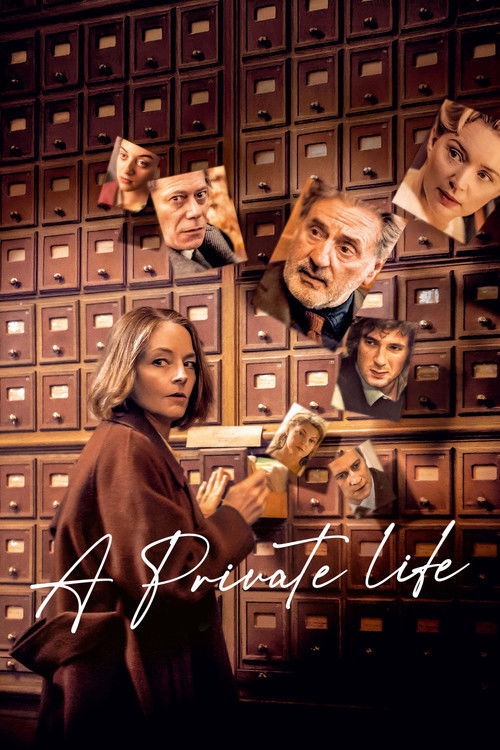
A sleek, cerebral Parisian noir bathed in warm autumnal light, where cold analytical detachment collides with unstemmable physical grief; the film operates as a shimmering mirror reflecting the labyrinthine corridors of the human subconscious.
A Private Life

A Private Life

Vie privée

27 September 2025 France 108 min 5.5 (249)

Director: Rebecca Zlotowski

Cast: Jodie Foster, Daniel Auteuil, Virginie Efira, Mathieu Amalric, Vincent Lacoste

Drama Crime Mystery Active Listening vs. Clinical Detachment Guilt, Grief, and Psychological Projection Re-marriage and Late-Life Intimacy Collective Memory and Jewish Identity The Myth of Objective Truth and Control
Box Office: $10,040,197

Overview

Dr. Lilian Steiner is an American psychoanalyst living and practicing in Paris. Cold, intellectually rigorous, and fiercely protective of her professional boundaries, Lilian records all of her client sessions on an outdated Sony MiniDisc recorder rather than actively engaging on an emotional level. Her orderly life begins to fracture when a longtime patient named Pierre angrily quits, threatening to sue her for thousands of euros because a single session with a hypnotherapist cured his smoking habit while years of Freudian therapy failed.

Before Lilian can process this blow to her professional pride, she receives devastating news: another long-term patient, Paula Cohen-Solal, has suddenly died. Attending the family's shemira (Jewish prayer vigil), Lilian is angrily thrown out by Paula’s hostile husband, Simon, who accuses her of causing Paula's death. Soon after, Paula’s daughter Valérie visits Lilian to inform her that Paula committed suicide via a prescription pill overdose, leaving behind a cryptic scribbled message on a prescription slip.

Rattled by guilt and unable to accept that she missed the signs of a suicidal crisis, Lilian becomes convinced that Paula was actually murdered. As Lilian's eyes mysteriously begin to weep uncontrollably—forcing her to visit her ophthalmologist ex-husband Gabriel—she launches her own amateur investigation. Re-evaluating Paula's recorded sessions, visiting the hypnotist who treated Pierre, and enlisting a hesitant Gabriel as her sleuthing partner, Lilian plunges into a web of family secrets, past-life visions, and buried personal truths.

Core Meaning

At its core, A Private Life (Vie privée) explores the illusion of intellectual control and the imperative of genuine human connection. Director Rebecca Zlotowski uses the framework of a Hitchcockian murder mystery to interrogate the boundaries of psychoanalysis, professional detachment, and personal vulnerability.

The film argues that true understanding cannot be achieved by merely archiving information or observing others from a safe distance. Lilian Steiner represents the modern intellect—rational, guarded, and convinced of her own objectivity—who uses clinical protocols to shield herself from grief, guilt, and intimacy. When her body revolts through uncontrollable weeping, the film suggests that suppressed emotion will inevitably manifest physically. The true mystery Lilian must solve is not a criminal conspiracy, but her own emotional paralysis as a mother, partner, and healer.

Thematic DNA

Active Listening vs. Clinical Detachment 30%
Guilt, Grief, and Psychological Projection 25%
Re-marriage and Late-Life Intimacy 20%
Collective Memory and Jewish Identity 15%
The Myth of Objective Truth and Control 10%

Active Listening vs. Clinical Detachment

Lilian relies on MiniDiscs to record her patients, treating therapy as a mechanical archiving process rather than an active dialogue. The film contrasts her cold Freudian approach with the immediate, visceral impact of hypnotherapy, demonstrating how rigid detachment can blind professionals to their patients' real desperate cries for help.

Guilt, Grief, and Psychological Projection

Refusing to accept that she failed to prevent Paula's suicide—and feeling guilty for breaking protocol by prescribing her pills—Lilian projects her inner guilt outward, concocting an elaborate murder mystery to blame external villains rather than confront her own professional failure.

Re-marriage and Late-Life Intimacy

Through the charming dynamic between Lilian and her ex-husband Gabriel, the film acts as a comedy of remarriage. Their investigation allows them to rediscover warmth, mutual support, and affection in the autumn of their lives, proving that personal relationships can be rebuilt after past failures.

Collective Memory and Jewish Identity

Interwoven into the plot are elements of Jewish rituals (shemira) and subconscious historical trauma. Lilian's hypnotic vision of 1942 Nazi-occupied Paris reveals how inherited cultural memory and collective trauma shape individual fears, desires, and self-conceptions.

The Myth of Objective Truth and Control

The film subverts classic detective tropes by showing how logic can be twisted to serve personal biases. Lilian’s clues often lead to dead ends or self-deceptions, emphasizing that human behavior is messier and far less tidy than a traditional genre narrative.

Character Analysis

Dr. Lilian Steiner

Jodie Foster

Archetype: Detached Rationalist / Unreliable Sleuth Key Trait: Sarcastic, sharp-tongued, fiercely intellectual, and intellectually defensive.

Motivation

To absolve her guilt over Paula's death by proving it was a murder rather than a suicide caused by her own oversights.

Character Arc

Evolves from an emotionally guarded, icy therapist who hides behind clinical equipment into a compassionate listener who embraces her own flaws, reconciles with her son, and accepts human limitations.

Gabriel Haddad

Daniel Auteuil

Archetype: Loving Partner / Grounding Companion Key Trait: Empathetic, warm, quietly humorous, and patient.

Motivation

To protect Lilian, keep her safe from her own manic delusions, and rekindle their emotional intimacy.

Character Arc

Moves from being an agreeable ex-husband to actively supporting Lilian through her psychological crisis, rediscovering his deep affection for her while establishing a healthy post-marital bond.

All 5 characters and cast

Symbols & Motifs

Sony MiniDisc Recorder / Cassettes

Meaning:

Symbolizes Lilian’s reliance on outdated, rigid structures of control and an ideological barrier.

Context:

Used during Lilian's client sessions to record voices so she can process them later rather than being fully present in the room.

Uncontrollable Tear Ducts / Crying

Meaning:

Represents the physical manifestation of repressed emotion and unresolved personal grief.

Context:

Manifests throughout Lilian's investigation, breaking her cold façade and forcing her patients and loved ones to view her as a vulnerable human being.

1942 WWII Hypnotic Sequence

Meaning:

Symbolizes Lilian's subconscious effort to reframe her feelings of guilt and unfulfilled intimacy as a high-stakes historical tragedy.

Context:

Occurs during Lilian's surreal regression vision under hypnosis in Nazi-occupied Paris, where she sees herself as a male Jewish cellist in love with Paula.

Gustav Mahler’s Kindertotenlieder

Meaning:

A musical motif symbolizing grief, loss, parental guilt, and the weight of mortality.

Context:

Recurs during key psychological moments across the film's soundtrack.

The Hairbrush in the Garbage

Meaning:

Symbolizes how far Lilian's obsessive sleuthing degrades her professional ethics, turning a respected analyst into a boundary-crossing stalker.

Context:

Featured when Lilian rifles through Simon's trash in Chérence to find DNA evidence.

Memorable Quotes

Je vous écoute. Je suis là.
— Dr. Lilian Steiner

Context

Spoken in the final scene as the climax of Lilian's transformation when she addresses a returning patient without her MiniDisc recorder.

Meaning

Signals Lilian's fundamental shift from passive recording to active, compassionate human presence.

Je vous ai donné 32 000 euros et 8 000 cigarettes !
— Pierre Hallan

Context

Spoken early in the film during Pierre's angry confrontation with Lilian in her office.

Meaning

Humorously highlights the perceived absurdities of long-term therapy where no tangible progress was made.

All 4 quotes

Philosophical Questions

Is total professional detachment possible, or is it an unethical illusion?

The film explores how trying to remain a completely neutral, recording observer can blind professionals to acute human suffering and obscure vital cries for help.

How does repressed emotional guilt physically express itself?

Through Lilian's uncontrollable tear ducts, the narrative asks whether the human body remembers and expresses emotional truths that the conscious mind refuses to accept.

Do we invent complex external narratives to avoid confronting simple personal failures?

The film questions why human beings often prefer believing in grand, sinister external conspiracies rather than accepting mundane, tragic personal realities.

Alternative Interpretations

The film offers multiple avenues for interpretation:

Full ending explanation

Cultural Impact

The film sits at the intersection of French psychoanalytic tradition (Freud and Lacan) and American character-driven thrillers. It also actively engages with contemporary conversations surrounding Jewish-French identity and historical memory in Paris.

Audience Reception

Premiering Out of Competition at the 2025 Cannes Film Festival, A Private Life received warm praise for Jodie Foster's commanding performance, her chemistry with Daniel Auteuil, and its stylish, witty tone. Critics described it as a frisky, feminine film noir and an entertaining fusion of murder mystery and romantic comedy.

While audiences and critics lauded the sharp dialogue, cinematography, and lead performances, main criticisms noted that the mystery deflates in the second half into a character study rather than a traditional hard-boiled thriller, with some finding the tonal shifts jarring. Produced on a $5 million budget, it grossed over $8 million globally.

Interesting Facts

  • Although Jodie Foster previously spoke French in supporting roles, A Private Life marks her very first full-length lead starring role performed entirely in French.
  • Director Rebecca Zlotowski originally wrote a role for Foster in her debut feature Belle Épine in 2010, leading to a meeting 10 years later where they spent 7 hours going line-by-line through the script.
  • Co-writer Anne Berest, author of the bestseller The Postcard, co-wrote the screenplay drawing inspiration from psychoanalytic concepts and classic Hollywood cinema.
  • Renowned 95-year-old American documentary director Frederick Wiseman makes a special cameo appearance as Dr. Goldstein, Lilian's former psychoanalyst mentor.
  • Jodie Foster became the first American actress ever nominated for the Lumière Award for Best Actress for her lead performance in this film.
  • Filming scenes inside a real narrow Parisian elevator added an unexpected sense of claustrophobia and physical intimacy between Jodie Foster and Daniel Auteuil.
  • The Sony MiniDisc player used in the film was an actual working vintage unit that Foster insisted on learning how to operate with authentic muscle memory.

Easter Eggs

Louis Malle Title Homage

The original French title Vie privée is a direct homage to Louis Malle’s classic 1962 film Vie privée (A Very Private Affair) starring Brigitte Bardot and Marcello Mastroianni, which also explored the boundary between public persona and private identity.

Gaslight / Cukor Homage

Paula’s character is intentionally named after Ingrid Bergman’s character Paula in George Cukor’s Gaslight (1944) (titled Hantise in French), hinting at central themes of psychological manipulation, paranoia, and self-doubt.

Psycho Killer Opening Track

The film opens with Talking Heads’ iconic song Psycho Killer, serving as an ironic, tongue-in-cheek musical entry into a thriller about a psychiatrist investigating a supposed murder.

Verhoeven & Roeg References

Visual sequences pay homage to Nicolas Roeg’s Don’t Look Now via a figure in a red coat in winter, and to Paul Verhoeven’s erotic thrillers (Elle, Basic Instinct) through ambiguous, morally gray female leads.

Frequently Asked Questions

Explore More About This Movie

Dive deeper into specific aspects of the movie with our detailed analysis pages

Comments (0)

Leave a comment

No comments yet. Be the first to share your thoughts!

Similar Movies