
A Walk to Remember
"It all comes down to who's by your side."
Overview
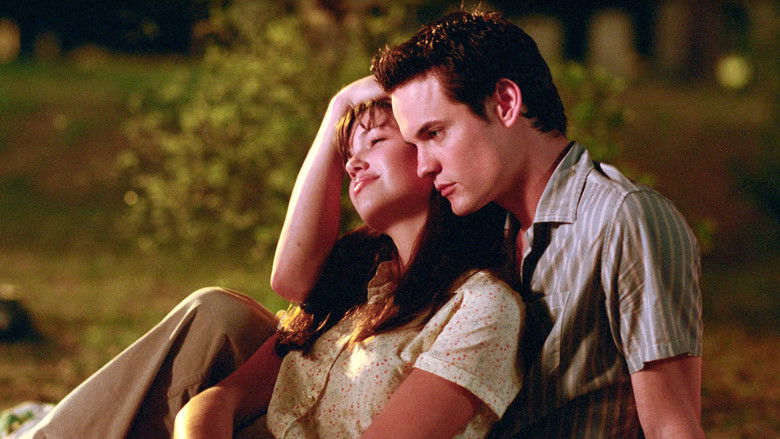
Set in the coastal town of Beaufort, North Carolina, the film follows Landon Carter (Shane West), a popular but aimless high school senior who is forced into community service and the school play after a prank goes wrong. Desperate for help with his lines, he turns to Jamie Sullivan (Mandy Moore), the reverend's pious and bullied daughter whom he has known—and ignored—his entire life. Jamie agrees to help him on one condition: he must promise not to fall in love with her.
As they spend time together, Landon defends Jamie from his cruel friends and discovers a depth of spirit that challenges his cynical worldview. Their friendship blossoms into a tender romance, leading Landon to turn his life around and seek a future he never imagined. However, their happiness is shattered when Jamie reveals a heartbreaking secret: she has leukemia and has stopped responding to treatment.
Refusing to give up, Landon dedicates his remaining time to fulfilling Jamie's "wish list," culminating in a wedding in the church where her late mother was married. Although Jamie passes away shortly after their summer together, her impact on Landon is permanent, inspiring him to become a doctor and carrying her faith and love with him forever.
Core Meaning
The director Adam Shankman and author Nicholas Sparks intended to explore the transformative power of unconditional love and faith. The film argues that true love is selfless and sacrificial, capable of redeeming even the most lost souls. It posits that while life is finite, the impact of a single person's belief in another can last forever, effectively answering the philosophical question of whether miracles exist—suggesting that change in a person is the true miracle.
Thematic DNA
Transformation and Redemption
Landon's arc from a reckless delinquent to a compassionate, ambitious young man is the film's central spine. Jamie's influence acts as a catalyst, proving that redemption is possible for anyone willing to step outside their ego and care for another. This theme is visually represented by his shift from dark, baggy clothing to a cleaner, more mature look.
Faith vs. Skepticism
Jamie represents unwavering faith, while Landon represents modern cynicism. The film does not preach religion as much as it illustrates faith in action—believing in things that cannot be seen (like the wind or love). Landon's acceptance of Jamie's faith allows him to find purpose.
The Fragility of Life
The juxtaposition of young love with terminal illness highlights the fleeting nature of time. The film encourages viewers to live intentionally and cherish the present moment, embodied by Jamie's "to-do list" which Landon helps her complete.
Social prejudice and Peer Pressure
The film critiques the superficiality of high school cliques. Landon's friends mock Jamie for her clothes and modesty, and Landon must overcome his fear of social suicide to publicly claim his love for her, marking his transition into adulthood.
Character Analysis
Landon Carter
Shane West
Motivation
Initially to avoid expulsion; later, to make Jamie happy and be the man she sees in him.
Character Arc
Starts as an aimless, peer-pressured bully who hurts others to maintain status. Through his relationship with Jamie, he learns responsibility, compassion, and self-worth. He ends the film as a medical student, driven by the desire to help others.
Jamie Sullivan
Mandy Moore
Motivation
To live her life according to God's plan and to witness a miracle before she dies.
Character Arc
She remains steadfast in her character but evolves from a social pariah to a beloved figure in Landon's life. Her arc is about opening her heart to romantic love despite knowing her time is short.
Reverend Hegbert Sullivan
Peter Coyote
Motivation
To protect his dying daughter from heartbreak and the world.
Character Arc
Initially hostile toward Landon due to his reputation and family history. He eventually softens, realizing Landon's love is genuine, and allows the marriage.
Cynthia Carter
Daryl Hannah
Motivation
To see her son find his path.
Character Arc
She watches her son with concern but gives him the space to grow. She is the first to notice the positive change Jamie brings out in him.
Symbols & Motifs
The Wind
It symbolizes love and faith—forces that cannot be seen but are felt deeply. It serves as the film's closing metaphor for Jamie's enduring presence.
Referenced in the final voiceover: "Love is like the wind, I can't see it but I can feel it."
The Telescope
Represents Landon's devotion and effort. Building it is his first major act of selfless love, giving Jamie a view of the heavens she cherishes.
Landon builds a telescope from scratch so Jamie can see the comet Hyakutake, fulfilling one of her dreams.
Jamie's List
A bucket list representing hope and ambition despite a limited future. It structures the narrative of their courtship.
Items include being in two places at once, getting a tattoo, and witnessing a miracle. Landon systematically makes these happen.
The Butterfly Tattoo
Symbolizes metamorphosis and the soul. It marks the moment Landon physically marks himself with Jamie's influence.
Landon applies a temporary tattoo of a butterfly on Jamie's shoulder, a moment of intimacy that bridges their physical distance.
The Sweater / Cardigan
Represents Jamie's modesty and social isolation, but later becomes a mantle of comfort.
Jamie wears the same brown/pink cardigan constantly. Her shedding it during the school play reveals her inner beauty to the town.
Memorable Quotes
Love is like the wind, I can't see it but I can feel it.
— Landon Carter
Context:
Spoken in the final voiceover as Landon looks out over the water, years after Jamie's death.
Meaning:
The film's thesis statement, bridging the gap between romantic love and spiritual faith. It affirms that death does not end a relationship.
You have to promise you won't fall in love with me.
— Jamie Sullivan
Context:
Jamie says this to Landon when she agrees to help him with the school play lines.
Meaning:
Dramatic irony. Initially interpreted as a quirky rule or rejection, it is later revealed to be a warning about her terminal illness.
Our love is like the wind... I can't see it, but I can feel it.
— Landon Carter
Context:
The very last line of the movie.
Meaning:
A callback to an earlier conversation about belief. It signifies Landon's complete conversion to Jamie's way of seeing the world.
I'm scared of not being with you.
— Jamie Sullivan
Context:
Spoken when she is in the hospital/home care as her condition worsens.
Meaning:
A rare moment of vulnerability where Jamie admits her fear of death is actually a fear of separation from her love.
Maybe God has a bigger plan for me than I had for myself. Like this journey never ends.
— Jamie Sullivan
Context:
Jamie discussing her illness and her perspective on dying.
Meaning:
Demonstrates her acceptance of her fate and her belief in the afterlife.
Philosophical Questions
Can faith exist without empirical proof?
The film uses the metaphor of the wind to argue that not everything real must be seen. It challenges the empiricist view through Landon's journey from skepticism to spiritual belief.
Why do bad things happen to good people (Theodicy)?
Jamie is depicted as a perfect Christian, yet she suffers a painful death. The film suggests that the value of a life is not in its length but in its impact, proposing that suffering can have a redemptive purpose for others (Landon).
Alternative Interpretations
The Nature of the Miracle: The film leaves the 'miracle' Jamie wished for open to interpretation. While she dies, most critics and viewers interpret the miracle not as divine healing, but as Landon's transformation. Jamie's love saved him from a wasted life, which was the miracle she unknowingly needed.
The Ending: Some viewers interpret Landon's final monologue ("She's with me") as a spiritual presence, while more cynical readings suggest it is a coping mechanism for grief. The ambiguity allows both secular and religious audiences to find comfort in the conclusion.
Cultural Impact
A Walk to Remember was a modest box office success but became a cult classic on home video, defining the 'sad teen romance' genre for the early 2000s. It solidified Mandy Moore's transition from pop singer to serious actress and established Nicholas Sparks as a Hollywood brand for romantic tearjerkers (following Message in a Bottle). The film is often cited as a precursor to the 'sick-lit' movie boom of the 2010s, influencing films like The Fault in Our Stars and Five Feet Apart. Its song, "Only Hope", performed by Moore, remains a staple in pop culture and wedding playlists.
Audience Reception
Audience Verdict: Highly favorable. Audiences embraced the emotional sincerity and the chemistry between West and Moore, often ranking it as one of the best romantic dramas of the 2000s.
Critical Verdict: Mixed to Negative. Critics at the time dismissed it as "oppressively syrupy" and cliché, criticizing its predictability and overt sentimentality. However, the film has aged better with fans than with critics, retaining a high audience score on platforms like Rotten Tomatoes.
Interesting Facts
- Mandy Moore was only 16/17 during filming, so she was legally a minor. This limited her working hours to 10 per day, and the production had to wrap around her schedule.
- The film was shot in Wilmington, North Carolina, utilizing the same sets as the TV show Dawson's Creek. The lake scene where Landon jumps in was filmed in the same creek as the show.
- Shane West liked the 1967 Camaro he drove in the film so much that he bought it after production wrapped.
- The director, Adam Shankman, makes a cameo appearance as the male nurse who wheels Jamie out of the hospital room.
- The character of Jamie Sullivan was inspired by Nicholas Sparks' younger sister, Danielle, who also had cancer and died young.
- Pop star Jessica Simpson was originally considered for the role of Jamie Sullivan before the director heard Mandy Moore's music.
- Mandy Moore's hair was naturally blonde at the time; she dyed it brunette for the role to distance herself from her 'bubblegum pop' image.
Easter Eggs
Childhood Photos
The pictures of Jamie on the mantle in the Sullivan house are actual childhood photos of actress Mandy Moore.
Shane West's Song
The song playing on the radio in Landon's car, "So What Does It All Mean?", is performed by Shane West's real-life band, Jonny Was (credited as West, Gould, & Fitzgerald).
The 'Walk' Title
While not explicitly explained in the film's dialogue, the title refers to the climax where a weak Jamie summons the strength to walk down the aisle at her wedding without a wheelchair, a detail more emphasized in the book.
⚠️ Spoiler Analysis
Click to reveal detailed analysis with spoilers
Frequently Asked Questions
Explore More About This Movie
Dive deeper into specific aspects of the movie with our detailed analysis pages
Comments (0)
No comments yet. Be the first to share your thoughts!