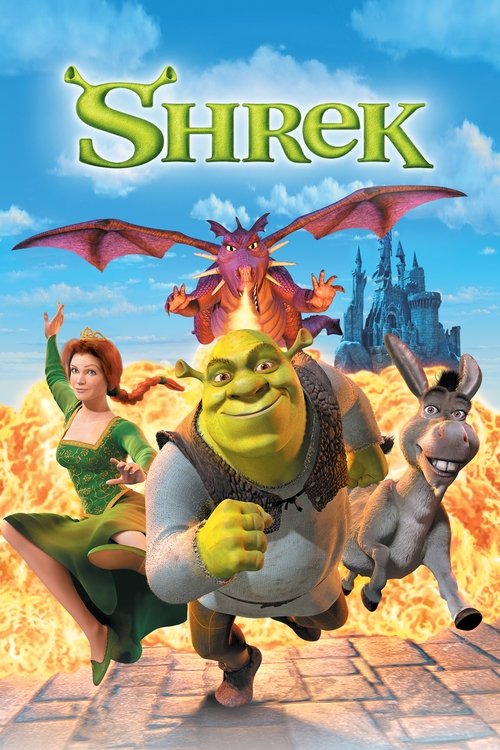
Shrek
"The greatest fairy tale never told."
Overview
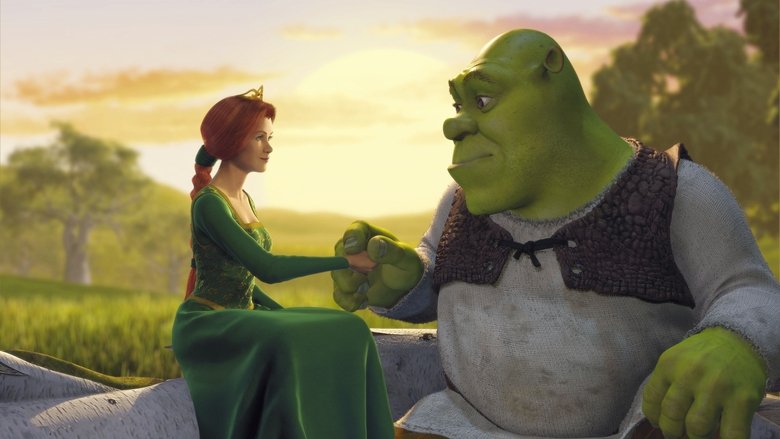
In a distant swamp, a solitary and grumpy ogre named Shrek finds his peaceful life shattered when a host of fairytale creatures are exiled to his land by the vertically challenged and tyrannical Lord Farquaad. To regain his privacy, Shrek strikes a deal with the ruler: he must rescue the beautiful Princess Fiona, who is locked in a dragon-guarded tower, and deliver her to Farquaad to be his bride.
Accompanied by a relentlessly talkative Donkey, Shrek embarks on a perilous quest that challenges his perception of himself and the world. As they rescue Fiona, they discover she is far from a traditional damsel in distress, hiding a deep secret of her own. The journey back to Duloc becomes a voyage of self-discovery, where Shrek begins to lower his emotional defenses and Fiona questions her idealized view of true love.
Ultimately, the film culminates in a chaotic interruption of a royal wedding, where true feelings are confessed, and curses are broken in unexpected ways. The story subverts the classic "happily ever after" trope, replacing superficial perfection with genuine connection and the acceptance of one's true self, warts and all.
Core Meaning
At its heart, Shrek is a subversive manifesto on self-acceptance and the deconstruction of superficial beauty standards. Director Andrew Adamson used the film to challenge the "Disneyfication" of folklore, arguing that true character is defined by layers rather than appearances.
The film posits that society's labels (monster, freak, hero) are arbitrary and that genuine happiness comes from embracing one's idiosyncrasies. It teaches that one does not need to be perfect or beautiful to be worthy of love and that friendship often blooms in the most unlikely places.
Thematic DNA
True Beauty & Self-Acceptance
The central theme challenges the equation of physical beauty with goodness. Through Fiona's curse and Shrek's insecurity, the film demonstrates that "love's true form" is not about external aesthetics but internal character. Fiona's decision to remain an ogre signifies the ultimate acceptance of her true self over societal expectations.
Subversion of Fairy Tale Tropes
The film relentlessly satirizes genre clichés. The "Prince Charming" is a villainous dwarf, the steed is a chatty donkey, and the princess knows kung fu. By flipping these tropes, the film exposes the absurdity of unrealistic storybook standards and offers a more grounded, albeit magical, reality.
Prejudice & Social Ostracization
Shrek's isolation is a defense mechanism against a world that judges him on sight. The film explores how prejudice creates monsters; Shrek acts terrifying because the world treats him as a terror. The narrative arc involves unlearning the belief that he is unworthy of companionship.
Friendship & Vulnerability
Through the relationship between Shrek and Donkey, the film illustrates the power of emotional vulnerability. Shrek's "layers" are walls built to keep pain out, and Donkey's persistence proves that loyalty requires breaking down those walls to let others in.
Character Analysis
Shrek
Mike Myers
Motivation
Initially motivated by a desire for privacy and isolation, which shifts to a desire for connection and love with Fiona.
Character Arc
Starts as a misanthropic recluse who embraces his role as a monster to keep people away. Through his journey, he learns to trust, accepts that he is worthy of love, and allows himself to be vulnerable, transitioning from a "terrifying beast" to a loving husband and friend.
Princess Fiona
Cameron Diaz
Motivation
To break the spell and find true love's first kiss, eventually realizing that true love accepts her ogre form.
Character Arc
Begins as a prisoner of fairy tale expectations, rehearsing her rescue and marriage. She evolves by realizing that her savior doesn't fit the mold and that her own "curse" is actually her authentic self. She chooses love over beauty.
Donkey
Eddie Murphy
Motivation
To find belonging and friendship; he is terrified of being alone and clings to Shrek for protection and companionship.
Character Arc
While he remains static in personality, his arc involves breaking through Shrek's defenses. He proves himself to be a fearless friend, facing dragons and ogres alike to support those he cares about.
Lord Farquaad
John Lithgow
Motivation
To become a King by marrying a princess, purely to validate his status and compensate for his insecurities.
Character Arc
He undergoes no positive growth; his obsession with perfection and control leads to his downfall. He represents the rigidity of societal standards that the heroes must reject.
Symbols & Motifs
Onions
Symbolizes the complexity of personality and the defense mechanisms used to protect the inner self. Unlike a cake (which is sweet and simple), an onion is pungent and complex.
Used in the famous dialogue where Shrek explains to Donkey that ogres have layers, just like onions, illustrating that there is depth beneath his rough exterior.
The Swamp
Represents isolation as a sanctuary but also a prison of loneliness. It is Shrek's safe space where he controls the narrative of his life.
The film begins and ends in the swamp, transforming it from a place of solitary confinement to a shared home filled with friends and love.
Duloc & Lord Farquaad's Castle
Symbolizes artificial perfection, overcompensation, and sterility. The immense size of the castle contrasts with Farquaad's stature, representing his fragile ego.
The perfectly manicured, empty streets of Duloc contrast sharply with the messy, organic vitality of the swamp, highlighting the villain's oppressive desire for control.
The Setting Sun
Represents the transition between appearance and reality. It is the boundary between the public mask and the private truth.
Fiona anxiously watches the sunset each day, as it triggers her transformation into an ogre, forcing her to hide the part of herself she deems unlovable.
Memorable Quotes
Ogres are like onions. Onions have layers. Ogres have layers.
— Shrek
Context:
Spoken to Donkey while walking through the fields, as Shrek tries to explain that there is more to him than just being a scary monster.
Meaning:
The defining metaphor of the film, explaining that people are complex and cannot be judged solely by their scary or rough exteriors.
What are you doing in my swamp?!
— Shrek
Context:
Shouted at the fairy tale creatures who have been dumped on his land, interrupting his peaceful solitude.
Meaning:
Establishes Shrek's territorial nature and his desire for isolation. It has become iconic in internet culture as a symbol of defensive privacy.
Some of you may die, but it's a sacrifice I am willing to make.
— Lord Farquaad
Context:
Address to the knights at the tournament, sending them on a quest he is too cowardly to undertake himself.
Meaning:
Highlights the villain's extreme narcissism and lack of empathy. It satirizes the trope of the noble leader by showing a ruler who views his subjects as disposable.
That'll do, Donkey. That'll do.
— Shrek
Context:
Spoken softly to Donkey to calm him down, showing a rare moment of gentle validation from the ogre.
Meaning:
A reference to the film Babe, this line signifies Shrek's begrudging acceptance and affection for Donkey. It marks a turning point in their friendship.
And in the morning, I'm making waffles!
— Donkey
Context:
Said excitedly after Shrek reluctantly agrees to let Donkey stay the night outside his house.
Meaning:
Showcases Donkey's relentless optimism and inability to read social cues, contrasting perfectly with Shrek's grumpiness.
Philosophical Questions
Does society create its own monsters?
The film suggests that Shrek is only a 'monster' because society treats him as one. He performs the role expected of him. This raises the question of social constructivism regarding identity and deviance.
What is the nature of true beauty?
By ending with Fiona permanently as an ogre, the film challenges the Platonic ideal that Beauty equals Goodness. It asks whether beauty is an objective physical quality or a subjective emotional experience derived from love.
Alternative Interpretations
The Marxist Class Analysis: Critics have noted that Shrek represents the proletariat (working class), living in squalor and content with his lot, while Lord Farquaad represents the bourgeoisie, obsessing over capital and perfection. Donkey attempts to raise Shrek's 'class consciousness,' urging him to fight for his rights rather than just negotiate for his swamp.
The Jungian Shadow: Shrek can be seen as a journey of individuation. Shrek projects his 'Shadow' (his aggression and monstrousness) onto the world to protect his ego. Fiona represents the 'Anima' (the female inner personality) that he must integrate to become a whole person. The quest is not physical but psychological, breaking down the persona to find the true self.
Cultural Impact
Shrek was a watershed moment in animation history. It put DreamWorks Animation on the map as a legitimate rival to Pixar and established a new tone for animated films: edgy, self-referential, and laden with pop-culture references that appealed as much to adults as to children. It won the first-ever Academy Award for Best Animated Feature in 2002.
Culturally, it sparked a shift away from the sincere, musical Broadway-style format of the Disney Renaissance toward more cynical, comedy-driven animated features. The film's legacy endures through internet meme culture, where 'Shrek' has become a symbol of absurdist humor. Smash Mouth's hit "All Star" became permanently associated with the franchise, enjoying a second life in digital culture decades later.
Audience Reception
Upon release, Shrek was a massive critical and commercial success. Critics praised its adult-oriented humor, technological advancements in CGI (particularly fluids and fire), and its bold subversion of Disney tropes. The voice acting, particularly the chemistry between Myers and Murphy, was universally acclaimed.
Some minor criticism at the time focused on the toilet humor, which some felt was excessive. However, audiences embraced it as a refreshing departure from the earnestness of typical animated fare. In the years since, it has maintained a high approval rating and is often cited as one of the most influential animated films of the 21st century.
Interesting Facts
- Mike Myers originally recorded the entire movie in his natural Canadian accent but decided later that a Scottish accent would better suit the character's working-class struggle. Reshooting this cost the studio approximately $4 million.
- Chris Farley was originally cast as Shrek and had recorded nearly all of his dialogue before his tragic death in 1997. The story was originally much different, with Shrek being a teenage ogre who didn't want to join the family business.
- The Kingdom of Duloc is widely considered a parody of Disneyland, complete with turnstiles, a mascot in a costume, and an annoying 'It's a Small World'-style song.
- During the scene where Donkey and Shrek look at the stars, a glitch in the animation software caused Donkey's fur to look like a 'Chia Pet'. The animators fixed it but kept the blooper for laughs.
- Cameron Diaz's burp in the film was real; she burped after drinking a Coke during a recording session, and they decided to write it into the script for Fiona.
- The animation team took actual mud showers to study how the fluid mechanics of mud should look and move on Shrek's body.
- John Lithgow (Lord Farquaad) is actually 6'4" (1.93m) tall, making his role as a short-statured villain an ironic casting choice.
Easter Eggs
Z from Antz
In the Magic Mirror scene, and in the windows of Duloc, you can briefly see the character Z from DreamWorks' previous film Antz (1998), acknowledging the studio's history.
Mama Bear Rug
In the opening, we see Mama Bear, Papa Bear, and Baby Bear in cages. Later, in Lord Farquaad's bedroom, there is a bear skin rug with a pink bow, implying a dark fate for Mama Bear.
Peter Pan and Tinkerbell
In the line of exiled creatures, Peter Pan is seen trying to sell Tinkerbell to the guards, a dark twist on their friendship and a jab at Disney's wholesome image.
Gepetto selling Pinocchio
Gepetto is seen handing Pinocchio over to the guards for money, further subverting the 'loving father' trope of the original story.
⚠️ Spoiler Analysis
Click to reveal detailed analysis with spoilers
Frequently Asked Questions
Explore More About This Movie
Dive deeper into specific aspects of the movie with our detailed analysis pages
Comments (0)
No comments yet. Be the first to share your thoughts!