Amour
Overview
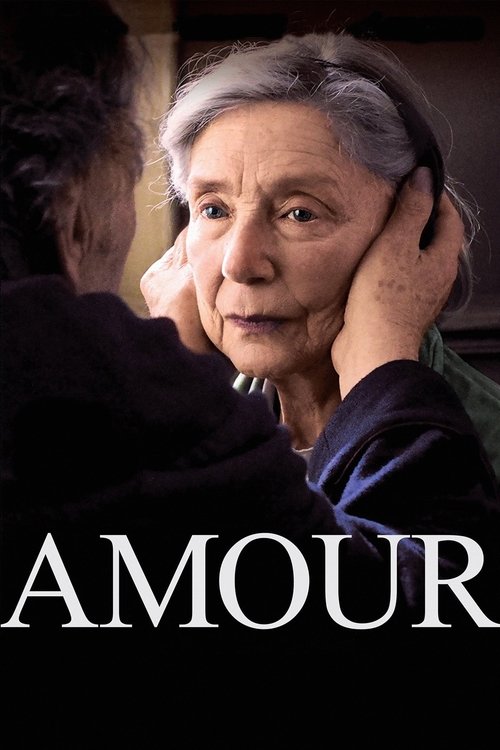
Amour follows Georges (Jean-Louis Trintignant) and Anne (Emmanuelle Riva), a cultivated octogenarian couple and retired piano teachers living in a spacious Paris apartment. Their peaceful existence is shattered when Anne suffers a stroke during breakfast, leaving her paralyzed on one side. Georges honors her wish to never be taken back to the hospital, becoming her primary caregiver as her condition progressively deteriorates.
As Anne suffers a second stroke and slips further into dementia and physical helplessness, their apartment becomes a hermetically sealed world. Their daughter, Eva (Isabelle Huppert), visits but is unable to cope with the brutal reality of her mother's decline or understand her father's refusal to institutionalize her. The film chronicles the grueling daily rituals of caregiving, testing the limits of Georges' devotion and dignity.
The narrative moves unflinchingly toward a tragic resolution, exploring the blurred lines between mercy and murder. It is a portrait of love stripped of all sentimentality, remaining only as a fierce, painful duty to witness and accompany a partner to the very end of their existence.
Core Meaning
At its heart, Amour is a meditation on the physical reality of abstract vows. Haneke interrogates the meaning of 'undying love' when faced with the literal death of the personality and body. The film suggests that true love is not just romance, but the excruciating burden of bearing witness to suffering and making impossible ethical choices to preserve a loved one's dignity. It posits that death is not a sudden event but a process that love must endure, even if it means destroying the object of that love to save them from humiliation.
Thematic DNA
The Cruelty of Physical Decline
The film unflinchingly depicts the humiliating loss of bodily autonomy. Anne, once a dignified intellectual, is reduced to a dependent body requiring diaper changes and spoon-feeding. This theme highlights how illness strips away identity, leaving only biological suffering.
Love as Duty and Sacrifice
Georges' love is defined not by affection but by labor. His devotion is shown through the grueling physical tasks of caregiving. The film asks whether love is the ability to hold on, or the strength to let go (or force an end).
Isolation and Confinement
The apartment evolves from a sanctuary of culture into a prison and finally a tomb. As the couple isolates themselves from society (including their daughter), the physical space mirrors their shrinking world and the claustrophobia of their situation.
The Interloper / The Outsider
Characters like the daughter Eva or the pigeon represent the outside world trying to break into the couple's sealed reality. Eva's inability to understand the gravity of the situation highlights the unbridgeable gap between the lived experience of suffering and the observer.
Character Analysis
Georges Laurent
Jean-Louis Trintignant
Motivation
To keep his promise to Anne never to send her back to the hospital, and to preserve her dignity at all costs.
Character Arc
He transitions from a loving husband enjoying retirement to an exhausted nurse, and finally to an 'angel of mercy' (or murderer). His journey is one of increasing isolation as he cuts ties with the world to focus solely on Anne.
Anne Laurent
Emmanuelle Riva
Motivation
To end her suffering and die with dignity rather than live as a vegetable.
Character Arc
She goes from an independent, talented musician to a helpless invalid. Her arc is a 'descent' into infancy, fighting to maintain her will to die as her body betrays her.
Eva
Isabelle Huppert
Motivation
To assuage her own guilt and fear of her parents' mortality.
Character Arc
She remains static, representing the societal view that 'something must be done' (hospitals, homes) without understanding the couple's pact. She is shut out of the inner circle of their tragedy.
Symbols & Motifs
The Pigeon
A chaotic intrusion of life and nature into the sterile, dying apartment. It represents the outside world, or perhaps Anne's soul.
A pigeon flies into the apartment twice. The first time, Georges scares it away (rejecting the intrusion). The second time, after Anne's death, he catches it gently in a blanket and caresses it before releasing it (accepting the release of life).
The Sealed Door
The finality of death and the separation of the living from the dead.
After killing Anne, Georges tapes the bedroom door shut, physically sealing off the corpse and the trauma, attempting to contain death within a specific space while he continues to exist in the rest of the apartment.
Water
The overwhelming, drowning nature of impending death and grief.
In a nightmare sequence, Georges imagines the hallway flooding with water while he is trapped, symbolizing his helplessness against the tide of Anne's illness.
The Slap
The breaking point of patience and the violent reality of caregiving.
When Anne refuses to drink water, spitting it out, Georges instinctively slaps her. It is a shocking moment that shatters the facade of saintly patience, revealing the frustration and exhaustion inherent in his role.
Memorable Quotes
Tout continuera, et puis un jour tout sera fini.
— Georges
Context:
Spoken during a conversation about their situation, highlighting his pragmatic approach to the tragedy unfolding.
Meaning:
Trans: "Things will go on, and then one day it will all be over."
Summarizes the film's existential stoicism. It reflects Georges' acceptance of the inevitable march towards death without comforting illusions.
C'est beau... La vie. Si long.
— Anne
Context:
Anne says this while looking through a photo album, struggling to articulate her thoughts as her mind fails.
Meaning:
Trans: "It's beautiful... Life. So long."
A heartbreaking moment of clarity amidst her dementia, expressing a paradoxical appreciation for life while simultaneously acknowledging the weariness of enduring it.
Vous êtes un monstre parfois. Mais très gentil.
— Anne
Context:
Said playfully earlier in the film, but it foreshadows the 'monstrous' act of mercy killing Georges will eventually commit.
Meaning:
Trans: "You are a monster sometimes. But very kind."
Captures the complexity of their relationship and the harsh actions Georges must take (like force-feeding) which are cruel but born of kindness.
Philosophical Questions
Is euthanasia an act of love or murder?
The film forces the viewer to judge Georges' final act. Is suffocation a merciful release from the torture of a decaying body, or is it a selfish act to end the caregiver's own pain? Haneke refuses to provide a moral verdict, leaving the ethics ambiguous.
What is the limit of dignity?
Anne asks, 'Why should I inflict this on us?' The film questions whether life is worth living when autonomy and dignity are completely lost, and whether preserving biological life at the cost of the 'self' is moral.
How do we deal with the suffering of others?
Through Eva's character, the film explores the helplessness of observers. It asks whether we can ever truly share another's pain or if suffering is an inherently solitary experience.
Alternative Interpretations
The Ending: The final scene where Georges leaves the apartment with a 'healthy' Anne is widely interpreted as Georges' death. Some view it as a hallucination before he commits suicide (perhaps by jumping out the window, or starvation). Others see it as a spiritual representation of their souls reuniting.
The Pigeon: While Haneke claims it is 'just a pigeon,' critics have interpreted it as Anne's soul returning to say goodbye, or as a symbol of the 'Holy Spirit' offering peace. The fact that Georges captures it (death) but then releases it (letting go) suggests he has found peace with his action.
Cultural Impact
Amour is widely considered a masterpiece of 21st-century cinema. It won the Palme d'Or at the 2012 Cannes Film Festival (Haneke's second win) and the Academy Award for Best Foreign Language Film. It sparked intense global debate about euthanasia and end-of-life care, forcing audiences to confront the taboo realities of aging that cinema usually sanitizes. Critics praised its unsentimental humanism, with many calling it the most honest film ever made about death. It solidified Haneke's reputation not just as a provocateur, but as a deeply empathetic, albeit severe, observer of the human condition.
Audience Reception
Praised: Audiences and critics alike were astounded by the raw, naturalistic performances of Trintignant and Riva. The direction was lauded for its restraint and respect for the subject matter. It is often described as 'perfect but painful.'
Criticized: Some viewers found the film too slow, depressing, or 'clinical.' The lack of music and the static camera work alienated mainstream audiences expecting a traditional tearjerker. A minority found the suffocation scene horrific and morally objectionable.
Verdict: Universally respected as a cinematic achievement, but often categorized as a 'watch once' film due to its emotional heaviness.
Interesting Facts
- Jean-Louis Trintignant came out of retirement specifically for this film because Michael Haneke wrote the role for him.
- Emmanuelle Riva was 85 years old when she received an Academy Award nomination for Best Actress, making her the oldest nominee in that category's history.
- The film was inspired by a personal tragedy in Haneke's life: his aunt, who raised him, suffered from a debilitating illness and asked him to help her die.
- The entire apartment was built on a soundstage. Haneke modeled the layout exactly after his parents' apartment in Vienna to increase the personal authenticity.
- There is no non-diegetic musical score in the film; all music heard is being played by characters or on a radio/CD player within the scene.
- Alexandre Tharaud, who plays the former student Alexandre, is a renowned real-life concert pianist.
- The painting of the landscape seen in the film belonged to Haneke's grandmother.
- Haneke directed the pigeon scene with extreme precision, requiring many takes to get the bird to move exactly as he wanted without using CGI.
Easter Eggs
Connection to 'Happy End' (2017)
In Haneke's later film Happy End, Jean-Louis Trintignant plays a character (also named Georges) who confesses to his granddaughter that he smothered his wife to end her suffering, effectively making Happy End a spiritual sequel or shared universe to Amour.
Reference to 'Hiroshima Mon Amour' (1959)
Casting Emmanuelle Riva is a meta-cinematic nod to her most famous role in Hiroshima Mon Amour. It creates a poignant bookend to her career, contrasting the passionate, traumatic love of her youth with the decaying, final love of her old age.
The Paintings
The landscape paintings on the walls are real heirlooms from Haneke's family, reinforcing the deeply personal nature of the story.
⚠️ Spoiler Analysis
Click to reveal detailed analysis with spoilers
Frequently Asked Questions
Explore More About This Movie
Dive deeper into specific aspects of the movie with our detailed analysis pages
Comments (0)
No comments yet. Be the first to share your thoughts!