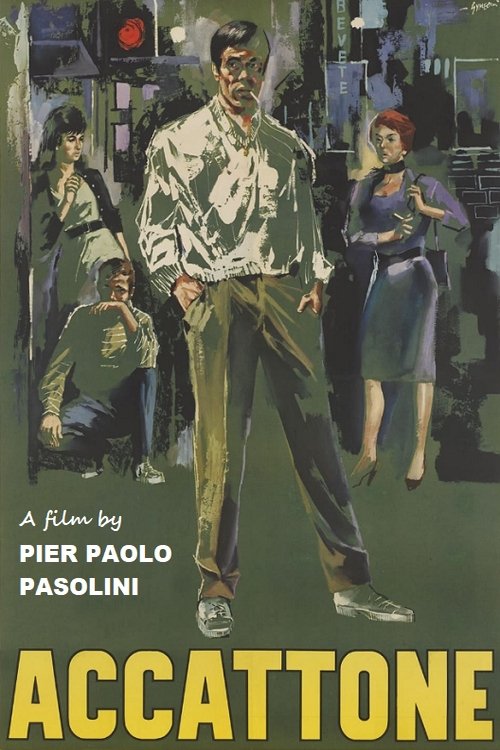
Accattone
"The Poor Man's "Dolce Vita""
Overview
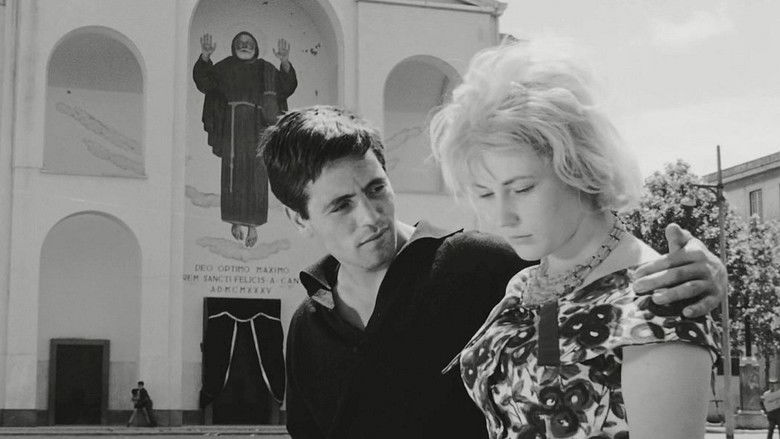
Vittorio "Accattone" Cataldi is a pimp living in the squalid borgate (slums) on the outskirts of Rome. He survives by exploiting Maddalena, a prostitute who supports his indolent lifestyle of card games and aimless loitering. When rival thugs attack Maddalena and she ends up in prison, Accattone loses his source of income and status. Facing starvation and the ridicule of his peers, he is forced to confront his own desperate existence.
Accattone meets Stella, an innocent and naive young woman whom he attempts to groom into prostitution. However, he unexpectedly falls in love with her purity, which sparks a conflicted desire for redemption. He attempts to work an honest job as a laborer but is physically and spiritually broken by the toil, declaring that work will kill him. Caught between a life he cannot escape and a salvation he cannot earn, Accattone's journey spirals toward an inevitable, tragic conclusion.
Core Meaning
Pasolini's debut film is a manifesto of "sacralizing the profane." By pairing the sordid lives of pimps and thieves with the sublime music of J.S. Bach, Pasolini argues that the sub-proletariat possesses a pre-Christian, archaic sacredness that the modern bourgeois world has lost. The film posits that for the marginalized, there is no place in history or society; their only possible redemption or release from existential suffering is death.
Thematic DNA
The Sacred and the Profane
Pasolini creates a "contamination" of styles, juxtaposing the gritty reality of Roman slums with high religious art. Bach's St. Matthew Passion plays over street fights and thefts, elevating these low acts to the level of a religious ritual or martyrdom.
Death as Destiny
Death permeates the film, from the boys diving into the dangerous Tiber river to Accattone's prophetic dream of his own funeral. The film suggests that for characters like Accattone, death is not a failure but the only possible resolution to an unlivable life.
Existential Immobility
Despite the characters' constant movement, they are socially and spiritually trapped. The circular narrative reinforces that the sub-proletariat is cut off from history and progress (the "economic miracle" of Italy), doomed to repeat the same struggles without advancement.
Hunger and Corporeality
Basic physical needs drive the plot. Hunger is not just a social issue but an ontological state. The characters are defined by their bodies—eating, fighting, suffering—emphasizing their raw, material existence over psychological depth.
Character Analysis
Vittorio "Accattone" Cataldi
Franco Citti
Motivation
Driven initially by sloth and survival, then by a desperate, confused desire to possess Stella's innocence, and finally by a need to escape the agony of existence.
Character Arc
Starts as a callous predator exploiting women. Through his love for Stella, he attempts a failed transformation into a worker, leading to a realization that he is unfit for 'normal' society, culminating in his death which brings his only peace.
Stella
Franca Pasut
Motivation
To survive and find love, driven by a naive trust in Accattone.
Character Arc
She enters as a pure, naive figure who unknowingly disrupts Accattone's life. She is nearly corrupted by him but her inherent innocence makes her a poor prostitute, indirectly forcing Accattone to confront his own moral bankruptcy.
Maddalena
Silvana Corsini
Motivation
Loyalty to Accattone despite his abuse.
Character Arc
She begins as Accattone's provider but is discarded and imprisoned. Her removal from the story precipitates Accattone's downfall.
Balilla
Mario Cipriani
Motivation
Survival through theft.
Character Arc
Represents the unrepentant criminal life that Accattone is part of. He serves as a foil to Accattone's internal conflict.
Symbols & Motifs
Bach's St. Matthew Passion
Symbolizes the tragic, sacred dimension of Accattone's life. It suggests he is a sacrificial figure, an "inverted Christ," whose suffering has spiritual weight.
Plays during the opening bet, the fight with Maddalena's attackers, and the final fatal crash, elevating these moments to epic tragedy.
The Dream Sequence
A foreshadowing of death and a manifestation of Accattone's subconscious desire for peace/redemption. It represents his exclusion from both the living world and the afterlife until he accepts his fate.
Accattone dreams he is attending his own funeral, but the cemetery gatekeeper refuses to let him in. He later asks the gravedigger to move his grave into the sunlight.
Gold Chain
Represents the material binding of human relationships in the slums—ownership, exploitation, and the commodification of people.
Accattone steals a gold chain from his own son to buy gifts for Stella, symbolizing the cannibalization of his family ties for his new obsession.
The River Tiber
A boundary between life and death, a place of baptism and danger.
The opening scene involves a bet where a character dives into the dirty river; later, it is where the boys bathe, exposing their vulnerability and raw connection to nature.
Memorable Quotes
Mo' sto bene.
— Accattone
Context:
Spoken lying on the ground on the Ponte Testaccio bridge after crashing the stolen motorcycle.
Meaning:
Translates to "Now I'm fine." His final words, spoken as he dies. It signifies that death is the only relief from the suffering of his life; he has finally found peace.
L'angel di Dio mi prese, e quel d'inferno gridava: O tu del ciel, perché mi privi? Tu te ne porti di costui l'eterno per una lacrimetta che 'l mi toglie.
— Epigraph (Dante Alighieri)
Context:
Shown as text on screen at the very beginning of the film.
Meaning:
From Purgatorio, Canto V. It speaks of a soul saved from Hell by a "little tear" of repentance. It frames Accattone's story as a spiritual struggle for a shred of dignity.
Il lavoro un giorno o l'altro ammazza.
— Accattone
Context:
Said after he quits his brief stint at manual labor, physically exhausted and unable to cope.
Meaning:
"Work creates a man, but it destroys him too." (Or more literally: Work will kill you sooner or later). Accattone's rejection of the capitalist work ethic, viewing labor not as dignity but as a death sentence.
Io so' nato con la vocazione del ladro... Tu non sei nato con la vocazione del pappa e perciò fai l'accattone.
— Balilla
Context:
Balilla explaining to Accattone why he struggles to survive in their world.
Meaning:
"I was born with a thief's vocation... You weren't born with a pimp's vocation, that's why you're a beggar." It defines Accattone's failure—he is incompetent even at being a criminal.
Philosophical Questions
Can the profane be sacred?
Pasolini challenges the church's monopoly on the sacred by finding holiness in a pimp. The film asks if the raw, instinctual life of the slums is more 'real' and spiritual than the bourgeois morality that condemns it.
Is redemption possible without social change?
Accattone tries to change his life through individual will (working) but fails because the social structure offers him no support. The film questions if spiritual redemption is meaningful if material conditions remain hellish.
Is death the only freedom for the outcast?
Accattone's life is a closed circle. The film explores the grim possibility that for the socially excluded, death is the only act of true liberation and the only way to reclaim dignity.
Alternative Interpretations
Critics debate whether Accattone's death is a form of redemption or nihilism. Some argue that his final words ("Now I'm fine") and the Dante epigraph imply he is saved, achieving a spiritual grace denied to him in life. Others, like critic Marc Gervais, argue that his death is a tragedy of immobility—he dies because society allows him no other exit, and his "salvation" is merely the cessation of pain, offering no hope for the class he represents. A third reading suggests the film is a Marxist critique disguised as a passion play, showing that the sub-proletariat is left behind by the capitalist "economic miracle."
Cultural Impact
Accattone marked a seismic shift in Italian cinema, moving from Neorealism to what Pasolini called "Cinema of Poetry." While it shared the location and poverty of Neorealism, it rejected its documentary objectivity and moral optimism. Instead, it offered a stylized, subjective, and sacralized view of the underclass. The film launched Pasolini's directorial career and was immediately controversial; it was initially banned by the Italian censorship board for "obscenity" and sparked riots by right-wing groups. It deeply influenced future filmmakers, most notably Martin Scorsese, who cited it as a major influence on Mean Streets and Raging Bull for its depiction of street life and sacred violence.
Audience Reception
Original 1961 Reception: Highly polarized. Intellectuals and leftists praised its poetic power and raw authenticity. Catholic conservatives and the right-wing press condemned it as vulgar, pornographic, and immoral. It was the first Italian film to be forbidden to under-18s.
Modern Reception: Now considered a masterpiece of world cinema. Modern audiences and critics praise Franco Citti's raw performance, the stunning cinematography, and the daring use of Bach. It holds a very high rating on review aggregators like Rotten Tomatoes, regarded as a seminal debut.
Interesting Facts
- Pier Paolo Pasolini had never directed a film before; he created his own 'grammar' of film because he didn't know the traditional rules.
- Bernardo Bertolucci, who would become a legendary director (The Last Emperor), served as a young assistant director on this film, calling it his 'film school'.
- Federico Fellini originally considered producing the film but pulled out after seeing test footage, finding it too amateurish and technically incompetent.
- The film uses almost exclusively non-professional actors; Franco Citti was a bricklayer and the brother of Pasolini's dialogue consultant, Sergio Citti.
- Pasolini chose to score the fights and slum scenes with Bach's 'St. Matthew Passion' to elevate the squalor to the level of the sacred.
- The dialogue is in Romanesco, a Roman dialect so thick that it was sometimes hard for non-Roman Italians to understand fully.
- During the premiere at a cinema in Rome, a group of neo-fascists attacked the theater, throwing ink at the screen and fighting with the audience.
Easter Eggs
Mantegna's 'The Dead Christ'
In the dream sequence and other shots where Accattone lies down, the camera films him from the feet up in a foreshortened perspective, directly referencing Andrea Mantegna's famous painting Lamentation over the Dead Christ.
Masaccio's Frescoes
Pasolini stated that his visual style was inspired by the paintings of Masaccio, specifically the frontal, blocky, and solemn framing of the characters, giving them a heavy, sculptural quality.
Dante's Purgatorio Canto V
The opening text is a direct quote from Dante regarding the death of Buonconte da Montefeltro, whose soul is saved at the last moment by a single tear. This suggests Accattone is a Purgatorial figure, not a Hellish one.
Sergio Citti Cameo
Sergio Citti, the main actor's brother and Pasolini's guide to the Roman slang/slums, appears as a waiter. He was instrumental in writing the dialogue.
⚠️ Spoiler Analysis
Click to reveal detailed analysis with spoilers
Frequently Asked Questions
Explore More About This Movie
Dive deeper into specific aspects of the movie with our detailed analysis pages
Comments (0)
No comments yet. Be the first to share your thoughts!