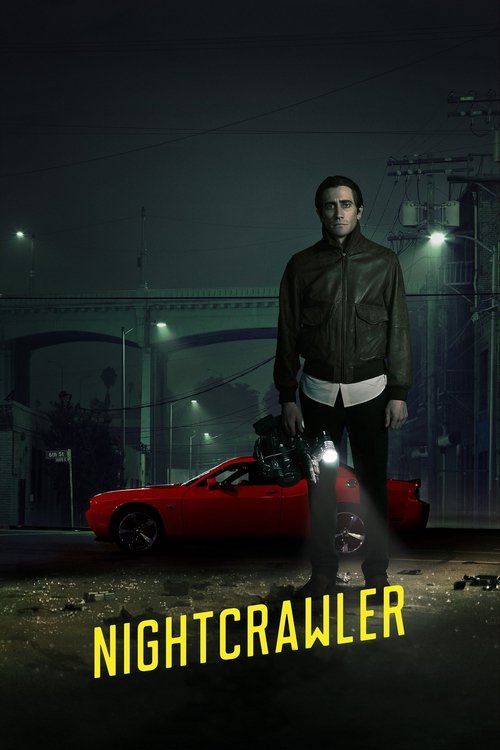
Nightcrawler
"The city shines brightest at night."
Overview
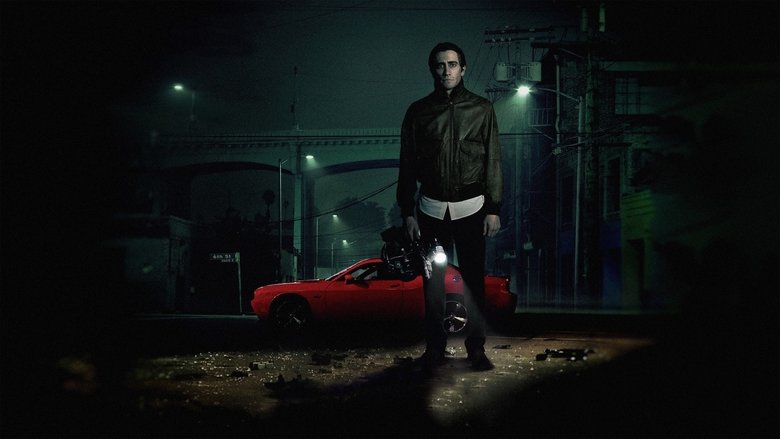
Nightcrawler follows Louis "Lou" Bloom (Jake Gyllenhaal), a driven and socially awkward petty thief in Los Angeles who is desperate for work. After stumbling upon a freelance camera crew filming a fiery car accident, Lou experiences an epiphany. He realizes he can monetize his lack of empathy and obsessive nature by becoming a "stringer"—a freelance photojournalist who hunts down crashes, fires, and murders to sell the footage to local news stations. Armed with a cheap camcorder and a police scanner, he begins prowling the city at night, developing a twisted mentorship with a desperate news director, Nina Romina (Rene Russo).
As Lou's skills and ambition grow, so does his ruthlessness. He hires a homeless drifter, Rick (Riz Ahmed), as an assistant and begins to blur the line between observer and participant. Lou moves bodies for better angles, tampers with crime scenes, and withholds evidence from the police to extend the lifespan of a story. The film spirals into a high-stakes thriller when Lou beats the police to a triple homicide, capturing the faces of the killers but keeping the footage for himself to orchestrate a more dramatic—and profitable—finale.
Core Meaning
At its heart, Nightcrawler is a scathing critique of modern capitalism and media consumption. Director Dan Gilroy presents Lou Bloom not as a malfunctioning outlier, but as the logical conclusion of a system that rewards ruthless ambition, efficiency, and profit above human life. The film argues that society creates and rewards monsters like Lou because we share his voyeuristic hunger for sensationalized tragedy. It is a satire of the "American Dream" stripped of all morality, asking the audience to confront their own complicity in the "if it bleeds, it leads" news cycle.
Thematic DNA
The Commodification of Tragedy
The film relentlessly portrays human suffering as a product to be packaged and sold. Victims of violent crimes and accidents are reduced to dollar amounts based on their race, social status, and the graphic nature of their injuries. Nina explicitly tells Lou that the ideal story is a "screaming woman running down the street with her throat cut," highlighting how fear is manufactured for ratings.
Capitalism as Pathology
Lou Bloom speaks almost entirely in self-help platitudes and corporate buzzwords he learned from the internet. He treats every interaction, including threats and blackmail, as a business negotiation. The film suggests that the traits of a psychopath—lack of empathy, manipulation, superficial charm—are indistinguishable from the traits celebrated in extreme corporate culture.
Voyeurism and Complicity
The camera serves as a shield that distances the characters (and the audience) from the reality of violence. By watching the film, the audience participates in the same voyeurism that Lou profits from. We are repulsed by Lou, yet we are captivated by the footage he captures, implicating us in the demand that fuels his supply.
Unemployment and Desperation
Set against the backdrop of a recovering economy, the film highlights how desperation drives people to moral extremes. Lou is initially a scavenger stealing scrap metal, while Rick is a homeless man willing to accept abuse for a few dollars. The precariousness of their economic situation fuels their descent into unethical behavior.
Character Analysis
Louis "Lou" Bloom
Jake Gyllenhaal
Motivation
To achieve the American Dream of self-made success and financial independence, regardless of the moral cost.
Character Arc
Lou possesses a flat arc; he does not change internally. Instead, he changes the world around him to fit his sociopathic worldview. He begins as a lone thief and ends as a successful business owner, validating his unethical methods.
Nina Romina
Rene Russo
Motivation
Professional survival and maintaining high ratings during sweeps weeks.
Character Arc
Nina starts as a desperate news director clinging to her job and ends as Lou's fully complicit partner. She surrenders her remaining ethical boundaries to secure the ratings Lou provides.
Rick
Riz Ahmed
Motivation
Basic survival and the hope of a steady paycheck.
Character Arc
Rick represents the desperate working class. He moves from homelessness to being Lou's employee, slowly realizing the danger he is in but unable to leave due to financial need. His arc ends tragically as collateral damage to Lou's ambition.
Symbols & Motifs
The Camera
A tool of objectification and power. It acts as a weapon that allows Lou to control the narrative and separate himself from humanity.
Lou constantly views the world through the viewfinder, even when not recording. In the climax, he films his dying partner rather than helping him, prioritizing the shot over the life.
The Car
A symbol of status, predator mobility, and the American drive for upgrade.
Lou upgrades from a beat-up hatchback to a sleek, high-performance Dodge Challenger as his success grows. The car becomes his office and his hunting vessel.
The Watch
A symbol of Lou's unchanging criminal nature and the rewards of his sociopathy.
Lou steals a watch from a security guard in the opening scene. In the final scene, despite his "legitimate" success, he is seen wearing that same stolen watch, signaling he hasn't reformed but has just found a legal channel for his predation.
Sodium Vapor Lights
The sickly yellow/orange glow represents the moral decay and toxicity of the nocturnal city.
The cinematography relies heavily on available street lighting, bathing the night scenes in an unnatural, jaundice-like hue that contrasts with the cyan shadows.
Memorable Quotes
My motto is if you want to win the lottery you've got to make money to buy a ticket.
— Lou Bloom
Context:
Lou says this during a job interview at a scrapyard, trying to sell himself as a hardworking employee.
Meaning:
Encapsulates Lou's warped view of success: it requires investment and risk, but he views it purely transactionally, ignoring luck or morality.
And I'm thinking that television news might just be something I love as well as something I happen to be good at.
— Lou Bloom
Context:
Lou pitching his services to Nina after capturing his first successful footage.
Meaning:
Reveals Lou's frightening realization that his predatory nature is perfectly suited for the cutthroat world of crime journalism.
Think of our newscast as a screaming woman running down the street with her throat cut.
— Nina Romina
Context:
Nina explaining to Lou exactly what kind of footage she wants him to capture.
Meaning:
A grotesque metaphor that exposes the news station's editorial policy: fear and gore are the only metrics that matter.
What if my problem wasn't that I don't understand people but that I don't like them?
— Lou Bloom
Context:
Lou speaking to his "date" (Nina) at a Mexican restaurant while blackmailing her.
Meaning:
A chilling admission that Lou is not socially awkward due to ignorance, but rather misanthropic and consciously detached from humanity.
I will never ask you to do anything that I wouldn't do myself.
— Lou Bloom
Context:
Lou's final speech to his new interns, framing his psychopathy as inspirational leadership.
Meaning:
Ideally a leadership quality, but here a terrifying threat because there is nothing Lou wouldn't do (including die or kill) for the perfect shot.
Philosophical Questions
Is the observer complicit in the event?
The film asks whether filming a tragedy makes one responsible for it. Lou crosses the line from observer to participant, but the film suggests that even passive observation (like Nina's or the audience's) creates a market that demands such events occur.
Does the end justify the means in a capitalist society?
Lou achieves traditional success—money, status, a growing company. The film challenges the viewer to define 'success.' If Lou is successful by society's metrics, does that mean society's metrics are fundamentally immoral?
Is empathy a weakness in the modern workplace?
Lou views his lack of empathy as a competitive advantage. The film explores the disturbing reality that corporate environments often reward sociopathic traits like ruthlessness and manipulation over compassion.
Alternative Interpretations
The Capitalist Superhero: Some interpret the film not as a tragedy, but as a perverted success story. If you remove moral judgment, Lou Bloom is the perfect capitalist hero: he pulls himself up by his bootstraps, works hard, takes risks, outsmarts the competition, and scales his business. In this reading, the film satirizes the very concept of the 'American Dream' by showing that the qualities required to achieve it are monstrous.
The 'Alien' Observer: Another interpretation views Lou as almost alien or non-human. His awkward speech patterns, inability to blink during intense moments, and mimicry of human behavior suggest an entity that is trying to learn how to be a person by watching TV and reading internet articles, but never quite gets the 'feeling' part right.
Cultural Impact
Nightcrawler was a critical darling upon release, praised for its biting screenplay and Gyllenhaal's transformative performance. It has since become a modern touchstone for discussions about media ethics, often compared to Sidney Lumet's Network (1976) and Martin Scorsese's Taxi Driver (1976). It sparked debates about the responsibility of news consumers and the 'gig economy' mindset where workers are exploited for minimal gain. While Jake Gyllenhaal was surprisingly snubbed for an Oscar nomination, the film received a Best Original Screenplay nomination. It remains a definitive 'LA Noir' film, capturing the city's dark, nocturnal underbelly.
Audience Reception
Audiences were generally captivated but disturbed. Reviews frequently praise the tension, the unique visual style, and Gyllenhaal's 'creepy' yet charismatic performance. Common criticisms occasionally mention the film's cynicism being too bleak or the lack of a 'good guy' to root for. However, the consensus is that it is a masterful, if uncomfortable, watch. The ending, where the villain 'wins,' is often cited as a bold and memorable, though frustrating, narrative choice.
Interesting Facts
- Jake Gyllenhaal lost 20-30 pounds for the role, visualizing Lou as a 'hungry coyote'. He ran or cycled to set every day to maintain the gaunt look.
- The scene where Lou screams at himself in the mirror and smashes it was improvised. Gyllenhaal actually cut his hand, and the shot in the film is real.
- This was Dan Gilroy's directorial debut. He is married to Rene Russo, who plays Nina.
- Riz Ahmed's character Rick was his breakout Hollywood role. He reportedly improvised the comedic mispronunciation of certain Americanisms.
- The film was shot in just 28 nights on a relatively low budget of $8.5 million.
- Bill Paxton, who plays the rival stringer Joe Loder, gained weight for the role to contrast with Gyllenhaal's emaciated look.
- The character of Lou Bloom was inspired by the photographer Weegee, famous for his stark black and white street photography of crime scenes in the 1930s and 40s.
Easter Eggs
The Stolen Watch
In the opening scene, Lou steals a watch from a security guard he attacks. In the very last scene of the movie, as he lectures his new interns, he is wearing that same watch. This subtle detail confirms that despite his 'legitimate' business success, he is still a criminal at his core.
Video Production News Credit
Lou demands that Nina give him a credit line "Video Production News" on the air. This isn't just vanity; it establishes a public record of his professional presence at the crime scene, which becomes a crucial part of his alibi when the police question why he was there.
Drive (2011) Diner
The diner where Lou interviews Rick is the same location used in the movie Drive. Both films are neo-noirs set in Los Angeles that feature sociopathic protagonists who drive at night.
Lou's Fast Clock
The clock in Lou's apartment is shown to be set slightly fast. This reflects his obsession with punctuality and beating the competition to crime scenes.
⚠️ Spoiler Analysis
Click to reveal detailed analysis with spoilers
Frequently Asked Questions
Explore More About This Movie
Dive deeper into specific aspects of the movie with our detailed analysis pages
Comments (0)
No comments yet. Be the first to share your thoughts!